White water rafting in Switzerland: rivers, regions and season
Where is the best white water rafting in Switzerland?
The Lütschine and Aare rivers near Interlaken are most popular. The Rhône in Valais offers serious rapids. Ticino rivers (Verzasca, Maggia) give a wilder experience. Season is May to September.
White water rafting in Switzerland: where glacial rivers meet the Alps
| At a glance | Details |
|---|---|
| Where | Bernese Oberland (Interlaken), Valais (Rhône), Ticino (Verzasca, Maggia) |
| Cost | Around CHF 75-170 per person for a half or full day |
| Time needed | Half a day for a standard program, including transfer and briefing |
| Getting there | Most operators run shuttles from central Interlaken or regional train stations |
| Best time | June to September; September often has the best combination of flow and weather |
Switzerland’s rivers are among the most powerful in Europe. Fed by glacial meltwater from some of the continent’s largest snowfields and glaciers, rivers like the Aare, Rhône, Lütschine, and Ticino rivers descend rapidly from high Alpine terrain, generating the conditions that make white water rafting genuinely exciting. Unlike rivers in lowland regions, Swiss rafting rivers flow through spectacular scenery: gorges flanked by limestone cliffs, valleys overlooked by 4,000-metre peaks, and canyons that see direct sunlight for only part of the day.
The rafting industry in Switzerland is well-developed and professionally run, with most commercial operations concentrated in three main regions: the Bernese Oberland (Interlaken area), the Valais, and Ticino. Each region offers a distinct character — different river types, different scenery, different difficulty levels — which means that the best choice depends on your experience level, location, and what type of experience you are looking for.
This guide covers all three regions in detail, including the specific rivers and sections run commercially, the grading system, seasonal conditions, pricing, and practical logistics.
River grading explained
International white water grading runs from Class I (flat water) to Class VI (not commercially runnable, extreme danger). Swiss commercial rafting falls predominantly in the Class II-IV range:
- Class II: Easy waves, small rapids, clear channels. No significant danger. Suitable for complete beginners including children. Comfortable for nervous participants.
- Class III: Moderate to irregular waves, narrow passages, complex maneuvering required. Splashing and excitement without serious danger. The standard for introductory commercial rafting.
- Class IV: Powerful waves, difficult passages requiring technical input from the guide. Participants will get thoroughly wet. Some swimming in current is possible if swimmers exit the raft. Experience or physical confidence in water is helpful.
- Class V: Violent, turbulent water with complex lines. Reserved for expert-only commercial operations and private expeditions.
Most introductory commercial rafting programs operate at Class III-IV. The guide controls the raft — your role is to paddle on command and lean in the right direction. Experience is not required, but comfort in water helps.
Bernese Oberland: the Lütschine and Aare rivers
Lütschine River (Interlaken)
The Lütschine is the river that runs through the Lauterbrunnen and Grindelwald valleys before joining the Aare at Interlaken. The commercial rafting section runs through a mix of Class II-III rapids in a deep glacially carved valley, with the Bernese Oberland peaks forming the backdrop. The water is characteristically turquoise — a colour produced by the fine glacial sediment (glacial flour) suspended in meltwater.
The standard commercial run on the Lütschine takes approximately 1.5-2 hours on the water, typically covering 8-12 km depending on the section run. This is the most popular entry-level rafting experience in Switzerland and is suitable for beginners from around age 10 upwards (operators vary on minimum ages — confirm when booking).
Water temperature in the Lütschine ranges from around 8-12 degrees Celsius in summer. Full wetsuits are provided, making extended immersion manageable, but you will get wet. This is not a gentle floating experience — rapids are genuine.
Aare River gorge sections
The Aare flows from Lake Brienz eastward and then creates the famous Aareschlucht (Aare Gorge) near Meiringen before joining the broader Aare system. Some commercial operations run sections of the upper Aare above the gorge, where Class III-IV conditions occur during peak flows. This is generally classified as an intermediate-level rafting experience.
The Aareschlucht itself (the gorge section) is more typically visited on foot via the spectacular gorge walkways rather than by raft, as the confined geometry makes rafting impractical, but the river above and below the gorge provides excellent commercial runs.
Operators near Interlaken
Several established adventure operators in Interlaken run river rafting as part of their broader adventure sports programs. Many offer combination packages — rafting in the morning, canyoning in the afternoon, or combined with paragliding over the same valley. Prices for a standard half-day rafting program on the Lütschine or Aare start at approximately CHF 85-110 per person.
Valais: the Rhône and its tributaries
The upper Rhône
The Rhône in the Valais is a different proposition from the Bernese Oberland rivers. The upper Rhône descends steeply from the Rhône Glacier above Gletsch through the upper Valais valley, and several sections offer Class III-IV rafting with longer, more sustained rapids than the shorter Bernese runs. The valley itself is broader and more open, with different visual character — the south-facing valley walls support vineyards and dry rocky terrain rather than dense forest.
Commercial rafting programs on the Rhône typically cover sections near Visp, Sion, or the upper valley. The river character changes significantly with seasonal flow — spring snowmelt creates very high-volume conditions, while late summer flows are more manageable.
The Saaser Vispa and Mattervispa
Tributaries of the Rhône descending from the Saas Valley and the Zermatt valley (Mattervispa) offer shorter but exciting Class III-IV runs. These river sections see less commercial traffic than the Bernese Oberland but are favoured by those who want a less crowded experience. Access is straightforward from the main Valais rail line.
White water kayaking in Valais
Kayaking is an extension of rafting that some operators offer as introductory sit-on-top sessions. In the Valais, where several rivers have well-established paddling communities, kayak-specific programs are available alongside raft tours. These are worth investigating if you are interested in developing a paddling skill rather than simply riding a guide-controlled raft.
Ticino: the Verzasca, Maggia, and Ticino rivers
The Verzasca valley
The Verzasca is perhaps Switzerland’s most beautiful river — crystal-clear water flowing over pale grey granite in a deep-green valley north of Locarno. The river is better known for swimming, cliff jumping, and the famous stone Roman bridge at Lavertezzo, but sections of the Verzasca offer Class III-IV kayaking and rafting, particularly in spring when flows are highest.
Commercial rafting on the Verzasca is less structured than in Interlaken, with most programs run by smaller local operators. The river’s granite character means it is boulder-strewn and technical rather than wave-based. The climate here is distinctly Mediterranean-influenced — warmer, more humid, and with dense chestnut and rhododendron forest lining the valley.
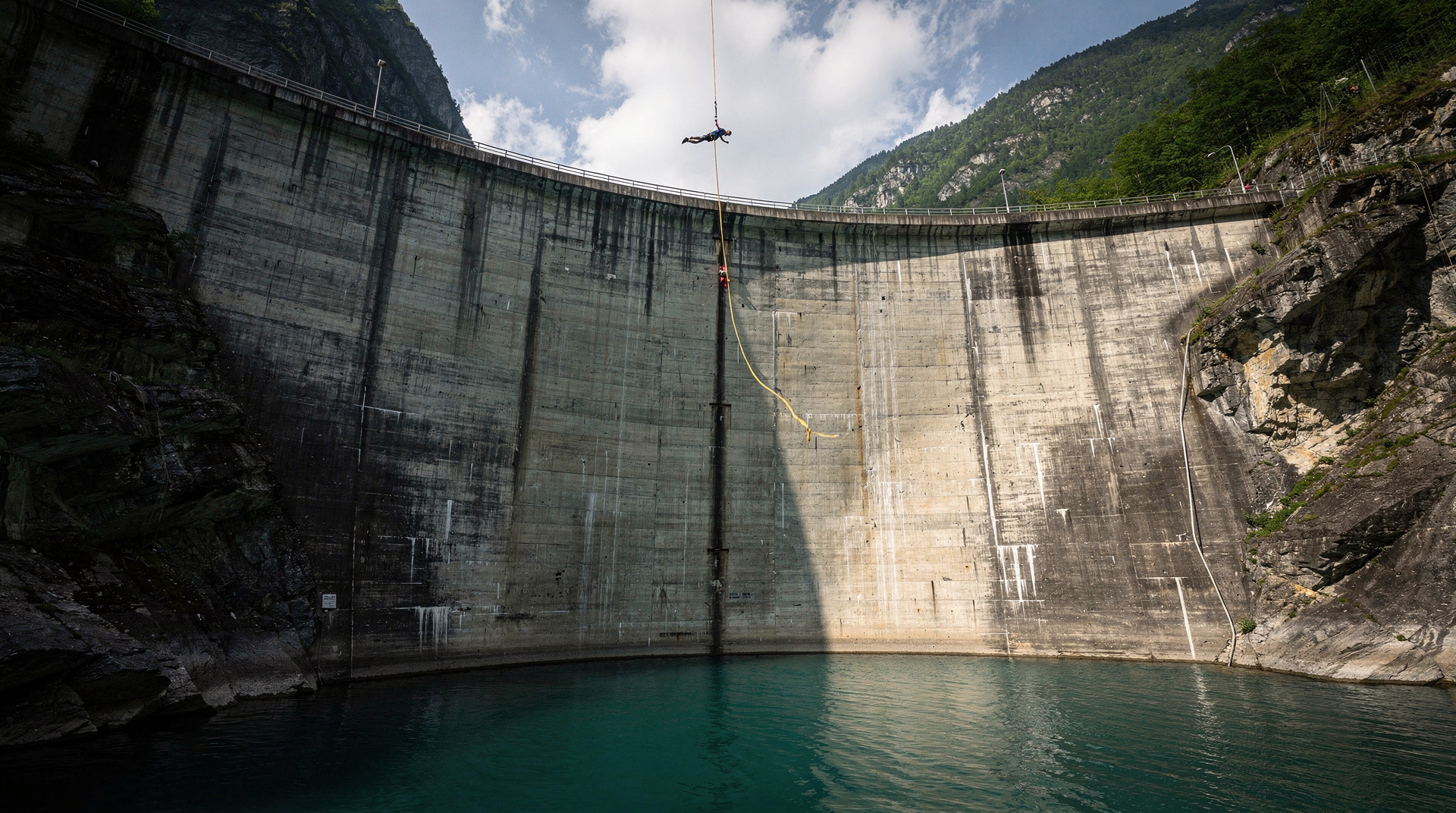
The Verzasca is also the site of Switzerland’s most famous bungee jumping location, the Contra Dam. Combining a Verzasca rafting or canyoning program with the dam jump makes for an excellent full day in the valley.
The Maggia River
The Maggia flows parallel to the Verzasca from the high Alps above to Locarno below. The commercial rafting section on the Maggia covers Class III-IV rapids through a lower-gradient valley, making it more accessible for beginners than the Verzasca. The Maggia is also a popular swimming river, with natural pools and flat rock slabs for sunbathing that create a relaxed atmosphere around the more intense rafting sections.
The Ticino River (upper reaches)
The Ticino River itself originates from the St. Gotthard massif and flows through the Leventina valley before crossing into Italy. The upper Ticino offers challenging Class IV conditions in spring, tapering to Class III in summer. This is a relatively remote experience compared to Interlaken — fewer commercial operators, more rugged terrain, and longer approach logistics.
Seasonal conditions
May: high water
Snowmelt in May creates the highest water levels of the year. Rivers that are Class III in summer can become Class IV-V in May. Many commercial operators run only on lower sections in May, and some suspend programs entirely in early May if flows are too high. The power of Swiss rivers in late spring is not to be underestimated. Not recommended for beginners.
June: transitional
Water levels decline through June. By late June, most rivers have dropped to conditions suitable for commercial beginner programs. Temperatures are still cold (wetsuit mandatory). This is an excellent month for those with some experience who want higher-energy conditions.
July-August: peak season
Flows are manageable on all commercial sections. Water temperatures improve slightly (still cold by most standards — 10-16 degrees Celsius). Peak season for all adventure operators. Book well in advance for Interlaken programs, where July and August fill up quickly.
September: excellent conditions
Lower flows, drier weather, smaller crowds. The most reliable month for rafting without the summer congestion. Water temperatures begin to drop again. An excellent choice for those with flexibility on timing.
October: late season
Most commercial operators wind down rafting programs in October, though some continue on lower-gradient sections. Water is cold, days are shorter, and weather is less reliable. November to April: no commercial rafting in most regions.
Age and physical requirements
Age minimums vary by operator and river grade. Most Interlaken Class III programs accept participants from age 10-12. Class IV programs typically require age 14-16. There is rarely an upper age limit for healthy adults.
Participants should be comfortable in water — not necessarily strong swimmers, but without a severe fear of water immersion. If you fall from a raft and find yourself swimming in current, the technique of floating feet-first on your back (not swimming against the current) is covered in all pre-trip briefings.
Physically, rafting requires the ability to paddle (sit and stroke) for extended periods. It is not particularly demanding but participants with severe back, shoulder, or neck problems should check with operators. Weight maximums are set per raft rather than per person.
What to bring and wear
Operators provide wetsuits, splash jackets, helmets, PFDs (personal flotation devices), and paddles. You need to bring:
- A swimsuit or synthetic base layer worn under the wetsuit
- Old trainers or water shoes that can get soaked (not sandals)
- A towel and dry clothes for after
- Sunscreen (waterproof)
Leave phones and cameras at base unless you have a fully waterproof housing. Operators may offer waterproof pouches for keys and essentials. Camera/GoPro mounts on helmets are permitted by some operators and prohibited by others — check in advance.
Safety on Swiss rivers
White water rafting involves real risk from moving water, submerged obstacles, and the physical demands of the river environment. Swiss commercial operators manage this risk through professional guiding, regulated equipment, and conservative route selection — but understanding the safety principles is worthwhile for all participants.
The most important rule: swim defensively. If you end up in the water (exit the raft), the technique is feet forward, toes up, on your back. Do not attempt to stand in fast-moving water — foot entrapment in submerged rocks is the leading cause of serious injury in river sports. Float feet-forward until you reach calmer water or a guide’s throw rope. All operators cover this in the briefing.
Follow the guide’s commands immediately. In rapids, there is no time to discuss or question. “Paddle forward” means paddle hard, now. “Stop” means stop. “Get down” means drop to the centre of the raft. The guide has seen the river dozens or hundreds of times and knows what the commands achieve.
Never grab the rope on the outside of the raft while in rapids. The perimeter rope is for holding on to while you are inside the raft. Grabbing it from outside during a swim can pull you under the raft.
High-flow conditions change everything. A river rated Class III in standard conditions can be Class IV-V in high flow. Commercial operators adjust their routes and cancel runs based on flow gauges. This is one reason why reputable operators are conservative about cancellations — they have seen what happens when the same section is run too high.
The role of the guide
In commercial white water rafting, the guide is the person who runs the raft. They call the strokes, read the river, position the raft through rapids, and manage group safety. Good guiding is the primary safety factor on the river — more important than equipment, physical fitness, or anything the participants do.
When evaluating operators, the guide’s experience level is the most important factor. Questions to ask: How long has this guide been running this specific river? What guide certification do they hold? Swiss guiding standards require certification from the Swiss Canoe Federation or an equivalent international body. A guide running commercial trips without certification is a red flag.
The ratio of guides to participants also matters. On Class III water, 1:8 or 1:10 is typically safe. On Class IV, 1:6 or lower is more appropriate. Ask the operator about their guide ratios before booking.
Prices and what’s included
A standard half-day rafting program in the Interlaken area costs approximately CHF 75-110 per person. Full-day programs cost CHF 120-170. These prices typically include:
- All equipment (wetsuit, splash jacket, helmet, PFD, paddle)
- Professional guide
- Transport from the put-in to the take-out (usually a shuttle)
- Changing facilities at the base
What is not usually included: personal accident insurance (check your travel insurance), transport to and from your accommodation unless specifically offered, and photographs/video (typically an add-on of CHF 20-40).
Combination packages (rafting plus canyoning, or rafting plus paragliding) reduce per-activity prices by 10-20% at most Interlaken operators. If you are planning multiple activities, ask specifically about combination deals.
In Ticino, prices for Verzasca and Maggia river programs are comparable to Interlaken. Remote canyon programs in the upper Ticino are typically more expensive due to access logistics (CHF 120-160 per person for full-day programs).
Families and white water rafting
White water rafting with children is possible on appropriate rivers and with operators experienced in family groups. The minimum age varies: most operators accept children from age 10-12 on Class II-III rivers. Some operators specifically run family-only sessions on calm sections of the river. The key factors for children:
- Weight minimum (typically 30-35 kg to ensure the PFD fits properly)
- Ability to follow instructions
- Comfort in water (swimming ability not required but water confidence helps)
- Physical capability to paddle and hold on in moving water
Parent and child in the same raft is the standard arrangement for family groups. Guides position children near the centre of the raft on easier sections. Avoid booking children on Class IV programs — these are adult difficulty levels.
Combining rafting with other activities
Rafting combines naturally with the broader adventure activities on offer in each region. In Interlaken, multi-activity days pairing rafting with canyoning in Interlaken or paragliding are offered by most operators. Many provide transport between activity locations as part of the package. For an extra adrenaline hit after a morning on the river, the Interlaken canyon swing is a popular add-on.
In Ticino, rafting on the Maggia or Verzasca combines well with swimming, cliff jumping, and a visit to the Verzasca Dam. For those using the Swiss Travel Pass, trains connect all three major rafting regions without additional cost, making a multi-region adventure itinerary genuinely practical.
The adventure itinerary provides specific multi-day programs for visitors prioritising outdoor activities, including suggested combinations of rafting with other pursuits.
Choosing a region: Bernese Oberland vs Valais vs Ticino
| Factor | Bernese Oberland (Lütschine/Aare) | Valais (Rhône) | Ticino (Verzasca/Maggia) |
|---|---|---|---|
| Typical grade | Class II-III | Class III-IV | Class III-IV |
| Scenery | Glacial valley, turquoise water, high peaks | Broad open valley, vineyards, drier terrain | Mediterranean forest, granite gorges |
| Crowds | Busiest — book ahead in July-August | Moderate | Quietest, most local operators |
| Best for | First-timers, combining with paragliding or canyoning | Those wanting longer, sustained rapids | Those wanting a wilder, less commercial feel |
| Access | Easiest — direct trains from Interlaken | Good rail access via Sion or Visp | Good from Locarno; some sites more remote |
If you are only doing one rafting trip in Switzerland, the Bernese Oberland is the easiest to organise and combine with other activities. If you are travelling through Ticino anyway and want a quieter, more scenic river experience alongside swimming and cliff jumping, the Verzasca or Maggia are excellent choices.
A couple more rafting questions
Can non-swimmers go rafting? Most operators do not require strong swimming ability, but genuine comfort in water is important — you will be wearing a PFD (personal flotation device) at all times, and guides brief everyone on defensive swimming before the trip. If you have a severe fear of water immersion, rafting is not the right activity.
Does rafting run in the rain? Light rain does not usually cancel a rafting trip — you are getting wet regardless. Operators cancel only for genuine safety concerns: lightning, dangerously high water levels, or extreme cold. Check the operator’s weather policy when booking.