Via ferrata in Switzerland: best routes and complete guide
What is the best via ferrata in Switzerland?
The Via Ferrata Grindelwald (Grosse Scheidegg) is among the most accessible and rewarding. Harder options include the Engelberg Fürenalp and routes above Zermatt. Season runs June to October.
Via ferrata in Switzerland: clipping into the Alps
| At a glance | Details |
|---|---|
| Where | Grindelwald (Bernese Oberland), Engelberg (Central Switzerland), Zermatt (Valais) |
| Cost | Rental gear around CHF 15-25/day; guided half-day around CHF 80-120 pp |
| Time needed | Half a day per route (3-5 hours), longer for high-altitude Zermatt routes |
| Getting there | Train + gondola/cable car from the base town; Swiss Travel Pass covers most rail legs |
| Best time | July-September, with September often the driest and least crowded |
Via ferrata — Italian for “iron road” — is a style of mountain route that uses fixed iron rungs, cables, stemples, and ladders bolted into rock faces to allow climbers without technical rope skills to access terrain that would otherwise require full rock climbing equipment and training. The system originated in the Dolomites during World War One, when military engineers equipped cliff faces to allow troop movement. Today, via ferrata has become one of Europe’s most popular mountain activities, and Switzerland has developed an excellent network of routes across the Alps.
What makes via ferrata in Switzerland distinctive is the combination of outstanding scenery and reliable infrastructure. Swiss mountain railways, cable cars, and well-maintained paths reduce the access time to many routes, meaning you can spend more time on the rock and less time on the approach. Routes range from beginner-friendly family adventures to serious climbs involving exposed traverses at 2,500 metres above sea level.
This guide covers the best routes in the three main regions — the Bernese Oberland around Grindelwald, Central Switzerland around Engelberg, and the Valais around Zermatt — plus a section on equipment, grades, and season.
Comparing the three main regions
| Region | Typical grade | Best for | Access base |
|---|---|---|---|
| Grindelwald (Bernese Oberland) | K1-K3 | First-timers and families, Eiger views | Interlaken, ~40 min by train |
| Engelberg | K3-K4 | Intermediate-to-advanced climbers | Lucerne, ~45 min by train |
| Zermatt | K2-K5 | High-altitude routes, Matterhorn panorama | Brig, then ~1h20 by train |
Understanding via ferrata grades
Switzerland uses the standard Alpine via ferrata grading system. Grades run from K1 (easiest) to K6 (hardest), though some guides use letters (A through F) on the same scale:
- K1/A (Easy): Fixed cables primarily for security, minimal climbing. Accessible to fit walkers with no prior climbing experience. Exposed sections are short.
- K2/B (Moderate): Some vertical sections using rungs and ladders. Requires comfort with heights and the ability to pull your own bodyweight on rungs.
- K3/C (Intermediate): Extended vertical and slightly overhanging sections. Real exposure. Requires a basic level of climbing fitness.
- K4/D (Difficult): Sustained vertical and overhanging climbing. Considerable exposure. Appropriate for experienced via ferrata participants or those with rock climbing background.
- K5-K6/E-F (Very difficult to extreme): Specialist routes with prolonged overhanging sections and extreme exposure. For experienced climbers only.
Most guided tours for beginners operate on K1-K2 routes. The majority of independent visitors are comfortable on K2-K3 with appropriate equipment.
What equipment you need
The via ferrata set
A via ferrata set consists of a Y-shaped lanyard with two snap hooks (carabiners) and an energy-absorbing unit in the Y-junction. The energy absorber is critical — in a fall, it deploys like a car airbag, slowing the arrest force to survivable levels. Without an absorbing unit, a fall on a via ferrata generates enough shock load to cause serious injury even though the cable arrests the fall. Never use a standard alpine climbing harness with a non-absorbing lanyard on a via ferrata.
Via ferrata sets are widely available for rent from mountain sports shops in Grindelwald, Engelberg, Zermatt, and most other Alpine villages with active climbing scenes. Rental costs approximately CHF 15-25 per day.
Harness
A sit harness rated for climbing (UIAA/EN 12277 standard). Most via ferrata participants use a standard climbing harness. Children’s harnesses and full-body harnesses for beginners are available from the same rental shops.
Helmet
A climbing or mountaineering helmet is mandatory on all serious routes — loose rock dislodged by other climbers and the risk of head impact in a slip make this non-negotiable. Rental helmets are available with the via ferrata set at most outlets.
Gloves
Thin leather or synthetic gloves protect hands on metal cables and rungs, particularly useful in cold or wet conditions. Not essential in warm dry conditions but recommended.
Footwear
Approach shoes or stiff hiking boots with good rubber soles are appropriate for most routes. Rock climbing shoes are not necessary or practical. Avoid hiking sandals or trail runners with thin soles for routes above K2.
The Bernese Oberland: Grindelwald and surrounds
Via ferrata Grindelwald (Grosse Scheidegg circuit)
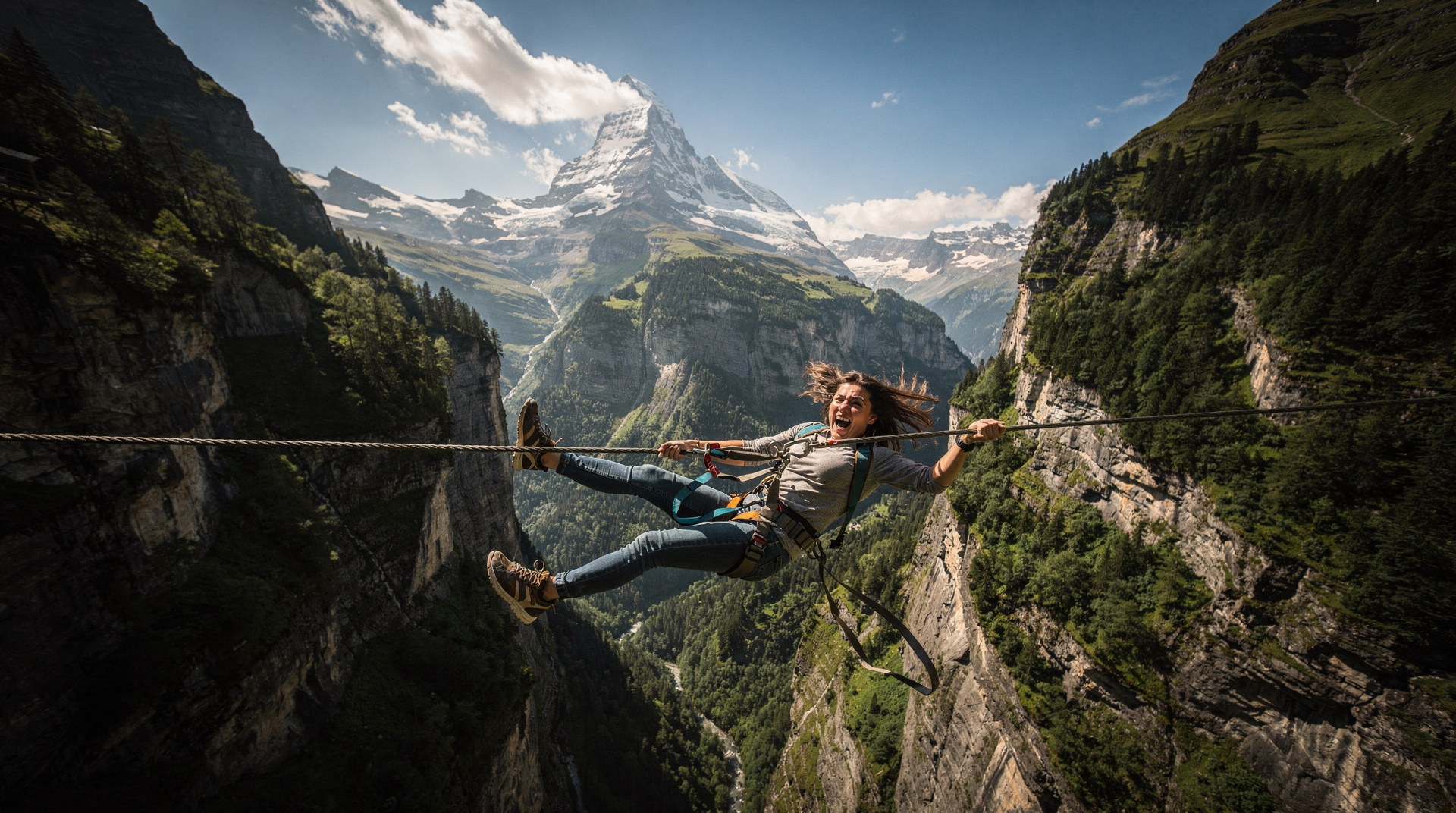
The Grindelwald area has several via ferrata routes, with the most popular taking advantage of the dramatic rock faces around First and the Grosse Scheidegg pass. The route above First involves a combination of ledge traverses, steel ladders, and cable-assisted scrambles with direct views of the Eiger’s north face throughout.
The circuit is rated K2-K3 (B-C) and takes approximately 3-4 hours at a moderate pace. The First gondola from Grindelwald reaches the starting area in around 25 minutes. The route is accessible to confident adults with no prior via ferrata experience, provided they are comfortable with heights and some exposure.
Kleine Scheidegg via ferrata
A shorter and gentler introduction to via ferrata runs near the Kleine Scheidegg station on the route to Jungfraujoch. This K1-K2 route is suitable for families with older children and provides dramatic views of the Eiger, Mönch, and Jungfrau without technical difficulty. It is an excellent first route for anyone uncertain about their comfort level on exposed terrain.
Access from Interlaken
The Bernese Oberland mountain railway network connects Interlaken to Grindelwald in approximately 40 minutes. The Swiss Travel Pass covers the train portion to Grindelwald, and the First gondola runs on a partial discount for pass holders. Equipment rental is available in Grindelwald village. If you would rather leave the logistics to someone else, a Grindelwald gondola and Mount First adventure makes an easy warm-up to the area before you tackle the rock.
Engelberg: Fürenalp and Hahnen
Via ferrata Fürenalp (Engelberg)
The Fürenalp via ferrata above Engelberg is one of Switzerland’s most celebrated routes, rated K3-K4 (C-D) and considered one of the finest intermediate-to-advanced experiences in the country. The route begins near the Fürenalp alp above the Engelberg valley (accessible by cable car), traverses a series of steep rock faces above 1,800 metres, and involves several long ladder sections of 20-30 metres of near-vertical climbing.
The views from the route include the Uri Alps, the Titlis glacier, and the deep valley of Engelberg below. The route takes 4-5 hours and requires reasonable fitness. The exposure on certain sections is serious — there are points where you are on an open face with a several-hundred-metre drop below.
The Fürenalp route is not appropriate for complete beginners but is a natural step up from easier Bernese Oberland routes. Prior experience on at least one K2 route is strongly recommended.
Via ferrata Hahnen
A shorter but vertigo-inducing route near the Hahnen summit above Engelberg, rated K4 and not recommended for first-timers. The route involves a thin exposed ridge traverse and is aimed at those with experience in alpine environments.
Access to Engelberg
Lucerne to Engelberg takes approximately 45 minutes by train. The Swiss Travel Pass covers this connection. Cable cars to the upper via ferrata zones run on reduced season schedules — check timetables before planning. Equipment rental is available in Engelberg village.
Zermatt: via ferrata above the Matterhorn valley
Via ferrata Zermatt (Riffelhorn)
The Riffelhorn above Zermatt offers via ferrata routes of several grades, from K2 to K5, on a compact and well-featured granite ridge at around 2,900 metres. The backdrop is one of the most famous mountain panoramas in the world: the Matterhorn, Monte Rosa, and the Weisshorn all visible from the ridge.
The lower routes on the Riffelhorn are accessible to confident beginners with a guide. The upper routes require technical climbing experience. The Riffelhorn is reached by the Riffelalp train and a short walk from the Riffelalp station.
Via ferrata Mettelhorn
A longer, high-altitude route accessed from the Rotenboden station on the Zermatt-Jungfraujoch line. This route involves sustained climbing at altitudes between 2,800 and 3,400 metres, with the physical effects of altitude (reduced oxygen, increased fatigue) becoming a real factor. Rated K3-K4. The route is typically done with a guide.
Considerations at altitude
Via ferrata above 2,500 metres introduces altitude as a factor. Some people experience mild altitude symptoms (headache, reduced stamina, faster breathing) at 3,000 metres. This is common and not dangerous unless you have pre-existing respiratory or cardiovascular conditions. Descend if symptoms become serious. Stay hydrated — altitude increases fluid loss.
Access to Zermatt
Zermatt is a car-free village accessible by train from Brig (on the main Swiss rail network) in approximately 1 hour 20 minutes. From Zurich, the total journey is around 3 hours. The Swiss Travel Pass covers the train to Brig; the Matterhorn Gotthard Bahn to Zermatt runs at 50% discount for pass holders. Equipment rental is available in Zermatt from multiple mountain sports shops.
Season guide
May-June: opening season
Snow on approach paths and cold temperatures characterise early season. K1-K2 routes at lower elevations are accessible by mid-May in most years. Higher-altitude routes (above 2,000m) are often snow-covered until mid-June. Rock is frequently wet from snowmelt, which significantly increases difficulty and risk.
July-August: prime season
Most routes are dry, accessible, and at their best. Peak crowds on popular routes (Grindelwald First in particular) mean earlier starts are preferable to avoid queuing at key technical sections. Weather in July and August can produce afternoon thunderstorms — always start before 09:00 and be off exposed ridges by early afternoon. Lightning risk on metal-cable routes is very real.
September-October: excellent conditions
Often the finest via ferrata weather. Cooler temperatures, dry rock, smaller crowds, and the autumn light on Alpine terrain. Routes above 2,500 metres start to accumulate early snow by October — check conditions for high routes. September is widely regarded as the sweet spot for the Engelberg and Zermatt routes.
Weather and lightning
Via ferrata involves metal cables running up cliff faces. You are effectively attached to a lightning conductor. All via ferrata participants should monitor weather forecasts carefully. If thunderstorms are forecast, do not start a route that cannot be completed and descended before storm arrival. If caught on a route with a storm approaching, descend immediately and move away from the cable. This is not a theoretical risk in the Swiss Alps — afternoon storms are common throughout the summer and arrive quickly.
Guided vs. independent via ferrata
Independent via ferrata
Experienced hikers with comfort at heights can complete K1-K2 routes independently with proper equipment. The Swiss Alpine Club (SAC) publishes detailed route guides, and apps like Klettersteig.de provide current conditions. For routes above K2, independent completion requires a real assessment of your abilities and experience — overestimating confidence on a K4 route at 2,500 metres has serious consequences.
Guided tours
Mountain guides certified by the Swiss Mountain Guide Association (SMGA) offer guided via ferrata tours across all the major regions. A guide provides route knowledge, emergency skills, and the ability to adjust the route based on current conditions and participant ability. For first-timers and for high-grade routes, a guide is strongly recommended.
Guided half-day tours typically cost CHF 80-120 per person in a group of 4-6, or CHF 200-350 for a private guide. Prices include the guide; equipment rental is separate.
Combining via ferrata with other activities
Via ferrata works well as part of a broader Alpine activities program. From Grindelwald, it combines naturally with hiking on the First Cliff Walk, the Bachalpsee trail, and the Eiger Trail. Paragliding from Interlaken provides an aerial counterpart to the rock-based perspective of via ferrata — seeing the Eiger from a harness and then flying above it are complementary experiences.
From Engelberg, via ferrata on the Fürenalp can be combined with a Titlis glacier visit for a full mountain day. From Zermatt, via ferrata can be built into a multi-day hiking program using the extensive path network above the village.
What to expect physically
Via ferrata is more physically demanding than hiking and less technically demanding than rock climbing. The primary physical requirements are:
Upper body strength: Pulling yourself up metal rungs and ladders requires functional arm and shoulder strength. On K2-K3 routes, this is the strength to lift your bodyweight repeatedly using handholds at chest and shoulder height. On K4+ routes, some overhanging sections require genuine pulling strength.
Grip strength: Your hands do a great deal of work on the cables, rungs, and rock. Grip strength fatigues faster than most people expect. On longer routes, hand fatigue can become a real factor in the upper sections. Climbing gyms are good preparation for this.
Balance and proprioception: Many via ferrata sections involve stepping across narrow ledges, crossing exposed ridges, or moving through sections where the footholds are small. Good balance significantly reduces the fear response and makes movement more efficient.
Cardiovascular fitness: Mountain via ferrata typically involves significant altitude gain on the approach. A K3 route in the Engelberg area might involve 500m of uphill walking before the first cable. General hiking fitness is a prerequisite.
Height tolerance: This is not a muscle but a psychological resource. Via ferrata exposes you to real heights — sections where you are on an open face with a long drop below. Some people manage this through focus on the next handhold; others find that looking down is genuinely difficult. There is no way to know how you will respond until you are on the rock, but building exposure gradually (starting with easier routes) is the sensible approach.
The via ferrata community
Switzerland has a well-developed via ferrata culture, and the social dimension of the activity is worth noting. Mountain huts along via ferrata routes are gathering points for climbers of all levels — from families doing their first K1 route to expert solo climbers tackling multi-pitch K5 lines. The Swiss Mountain Club (SAC) publishes a route guide (in German, French, and Italian) covering the full national via ferrata network with current condition reports.
Online communities on sites like hikr.org and via-ferrata.de maintain current condition reports, recent photographs, and user reviews of specific routes — invaluable for planning visits to routes with variable conditions.
Children and family via ferrata
Switzerland has a small number of via ferrata routes specifically designed for families with children, classified K1 with minimal exposure and short rope sections. These are found near several major resort areas:
- Near Grindelwald: the easier First circuit sections
- Near Andermatt: a K1 route specifically promoted for families
- Near Flims/Laax: a beginner route accessible from the village
Children must be old enough to follow instructions and physically capable of using the harness and cable. Most operators suggest a minimum of age 8-10 for easier routes. Children must have a properly fitted children’s harness — adult harnesses do not fit.
The via ferrata set (harness, absorber lanyard, helmet) must be properly sized for children. Rental shops in via ferrata areas carry children’s sizes, but availability can be limited in peak season — call ahead.
Via ferrata in winter and early spring
Winter via ferrata is a specialist activity requiring specific equipment and experience beyond the scope of a standard guide. Ice on rungs and cables, snow on approach paths, and reduced daylight make winter via ferrata genuinely hazardous for all but expert alpinists. This guide covers the standard summer season only.
In early spring (March-May), lower-elevation routes may be dry and accessible while higher routes remain snowed-in. Check SAC and hikr.org for current conditions before planning spring via ferrata.
Where to rent equipment
Equipment rental is available at mountain sports shops in all major via ferrata regions:
- Grindelwald: Sport Marti, Bächli Bergsport, and several other shops in the village
- Engelberg: Mountain sports shops in the village centre
- Zermatt: Multiple rental shops near the village square
- Interlaken: Several rental and outdoor shops in the town centre
Rental typically costs CHF 15-25 per day for the complete via ferrata set (harness, absorber, helmet). Approach shoes are usually not available for rental — bring your own stiff-soled hiking footwear.
For insurance purposes, note that standard travel insurance does not always cover via ferrata — check your policy. Some policies classify it as a high-risk activity. SAC membership includes rescue insurance in Switzerland and is worth considering for regular Alpine activity.
The adventure activities section covers the full range of Swiss outdoor experiences, and the adventure itinerary suggests multi-day programs for those planning a climbing and activity-focused visit.