Best thermal baths in Switzerland: the complete guide
What are the best thermal baths in Switzerland?
The top Swiss thermal baths are Leukerbad (largest Alpine spa), Therme Vals (Peter Zumthor architecture), Scuol Spa (Engadine), Bad Ragaz (luxury), and Lavey-les-Bains (hottest natural spring).
Thermal baths in Switzerland: a complete guide to the country’s finest spas
| At a glance | |
|---|---|
| Cost | Around CHF 22–50 for a day entry, depending on destination |
| Best for architecture | Therme Vals — book well ahead, capacity is limited |
| Best for families | Leukerbad Therme — waterslides, children’s pool |
| Closest to Zurich | Baden (Fortyseven), about 25–30 minutes by S-Bahn |
| Bring | Swimwear, sandals, towel (rentals available for around CHF 5–10) |
Switzerland sits above one of Europe’s most geologically active subterranean systems. The Alpine mountain-building process that created the peaks above also fractured the rock below, allowing groundwater to descend to great depths, heat through contact with the earth’s crust, and return to the surface via faults and springs at temperatures ranging from 20 to over 70 degrees Celsius. The result is a network of thermal springs distributed across the country, many of which have been used medicinally and recreationally for centuries.
The Romans used the Baden springs. The medieval monks of Saint-Moritz knew about the iron-rich springs of the Engadine. The Leukerbad baths were in use by the 13th century. Switzerland’s thermal bath culture is old, deep, and embedded in the landscape in ways that the modern spa industry has built upon rather than invented.
This guide covers the six most significant thermal bath destinations: Leukerbad, Vals, Lavey-les-Bains, Scuol, Baden, and Bad Ragaz. Each offers a distinct character, specific therapeutic profile, and different price and accessibility levels.
Leukerbad: Europe’s largest Alpine thermal bath
Leukerbad sits at 1,411 metres in the Valais, in a natural cirque surrounded by the Gemmi and Torrenthorn massifs. Europe’s largest Alpine thermal spa resort, it has been drawing visitors to its sulphur-rich springs since the Middle Ages. The water temperature at source is around 51 degrees Celsius; the pools are maintained at 28-43 degrees depending on the facility.
The village has two main public bath complexes:
Leukerbad Therme is the larger and more family-friendly complex, with indoor and outdoor pools, waterslides, a children’s pool, a sports pool, and extensive thermal pools at various temperatures. The outdoor pools in winter — with steam rising from the water against a backdrop of snow and vertical rock walls — are one of Switzerland’s most dramatic visual experiences.
Walliser Alpentherme (Burgerbad) is more spa-focused, with a grotto pool, Turkish hammam, Roman steam baths, and a full range of body treatments. This is the more upscale option for adults seeking a quieter atmosphere.
Prices at Leukerbad Therme: Adults CHF 22-28 for the standard day entry; CHF 35-45 for packages including sauna access. Walliser Alpentherme: Adults from CHF 29.
A full guide to Leukerbad is at Leukerbad: guide to Europe’s largest Alpine thermal spa.
Getting there: Train from Visp (on the main Lausanne-Brig line) to Leuk, then bus to Leukerbad (approximately 40 minutes total). The Swiss Travel Pass covers the train; the bus is covered by the pass for regional holders. From Bern, allow about 1.5 hours. Car access is possible via the Leuk exit.
Therme Vals: Peter Zumthor’s masterpiece
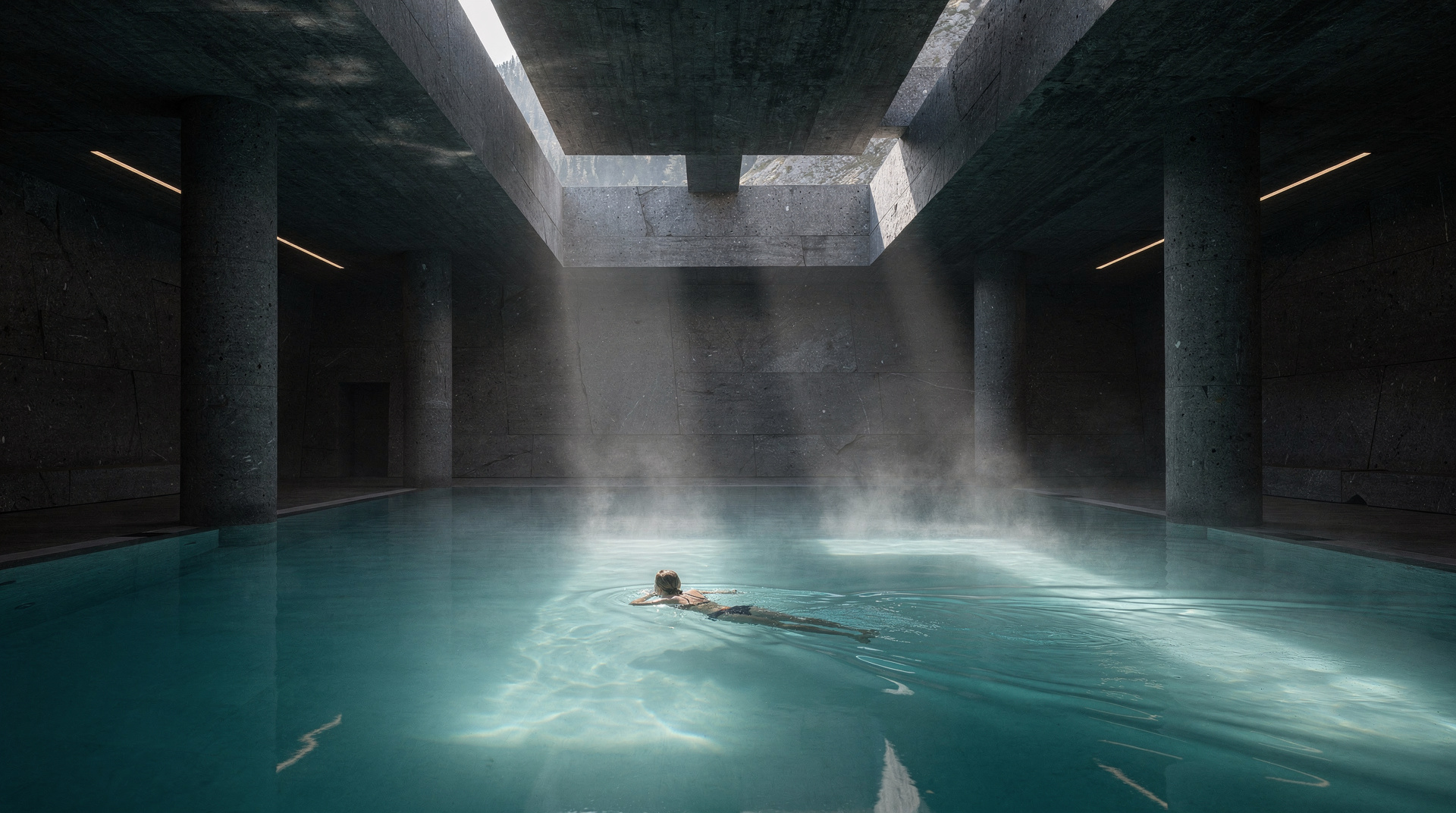
The Therme Vals in the Vals valley of Graubünden is in a category of its own architecturally — commissioned in 1996 from Swiss architect Peter Zumthor, it is widely considered one of the finest examples of modern architecture in the world. The building uses 60,000 slabs of Valser quartzite stone in alternating layers, emerging from the hillside as if growing from the geology itself. The internal spaces are a sequence of pools, chambers, and passages cut through the stone, lit by narrow slots and reflections from the water surfaces.
The experience is contemplative rather than recreational. The space is designed for silence and movement through changing thermal and sensory environments: a hot pool (42 degrees), a cold plunge pool (14 degrees), a flower bath, an outdoor pool at 36 degrees with mountain views, and a fire pool in a vaulted cave-like space. The architecture changes how you move through a building — every corner, every water surface, every shaft of light is precisely considered.
The Therme Vals has a limited capacity by design. Entry is restricted to ensure the quality of the experience, and booking in advance is essential. Day visitors must book online; hotel guests at the 7132 Hotel have morning priority access.
A full guide to Therme Vals is at Therme Vals: visiting Peter Zumthor’s architectural thermal bath.
Getting there: Ilanz (on the Chur-Disentis Rhaetian Railway line, accessible with the Swiss Travel Pass) to Vals by PostBus (40 minutes). Total journey from Zurich approximately 2.5 hours. Car access via the Ilanz exit on the A13.
Lavey-les-Bains: Switzerland’s hottest spring
Lavey-les-Bains, on the Rhône plain between Lausanne and Brig in the canton of Vaud, has the hottest thermal spring in Switzerland: water emerges at 68 degrees Celsius from a source at 680 metres depth. The mineral profile is sulphurous and rich in trace elements. The modern spa facility opened in 2016 after a complete renovation that transformed the original 1870s thermal establishment into a contemporary wellness centre.
The pools here include a large indoor thermal pool, an outdoor pool overlooking the Rhône valley and the Chablais Alps on the opposite shore, private pools for couples, and extensive wellness facilities including sauna, hammam, and treatment rooms. The outdoor pool with the mountain panorama is particularly notable — the view across to the Dents du Midi is exceptional.
Lavey is a more local and lower-profile destination than Leukerbad or Vals, which means smaller crowds and a more relaxed atmosphere. It is also very accessible from Lausanne (40 minutes by train) and Geneva (1 hour 20 minutes), making it an excellent day trip option for visitors based in the Lake Geneva region.
Prices: Adults CHF 28-35 for a half-day; CHF 38-45 for a full day with sauna access.
Getting there: Train from Lausanne to Bex (40 minutes), then bus to Lavey-les-Bains (10 minutes). Swiss Travel Pass covers both.
Scuol: the Engadine spa
Scuol sits in the Lower Engadine valley of Graubünden, close to the Austrian border. The Bogn Engiadina spa complex here is one of the most complete wellness destinations in Switzerland, built around the natural mineral springs of the valley, which have been used since the 16th century. The Engadine mineral water — slightly sparkling, iron and salt-rich — differs from the sulphurous springs of the Valais and has traditionally been used for digestive and circulatory complaints.
The spa complex combines indoor and outdoor thermal pools (maintained at various temperatures up to 40 degrees), an extensive Roman-Irish bath circuit (hot room, warm room, cold pool, relaxation room, in sequence), a saltwater pool, several saunas, and a grotto pool. The outdoor pool overlooks the Inn valley and the surrounding peaks.
Scuol is also the start of the famous Scuol-Nauders cycling and hiking route, making it a logical base for an active wellness holiday combining outdoor activity with spa recovery.
Prices: Adults CHF 27-32 for the thermal pools; CHF 38-48 including the Roman-Irish circuit; full-day packages from CHF 55.
Getting there: Direct train from Chur to Scuol-Tarasp (1 hour 40 minutes on the Rhaetian Railway). Swiss Travel Pass covers this connection.
Baden: the Roman thermal city
Baden in canton Aargau, 25 km northwest of Zurich, is Switzerland’s original spa town — the Romans called it Aquae Helveticae (Waters of the Helvetians) and built extensive bath facilities here in the 1st century AD. The hot sulphurous springs (47 degrees at source) have supported a spa culture here for 2,000 years.
The modern Baden spa scene centres on the Fortyseven thermal spa, opened in 2021 after 15 years of planning and construction. This state-of-the-art facility is built on the original Roman spring sites and offers indoor and outdoor pools, a spectacular rooftop pool with views over the old town, sauna facilities, and a full range of treatments. The architecture — contemporary in design but incorporating archaeological fragments from the Roman and medieval periods — is impressive.
A full guide to Baden’s spa scene is within the best spas near Swiss cities guide.
Getting there: Baden is directly accessible by S-Bahn from Zurich Hauptbahnhof in 25-30 minutes. Swiss Travel Pass covers this connection.
Bad Ragaz: luxury Alpine spa
Bad Ragaz in St. Gallen canton, at the entrance to the Tamina gorge, has been a thermal spa destination since 1240, when monks discovered the spring in the gorge above the village. Today it is Switzerland’s most upscale thermal spa resort — the Grand Resort Bad Ragaz operates two five-star hotels with direct access to the thermal pools and a spa complex that regularly features on lists of Europe’s best.
The thermal water emerges at 36.5 degrees — body temperature — and the pools are maintained at 34-38 degrees. The mineral profile is calcium-rich and the water has historically been used for rehabilitation following joint surgery and cardiovascular conditions. The Grand Resort operates medical spa programs alongside recreational bathing.
Day access to the thermal pools is available without hotel accommodation: Adults from CHF 30-40. The full spa experience with sauna and treatment packages is considerably more.
Getting there: Train from Zurich to Sargans (1 hour), then regional train or bus to Bad Ragaz (5 minutes). The Rhaetian Railway to Chur and beyond also passes through. Swiss Travel Pass covers all connections.
Comparing Switzerland’s thermal baths
| Destination | Character | Best for | Price (day entry) | From Zurich |
|---|---|---|---|---|
| Leukerbad | Alpine resort, large complex | Families, mountain scenery | CHF 22-28 | 2.5 hours |
| Therme Vals | Architectural masterpiece | Design lovers, contemplation | CHF 70–85 | 2.5 hours |
| Lavey-les-Bains | Relaxed, hot springs | Lake Geneva visitors | CHF 28-35 | 3 hours |
| Scuol | Engadine valley spa | Active travellers, romansh culture | CHF 27-32 | 3 hours |
| Baden (Fortyseven) | Urban day spa | Zurich-based visitors | CHF 35-45 | 30 minutes |
| Bad Ragaz | Luxury resort | Upscale wellness stays | CHF 30-40 | 1 hour |
The therapeutic tradition: why Swiss thermal baths work
The therapeutic value of thermal baths rests on several well-documented physiological mechanisms. Understanding these helps make sense of why thermal bath cultures have persisted for centuries, and how to use the facilities to maximum benefit.
The heat-cold cycle
The most widely practised thermal bath ritual involves alternating between hot and cold environments: a sauna or hot pool (80-95 degrees in the sauna; 40-42 degrees in a hot pool), followed by a cold plunge or shower (14-18 degrees), followed by rest. A full cycle takes 30-45 minutes and the physiological effects accumulate over 2-3 cycles.
The hot phase causes blood vessels to dilate, heart rate to increase mildly, and muscles to relax. Circulation to the skin and peripheral tissues increases substantially. The cold phase causes rapid vasoconstriction, a flush of cortisol and adrenaline, and a return to baseline temperature over 10-15 minutes. After the cold phase, the rewarming is accompanied by an increase in endorphin levels that contributes to the characteristic sense of wellbeing.
Done properly over 2-3 cycles, this sequence produces effects that persist for several hours after leaving the facility: muscle relaxation, improved sleep quality, and the post-sauna drowsiness that is considered the signature of a good thermal bath session.
The mineral component
Different thermal springs have different mineral profiles that have traditionally been associated with specific therapeutic effects:
- Sulphur springs (Leukerbad, Baden): Associated with skin conditions (psoriasis, eczema) and musculoskeletal inflammation. The sulphur smell is distinctive.
- Calcium/magnesium springs (Bad Ragaz, Scuol): Associated with cardiovascular effects and joint health. The body absorbs small amounts of minerals through the skin.
- Iron springs (St. Moritz, Pontresina): Traditionally used for anaemia and fatigue. The orange-red colour of iron-rich springs is distinctive.
- Radon springs (Bad Gastein, Austria; some Swiss sites): A more controversial category — low-level radioactive springs once widely prescribed for arthritis and now largely fallen out of medical use.
The medical evidence for most of these traditional associations ranges from plausible to well-established for some conditions and absent for others. The relaxation and circulation benefits of thermal bathing are well-established regardless of mineral content.
Swiss medical spa tradition
Several Swiss thermal resorts operate genuine medical programs alongside recreational bathing: Bad Ragaz has long-established cardiac and orthopaedic rehabilitation programs; Leukerbad has a hospital specialising in dermatological and rheumatological conditions; Scuol offers Kneipp hydrotherapy in a medically supervised context.
These programs are primarily used by Swiss and European patients on referral from physicians, sometimes covered by health insurance. For casual visitors, the recreational side of the same facilities is accessible without medical context, but the facilities are genuinely clinical grade rather than pure hospitality.
Seasonal guide to Swiss thermal baths
Winter (December-March)
The finest season for outdoor thermal pool experiences. The combination of hot water and cold air — with the added visual drama of snow on surrounding mountains at destinations like Leukerbad — creates the most memorable thermal bath experience. This is peak season: book in advance, particularly for weekends and the Christmas-New Year period.
Spring (April-May)
Shoulder season with smaller crowds and pleasant weather. Some outdoor areas are at their best in spring. The mountain thermal destinations begin their tourist season.
Summer (June-August)
Thermal baths in summer are refreshing and popular, but the dramatic outdoor pool contrast with cold air is reduced. The more architecturally interesting experiences — Therme Vals, Thermalbad Zurich — are at their best in summer light. Leukerbad and Scuol can be combined with hiking programs.
Autumn (September-October)
The return of cold air creates better outdoor pool conditions. Smaller crowds than summer. Leaf colour in the mountains adds visual richness to highland spa destinations. An excellent season for combining thermal baths with scenic train journeys.
Practical tips for visiting Swiss thermal baths
What to bring: Swimwear, flip-flops or sandals, and a large towel. Many facilities have rental towels available (CHF 5-10). Most require swimwear to be worn in pools and sauna areas — naturist saunas exist in some facilities but are clearly signposted.
Booking: Therme Vals requires advance booking. Leukerbad, Lavey, and Scuol can be visited without booking on most days (weekends can be busier). Bad Ragaz and Fortyseven in Baden benefit from advance booking.
Sauna culture: Swiss sauna culture follows a Central European mixed-gender, textile-free convention in dedicated sauna areas. Swimwear is NOT worn in the sauna rooms themselves — a towel is used for seating. This can surprise visitors from North American or East Asian bath traditions. Swimwear pools and sauna areas are typically clearly separated.
Duration: Most visitors spend 3-5 hours at a thermal bath. Full-day visits of 6-8 hours are possible and some facilities charge flat rates rather than time-based entry. Build in time for at least two sauna cycles (15-20 minutes sauna, 10-minute cool down, 15-minute rest) to fully experience the thermal circuit.
For those based in Zurich wanting a quick spa experience, the Zurich thermal spa and pool offers a rooftop bathing experience right in the city. On Rigi, the Rigi mineral baths and spa at Kaltbad combine thermal bathing with panoramic views over Lake Lucerne.
Combining thermal baths with the rest of a Swiss trip
A thermal bath day works well as a rest day within a busier itinerary rather than a standalone trip. Leukerbad and Scuol pair naturally with a hiking day the day before or after — the heat-cold cycle is genuinely effective at easing tired legs. For a city break, Baden’s Fortyseven is close enough to Zurich to slot in as a half-day between museum visits or before an evening flight. If you’re building a longer route around the 7-day itinerary or a family itinerary, a thermal bath afternoon is an easy way to give children (and parents) a lower-intensity day between train journeys and summit excursions.
Combining with mountain excursions: Leukerbad sits within reach of the Gemmi Pass cable car, so a hiking-then-soaking day is straightforward. Scuol is the natural stop after a day on the Engadine’s hiking trails. Bad Ragaz suits a quieter day after the more demanding legs of a Graubünden itinerary.
Frequently asked questions about Best thermal baths in Switzerland
Do Swiss thermal baths require swimwear? Yes, in the pool areas — swimwear is required throughout. The exception is dedicated sauna rooms, where Central European convention means no swimwear is worn and a towel is used for seating instead; these areas are clearly signposted separately from the swimming pools.
Is Therme Vals worth the trip if I’m only visiting Zurich? It’s a demanding day trip — around 2.5 hours each way — so it works best as an overnight stay (the 7132 Hotel gives guests priority access) rather than a rushed day trip. If your time in Switzerland is limited to a Zurich base, Baden’s Fortyseven or the Zurich thermal spa are far more practical alternatives.
For detailed guides to individual destinations, see Leukerbad, Therme Vals, and spas near Swiss cities. The full wellness section covers all thermal and spa experiences.