Therme Vals: visiting Peter Zumthor's architectural thermal bath
How do you visit Therme Vals?
Therme Vals (7132 Therme) requires advance booking as capacity is strictly limited. Day entry for adults costs CHF 70 (Mon-Tue) or CHF 85 (Wed-Sun). Guests at the 7132 Hotel have morning priority. Access is by PostBus from Ilanz.
Therme Vals: the building that changed how we think about baths
| At a glance | |
|---|---|
| Where | Vals, Graubunden — remote valley reached via Ilanz |
| Cost | Adult day entry CHF 70 (Mon-Tue) or CHF 85 (Wed-Sun); children aged 6-15 CHF 55 / CHF 60 |
| Time needed | Minimum 2-3 hours; 3-4 hours typical, some visitors stay a full day |
| Getting there | Train Zurich-Chur-Ilanz, then PostBus Ilanz-Vals (around 2h20-2h40 total from Zurich) |
| Best time | Book 1-2 weeks ahead for weekends; 2-3 months ahead for Christmas/New Year/major holidays |
In 1996, a small mountain community in Graubünden opened a thermal bath designed by an architect who had never designed a spa before but had thought deeply about stone, water, and the nature of bathing. Peter Zumthor’s Therme Vals — now officially the 7132 Therme — is widely considered one of the most important buildings of the 20th century. It has been the subject of more architecture monographs, academic papers, and photography projects than almost any other Swiss building. Zumthor himself received the Pritzker Prize (architecture’s Nobel Prize) in 2009, and the Therme is a primary reason why.
But the building is not an architecture museum. It is a functioning thermal bath, intended to be used, immersed in, moved through, and experienced physically. The extraordinary thing about the Therme Vals is that the architectural achievement and the bathing experience are not separate — they are the same thing. You cannot understand why the building is extraordinary without being in the water, and the water experience is inseparable from what the building does.
This guide covers the building’s architecture, the experience of bathing here, the practical details of visiting, and how to build a visit into a wider Swiss itinerary.
Peter Zumthor and the architecture of the Therme Vals
The commission
The community of Vals had operated a modest thermal bath facility since the 1960s, attracting visitors to the valley’s thermal springs. By the early 1990s, the facility needed replacement. The local authority appointed Peter Zumthor — an architect from the nearby Graubünden town of Haldenstein, then known primarily for small projects and private houses — to design the new building.
Zumthor’s response to the commission was to begin not with program or form but with what he called “the presence of the mountain.” He wanted to design a building that felt as if it had always been in the hillside — not placed on it, but grown from it. The building he produced is partly embedded in the hill, accessed by a tunnel from the hotel above, and clad entirely in a stone quarried in the valley itself.
The Valser quartzite
The building is constructed from 60,000 slabs of Valser quartzite — a metamorphic stone quarried above the village, with a layered grey-green-silver colour and a texture that takes light differently in morning and afternoon, dry and wet, air-lit and water-lit. Zumthor used the stone in horizontal layers of varying thickness, separated by thin concrete joints, creating a striated surface that reads as geological rather than architectural.
Every surface in the building — floors, walls, pool edges, steps — is this same stone. There is no material contrast, no decorative relief. The stone is the building, and the building is the stone.
The spatial sequence
The Therme is organised around a central outdoor pool and a series of enclosed spaces — chambers, grottos, and passages — cut into the stone mass. The spatial sequence is not linear but labyrinthine: there is no single correct path through the building, and the pools and chambers appear and disappear depending on which passage you take.
Key spaces include:
- The main indoor pool (36 degrees): The largest space, lit from above through narrow glazed slots between the stone layers. Light enters as pale horizontal bands that move across the water surface through the day.
- The fire pool (42 degrees): A smaller pool in a darker, lower vaulted chamber. The heat here is intense; the light is minimal.
- The cold pool (14 degrees): A plunge pool in cool grey stone. The shock of entering from the fire pool is designed to be abrupt.
- The flower bath: A shallow pool containing flower petals and essential oils, contemplative and softly scented.
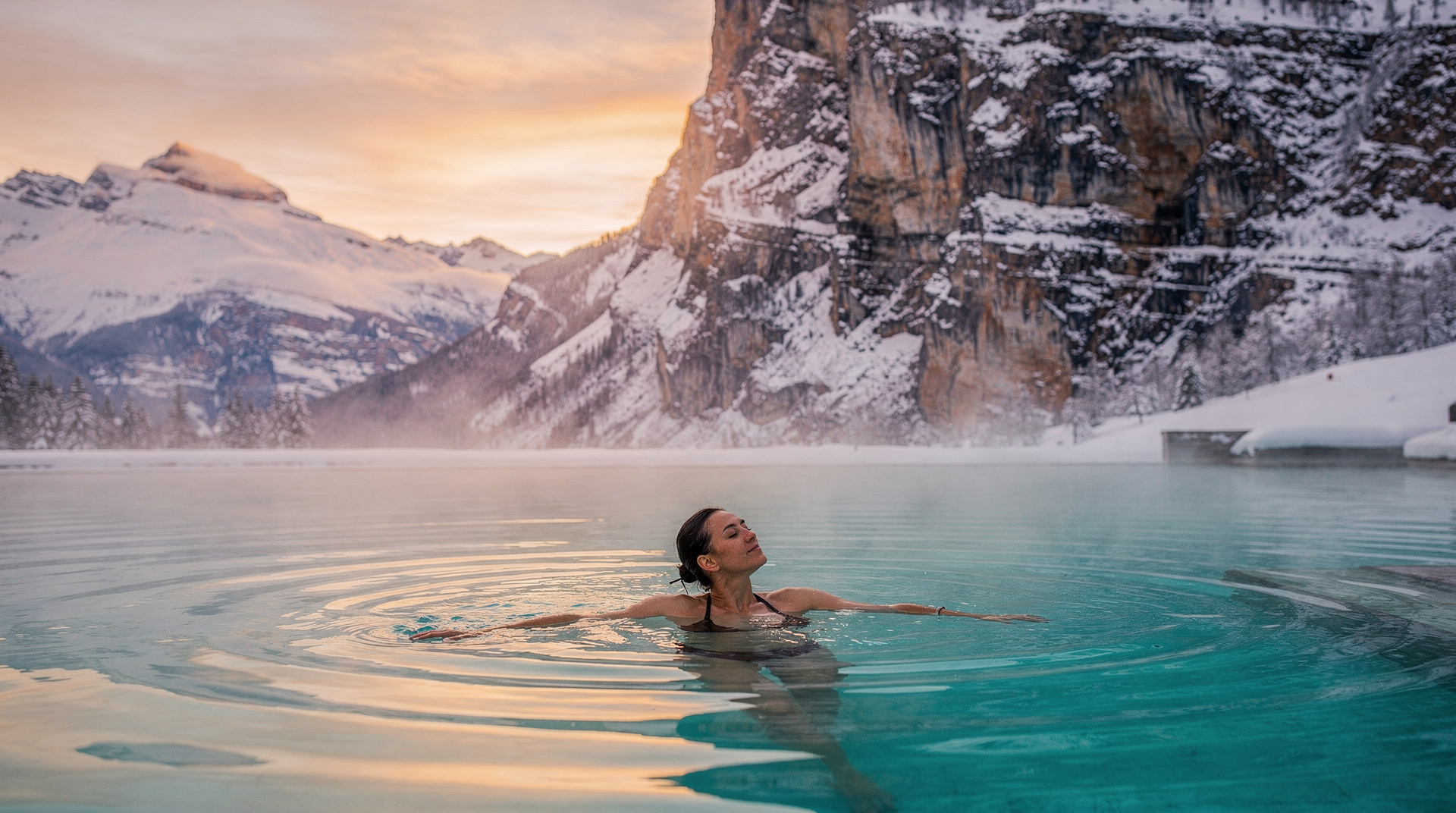
- The outdoor pool (36 degrees): Cut into the hillside exterior with views across the Vals valley and the mountains beyond. The combination of the stone edge, the 36-degree water, and the mountain air is the most directly sensory experience of the building.
- The sound cave: A submerged chamber lit by a single shaft of light, where the acoustics create a resonant quality from the slightest movement in the water.
- The drinking spring: The thermal water of the Vals spring, cold and mineral-rich, fed to a stone trough near the entrance to the indoor pool area.
Light and shadow
Zumthor’s use of light in the Therme Vals is the element most difficult to convey in photographs or descriptions. The building receives natural light through the narrow gaps between stone layers and through strategic openings in the roof plane, never through conventional windows. The result is that the pools are always lit differently from moment to moment — not dramatically, but with a slow quality of change that rewards extended immersion. A photograph of the building captures a single moment; the experience accumulates over time.
The bathing experience
Temperature and sequence
The Therme is designed around a thermal circuit — a sequence of hot, cold, and neutral pools and spaces that constitutes the therapeutic and experiential core of the visit. The recommended sequence moves between hot pool (42 degrees), cold plunge (14 degrees), and neutral immersion (36 degrees) in cycles, with rest periods in between.
The physiological effect of repeated hot-cold cycles includes improved circulation, muscle relaxation, and (for most people) a profound drowsiness and sense of wellbeing that sets in after the second or third cycle. This is the traditional therapeutic rationale for all thermal bath architecture, and it is the reason the Therme Vals is designed for extended visits rather than a quick dip.
Atmosphere and rules
The Therme is not loud. Mobile phones are not permitted in the bathing areas. Children from age 6 are welcome when accompanied by an adult. The general atmosphere is closer to contemplative than recreational — which is the intended character. This is not an entertainment complex; it is a place designed for stillness and physical attention.
Most visitors spend a minimum of 2-3 hours. 3-4 hours is typical for those who complete multiple thermal cycles. Some visitors spend a full day, alternating between pools, the outdoor terrace, and the rest areas.
Swimwear
Swimwear is worn in all pool areas. The indoor sauna spaces (operated separately from the pools) follow the Central European textile-free convention. The two areas are entirely separate.
Practical information
Booking
This is essential. The Therme Vals strictly limits capacity to preserve the quality of the experience. Without a reservation, access is not guaranteed — and in peak season and on weekends, the bath is frequently fully booked. Book at least 1-2 weeks in advance for weekends; midweek may be bookable closer to the date.
Booking is done through the 7132 Hotel website (7132.com).
Entry fees
- Adults (day entry): CHF 70 Monday-Tuesday, CHF 85 Wednesday-Sunday
- Children aged 6-15: CHF 55 Monday-Tuesday, CHF 60 Wednesday-Sunday (accompanied by an adult)
- Hotel guests: Morning access included in specific room packages
Price structures have changed as the 7132 Hotel has repositioned the resort upmarket. Check current pricing on the hotel website, as prices have increased since the hotel’s luxury renovation in the early 2020s.
The 7132 Hotel
The hotel above the Therme was purchased by investors in 2013 and has been progressively developed into a luxury property. In addition to the Zumthor building, three additional building extensions have been commissioned from four other Pritzker Prize-winning architects (Tadao Ando, Thom Mayne, Peter Märkli, and Kengo Kuma), creating a hotel that functions as a gallery of contemporary architectural work.
Staying at the 7132 Hotel is the most complete way to experience Therme Vals — guests have morning access to the pools before day visitors arrive, access to all hotel facilities, and the ability to experience the building across different light conditions (dawn and evening access are only available to hotel guests).
Check current room rates on the hotel website.
Getting to Vals
Vals is in a relatively remote valley of Graubünden, accessible only by road and PostBus.
By public transport:
- Zurich to Chur: 1 hour (IC train, Swiss Travel Pass covered)
- Chur to Ilanz: 40 minutes (Rhaetian Railway, Swiss Travel Pass covered)
- Ilanz to Vals: 40 minutes (PostBus, Swiss Travel Pass covered for regional pass holders — confirm current coverage)
- Total from Zurich: approximately 2 hours 20 minutes to 2 hours 40 minutes
The Swiss Travel Pass is particularly useful for Vals as it covers all three transport legs of the journey.
Check the PostBus timetable at postauto.ch — services run several times daily but are not frequent. The last bus from Vals back to Ilanz departs in the late afternoon/early evening; confirm timing before visiting.
By car:
- From Zurich: approximately 1 hour 40 minutes (A3 to Sargans, then A13 to Reichenau, then via Ilanz)
- From Chur: approximately 1 hour
- Parking in Vals: free, adjacent to the hotel
What visitors say about Therme Vals: managing expectations
Therme Vals has a reputation that attracts visitors with very high expectations — some of whom are primarily architecture enthusiasts who will scrutinise every detail, and some of whom are spa visitors who have heard it is Switzerland’s finest and arrive expecting opulence. The experience does not quite match either framing.
For architecture enthusiasts: The building is everything the monographs suggest, but photographs do not convey the scale — the spaces are smaller and more intimate than images suggest. The light quality, the acoustic character of the stone, and the relationship between pools and passages are things experienced over time, not at a glance. Plan at least three hours to move through the spaces properly.
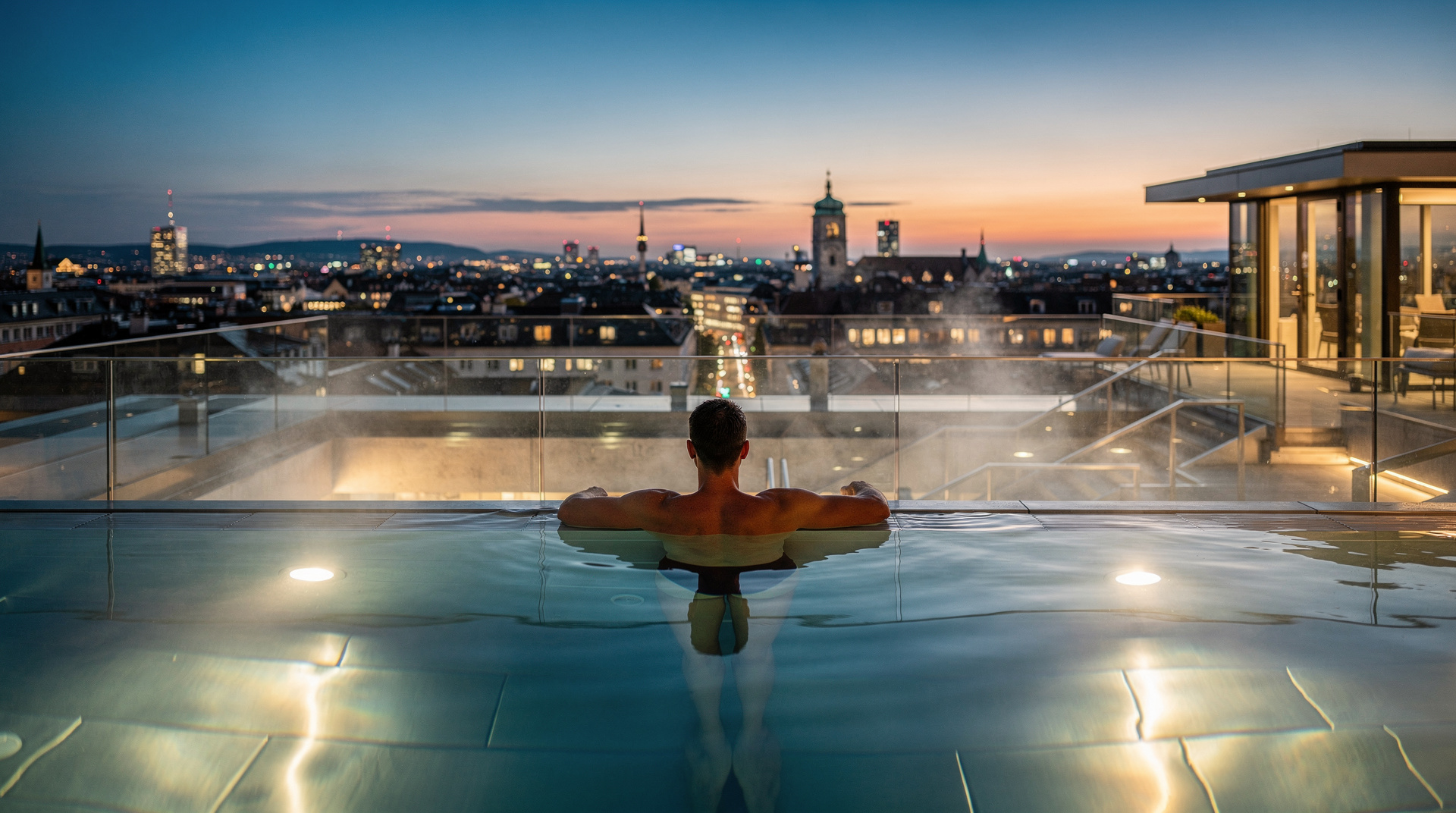
For spa enthusiasts seeking luxury: This is not a luxury spa in the five-star hotel sense. There are no robes, no scented candles, no playlist of ambient music. The experience is austere, mineral, and architectural. The pools are outstanding; the treatments are competent but not the focus. If you are looking for the pampering experience, Bad Ragaz or Thermalbad Zurich may be more appropriate. If you would rather stay near the city, the thermal baths and spa with panoramic views in Zurich offer an easier, more conventional spa day.
For those who want both: Therme Vals occupies a category of its own — it is neither a luxury spa nor a purely functional thermal facility. It is a serious work of spatial architecture that uses thermal bathing as its program. If that combination interests you, the experience is essentially unique in the world.
The booking reality
The limited capacity (enforced by the hotel’s policy) means that visiting Therme Vals requires planning in a way that other Swiss experiences do not. For a weekend visit in summer, booking 3-4 weeks in advance is realistic. For a specific peak date (around Christmas, New Year, or major Swiss holidays), 2-3 months in advance may be necessary. Weekday slots in low season (November, February) are often bookable on shorter notice.
If you visit Switzerland without a Therme Vals booking and decide you want to go, it is worth checking the 7132 Hotel website on the day — last-minute cancellations occasionally open slots. But arriving without a booking and expecting access is a gamble.
Photography at Therme Vals
Therme Vals is one of the most photographed spa interiors in the world, and the 7132 Hotel permits photography with specific restrictions: no photography of other guests, no flash, tripods only at specific times (usually before opening, by arrangement). The standard visitor experience does not include photography time — if photographing the building is a primary motivation, contact the hotel directly about their photography policy.
Combining Therme Vals with other experiences
The Vals valley
The valley itself rewards a slower visit. The village of Vals sits at 1,252 metres in a U-shaped glacial valley. The quartzite rock that Zumthor used in the Therme appears throughout the valley — in dry stone walls, in the church, in the road retaining walls — creating a material continuity between the building and its landscape. Hiking above the village reaches high Alpine terrain within 2-3 hours.
Ilanz and the Rhine Gorge
Ilanz (accessible on the way to or from Vals) is the first town on the Rhine, with a well-preserved historic centre. The Rhine Gorge (Ruinaulta) between Ilanz and Versam-Safien is one of Switzerland’s most dramatic landscapes — the so-called Swiss Grand Canyon — and walking or cycling through it is a 2-3 hour excursion. The Glacier Express passes through the gorge on its Zermatt-St. Moritz route.
Combining with other thermal baths
A Graubünden thermal circuit could include Therme Vals and the Scuol Spa (both accessible by public transport from Chur). The contrast between Zumthor’s architecturally conceived space and the larger, more family-oriented Scuol complex provides an interesting comparison. The thermal baths overview covers all Swiss thermal destinations.
For context on Swiss architecture and why Therme Vals matters in the broader context of 20th-century building, the visitor centre in the 7132 Hotel lobby has a permanent exhibition on the design and construction of the building.
The full wellness section covers spa and thermal bath experiences across Switzerland, from Leukerbad to Baden and beyond. If your visit to Switzerland combines wellness with other activities, the 7-day itinerary guide provides a framework for combining thermal baths with hiking, train journeys, and cities.
The Vals quartzite: understanding the stone
The Valser quartzite used in the Therme Vals is central to understanding the building. This is not a decorative facing material — it is a load-bearing structural element used in a way that conventional architects would not attempt with stone of this character.
Quartzite is a metamorphic rock formed when sandstone is subjected to intense heat and pressure, recrystallising the quartz grains into a denser, harder structure. The Valser quartzite is a specific variety quarried above the village from a formation of Triassic origin, approximately 250 million years old. Its colour varies from pale grey-green in fresh exposures to a darker silver-grey when weathered and wet — which means the building changes colour in rain, in morning light, and in the underwater illumination of the pools.
Zumthor had the quartzite cut into slabs of 10-12 centimetres thickness and 30-50 centimetres depth, laid in alternating courses with concrete joints. The horizontal layering mimics the geological strata of the rock in situ — the building looks as if it was cut from the mountain face and arranged on flat ground.
The thermal and tactile quality of the stone is significant in the bathing context. Quartzite has high thermal mass — it absorbs heat slowly and releases it slowly. In the Therme Vals, the stone feels warm at body temperature rather than cold as most stone surfaces do. This quality is not incidental; Zumthor discussed the thermal character of materials extensively in his design process.
Peter Zumthor and Swiss architecture
The Therme Vals is part of a specifically Swiss architectural tradition that prioritises material quality, craft, and site responsiveness over formal invention. Swiss architecture of the 20th century — represented by figures like Rino Tami, Werner Blaser, and eventually Zumthor himself — developed a philosophy of building that treated materials with exceptional care and saw the act of making as inseparable from design intention.
Zumthor trained as a cabinetmaker before studying architecture, and this background is visible in the Therme Vals at every scale: the precision of the stone joints, the way the handrails are integrated into the wall structure, the careful sizing of every detail. The building is not designed from a distance and handed to contractors; it is made with the same attention that a fine piece of furniture receives.
The Pritzker Prize committee cited Zumthor specifically for this quality when awarding him the prize in 2009 — a “profound sense of place” and a commitment to “poetry and power” through materials and craft. The Therme Vals is the single most accessible and complete demonstration of what those phrases mean in practice.
Vals in the wider Graubunden context
Vals sits within the canton of Graubunden, Switzerland’s largest and most sparsely populated canton, known for Romansh culture and deep side valleys like this one. Chur, the cantonal capital and the gateway rail hub for reaching Vals, is worth an hour or two if your itinerary allows — it is Switzerland’s oldest town, with a compact and walkable historic centre. Weather in this part of Graubunden can differ noticeably from the Swiss Plateau; check the weather and climate guide before finalising a visit, particularly in shoulder season when valley roads and PostBus schedules can be affected by snow.
The Swiss Travel Pass is worth weighing against a point-to-point ticket for this trip specifically, since it covers all three legs (Zurich-Chur, Chur-Ilanz, Ilanz-Vals) plus any other rail travel during your stay. For overall trip timing, the best time to visit Switzerland guide covers how shoulder-season crowds and pricing affect a destination like Vals, where capacity is capped year-round regardless of season.