© Swiss Travel System AG, 2019, Fotograf: Tobias Ryser
7 days in Switzerland: the ultimate one-week itinerary
Why this is the classic Switzerland itinerary
One week in Switzerland is the benchmark. It is long enough to see the country’s four great landscapes — the lakes of central Switzerland, the glaciated peaks of the Bernese Oberland, the dramatic valleys of Valais, and the French-speaking shores of Lake Geneva — without feeling like you are rushing. This itinerary is the most important on this site because it captures Switzerland at its full breadth: medieval cities, the world’s highest railway station, the Matterhorn, the Glacier Express, and the elegance of the Riviera suisse.
The route runs west: Zurich to Lucerne to Interlaken to Zermatt to Geneva/Montreux. It is entirely linear, meaning you don’t backtrack. The Swiss Travel Pass covers nearly all transport and makes the logistics straightforward. Two excursions require advance booking: the Jungfraujoch train and the Glacier Express from Zermatt to St. Moritz (though on this itinerary we ride a partial section of that route as a scenic day train).
| At a glance | |
|---|---|
| Where | Zurich → Lucerne → Interlaken → Zermatt → Geneva/Montreux |
| Cost | Moderate — around CHF 2,200-2,700 per person (excluding flights) |
| Time needed | 7 days, linear route with no backtracking |
| Getting there | Fly into Zurich, depart from Geneva (or vice versa) |
| Best time | Mid-May through September; June and September balance clear skies with manageable crowds |
Day 1: Zurich
Morning and afternoon — the city on two rivers
Fly into Zurich Airport and take the direct train (10 minutes) to Zurich Hauptbahnhof. Check in, then spend the day in Zurich. The old town (Altstadt) on both sides of the Limmat is a world-class historic centre: Grossmünster cathedral, Fraumünster (with Chagall windows), guild houses, and the Lindenhügel hilltop with its panorama toward the lake and Alps.
The Kunsthaus Zürich, recently expanded, is one of the finest art museums in Europe with exceptional collections of Swiss art (Hodler, Giacometti), German Expressionism, and a growing collection of contemporary work. Allow two hours.
In the afternoon, walk Bahnhofstrasse to the lake and take a short cruise on Lake Zurich — the boats are covered by the Swiss Travel Pass and give a completely different perspective on the city skyline and the mountains beyond. On a clear evening, the silhouette of the Säntis massif and the Glärner Alps rises directly behind the city.
Dinner in the Langstrasse or Niederdorf district. These two areas, on opposite sides of the river, contain the highest concentration of restaurants in the city at every price point. For a quintessential first-evening experience, try Zeughauskeller on Bahnhofstrasse — a historic beer hall with excellent Swiss classics at reasonable prices.
Pre-book your Lindt Home of Chocolate museum ticket →Accommodation: 1 night in Zurich. Mid-range hotels near the Hauptbahnhof cost CHF 160-250. Hotel Marktgasse in the old town is an excellent mid-range option with character.
Day 2: Lucerne
Morning — train from Zurich, Chapel Bridge and old town
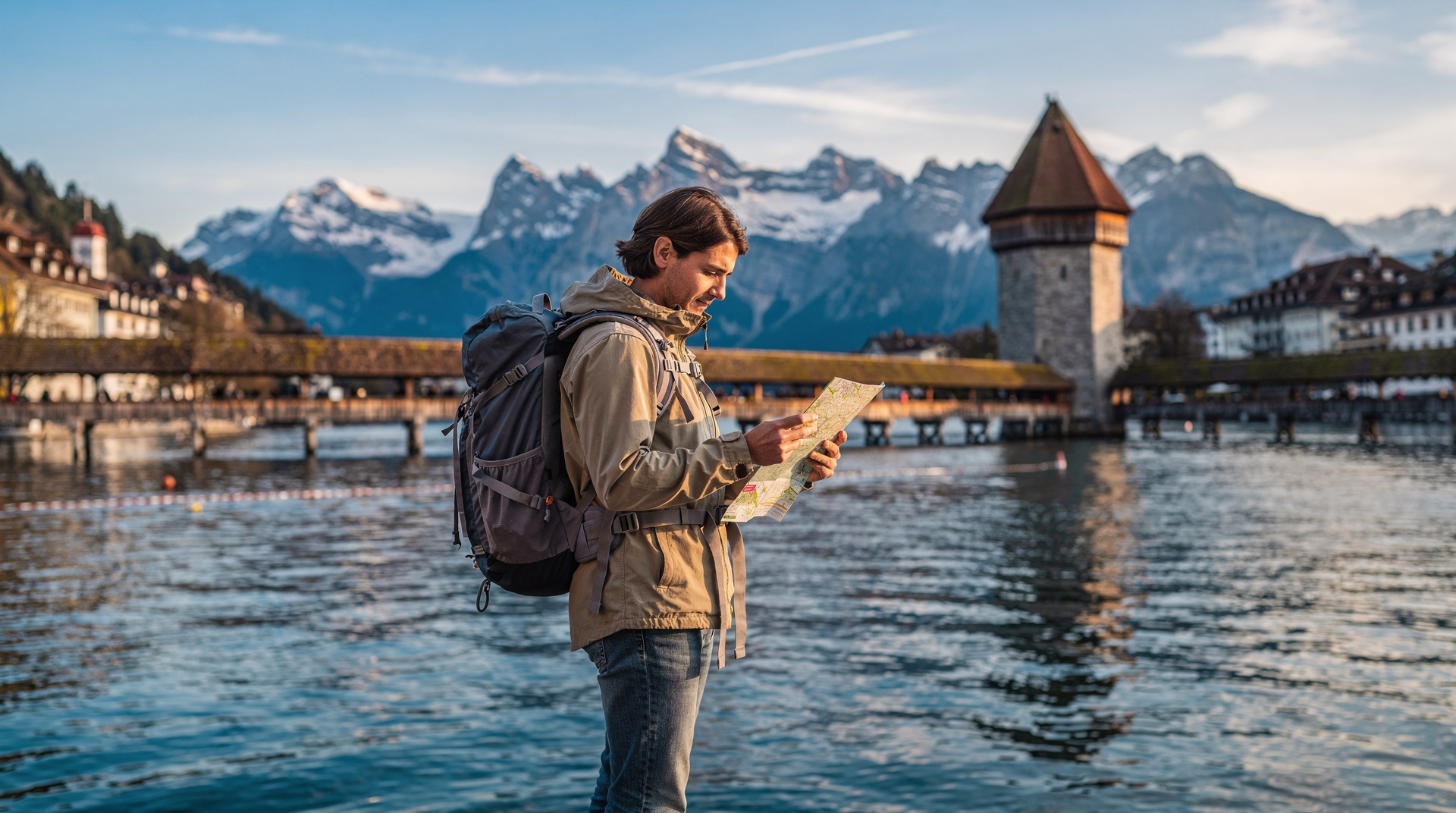
The 45-minute train to Lucerne runs every 30 minutes. Arrive by 9am and walk straight to the Chapel Bridge (Kapellbrücke) — the oldest covered wooden bridge in Europe and the most photographed single sight in Switzerland. The morning light from the east catches the painted panels under the roof and the Water Tower perfectly.
Walk the Altstadt: Weinmarkt square with its painted facades, Kornmarkt, and the narrow lanes climbing toward the Musegg Wall. The wall’s nine towers are largely intact and three are open to visitors — the Zyt Tower chimes one minute before all others in the city, a medieval privilege that still holds.
The Swiss Museum of Transport (Verkehrshaus) on the lakefront deserves a full morning if you have a particular interest in rail, aviation, or shipping history — it is the most visited museum in Switzerland and genuinely impressive.
Afternoon — boat on Lake Lucerne
Board one of the historic paddle steamers that still serve Lake Lucerne. The boat from Lucerne to Flüelen at the southern end of the lake is a three-hour journey through one of the most dramatic lake landscapes in Europe — sheer limestone walls, medieval chapels on promontories, the Tell’s Platte landing stage associated with the William Tell legend. The Swiss Travel Pass covers the boat.
Return by train from Brunnen or Flüelen (30-40 minutes) in the late afternoon. Dinner in Lucerne — Wirtshaus Galliker is a beloved local institution for traditional Lucerne cooking (try the Pastetli or Kügeli-Pastete).
Book a scenic Lake Lucerne boat cruise →Accommodation: 1 night in Lucerne. Hotel des Alpes offers a prime lakefront location directly facing the Chapel Bridge at mid-range prices.
Day 3: Interlaken and arrival in the Bernese Oberland
Morning — scenic rail via Brünig Pass
Take the scenic train from Lucerne to Interlaken via the Brünig Pass route. This older narrow-gauge line (the Zentralbahn) climbs from Lucerne through forests and farmland over the Brünig Pass, then descends to the turquoise Brienzersee. The section along the lake before arriving into Brienz and then Interlaken is beautiful. Total journey: about 2 hours.
Arrive at Interlaken Ost by midday. Check in and walk the Höheweg — the broad tree-lined boulevard running through the town, with the Eiger, Mönch, and Jungfrau filling the southern horizon completely. This view, of three of the great peaks of the Alps framed by parkland and horse chestnut trees, never gets old.
Afternoon — Harder Kulm viewpoint
The Harderbahn funicular from Interlaken Ost takes eight minutes to the Harder Kulm summit at 1,322 metres. The terrace here — nicknamed the “Two Lakes Bridge” — looks directly north across Interlaken, with the Brienzersee on the left and Thunersee on the right, and the whole Bernese Oberland mountain chain from Eiger to Blümlisalp spread across the south. It is one of the great viewpoints in Switzerland and is included in the Swiss Travel Pass. Go in the afternoon when the light is on the mountains.
Evening — Interlaken
The town has excellent fondue restaurants. This is the Bernese Oberland and the cheese culture is serious — the local Emmentaler and Gruyère are genuine articles, and a shared pot of fondue with local bread and wine is one of the pleasures of the region. For something different, Benacus offers rooftop dining with views of the mountains.
If you have time in the afternoon, consider a side trip to Lauterbrunnen — the valley of 72 waterfalls is just 20 minutes by train from Interlaken Ost and is one of the most spectacular settings in the Alps. The Staubbach Falls plunge 297 metres directly into the village. It also serves as the gateway to Mürren and Gimmelwald, two car-free villages perched on cliffs above the valley.
Reserve your Harder Kulm funicular ticket →Accommodation: 2 nights in Interlaken. Hotel Interlaken is a historic property (dating to 1323) in the centre with comfortable mid-range rooms.
Day 4: Jungfraujoch — top of Europe
Early morning — the railway into the mountain
This is the centrepiece of the week. The Jungfraujoch summit at 3,454 metres is reached by a railway that was completed in 1912, bored through the limestone of the Eiger and Mönch. There is nothing quite like it anywhere else in the world. From Interlaken Ost, the journey takes about two hours with changes at Lauterbrunnen (or Grindelwald) and Kleine Scheidegg.
Be at Interlaken Ost by 7:30am. The first morning trains are less crowded and more likely to have clear skies before afternoon cloud develops. Your Jungfraujoch train ticket must be booked in advance (book at least one week ahead in summer, two weeks in July and August). Swiss Travel Pass holders pay a reduced fare of approximately CHF 145 (full fare is around CHF 190).
At the top: the Sphinx Observatory with its panoramic viewing terraces, the Ice Palace (carved tunnels with ice sculptures inside the glacier), the Plateau de Glace where you can walk on the glacier itself, and views across the 23-kilometre Aletsch Glacier — the largest in the Alps and a UNESCO World Heritage Site. Dress warmly. Even in August the temperature is around 0°C and the wind can be sharp.
Midday — Kleine Scheidegg
On the way back, stop at Kleine Scheidegg (2,061 metres) for lunch on the sun terrace. The north face of the Eiger rises immediately behind you — 1,800 metres of vertical limestone that has been the setting for some of the most dramatic mountaineering stories in history. The 1938 first ascent by Heckmair, Vörg, Harrer, and Kasparek is commemorated in the Kleine Scheidegg hotel bar, which has photographs and documents from the climb.
Don’t miss the first train — book your Jungfraujoch ticket today →Return to Interlaken by mid-afternoon. Rest or wander the town.
Day 5: Travel day — Interlaken to Zermatt
Morning — train through the Rhône Valley
The train from Interlaken to Zermatt takes about two hours and fifteen minutes via Spiez and Visp. The section down the Rhône Valley from Brig is unlike anything in the German-speaking Alps — the valley is wide, dry, and lined with apricot orchards and vineyards on south-facing terraces. This is the warmest, driest part of Switzerland, and it looks nothing like the postcards.
From Visp, the Matter Valley train (BVZ Zermatt Bahn) climbs the narrow Mattertal gorge to Zermatt. The valley closes in progressively, the cliffs rising on both sides, until the train arrives at the car-free village and the Matterhorn appears at the end of the main street — a perfect pyramid of dark rock and snow, exactly as you have always seen it.
Afternoon — Zermatt village
Zermatt is small enough to walk end-to-end in 20 minutes but contains world-class restaurants, excellent museums, and some of the finest mountain scenery accessible to non-climbers anywhere in the Alps. Visit the Matterhorn Museum Zermatlantis in the afternoon — it is genuinely moving, telling the story of the 1865 first ascent and the deaths on the descent. The churchyard outside has the graves of climbers who have died on the Matterhorn, including Edward Whymper’s party from that first ascent.
Take the Sunnegga funicular (5 minutes) to the alp plateau above the village for the afternoon light on the Matterhorn. The walk from Sunnegga to Stellisee (30 minutes) reaches a small lake that perfectly reflects the Matterhorn on calm mornings.
Evening — raclette in Zermatt
Dinner in Zermatt. Raclette — the traditional Valais dish of melted cheese scraped over potatoes — is the dish to order here. Many restaurants have raclette stations where the wheel is melted tableside. Whymper Stube (named after Edward Whymper, who first summited the Matterhorn) is an atmospheric choice with mountaineering memorabilia and excellent cheese dishes.
Accommodation: 2 nights in Zermatt. Hotel Bristol is a reliable mid-range option with views of the Matterhorn from some rooms.
Day 6: Matterhorn Glacier Paradise and the Gornergrat
Morning — Matterhorn Glacier Paradise
The Matterhorn Glacier Paradise cable car system rises from the village to 3,883 metres in a series of stages. At the top is the highest cable car station in the Alps, with viewing platforms in four directions and the Glacier Palace ice cave inside the mountain. On a clear day you can see the summit of the Matterhorn directly above, the Monte Rosa massif (Switzerland’s highest peak at 4,634 metres) to the east, and the peaks of the French and Italian Alps stretching to the horizon.
Book your Matterhorn Glacier Paradise experience in advance. The Swiss Travel Pass gives 25% off. Round trip approximately CHF 100 with the pass discount.
Reserve your spot at Europe’s highest cable car station →Afternoon — Gornergrat panorama
The Gornergrat rack railway from Zermatt station climbs to 3,089 metres and arrives at the highest open-air railway station in Europe. The panorama from the Gornergrat Observatory terrace takes in 29 four-thousand-metre peaks simultaneously, including the Matterhorn, Monte Rosa, and the entire Zermatt skyline. The Swiss Travel Pass gives 50% discount on this railway.
Walk part of the way back down on the summer hiking trails if conditions allow — the descent from Riffelberg to Riffelalp (about one hour) passes glacial lakes and has close views of the Gorner Glacier.
Day 7: Geneva and Montreux — the Riviera suisse
Morning — train to Geneva
Leave Zermatt on the morning train via Visp and change at Lausanne for Geneva. The total journey takes about three and a half hours, arriving in Geneva by midday. Geneva is the most international city in Switzerland — home to the UN, the Red Cross, CERN, and dozens of other global institutions, and with a sophistication and diversity unlike any other Swiss city.
If time allows, visit the Jet d’Eau — Geneva’s famous water jet shooting 140 metres over the lake — and the old town, with the St. Pierre Cathedral (partly Romanesque, partly Gothic) and the Reformation Wall behind it, one of the great monuments to Protestant history in Europe.
Afternoon — Montreux and Chillon Castle
Rather than staying in Geneva for the afternoon, take the lake train 45 minutes east to Montreux. The Riviera suisse — the north shore of Lac Léman between Lausanne and Villeneuve — is famous for its microclimate (palm trees grow here), its wine (the Lavaux UNESCO terraced vineyards rise directly above the railway), and the Château de Chillon, the most visited historic monument in Switzerland.
Book your Chillon Castle entrance ticket for the afternoon. The 13th-century fortress stands on a rock shelf in the lake, connected to the shore by drawbridge, with dungeons (where Bonivard, the prisoner of Chillon, was held for four years), great halls, and extraordinary lake views. Byron scratched his name into one of the dungeon pillars in 1816. Allow two hours.
Walk the lakefront promenade back toward Montreux — the Freddie Mercury statue (he recorded at Mountain Studios here for 20 years) is at the western end, and the whole lakeside is lined with flowers, public art, and the best views of the Alps across the lake. For a memorable lakeside meal in Geneva, try Buvette des Bains (a casual spot right on the water near the Bains des Paquis).
Skip the queue — book your Château de Chillon entrance ticket →Departure: Geneva Airport is 15 minutes from Geneva Cornavin station by direct train. Or fly the following morning and spend the night in Montreux or Geneva. In Montreux, Hotel Helvetie is a charming mid-range choice steps from the lakefront promenade.
Practical information
The Swiss Travel Pass for this itinerary
The Swiss Travel Pass (7 consecutive days) costs approximately CHF 395 per adult in 2026. It covers: all trains (Zurich-Lucerne, Lucerne-Interlaken, Interlaken-Zermatt, Zermatt-Geneva), the Lucerne lake boats, the Harder Kulm funicular, and gives 25-50% off mountain railways. This is the best-value transport option for this itinerary.
What to book in advance
- Jungfraujoch train — book at least 1-2 weeks ahead in summer
- Matterhorn Glacier Paradise — can usually book 2-3 days ahead
- Chillon Castle — can usually book same-day but advance booking skips queues
- All accommodation — book 4-8 weeks ahead for July/August
Budget estimates (per person for 7 days)
- Swiss Travel Pass (7 days): CHF 395
- Jungfraujoch (with pass discount): CHF 145
- Matterhorn Glacier Paradise (with pass discount): CHF 75
- Gornergrat (with pass discount): CHF 25
- Accommodation (7 nights, mid-range average): CHF 1,100-1,600
- Food (CHF 65/day): CHF 455
Total per person (excluding flights): approximately CHF 2,200-2,700
Best time to visit
Mid-May through September is optimal. The Jungfraujoch operates year-round. June and September offer the best combination of clear skies, manageable crowds, and reasonable hotel prices. July and August are peak season — expect higher prices and busier trails. The winter itinerary covers December-March for snow-seekers.
Extending the trip
For a more leisurely version of this route with additional destinations, see the 10-day itinerary (which adds Bern, Lauterbrunnen, and a scenic train day) or the 14-day itinerary which includes Lugano and St. Moritz. For the Glacier Express in full, add two to three days to travel from Zermatt to St. Moritz before continuing to Geneva.
Frequently asked questions about planning 7 days in Switzerland
Is 7 days enough for Switzerland?
Yes, 7 days is the ideal length for a first trip to Switzerland. It allows you to experience lakes, mountains, cities, and scenic trains without feeling rushed. This itinerary covers Zurich, Lucerne, the Jungfraujoch, Zermatt, and Lake Geneva — the essential highlights. For a more relaxed pace or to add destinations like Lugano or St. Moritz, consider extending to 10 or 14 days.
How much does a 7-day Switzerland trip cost?
Budget approximately CHF 2,200-2,700 per person excluding flights. This includes a 7-day Swiss Travel Pass (CHF 395), Jungfraujoch with pass discount (CHF 145), Matterhorn Glacier Paradise (CHF 75), mid-range accommodation for 7 nights (CHF 1,100-1,600), and food at CHF 65 per day (CHF 455). Budget travellers can reduce this to CHF 1,500 with hostels and supermarket meals.
Do I need the Swiss Travel Pass for this itinerary?
The Swiss Travel Pass is strongly recommended for this itinerary and typically pays for itself within the first 2-3 days. It covers all trains between cities (Zurich, Lucerne, Interlaken, Zermatt, Geneva), lake boat cruises, city transport, 500+ museums, and gives 25-50% off mountain railways. Without it, individual tickets for these journeys would cost significantly more.
Should I start in Zurich or Geneva?
Starting in Zurich and ending in Geneva (or vice versa) works best because the itinerary is linear — you never backtrack. Both cities have international airports. Starting in Zurich puts the mountain highlights in the middle of the trip, building toward the dramatic Jungfraujoch and Zermatt days. Starting in Geneva and reversing the route works equally well.
What should I book in advance for a 7-day trip?
Book the Jungfraujoch train tickets 1-2 weeks ahead in summer (2 weeks in July-August), accommodation 4-8 weeks ahead for peak season, and Chillon Castle tickets for queue-free entry. The Matterhorn Glacier Paradise can usually be booked 2-3 days ahead. The Swiss Travel Pass can be purchased and activated at any time.
Can I add the Glacier Express to a 7-day itinerary?
The full Glacier Express from Zermatt to St. Moritz takes 8 hours and would require adding 2-3 extra days to include St. Moritz and return transport. For a 7-day trip, you can ride a partial section of the same route as a scenic day train from Zermatt. If the Glacier Express is a priority, consider the 10-day or 14-day itinerary instead.
Is this itinerary suitable for families with children?
Most of it, yes — Zurich, Lucerne, and Montreux are all easy with kids, and the Swiss Museum of Transport is a highlight for most children. Jungfraujoch and the Matterhorn Glacier Paradise involve altitude and cold that are fine for most healthy children but worth planning around nap times and layering. For a dedicated family version with a gentler pace, see the family itinerary or the best family activities guide.