14 days in Switzerland: the comprehensive two-week itinerary
14 days in Switzerland: the comprehensive two-week tour
Two weeks in Switzerland allows you to do something that shorter trips cannot: explore the country’s four linguistic and cultural regions, each with its own distinct character. German-speaking Switzerland (Zurich, Lucerne, Bern) is orderly, prosperous, and defined by mountains and lakes. The Valais and its high alpine world centres on Zermatt and the Matterhorn. The Engadine — Switzerland’s highest inhabited valley — is the world of St. Moritz, the Bernina Express, and Romansh culture. And Italian-speaking Ticino, around Lugano, is a different Switzerland entirely: Mediterranean light, palm trees, and a Latin sensibility.
This itinerary covers all four regions and includes both the Glacier Express and the Bernina Express — the two most celebrated scenic railway journeys in the Alps. The Swiss Travel Pass covers nearly all transport. Book both scenic trains and the Jungfraujoch as far in advance as possible.
| At a glance | |
|---|---|
| Route | Zurich → Lucerne → Bern → Interlaken → Zermatt → St. Moritz → Lugano → Geneva |
| Cost (excl. flights) | Around CHF 4,000-5,000 per person |
| Pace | Moderate — mostly two-night stays, two full scenic-train days |
| Best for | Couples and comprehensive first-or-second trips wanting all four linguistic regions |
| Best time | June or September; book Glacier Express/Bernina Express 2-3 weeks ahead |
Days 1-2: Zurich
Day 1 — arrival and the old city
Arrive at Zurich Airport, take the direct rail into Zurich Hauptbahnhof (10 minutes). Two nights here allows for a genuinely unhurried visit to one of Europe’s most liveable cities.
Spend Day 1 in the Altstadt: Grossmünster and Fraumünster cathedrals (Chagall windows), the Lindenhügel viewpoint, and the lakefront promenade. The Kunsthaus Zürich (closed Mondays) is the finest art museum in Switzerland — the Chagall, Giacometti, and Swiss Romantic collections alone justify two hours.
In the evening, explore the Langstrasse neighbourhood for dinner — this is Zurich’s most diverse restaurant district, with excellent Lebanese, Turkish, Indian, and Swiss options all within a few blocks.
Day 2 — excursion to Rapperswil or Rheinfall
Two good day-trip options from Zurich. Rapperswil (45 minutes by S-Bahn) is a medieval town on the upper Zürichsee with a 13th-century castle, a rose garden, and lakeside promenades — quieter and more intimate than the city. The Rheinfall (train to Schaffhausen, 40 minutes, then bus) is Europe’s largest waterfall by volume — 700 cubic metres of water per second tumbling over a 23-metre cliff. The boat to the central rock goes directly into the spray.
The Lindt Home of Chocolate museum at Kilchberg is a 20-minute S-Bahn journey from the city and is an excellent afternoon option on Day 2 if you prefer to stay closer to Zurich.
Book your Lindt chocolate museum tickets in advance →Accommodation: 2 nights Zurich.
Days 3-4: Lucerne
Train to Lucerne (45 minutes). Spend two nights — this allows you to explore the city and do a full mountain excursion.
Day 3 — Lucerne city
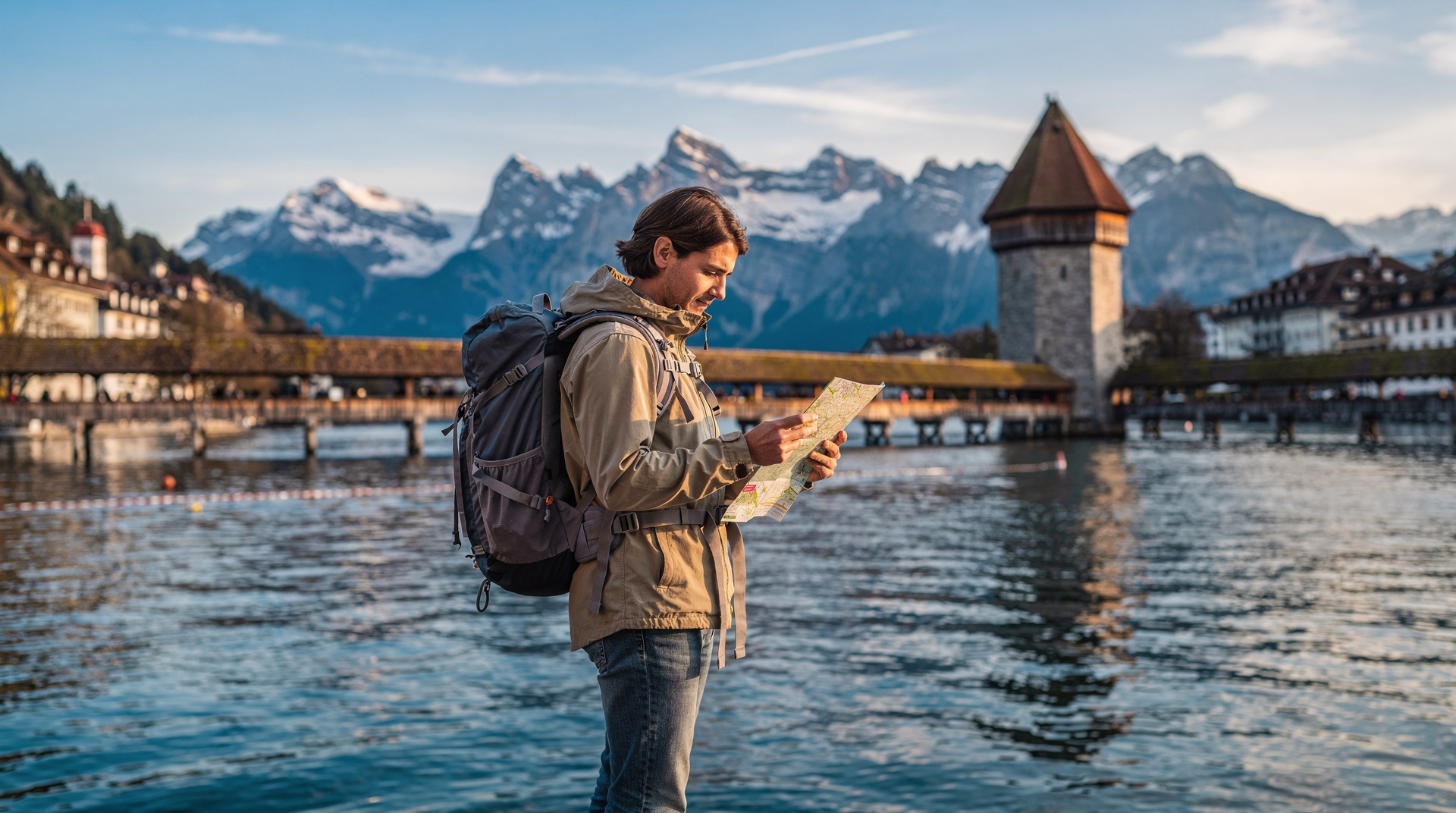
Lucerne old town, Chapel Bridge, Musegg Wall. The Swiss Museum of Transport on the lakefront is the most visited museum in Switzerland — genuinely excellent, especially the rail and aviation collections. Take the evening lake steamer for sunset views of the Rigi and Pilatus.
Book a Lucerne walking and boat tour with cheese and wine tasting →Day 4 — Mount Pilatus
The full Pilatus Golden Round Trip — boat across the lake to Alpnachstad, world’s steepest rack railway to the 2,132-metre summit, and cable car return. Allow four to five hours for the circuit. At the summit, walk the ridge between the Esel and Oberhaupt peaks for the full panorama.
Pre-book the Pilatus Golden Round Trip to guarantee your spot →Accommodation: 2 nights Lucerne.
Day 5: Bern
Train from Lucerne to Bern (1 hour 20 minutes). The Swiss capital is one of the great medieval cities in northern Europe — 6 kilometres of continuous covered arcades, ornate 16th-century fountains, and the Zytglogge astronomical clock tower at the centre of the old town. The entire Altstadt is a UNESCO World Heritage Site.
Visit the Federal Palace (free guided tours), walk the Rose Garden for the panorama of the Aare bend, and explore the Bear Park (free entry) where the city’s emblematic animals live in a large riverside enclosure. The Bern Historical Museum includes the Einstein Museum — he developed the Special Theory of Relativity while living in Bern in 1905.
Catch a late afternoon train to Interlaken (50 minutes) and check in for two nights.
Explore Bern with a local guide — book a walking tour →Days 6-7: Interlaken and the Jungfrau region
Day 6 — Jungfraujoch
Early start. The first train from Interlaken Ost toward Jungfraujoch leaves around 7:35am. Be on it. The Jungfraujoch ticket must be booked well in advance. Spend the morning at 3,454 metres: Sphinx Observatory, Ice Palace, Aletsch Glacier views.
Book the early train to Jungfraujoch — Top of Europe tickets →Descend via Grindelwald and spend the afternoon walking in Grindelwald village below the Eiger north face.
Day 7 — Lauterbrunnen and Schilthorn
Take the train to Lauterbrunnen, the glacial valley with 72 waterfalls and 300-metre cliffs. From Lauterbrunnen, the cable car rises to Mürren and the Schilthorn (2,970 metres) — the rotating restaurant at the summit was the filming location for the James Bond film “On Her Majesty’s Secret Service” (1969). The 360-degree panorama from the Schilthorn includes the Eiger, Mönch, and Jungfrau, the Bernese plateau, and on clear days, Mont Blanc in France.
Walk the Northface Trail from Mürren to Gimmelwald (1.5 hours) for sustained views of the Jungfrau massif before descending back to Lauterbrunnen by cable car and returning to Interlaken.
Book a Lauterbrunnen and Mürren small-group day trip →Days 8-9: Zermatt
Train to Zermatt via Spiez and Visp (2h 15min). Two nights allows you to do both major mountain excursions without rushing.
Day 8 — arrival and Sunnegga
Arrive midday. Walk the village, visit the Matterhorn Museum, and take the Sunnegga funicular for afternoon light on the Matterhorn. Walk to Stellisee lake (30 minutes from Sunnegga) for the famous reflection of the peak.
Day 9 — Glacier Paradise and Gornergrat
Morning: Matterhorn Glacier Paradise at 3,883 metres (highest cable car in the Alps). Afternoon: Gornergrat rack railway to 3,089 metres (50% off with Swiss Travel Pass) for the 29-peak panorama. Walk down from Riffelberg to the village.
Reserve the Matterhorn Glacier Paradise — 29 four-thousand-metre peaks in view →Accommodation: 2 nights Zermatt.
Day 10: Glacier Express — Zermatt to St. Moritz
The world’s slowest express train
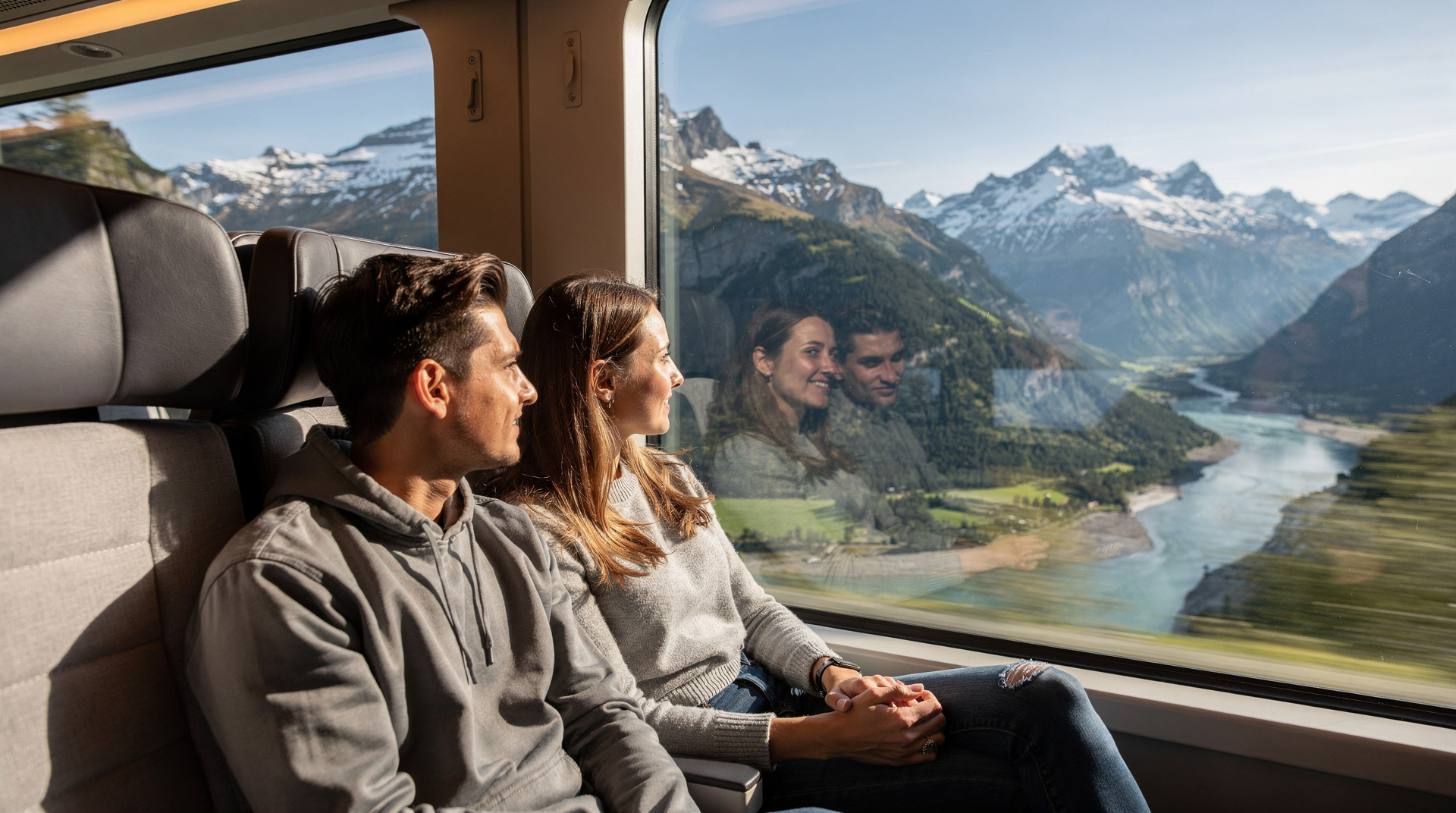
This is the full eight-hour Glacier Express from Zermatt to St. Moritz in first class. The train departs Zermatt at 9:52am and arrives St. Moritz at 6:57pm, passing through 291 bridges, 91 tunnels, and over the 2,033-metre Oberalp Pass — the highest point on the journey. Through the panoramic windows you will see the Rhône Valley, Andermatt, the Rhine Gorge (Ruinaulta, sometimes called the “Swiss Grand Canyon”), and finally the descent into the Engadine.
Lunch is served at your seat — the dining service on first class Glacier Express is a proper sit-down meal with local wine. A seat reservation (CHF 43 for first class) is required in addition to the Swiss Travel Pass.
Reserve your Glacier Express first-class seat — 291 bridges, 91 tunnels →St. Moritz is the most famous ski resort in Switzerland — actually two lakes and several villages at 1,800 metres, surrounded by 300 days of sunshine per year (it is statistically one of the sunniest places in the Alps). In summer it is a walking and cycling paradise.
Accommodation: 2 nights St. Moritz.
Day 11: St. Moritz and the Engadine
Spend a full day in the Engadine valley. St. Moritz itself has the Segantini Museum (extraordinary late 19th-century paintings of Alpine life), the Engadine Museum, and the lake with its stunning Corvatsch backdrop. The village of Sils Maria, 10 kilometres up the valley, is where Nietzsche spent seven summers and developed his concept of eternal recurrence — there is a small museum in his house.
Maloja, at the valley’s western end, is a dramatic mountain pass with a road that drops 500 metres in less than 5 kilometres. Walk the Inn riverbank upstream from St. Moritz toward Pontresina for access to the Morteratsch Glacier, one of the most accessible glaciers in the Alps.
Day 12: Bernina Express — St. Moritz to Lugano
The most scenic railway in the world
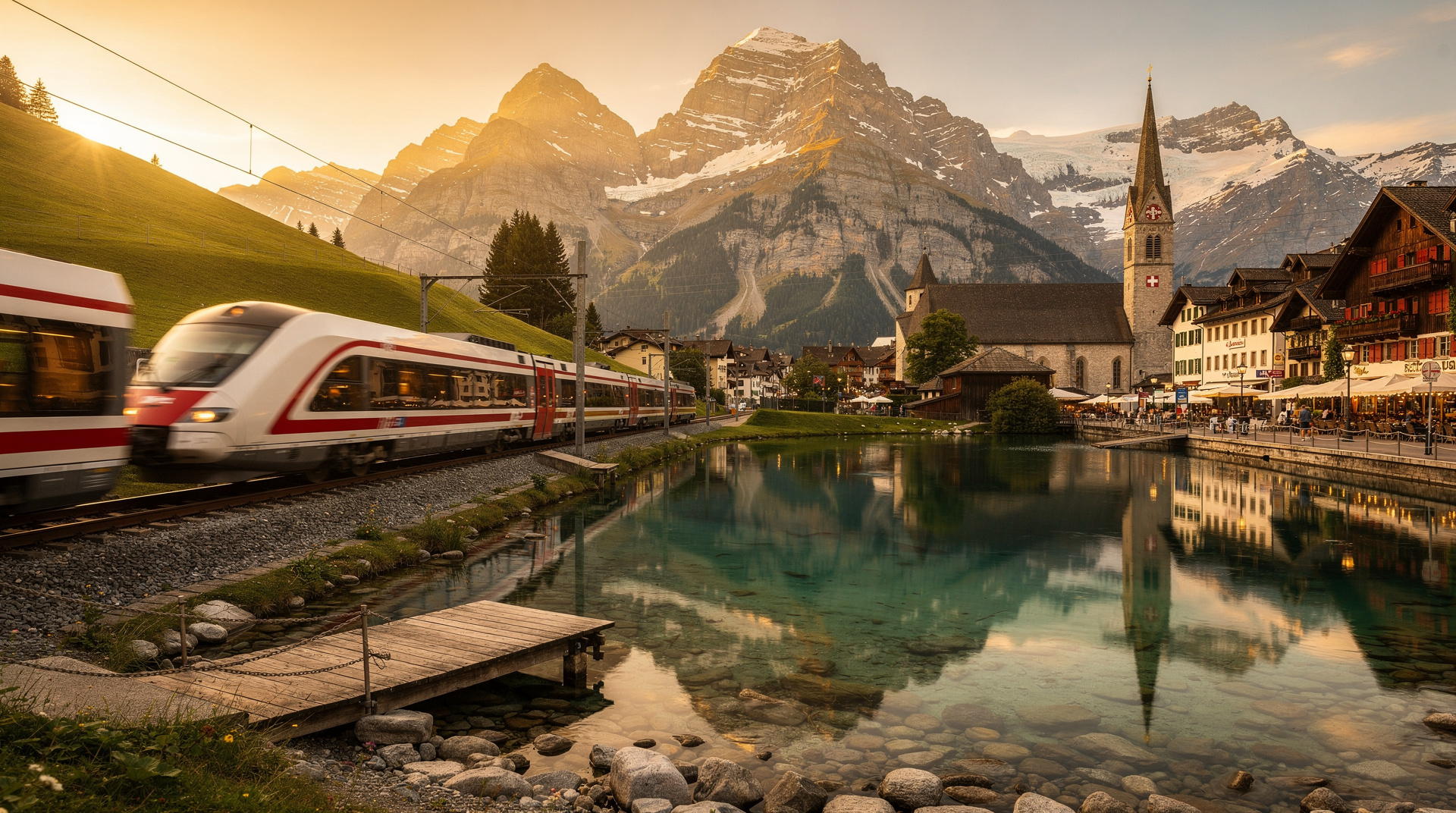
The Bernina Express from St. Moritz to Tirano (Italy) and then by postbus to Lugano is one of the greatest railway journeys on earth — a UNESCO World Heritage Line that crosses the Bernina Pass at 2,253 metres, negotiates spiral viaducts, and descends 1,800 metres from Alpine snowfields to the subtropical palm trees of the Italian border in under three hours.
The most dramatic section is between Pontresina and Tirano: the Montebello Curve and Bernina Lagalb with the Morteratsch Glacier backdrop, the Diavolezza panorama, the Alp Grüm spiral, and then the Brusio circular viaduct (a perfect stone circle 360-degree loop to control the gradient). Seat reservations are required (CHF 13-33 depending on class). The Swiss Travel Pass covers the Swiss section; the Italian section requires a separate supplement.
From Tirano, the postbus to Lugano (about 2 hours through Como and the Italian lakes) is dramatic in a completely different way — tropical vegetation, deep-blue lake water, and the terracotta towns of northern Lombardy.
Book your Bernina Express seat reservation — UNESCO World Heritage railway →Accommodation: 2 nights Lugano.
Day 13: Lugano and Ticino
Lugano is Switzerland’s southernmost major city and feels entirely Italian: the piazzas, the gelato, the palm-lined promenades, and the mountains dropping directly into the deep blue of Lake Lugano. It is also specifically Swiss — orderly, well-maintained, with excellent public transport and museums.
Take the funicular to Monte San Salvatore (912 metres) for the panorama over the lake and the Ticino Alps, then the cable car to Monte Brè (933 metres) on the opposite side of the city. Between the two, walk the Via Lugano lakefront promenade from Paradiso to Gandria — the village of Gandria, accessible only by boat or a two-hour lakeside walk, is one of the most beautiful small villages in Switzerland.
Visit the Villa Favorita or the Museo d’Arte della Svizzera Italiana (MASI) in the afternoon. The market on Piazza della Riforma (Tuesday and Friday mornings) is worth timing your visit around.
Book a Lake Lugano cruise to the medieval village of Morcote →Day 14: Geneva — arrival and departure
Train from Lugano to Geneva via Bellinzona and the Gotthard BasePass tunnel (3 hours). The Gotthard tunnel, at 57 kilometres the longest railway tunnel in the world, connects Ticino to German-speaking Switzerland in 17 minutes — a journey that once took a full day over the mountain pass.
Arrive in Geneva in time for a final afternoon. Walk the old town, see the Jet d’Eau and the Reformation Wall, and visit the Palais des Nations if you have booked a tour. Geneva Airport is 15 minutes from Cornavin station by direct train.
Practical information
Transport planning
The Swiss Travel Pass (15 consecutive days) covers this entire itinerary. In 2026 it costs approximately CHF 490 per adult. It covers all regular trains, the Lucerne-Alpnachstad boat (Pilatus round trip), lake boats in Lucerne, Interlaken, and Lugano, and gives significant discounts on mountain railways.
What is extra: Glacier Express seat reservation (CHF 43 first class), Bernina Express seat reservation (CHF 33), Jungfraujoch pass-holder fare (approximately CHF 145), Matterhorn Glacier Paradise (25% off with pass, approximately CHF 75).
Advance bookings required
Book at least two to three weeks before travel: Jungfraujoch, Glacier Express, Bernina Express. Book six to eight weeks ahead for July/August travel.
Budget estimate (per person, 14 days)
- Swiss Travel Pass (15 days): CHF 490
- Mountain excursions: CHF 250-300
- Scenic train reservations: CHF 80
- Accommodation (14 nights, mid-range): CHF 2,200-3,200
- Food (CHF 65/day): CHF 910
Total per person (excluding flights): CHF 4,000-5,000
See the budget Switzerland guide for strategies to reduce accommodation costs. For a fully immersive experience including every region and every major scenic train, the 21-day itinerary adds Appenzell, the Jura, and the GoldenPass line.
How Switzerland’s four regions feel different
One of the most remarkable things about spending two weeks in Switzerland is experiencing how dramatically the country changes as you cross linguistic and geographic boundaries. For many visitors this is the biggest surprise of a Swiss trip.
German-speaking Switzerland (Zurich, Lucerne, Bern, Interlaken) is what most people picture: the dairy-farming landscape, the tidy villages with window boxes, the efficient trains, the reserve and correctness of the people. It is northern European in its sensibility — orderly, reliable, somewhat formal — and the mountains feel owned and managed in a way that reflects centuries of farming and tourism infrastructure.
The Valais (Zermatt, Saas-Fee, Verbier) is a region apart — a dry, sun-baked valley running east-west through the highest Alps, bordered by Italy to the south. The local culture is Alalic (an old Franco-Provençal dialect is still spoken in some villages), the wine is different from anything else in Switzerland, and the mountains are wilder and more vertical than in the Bernese Oberland. Zermatt feels different from Grindelwald in the same way that a Valais red wine tastes different from a Zurich Riesling.
The Engadine and Graubünden (St. Moritz, Davos, the Bernina valley) are the land of Romansh — the fourth national language, spoken by only 50,000 people but given equal constitutional status with German, French, and Italian. The landscape here has a high, austere beauty very different from the lusher alpine valleys: the light is sharper, the winters longer, the villages built of grey granite rather than painted timber. The Bernina Express descends from this world into Italy with dramatic suddenness.
Ticino (Lugano, Locarno, Bellinzona) is unambiguously Italian in atmosphere — piazzas, gelato, campanile towers, and a relaxed outdoor culture that makes the canton feel like a sliver of Lombardy that somehow ended up in Switzerland. The contrast with Zurich, three hours away by train through the Gotthard tunnel, is genuinely startling and one of the great pleasures of a comprehensive Switzerland trip.
Day-by-day summary
| Days | Base | Highlight |
|---|---|---|
| 1-2 | Zurich | Old town, Kunsthaus, Rheinfall or Rapperswil |
| 3-4 | Lucerne | Chapel Bridge, Pilatus Golden Round Trip |
| 5 | Bern | Zytglogge, Bear Park, Federal Palace |
| 6-7 | Interlaken/Grindelwald | Jungfraujoch, Schilthorn, Lauterbrunnen |
| 8-9 | Zermatt | Sunnegga, Matterhorn Glacier Paradise, Gornergrat |
| 10-11 | St. Moritz | Glacier Express arrival, Engadine valley |
| 12 | Lugano | Bernina Express |
| 13 | Lugano | Monte San Salvatore, Monte Brè, Gandria |
| 14 | Geneva | Old town, Jet d’Eau, departure |
Frequently asked questions about 14 days in Switzerland
Is 14 days too long for a first trip to Switzerland?
Not if you enjoy a comprehensive trip — two weeks lets you add St. Moritz and Ticino to the classic German-Swiss and Valais route without rushing. If you would rather see less in more depth, or have less time, the 10-day itinerary is a good alternative built around the same core stops.
Which is more scenic, the Glacier Express or the Bernina Express?
Both are outstanding but different. The Glacier Express is the more famous journey through high alpine passes; the Bernina Express is a UNESCO World Heritage line and, for many travellers, the more dramatic of the two, descending from snowfields to subtropical Ticino in under three hours. This itinerary includes both so you do not have to choose.
The language question
Switzerland has four national languages but English is widely spoken in every tourist area, all train stations, and most hotels. In French-speaking regions (Geneva, Montreux, Lausanne), French-speakers appreciate basic French (“Bonjour”, “Merci”, “S’il vous plaît”) even if you continue in English. In Ticino, Italian is welcomed similarly. In the Engadine, a “Allegra!” (the Romansh greeting) will earn a warm smile from locals. In German-speaking regions, “Grüezi” (the Swiss German greeting) is more appropriate than “Guten Tag” (the German German greeting, which sounds formal to Swiss ears).
Switzerland has three currency regions (Swiss Francs everywhere, but in border areas euros are often accepted), but the standard recommendation is to carry francs — the exchange rate when paying in euros is typically unfavourable. The Swiss franc (CHF) is stronger than the euro and significantly stronger than the pound or dollar; this is the main driver of Switzerland’s expensive reputation. Budget accordingly and see the budget travel guide for practical cost-control strategies.