Solo Switzerland itinerary: 10 days travelling alone
Why Switzerland is perfect for solo travel
Switzerland is one of the best countries in the world for solo travel. It is extraordinarily safe (consistently ranked in the top three globally for personal safety), has a transport system so reliable and intuitive that navigation is almost foolproof, and has a hostel culture in its tourist towns — particularly Interlaken — that is genuinely social and welcoming to solo travellers. The challenge is not safety or logistics but cost: single-room supplements add up, and Switzerland’s prices are already high.
This itinerary is built around three principles: safety and simplicity (routes and accommodation are designed to minimise complexity for a solo traveller), social opportunities (the best hostels for meeting other travellers, the best structured tours for arriving somewhere with people already around you), and budget discipline (hostels over hotels, supermarket meals over restaurants, the Swiss Travel Pass for maximum value). It covers the same great destinations as the other itineraries — there is no need to miss anything in Switzerland because you are travelling alone.
| At a glance | |
|---|---|
| Route | Zurich → Lucerne → Bern → Interlaken → Lauterbrunnen/Grindelwald → Zermatt |
| Cost (excl. flights) | Around CHF 1,600-1,800 per person |
| Time needed | 10 days as written, though it can be trimmed to 7 by dropping Bern or one Zermatt day |
| Getting there | Fly into Zurich; the airport train drops you directly at the Hauptbahnhof |
| Best time | Late spring to early autumn, when hostels are fully open and free walking tours run daily |
Before you arrive: the solo traveller checklist
Download the SBB app before you board your first flight. It contains the complete Swiss rail timetable, real-time platform information, and can purchase tickets. You will not need to queue at a ticket window or speak to anyone to navigate the entire rail network.
Book hostels in advance for July and August. The best social hostels in Interlaken (Balmer’s Herberge, Funny Farm) and Zermatt fill weeks ahead in summer. Book even in shoulder season — the best beds go first.
Share your itinerary with someone at home and check in every two days. This is good practice anywhere; in Switzerland it is formality more than necessity.
Day 1: Zurich — solo arrival in a safe city
Zurich is the ideal entry point for a solo trip. The airport train runs every 10 minutes and deposits you at the Hauptbahnhof — one of the safest and most navigable main stations in Europe, with clear signage in English, well-lit platforms, and lockers for left luggage. The city centre is entirely walkable and safe at all hours.
Spend the first afternoon and evening walking the old town. The Fraumünster (Chagall windows), the Lindenhügel viewpoint, and the lake promenade are all best appreciated slowly and alone — there is no social pressure to keep pace with anyone, and the reflective quality of solo travel means you will notice things in a group you would miss. Zurich’s old town is dense with detail.
For dinner alone, the Langstrasse district has dozens of restaurants where a solo diner at the bar is completely normal. Swiss people are reserved in the Germanic style — not unfriendly but not initiating conversation — so do not expect to make friends over a restaurant meal. Hostels are where that happens.
Accommodation: Youth Hostel Zurich (Mutschellenstrasse) or City Backpacker Hotel Biber in the old town (well-regarded for solo travellers, central location, good common areas).
Day 2: Lucerne — the most walkable city in Switzerland
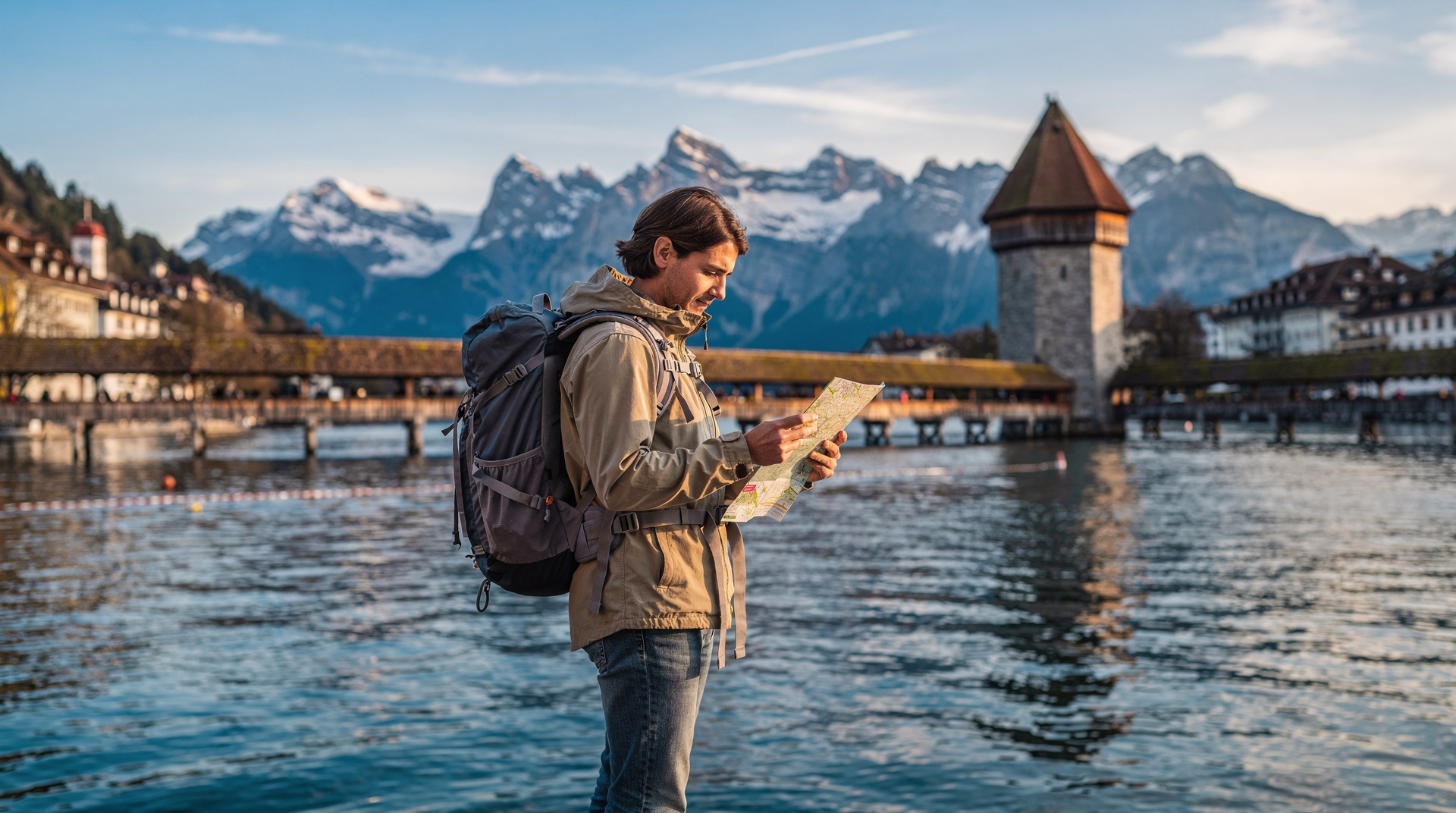
Train to Lucerne (45 minutes). Lucerne is ideal for solo travel because it is compact enough to understand quickly and beautiful enough that wandering without a plan produces constant rewards. The old town is a grid of streets and squares manageable in a single morning; the lakefront extends as far as you want to walk.
Join a free walking tour. Lucerne has several free walking tours (tip-based) that depart daily from the Chapel Bridge or the tourist office. These are one of the best tools available to solo travellers — they provide structure, context, and an immediate social group of other travellers. Guides are typically excellent. The tour takes two hours and covers the main old town sights with historical commentary.
Afternoon: the Lake Lucerne boat (Swiss Travel Pass covers it) to Weggis or Beckenried. On the boat, sitting at an outdoor table, solo travellers tend to fall into conversation naturally — the shared experience of a mountain lake and the open deck makes it easier than a restaurant.
The Pilatus excursion (Pilatus Golden Round Trip) is excellent solo — the cable car and rack railway put you in conversation-starting proximity to other visitors, and the summit is compact enough that you will share the terrace with everyone else up there.
Book the Pilatus Golden Round Trip — world’s steepest rack railway, great solo day →Accommodation: Youth Hostel Lucerne (on the lake, excellent location).
Day 3: Bern — the capital and a free afternoon
Train to Bern (1h 20min, covered by Swiss Travel Pass). The federal capital has a relaxed student population and a thriving cafe culture — Bern is one of the best Swiss cities for solo coffee shop afternoons.
Walk the covered arcades (Lauben) of the Altstadt — the entire old town is protected from rain by 6 kilometres of continuous arcaded walkways, which makes it wonderfully easy to explore regardless of weather. The Zytglogge animated clock tower, the Bear Park (free), and the Rose Garden viewpoint are the key free sights.
For a structured afternoon activity, the Gurten funicular (covered by Swiss Travel Pass) takes you to the hilltop park above the city where there is a miniature train and viewpoints. In summer, the Aare river swimming (free) near the Marzili lido is where Bern’s population congregates on warm afternoons — entirely safe, easily accessible, and a natural social environment.
Accommodation: Youth Hostel Bern or SOHO Hostel — both well-regarded for solo travellers with good common spaces.
Days 4-5: Interlaken — solo adventure capital
Train to Interlaken (50 minutes from Bern). This is the most social destination on any Swiss solo itinerary. The adventure tourism industry has created a hostel and activity culture in Interlaken that is probably the most naturally social in Switzerland — people arrive alone, join group activities, and leave with friends they have made over shared canyoning or paragliding. If you are open to it, you will not be alone here unless you choose to be.
Day 4 — settling in and Harder Kulm
Check into your hostel. Balmer’s Herberge is the legendary backpacker institution in Interlaken — it has an on-site bar, a social kitchen, a garden, and decades of experience hosting solo travellers. Funny Farm is similar in atmosphere. Both are excellent. Book at least a week ahead in summer.
Afternoon: Harder Kulm funicular (covered by Swiss Travel Pass) to the Two Lakes Bridge viewpoint. Walk the short ridgeline path and spend an hour watching the Eiger-Mönch-Jungfrau from 1,322 metres. In the evening, the hostel bar is the natural gathering point.
Book your Harder Kulm funicular ticket — the Two Lakes Bridge view →Day 5 — Jungfraujoch or a group activity
Option A — Jungfraujoch alone: Book the Jungfraujoch train and go at your own pace. The mountain railway puts you in proximity with other visitors (many of them solo travellers). At the summit, the compact space means you are always near other people. The experience of standing on the Aletsch Glacier alone is genuinely powerful.
Option B — group adventure: Book a group paragliding, canyoning, or rafting trip through one of the Interlaken adventure companies. These are inherently group activities — you will share the minibus to the launch site, the pre-flight briefing, and the post-activity high with a group of other travellers. See the adventure itinerary for details. Paragliding over the Bernese Alps is the signature Interlaken experience and in a group setting is an immediate social catalyst.
Book your Jungfraujoch solo ticket — the summit is small, you will meet others →Accommodation: 2 nights Interlaken (hostel).
Day 6: Lauterbrunnen valley — solo hiking day
Take the train to Lauterbrunnen and spend the day in the valley. The sheer glacial cliffs, the 72 waterfalls, and the flat valley floor are ideal for a solo walking day — the trails are extremely well-marked, the valley is linear and impossible to get lost in, and the scenery rewards contemplative walking alone more than conversation.
Walk from Lauterbrunnen village to Staubbach Falls (15 minutes), then to Trümmelbach Falls (45 minutes). The Trümmelbach Falls are inside the mountain — a series of glacier meltwater cascades carved through the limestone, accessed by an underground lift. The sound and scale of the water in the rock chambers is extraordinary and disorienting.
From Lauterbrunnen, take the cable car to Mürren and walk the Northface Trail (2 hours, well-marked) with constant views of the Jungfrau massif. Return to Interlaken or continue to Grindelwald for the night.
Day 7: Grindelwald and the Eiger
Train to Grindelwald (35 minutes from Interlaken). Spend the morning on the Grindelwald First plateau (gondola, 6 minutes) — the Cliff Walk and the walk to Bachalpsee lake are both excellent solo half-day walks. The views of the Eiger north face from Bachalpsee lake, the water perfectly reflecting the peak on a still morning, is one of those moments that solo travellers often describe as particularly intense.
The Glacier Gorge at the base of the Lower Grindelwald Glacier (CHF 7, 45 minutes) is a short, dramatic walk that is easy to navigate alone and good for photographs.
Book the Grindelwald First gondola — Eiger north face views, Cliff Walk →Return to Interlaken by late afternoon, collect bags, and catch the evening train toward Zermatt via Visp (about 2h 15min).
Accommodation: 2 nights Zermatt.
Day 8: Zermatt — the Matterhorn alone
Zermatt solo has a particular quality. The car-free village, the Matterhorn at the end of every street, the focused purpose of everyone here (either climbing, skiing, or looking at an extremely famous mountain) creates an atmosphere where solitude feels active rather than lonely.
Walk the village in the morning. The Matterhorn Museum Zermatlantis (CHF 10) is excellent for solo visitors — the story of the 1865 first ascent, the controversy, and the deaths on the descent is properly told here. The climbers’ churchyard outside is moving.
Take the Sunnegga funicular (50% off with Swiss Travel Pass) in the afternoon for the light on the Matterhorn. Walk to Stellisee lake (30 minutes) — a quiet spot with few visitors and the perfect Matterhorn reflection on still mornings.
The Matterhorn Glacier Paradise cable car is worth doing on Day 9 if budget allows.
Pre-book the Matterhorn Glacier Paradise — 25% off with Swiss Travel Pass →Day 9: Gornergrat and free afternoon
The Gornergrat rack railway (50% off with Swiss Travel Pass) to 3,089 metres gives a panorama of 29 four-thousand-metre peaks. The railway itself has a long history of bringing solo travellers and writers to the mountain — Mark Twain rode it, various Victorian poets wrote about it. On the way back down, walk from Riffelberg to Riffelalp (1 hour, marked trail) through alpine meadows with the Matterhorn views.
Free afternoon in Zermatt. Buy provisions for the train journey tomorrow, explore the back streets of the village above the main Bahnhofstrasse, or simply sit in a café with a coffee and the Matterhorn in front of you.
Day 10: Return and departure
Train from Zermatt to Zurich (about 3 hours via Visp) or Geneva (about 3 hours via Visp and Lausanne). Both are covered by the Swiss Travel Pass.
Geneva has a final-day advantage: the old town, the Jet d’Eau, and the airport connection (15 minutes from Cornavin) make it a natural endpoint. If flying from Zurich, the city rewards a final morning coffee by the lake before the airport train.
Practical information for solo travellers
Safety
Switzerland is one of the safest countries in the world. Violent crime is extremely rare. Petty theft (pickpocketing in crowds) is the main risk and is very low by European standards. Standard precautions apply: keep your passport and cards in a body wallet or inside your hostel locker, do not leave bags unattended. Solo female travellers consistently report Switzerland as one of the most comfortable countries in Europe to travel alone.
Late-night safety: Swiss cities and towns are safe at night. Zurich’s Langstrasse district is the red-light area and can be rowdy on Friday and Saturday nights, but is not dangerous. Train stations are well-lit and patrolled. Follow normal common sense.
Meeting other travellers
The most reliable places to meet other solo travellers in Switzerland: adventure activities in Interlaken (canyoning, paragliding — group activities by nature), hostel common rooms and bars (Balmer’s in Interlaken, City Backpacker in Zurich), free walking tours (Lucerne, Zurich, Bern), and the Jungfraujoch train journey (the confined space naturally creates conversation).
Transport
The Swiss Travel Pass (10 consecutive days) costs CHF 445 per adult. The single-person cost is full price — there is no solo discount — but the value calculation works the same as for couples. See Swiss Travel Pass explained.
Budget breakdown (per person, 10 days solo)
- Swiss Travel Pass (10 days): CHF 445
- Jungfraujoch (pass rate): CHF 145
- Pilatus (pass discount): CHF 46
- Matterhorn Glacier Paradise (pass discount): CHF 75
- Accommodation (10 nights, hostel dorm): CHF 430-550
- Food (CHF 40/day, hostel kitchen + Coop): CHF 400
- Activities and entrance fees: CHF 80-100
Total per person (excluding flights): CHF 1,620-1,760
See the full budget guide for strategies. For a more structured social experience, the adventure itinerary based in Interlaken is an excellent complement to this solo route.
Hostel vs hotel: what solo travellers actually gain
| Hostel dorm | Budget hotel/Airbnb single | |
|---|---|---|
| Cost per night (2026) | Around CHF 40-65 | Around CHF 120-180 |
| Social contact | High — common kitchens, bars, organised events | Low — you interact with staff, not other travellers |
| Privacy | Low, shared room | Full |
| Best for | Interlaken, Zermatt, Lucerne (social-first legs) | Bern, quieter nights, or if you value a full night’s sleep after a long hiking day |
Most solo travellers on this route mix the two: hostels in Interlaken and Zermatt where the social scene is the point, and a private room in Bern or Lucerne where a quiet night matters more. See the best hikes guide for solo-friendly trail options and the safety guide for wider context on travelling alone in Switzerland.
Solo-friendly day trips worth adding
If you have an extra day or two, several nearby options extend naturally from this route without adding complexity: day trips from Bern cover easy half-day excursions if you base yourself there longer, while day trips from Lucerne suit a slower pace in the middle of the trip. Solo travellers heading toward Zermatt who want one more mountain fix before Zermatt itself should also read the Mount Pilatus guide, an easy half-day from Lucerne that pairs well with the free walking tour on Day 2.