© si, 2025, Fotografin: Sara Daepp
Multi-country itinerary: Switzerland, France, Italy, and Germany
Multi-country itinerary: Switzerland, France, Italy, and Germany in 14 days
Switzerland sits at the geographical heart of western Europe, bordered by France, Italy, Germany, Austria, and Liechtenstein. Its central position and the extraordinary quality of its cross-border transport links make it the natural hub for a multi-country Alpine itinerary. This 14-day plan combines the essential Swiss experiences with three cross-border excursions: Chamonix and Annecy in France, the Italian lakes via Tirano and Como, and the Black Forest in Germany. It is a route for travellers who want to see how the Alps shape four different nations and cultures — and who want to arrive home having done something genuinely comprehensive.
The Swiss Travel Pass covers all Swiss trains and gives discounts on mountain railways inside Switzerland. Cross-border trains are either covered by the pass (to a point) or require additional tickets — specifics are noted for each section. Book the Glacier Express and Bernina Express in advance; the cross-border buses are generally walk-up services.
At a glance
| Route | Zurich → Black Forest (DE) → Lucerne → Bern → Interlaken → Zermatt → Chamonix/Annecy (FR) → Geneva → Montreux → Tirano/Como (IT) |
| Duration | 14 days |
| Total budget (per person, excl. flights) | around CHF 3,800-4,800 |
| Key pass | Swiss Travel Pass, 14 days, plus separate French/Italian/German tickets |
| Countries visited | Switzerland, Germany, France, Italy |
| Best time to go | June or September for stable weather across all four countries |
Days 1-2: Zurich and Germany — the Black Forest
Day 1 — Zurich arrival
Land at Zurich Airport and spend your first afternoon in Zurich. The old town, the Fraumünster (Chagall windows), and the lake are the priorities. The Lindt Home of Chocolate museum at Kilchberg is a 20-minute S-Bahn trip and a perfect jet-lagged afternoon activity — engaging without being demanding.
Book your Lindt Home of Chocolate museum ticket →Accommodation: 1 night Zurich.
Day 2 — day trip to the Black Forest, Germany
The German Black Forest (Schwarzwald) begins just across the Rhine, about 90 minutes from Zurich by train via Basel. The fastest connection goes Zurich-Basel (55 minutes, covered by Swiss Travel Pass to Basel), then a local German train from Basel Bad Bf to Freiburg im Breisgau (45 minutes, requires German rail ticket or Eurail).
Freiburg im Breisgau is the capital of the Black Forest region — a medieval university city (founded 1457) with a remarkable Gothic Minster, a network of Bächle (open water channels running through the pedestrian streets), and easy access to the forest hills above. Take the Schauinsland cable car from Horben (bus from Freiburg) to 1,284 metres for a Black Forest hilltop walk and views across the Rhine plain to the Alps.
Alternatively, the Titisee (lake resort in the forest) or the village of Triberg (home to Germany’s highest waterfall) are two hours from Basel by local train. The Black Forest is the origin of cuckoo clocks, Black Forest cake (Schwarzwälder Kirschtorte), and an entire tradition of German craft culture that contrasts interestingly with Switzerland across the river.
Return to Basel or Zurich for the night.
Days 3-4: Lucerne
Train from Zurich to Lucerne (45 minutes). Two days for the most beautiful medieval city in Switzerland.
Day 3 — Lucerne city
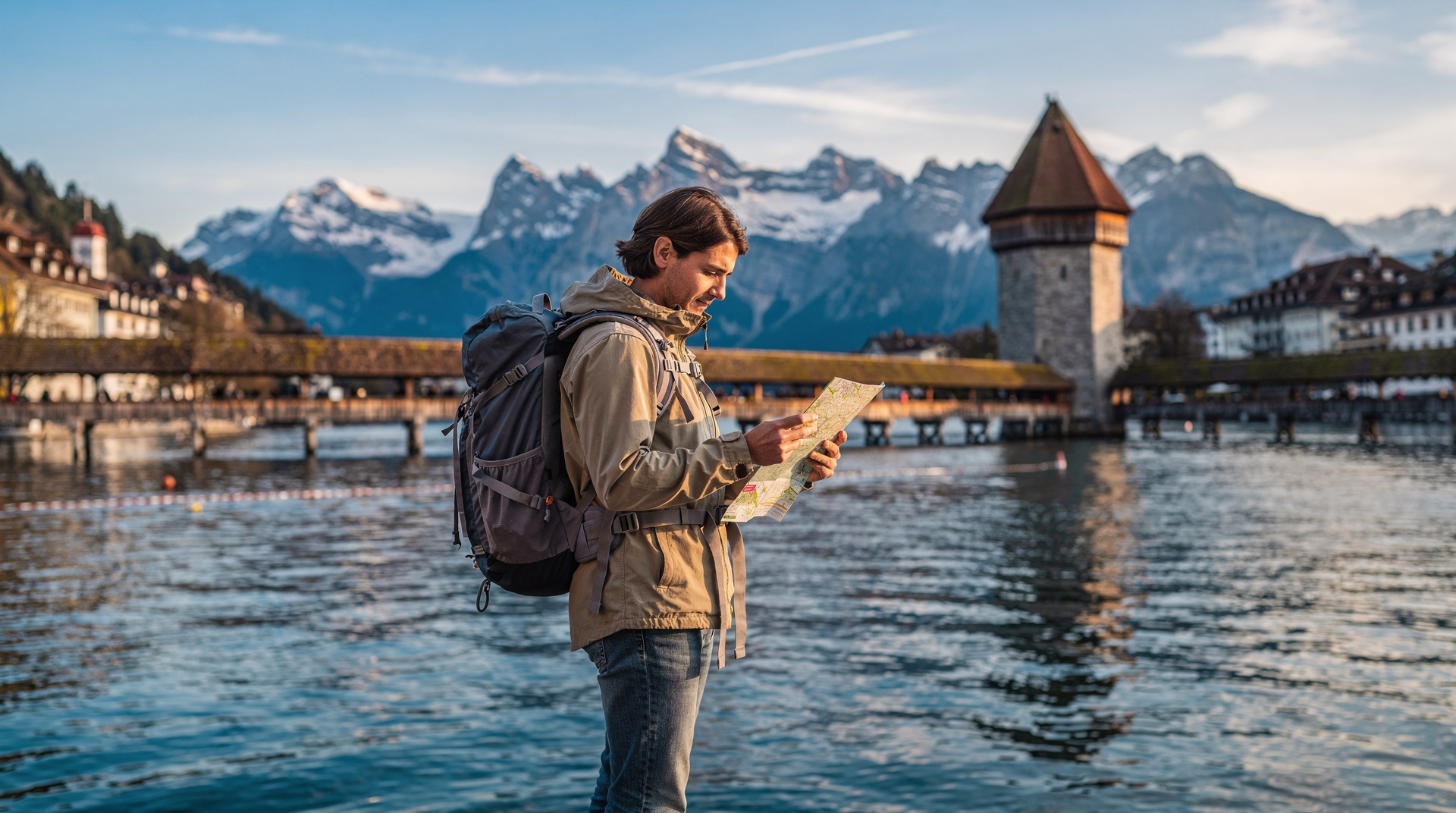
Chapel Bridge, Musegg Wall, old town, Swiss Museum of Transport. Lake boat in the afternoon.
Day 4 — Mount Pilatus
The Pilatus Golden Round Trip — boat to Alpnachstad, world’s steepest rack railway to 2,132 metres, cable car return. The full circuit takes four to five hours and is one of the great Swiss mountain excursions. Swiss Travel Pass gives 50% discount.
Skip the queue — pre-book the Pilatus Golden Round Trip →Accommodation: 2 nights Lucerne.
Day 5: Bern — the medieval Swiss capital
Train to Bern (1h 20min). The covered arcades, the Zytglogge tower, the Bear Park, the Rose Garden viewpoint, and the Federal Palace make for an excellent full day. Walk the Aare peninsula — the entire Altstadt sits on a dramatic natural promontory almost completely encircled by the river.
Evening train to Interlaken (50 minutes).
Days 6-7: Interlaken and the Jungfraujoch
Day 6 — Jungfraujoch
Jungfraujoch train to 3,454 metres — the top of Europe and the most impressive single Swiss excursion. Early morning departure from Interlaken Ost. Descent via Lauterbrunnen.
Book your Jungfraujoch ticket — Top of Europe railway sells out weeks ahead →Day 7 — Grindelwald and the Eiger
Train to Grindelwald (35 minutes). Grindelwald First gondola to 2,168 metres, the Cliff Walk, and Bachalpsee lake. The north face of the Eiger close enough to count the ice gullies.
Book the Grindelwald First gondola and mountain adventure ticket →Accommodation: 2 nights Interlaken.
Day 8: Zermatt and the Swiss Alps
Train to Zermatt via Spiez and Visp (2h 15min). Spend the afternoon walking the car-free village and taking the Sunnegga funicular for the Matterhorn in the afternoon light.
Matterhorn Glacier Paradise at 3,883 metres (highest cable car in the Alps) is the must-do in Zermatt. Book in advance; Swiss Travel Pass gives 25% off.
Reserve the Matterhorn Glacier Paradise — ice cave, 29 four-thousand-metre peaks →Accommodation: 1 night Zermatt.
Day 9: France — Chamonix and Mont Blanc
Cross-border day to Chamonix
The journey from Zermatt to Chamonix requires a combination of Swiss train and bus. Take the train from Zermatt to Martigny (1h 20min via Visp), then the narrow-gauge Mont-Blanc Express train from Martigny to Chamonix in France (about 2 hours). The Swiss section is covered by the Swiss Travel Pass; the French section from Vallorcine to Chamonix requires a separate French ticket (approximately €10-15).
Chamonix-Mont-Blanc sits at the foot of Europe’s highest peak — Mont Blanc at 4,808 metres — and is the mountaineering capital of Europe. The Aiguille du Midi cable car from Chamonix reaches 3,842 metres (approximately €60-70 round trip) and gives one of the most dramatic high-altitude panoramas accessible without climbing skills — the Mer de Glace glacier, the summit ridges of Mont Blanc, and on a clear day, the entire Swiss-French-Italian Alps in every direction.
The Mer de Glace itself — France’s largest glacier, accessible by the Montenvers rack railway from Chamonix (approximately €35 round trip) — is a worthwhile afternoon addition. The scale of the glacier and its dramatic retreat over the past century (marked by plaques on the cliff) is sobering.
Stay in Chamonix for the night or return to Martigny/Zermatt.
Accommodation: 1 night Chamonix, France (or return to Martigny, Switzerland).
Day 10: France — Annecy, the Venice of the Alps
From Chamonix, take the bus to Geneva (approximately 1.5 hours, operated by Ouibus or Flixbus, approximately €15-25) and from Geneva take the French TER train to Annecy (approximately 45 minutes, €10-15).
Annecy is one of the most beautiful towns in France — a medieval canal town (the Thiou river runs through the centre in a network of flower-lined channels) on the northern shore of the turquoise Lac d’Annecy. The old town, with its canal-side paths, the Palais de l’Isle prison island in the middle of the river, and the château above, is one of the finest medieval ensembles in the French Alps.
The Lac d’Annecy is considered the cleanest lake in Europe — the swimming and paddleboarding from the public beaches is excellent in summer. Walk the lakeside path from Annecy to Menthon-Saint-Bernard (5 kilometres) for the château on the cliff above the lake (Château de Menthon, which may have been the model for the Sleeping Beauty castle in Charles Perrault’s version of the fairy tale).
From Annecy, take the train to Geneva (45 minutes) for the night.
Accommodation: 1 night Geneva.
Day 11: Geneva and Montreux
Spend the morning in Geneva. The old town, the Reformation Wall, the Jet d’Eau, and the Palais des Nations (UN headquarters, guided tours by advance booking) give a full morning. The day trip from Geneva to Gruyères for cheese and chocolate is an option if you skipped it on a previous day.
Afternoon train to Montreux (45 minutes). Visit the Château de Chillon by lakeside walk (3 kilometres from Montreux, 40 minutes). The 13th-century fortress, Byron’s dungeon inscription, and the views of the Alps of Savoy across the lake make it the finest single historic monument in Switzerland.
Book your Château de Chillon ticket — no queue at Europe’s most romantic fortress →Accommodation: 1 night Montreux.
Day 12: Bernina Express — to Italy via the highest Alpine pass railway
From Montreux, take the GoldenPass train to Zweisimmen (regular train connection), then connect through Bern and Chur to St. Moritz — a long half-day of scenic rail. Alternatively, take the fast train Montreux-Lausanne-Bern-Chur-St. Moritz (approximately 4.5 hours).
In the afternoon, board the Bernina Express from St. Moritz to Tirano, Italy. The journey takes 2.5 hours over the UNESCO World Heritage railway — the Montebello Curve, the Diavolezza panorama, the Alp Grüm views, and the Brusio Circular Viaduct are all extraordinary.
Arrive in Tirano, Italy. The Basilica di Madonna di Tirano (1505), directly beside where the train arrives, is worth 30 minutes. Book the Bernina Express seat reservation well in advance.
Book your Bernina Express seat — UNESCO World Heritage railway over 2,253 metres →Accommodation: 1 night Tirano or Como, Italy.
Day 13: Italy — Lake Como and Varenna
From Tirano, take the regional train to Como via Lecco (approximately 2 hours, €15-20). Lake Como (Lago di Como) is one of the most beautiful lakes in Italy — deep, narrow, and fjord-like, with steep forested hills dropping directly into deep blue water and terracotta villages on the shores.
The town of Varenna on the eastern shore (accessible by ferry from Bellagio or by train from Lecco) is the finest of the lake towns for a short visit — the Villa Monastero and Villa Cipressi have exceptional lakeside gardens, and the Vezio Castle above the village gives a panorama of the entire lake.
Bellagio, the “pearl of the lake” on the central promontory where the lake divides, is the most famous of Como’s towns. The narrow streets, the terraced gardens, and the ferry service across the lake are worth an afternoon.
From Como, take the train to Milan Malpensa Airport (45 minutes) if flying home, or return to Zurich via the Gotthard Base Tunnel (Lugano-Bellinzona-Zurich, approximately 3 hours, covered by Swiss Travel Pass for the Swiss section).
Day 14: Return home
From wherever you spent night 13 — Tirano, Como, or Lugano — connect to your departure airport. The Swiss section of any return journey to Zurich or Geneva is covered by the Swiss Travel Pass.
If returning via Geneva, the Montreux-Geneva leg (45 minutes) allows a final lakeside morning before the airport train.
Practical information
Passes and tickets for this itinerary
- Swiss Travel Pass (14 days): CHF 490 per adult — covers all Swiss rail, lake boats, city transport, and mountain railway discounts.
- German rail (Black Forest day): approximately €30-50 for local trains from Basel.
- Chamonix (Aiguille du Midi): approximately €65 round trip — not covered by any pass.
- French trains (Geneva-Annecy, Annecy-Geneva): approximately €20-30 — not covered by Swiss Travel Pass.
- Bernina Express seat reservation: CHF 13-33 — required in addition to pass.
- Italian trains (Tirano-Como, Lecco-Milan): approximately €20-30.
The Swiss Travel Pass covers the vast majority of travel costs on this itinerary. Cross-border and foreign rail segments add approximately CHF 150-200 in additional tickets.
Visa requirements
For EU/EEA, US, Canadian, Australian, and most other nationalities: no visa required for Switzerland, France, Germany, or Italy (all Schengen area). A valid passport is required; UK citizens should check current requirements post-Brexit.
Budget estimate (per person, 14 days)
- Swiss Travel Pass (14 days): CHF 490
- Foreign rail and bus tickets: CHF 150-200
- Mountain excursions (Jungfraujoch, Pilatus, Matterhorn, Chamonix): CHF 350-450
- Accommodation (14 nights, mid-range mix): CHF 2,000-2,800
- Food (CHF 60/day, mix of countries): CHF 840
Total per person (excluding flights): CHF 3,830-4,780
For Switzerland-only alternatives, the 14-day Switzerland itinerary covers more Swiss destinations in the same time frame. For the full Switzerland experience before branching out, start with the 7-day classic itinerary to establish your baseline.
Cross-border logistics: what to know
Currency across four countries
You will use Swiss Francs (CHF) in Switzerland, Euros in France, Italy, and Germany. Switzerland does not use the euro but border areas often accept it at unfavourable exchange rates — withdraw francs from Swiss ATMs for Swiss expenses. The main border towns (Tirano, Chamonix, Annecy, Freiburg) operate in their local currencies. A multi-currency travel card (Revolut, Wise) is the most practical tool for this itinerary.
Mobile data
The Swiss Travel Pass includes no data roaming. Within Switzerland, Swiss SIM cards are relatively cheap (CHF 10-20 for a 10-day data SIM at Coop or Lidl). Within the EU (France, Italy, Germany), EU roaming rules mean that EU SIM cards work across all three countries at your home rate. If your home SIM has EU roaming, it will cover France, Italy, and Germany but not Switzerland — plan accordingly with a local Swiss SIM or an international eSIM.
Border crossings
All borders on this itinerary are Schengen internal borders — there are no passport checks for EU/EEA citizens and most other nationalities. For UK and other non-EEA citizens, your passport may be checked at some border crossings even within Schengen. Always carry your passport. The Swiss-Italian border at Tirano is one where checks occasionally occur.
Train ticket systems across countries
- Switzerland: SBB app or Swiss Travel Pass
- France: SNCF app or European rail booking sites
- Italy: Trenitalia or Italo apps
- Germany: DB (Deutsche Bahn) app
Each country has its own ticketing system. The Swiss Travel Pass covers only Swiss territory. A Eurail Global Pass can be a useful supplement for this itinerary — it covers trains in all four countries but does not always include high-speed trains or require additional seat reservations. Calculate carefully: for 14 days with 3-4 days in non-Swiss countries, point-to-point foreign tickets are often cheaper than the Eurail supplement.
Why Switzerland is the ideal hub for this itinerary
Geneva sits 45 minutes from Lyon and 1.5 hours from Annecy by train. Zurich is 1 hour from Stuttgart and 3 hours from Munich. Lugano is 1 hour from Milan by train. Zermatt is 3 hours from Turin via Visp and Aosta. Switzerland’s position at the centre of western Europe, combined with its outstanding rail infrastructure, makes it the natural hub for any multi-country Alpine trip. No other country gives you this quality of access to four distinct national cultures and mountain ranges within a single rail pass area.
Frequently asked questions about Multi-country itinerary
Does the Swiss Travel Pass cover the France, Italy, and Germany legs of this trip? No. The pass covers Swiss rail, lake boats, and city transport only. Each cross-border leg (Basel-Freiburg, Martigny-Chamonix, Geneva-Annecy, Tirano-Como) needs a separate local ticket, typically in the €10-30 range per leg. Budget approximately CHF 150-200 in total for these add-on tickets across the 14 days.
Is this itinerary too rushed with four countries in 14 days? It moves briskly by design — most non-Swiss stops are single overnight visits rather than multi-day stays. Travellers who prefer to go deeper into fewer places should consider the 14-day Switzerland-only itinerary instead, which keeps the same duration but stays within one country and one rail pass.