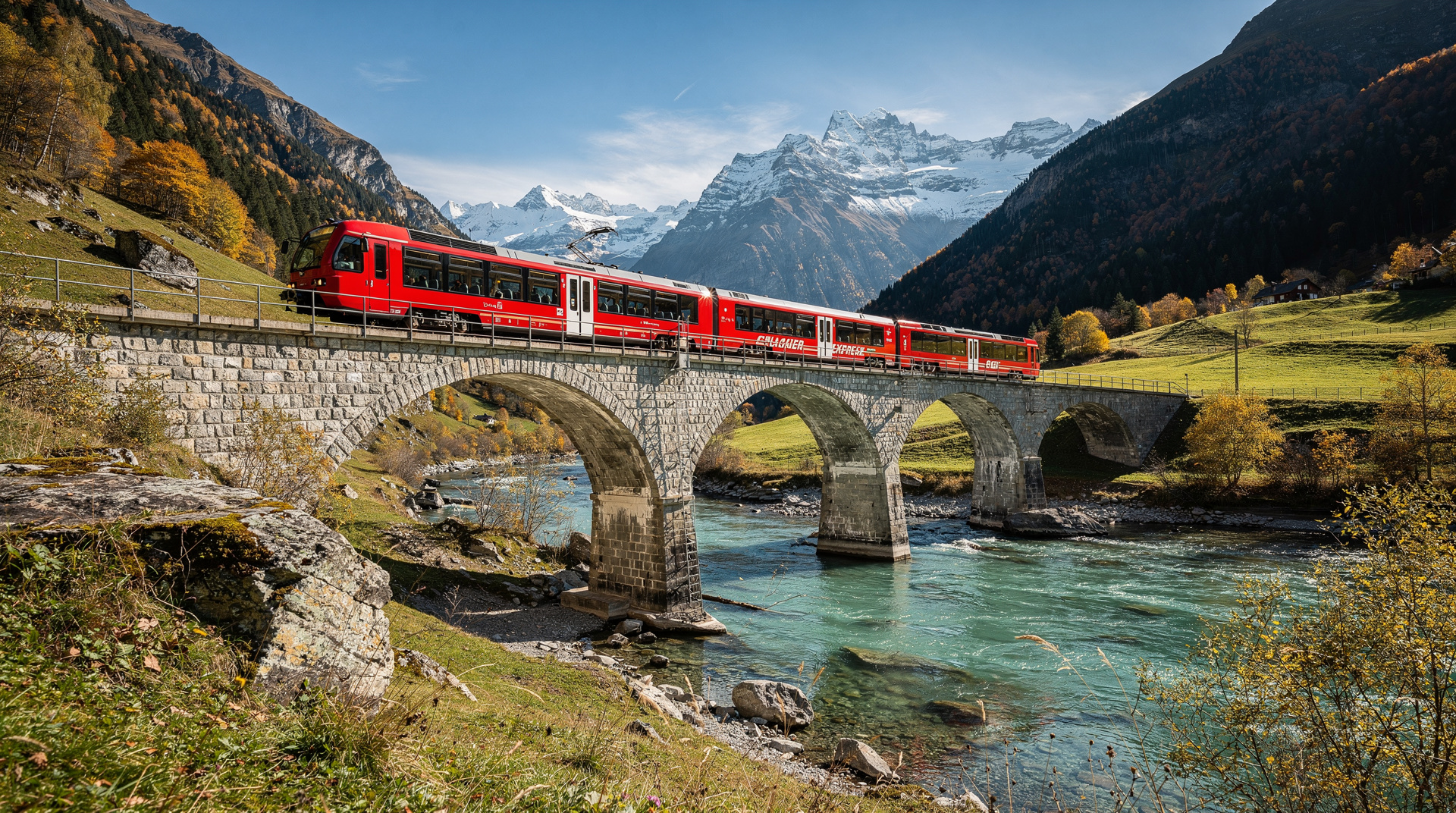
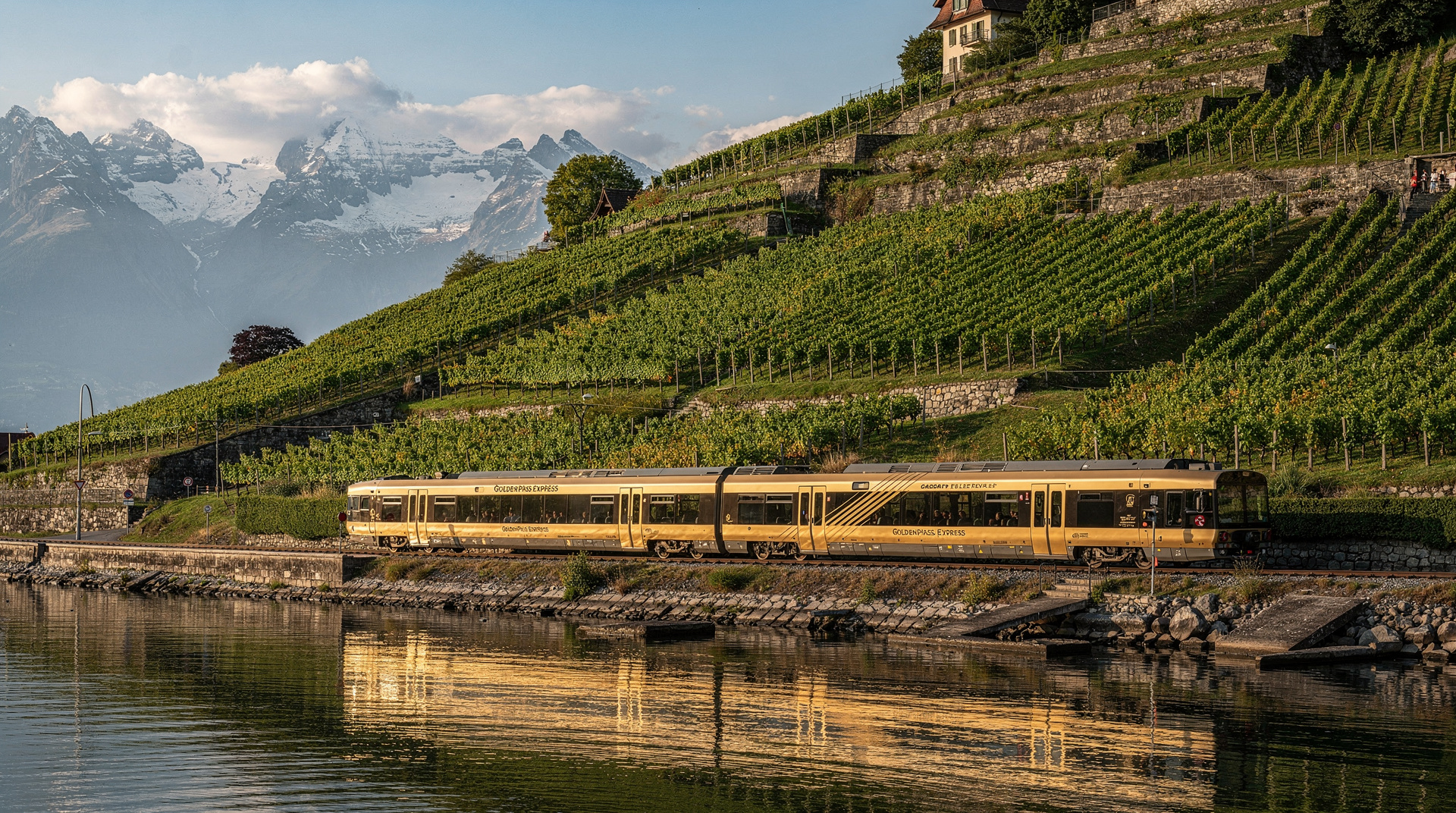
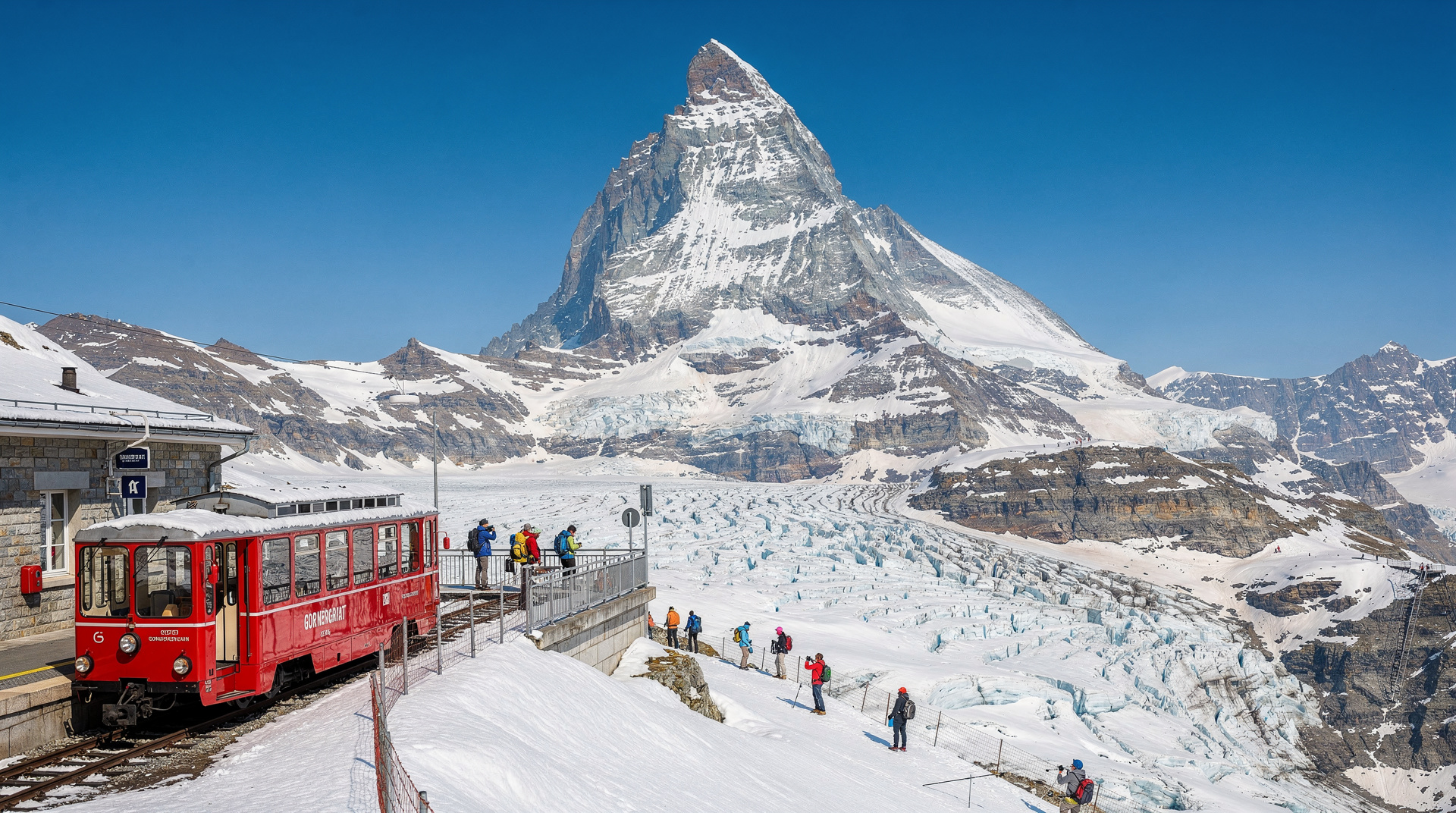
© RhB, 2018, Fotograf: Christoph Benz
Bernina Express: route, tickets, and tips
Is the Bernina Express worth it?
Yes. The Bernina Express is a UNESCO World Heritage route with dramatic scenery including the Landwasser Viaduct, and it crosses into Italy. Ticket and seat reservation are both required; see rhb.ch for current fares.
What is the Bernina Express?
The Bernina Express is a panoramic train that runs between St. Moritz in Switzerland and Tirano in northern Italy, crossing the Bernina Pass at 2,253 metres — the highest railway crossing in the Alps that operates year-round without entering a tunnel. The entire Rhaetian Railway line on which it runs is a UNESCO World Heritage Site, awarded that status in 2008 for its extraordinary engineering achievements: spiralling loops, dramatic viaducts, and a gradient of up to 70 per thousand, all without rack-and-pinion assistance.
The journey takes approximately 2.5 hours for the train-only section, or longer if you take the connecting bus from Tirano toward Lugano. Compared to the 8-hour Glacier Express, the Bernina Express is compact, punchy, and arguably offers more scenery per hour than any other train in the Alps. Many travellers rank it as the single best scenic train in Switzerland — and the argument is a strong one.
At a glance
| Where | St. Moritz in the Engadin to Tirano, Italy, via the Bernina Pass |
| Cost | ticket plus required seat reservation (see rhb.ch for current fares); regional trains cheaper, reservation optional (CHF 5 per person and route) |
| Time needed | around 2.5 hours train-only, or a full day with stops and the Lugano bus extension |
| Getting there | direct rail from Zurich or Chur to St. Moritz; the Swiss Travel Pass covers the Swiss portion |
| Best time | June to September for full access and clear passes; October for larch colour with fewer crowds |
The UNESCO World Heritage route explained
The Rhaetian Railway’s Albula and Bernina lines were inscribed together on the UNESCO World Heritage List. The citation highlights three things: technical mastery (the railway was built between 1904 and 1910 using only pre-electric construction methods), landscape integration (the line follows natural valley contours rather than blasting straight through mountains), and ongoing cultural significance (the railway has shaped settlement patterns in Graubunden for over a century).
The Bernina Express travels the Bernina Line section of this heritage route. Every bridge, tunnel, and curve you cross on this train has been deemed irreplaceable by UNESCO. That context matters when you are looking out of the panoramic windows — what you are seeing is not just beautiful, it is globally significant.
The full route
St. Moritz to Tirano: key stops and timings
The standard morning departure from St. Moritz operates around 09:32, arriving Tirano at approximately 12:25. An afternoon departure runs around 14:00, arriving Tirano around 16:49. Times shift seasonally — check the Rhaetian Railway website for your exact travel date.
St. Moritz (1,775m): The journey begins in Switzerland’s most glamorous mountain resort. The station sits above the frozen lake in winter; in summer the lake is deep blue. The train heads south-east through the upper Engadin Valley.
Pontresina (1,774m): First stop, 10 minutes from St. Moritz. A quieter alternative base for the Bernina region, popular with hikers and cross-country skiers. The Morteratsch Glacier can be reached by foot from here.
Morteratsch (1,896m): The train passes close to the Morteratsch Glacier, one of the Engadin’s most dramatic ice masses. Marker stones along the valley floor show how far the glacier has retreated since the 1880s — a sobering and visible record of climate change. A 30-minute walk from the small station platform takes you to the current glacier front.
Bernina Suot / Pontresina junction area: The train begins its ascent. Gradient increases noticeably.
Ospizio Bernina (2,253m): The summit of the pass and the highest point of the journey. Lago Bianco (White Lake), straddling the European watershed between the Rhine and the Po, sits alongside the track. The landscape here is austere and lunar — stripped of trees, entirely alpine. Even in July there are often patches of snow.
Alp Grum (2,091m): Possibly the most dramatic single viewpoint on the entire route. The station sits at the edge of a cliff, and from the platform on a clear day you can see across the Poschiavo Valley deep into Italy. The temperature can drop by 15 degrees compared to Tirano in the valley below. A restaurant at the station serves food — worth stepping off if the train stops long enough.
Poschiavo (1,014m): The principal town of the Italian-speaking Val Poschiavo, still in Switzerland. The old town has Spanish-style architecture — descendants of 18th-century emigrants to Spain returned home with their fortunes and built accordingly. The train winds down through the village at a remarkably tight curve.
Le Prese and Miralago: Two stations on the shore of Lago di Poschiavo, a warm-water lake that sits 1,000 metres below the alpine pass. Swimming in summer. The contrast with Ospizio Bernina, reached just 40 minutes earlier, is startling.
Brusio (780m): Home of the famous Brusio circular viaduct — a spiral loop in which the train makes a 360-degree turn to lose altitude while staying within a confined valley. You can see the entire circle from the windows. It is one of the most photographed railway structures in the world.
Tirano (429m): The Italian border town where the journey ends. Technically in Italy, Tirano requires no passport control from Switzerland (both countries are in the Schengen Area). The town has a famous 16th-century pilgrimage basilica (Madonna di Tirano) directly next to the station. Time for a coffee and a look around before returning.
Ticket prices 2026
Train tickets (St. Moritz to Tirano, one way)
| Ticket type | Price |
|---|---|
| Panorama 2nd class | See rhb.ch for current fares |
| Panorama 1st class | See rhb.ch for current fares |
Seat reservation
On the Bernina Express panoramic train, both a ticket and a seat reservation are required, and Swiss Travel Pass holders can book the seat reservation only. On the regional trains of the Bernina Line, a seat reservation is optional but recommended (CHF 5.00 per person and route). See rhb.ch for current reservation fees.
Bus extension to Lugano
A connecting Bernina Express bus runs from Tirano to Lugano, passing through the Valchiavenna and along Lake Como. This adds approximately 3.5 hours to the journey and has its own fare (see rhb.ch for the current price). The bus extension makes the journey a full cross-Alps experience from the Engadin to Lake Lugano, and is particularly popular as a one-way routing that avoids backtracking.
Booking your tickets
Book directly via the Rhaetian Railway website (rhb.ch) or SBB, or through GetYourGuide:
- Bernina Express panorama train ticket — St. Moritz to Tirano
- Bernina Express — Tirano to St. Moritz (reverse direction)
Book at least 3–4 weeks ahead for July and August travel. Other months are less pressured but weekends can still be busy.
Swiss Travel Pass coverage
The Swiss Travel Pass covers the Swiss portion of the Bernina Express (St. Moritz to the Italian border at Campocologno) at no additional cost. The small section from the border into Tirano is technically in Italy and not covered by the pass, but in practice the ticket price for this segment is minimal and often included in the through-ticket purchased alongside the pass.
The required seat reservation is not covered by the Swiss Travel Pass and must be booked separately (see rhb.ch for current fees).
The Bernina Express counts as one travel day on a Swiss Travel Flex Pass.
Best seats on the Bernina Express
Travelling St. Moritz to Tirano: sit on the left side of the train. The Brusio circular viaduct is most visible from the left side heading south. The descent into the Poschiavo Valley also opens up on the left.
Travelling Tirano to St. Moritz: sit on the right. The viaduct appears on the right ascending northward, and the views up toward the pass are outstanding on the right side approaching Alp Grum.
Both directions: The panoramic windows extend nearly to ceiling level, so views from any seat are good. The key is choosing a window seat rather than an aisle seat, and ensuring you are not stuck behind a pillar. The Bernina Express uses Rhaetian Railway panorama cars with generous window spacing — pillars are narrower than on older rolling stock.
Table seats vs individual seats: Table configurations (four seats around a small table) are popular with families and groups. Individual pairs of seats facing forward or backward are preferable for solo travellers who want an unobstructed forward-facing view.
Panorama cars vs standard cars
Rhaetian Railway runs two types of rolling stock on the Bernina route:
Panorama cars: The premium stock used specifically for the Bernina Express service. These have large curved windows extending into the roof, providing dramatic sky views at Ospizio Bernina and over the viaducts. The required reservation guarantees you a seat in these carriages.
Standard cars: Used on regular regional trains (numbered services, not the designated Bernina Express). The windows are smaller and the experience is more functional. These trains run the same route at lower prices without a surcharge — a legitimate budget option that many in-the-know travellers use.
If budget is tight, take the regular regional service. The route is identical. You lose the panoramic ceiling windows but gain significant savings. Seat reservations are not required on the regional service.
What to see along the way: the highlights
Landwasser Viaduct
The Landwasser Viaduct is perhaps the single most iconic railway structure in Switzerland. The six-arch stone viaduct curves gracefully in an arc and disappears directly into a cliff face — no approach road, no turning, just the viaduct and then the mountain. At 65 metres high and 136 metres long, it is relatively modest in scale but extraordinary in design.
The Bernina Express crosses the Landwasser Viaduct as part of its route through the Albula Valley (the northern section). If you are travelling the full Albula-Bernina routing (from Chur or Thusis via Filisur), you will cross it. If boarding at St. Moritz, you miss this specific viaduct — it lies north of the Bernina Express’s St. Moritz origin.
However, the Brusio circular viaduct, exclusively on the Bernina route, more than compensates.
Morteratsch Glacier
Visible from the train between Pontresina and the pass, the Morteratsch Glacier is one of the most accessible major glaciers in the Alps. The tongue of ice has retreated dramatically — marker posts in the valley date the glacier’s position every decade since the 1880s, and the retreat is visible over hundreds of metres. It remains impressive and vast from the train window, particularly in spring when snow cover is still significant.
The Brusio spiral viaduct
Unique in world railway engineering, the Brusio circular viaduct allows the train to descend a steep gradient within a narrow valley by completing a full 360-degree loop. As the train curves through the viaduct, you can look across the curve and see the locomotive of your own train from the rear carriages. It takes about 90 seconds to traverse. You will want your camera ready.
Alp Grum viewpoint
Even if the train only stops briefly at Alp Grum, step out onto the platform on the Italian side of the station. The view south across the Poschiavo Valley — vineyards, a palm-lined lake, Italian villages — visible from a perch above 2,000 metres is one of the most dramatic geographical transitions in Switzerland. The restaurant at Alp Grum has been feeding travellers since 1899.
Combining the Bernina Express with the Glacier Express
The classic multi-day itinerary runs both trains in sequence: the Glacier Express from Zermatt to St. Moritz (one day), then the Bernina Express from St. Moritz to Tirano (the following morning). From Tirano you can return by the bus extension to Lugano, or by Italian train toward Milan, or reverse back to St. Moritz and fly home from Zurich.
This combination covers the full breadth of the Swiss Alps in two memorable days of train travel. See our 7-day Switzerland itinerary for how to fit both trains into a broader trip, and our Glacier Express vs Bernina Express comparison if you can only choose one.
Practical tips
Tip 1 — Take the morning departure from St. Moritz. Afternoon clouds can build over the Bernina Pass by midday in summer, and the morning light on the glaciers is superior. The 09:32 departure from St. Moritz arrives Tirano at 12:25, leaving the afternoon free in Italy.
Tip 2 — Get off at Alp Grum. Take a later Bernina Express or regional train if you want to spend 30–60 minutes at Alp Grum. The hike down from Alp Grum to Poschiavo through the alp is beautiful in summer and takes about 2.5 hours.
Tip 3 — Dress in layers. The temperature difference between Tirano (often 25–30°C in summer) and Ospizio Bernina (often 5–10°C) is stark. You will be cold at the pass and possibly hot at the start and end. Pack a jacket even in August.
Tip 4 — Check for the Trenino Rosso del Bernina. The ordinary Rhaetian Railway regional service (not the Bernina Express panorama service) runs the same route and is cheaper. Locals call it the Trenino Rosso (Little Red Train). Reservation optional, smaller windows, but identical views. Use this option on days when the panorama service is fully booked.
Tip 5 — Consider the reverse direction. The ascent from Tirano to St. Moritz provides a different perspective — you are climbing up through the valley rather than descending, and the Brusio viaduct looks slightly different from below. If you are based in Lugano or Italian-speaking Switzerland, starting from Tirano is equally logical.
Tip 6 — Use the bus extension to Lugano. If you want a one-way journey without backtracking, the Bernina Express bus from Tirano to Lugano is one of Switzerland’s most underrated scenic routes, following the shores of Lake Como through Italian villages before crossing back into Switzerland.
Getting to St. Moritz
From Zurich: IC to Chur (1h10), then Rhaetian Railway to St. Moritz (2h). Total around 3h15.
From Milan: Train to Tirano (2h15), then Bernina Express to St. Moritz (2h30). A beautiful approach from the Italian side.
From Zurich Airport: Direct IC to Chur, then connection — around 3.5 hours.
Weather and seasonal considerations
Summer (mid-June to September): The best window for clear skies and access to all stops. Morteratsch walks, Alp Grum hikes, and Poschiavo warmth all at their best. High season — book early.
Autumn (October): The larches in the Engadin and around Pontresina turn vivid amber and orange. Morteratsch views are excellent on clear days. Fewer tourists, easier bookings.
Winter (December to April): The route runs year-round, which is itself an engineering achievement — the pass stays open thanks to careful track management and snowploughs. The winter landscape is striking. Ospizio Bernina is often buried in snow. Poschiavo and Tirano feel Mediterranean by comparison. A remarkable seasonal contrast.
Spring (May to June): Snow still present at altitude, but the lower valley flowers and the glaciers are dramatic. Can be quiet and rewarding.
The Bernina Express is shorter, cheaper, and more affordable than the Glacier Express, yet the scenery is arguably denser and more varied. For travellers choosing between the two, the Bernina Express wins on pure scenic intensity per hour. For the full Alpine crossing experience, the Glacier Express has no rival. Our detailed comparison guide breaks down both options across every decision factor.
Panorama service vs regional train: quick comparison
| Bernina Express (panorama) | Regional train (Trenino Rosso) | |
|---|---|---|
| Windows | Large, curved, extend to ceiling | Standard size |
| Reservation | Required | Optional (CHF 5 per person and route) |
| Price | ticket + required reservation (see rhb.ch) | Base fare only |
| Route | Identical | Identical |
| Best for | First-timers, photography, families | Budget travellers, repeat riders |
Hiking and stopover options along the line
Several of the stations on the Bernina line double as trailheads. From Alp Grum, a marked path descends through larch woods to Poschiavo in around 2.5 hours, dropping over 1,000m in altitude and giving close-up views the train itself only glimpses. From Ospizio Bernina, a shorter walk along Lago Bianco toward Diavolezza connects to further cable-car-served trails in the best hikes guide. Pontresina, at the start of the line, is also a base for glacier walks toward Morteratsch that pair well with an early Bernina Express departure the same day — see where to stay in Grindelwald style planning applies equally here: book your Engadin night before the peak-season train, not after.
If you are building a longer rail-based trip, the 21-day itinerary and the dedicated scenic trains itinerary both use the Bernina Express as a core day, usually paired with an Engadin or Ticino overnight.
Frequently asked questions about the Bernina Express
How long is the Bernina Express journey?
The train-only section from St. Moritz to Tirano takes approximately 2.5 hours. If you add the connecting Bernina Express bus from Tirano to Lugano, the total journey extends to about 6 hours. This is significantly shorter than the 8-hour Glacier Express and many travellers find the scenery more concentrated per hour.
Do you need to book the Bernina Express in advance?
Seat reservations are required on the Bernina Express panoramic train, as on the Glacier Express. In July and August the panorama cars fill completely, so booking 3-4 weeks ahead is strongly recommended for summer travel. Regional trains on the same line need no reservation, though one is recommended (CHF 5.00 per person and route).
Does the Swiss Travel Pass cover the Bernina Express?
The Swiss Travel Pass covers the base fare for the entire Swiss portion of the route (St. Moritz to the Italian border). The small section into Tirano is technically in Italy but the cost is minimal. The required seat reservation is not covered by the pass and must be purchased separately (see rhb.ch for current fees). The pass counts this journey as one travel day on a Flex Pass.
Which side should I sit on the Bernina Express?
Sit on the left side travelling from St. Moritz to Tirano for the best views of the Brusio circular viaduct and the descent into the Poschiavo Valley. Travelling in the reverse direction (Tirano to St. Moritz), sit on the right. The panoramic windows extend nearly to the ceiling, so views from any seat are good, but window seats are strongly preferable to aisle seats.
Is the Bernina Express better than the Glacier Express?
The two trains offer different experiences. The Bernina Express is shorter (2.5 hours vs 8 hours), cheaper, crosses into Italy, and arguably offers more scenic variety per hour. The Glacier Express covers a longer Alpine crossing with the Rhine Gorge and Oberalp Pass. Many travellers ride both on consecutive days, connecting at St. Moritz. If you can only choose one, the Bernina Express wins on pure scenic intensity per hour.
Can I take a regular train instead of the Bernina Express?
Yes, the ordinary Rhaetian Railway regional service (locally called the Trenino Rosso) runs the same route on the same tracks at lower prices and with only an optional reservation. The windows are smaller and there are no panoramic ceiling windows, but the views are identical. This is a legitimate budget alternative and useful when the Bernina Express is sold out.
For the full picture on planning your Swiss rail travels, explore our how to book scenic trains guide and the Swiss Travel Pass guide.