© Swiss Travel System AG, 2022, Fotograf: Tobias Ryser
GoldenPass Express: Montreux to Interlaken
What is special about the GoldenPass Express?
The GoldenPass Express is the first train to run directly from Montreux to Interlaken without changing trains, using a unique gauge-changing system. It offers Prestige class with extra-large panoramic windows.
What is the GoldenPass Express?
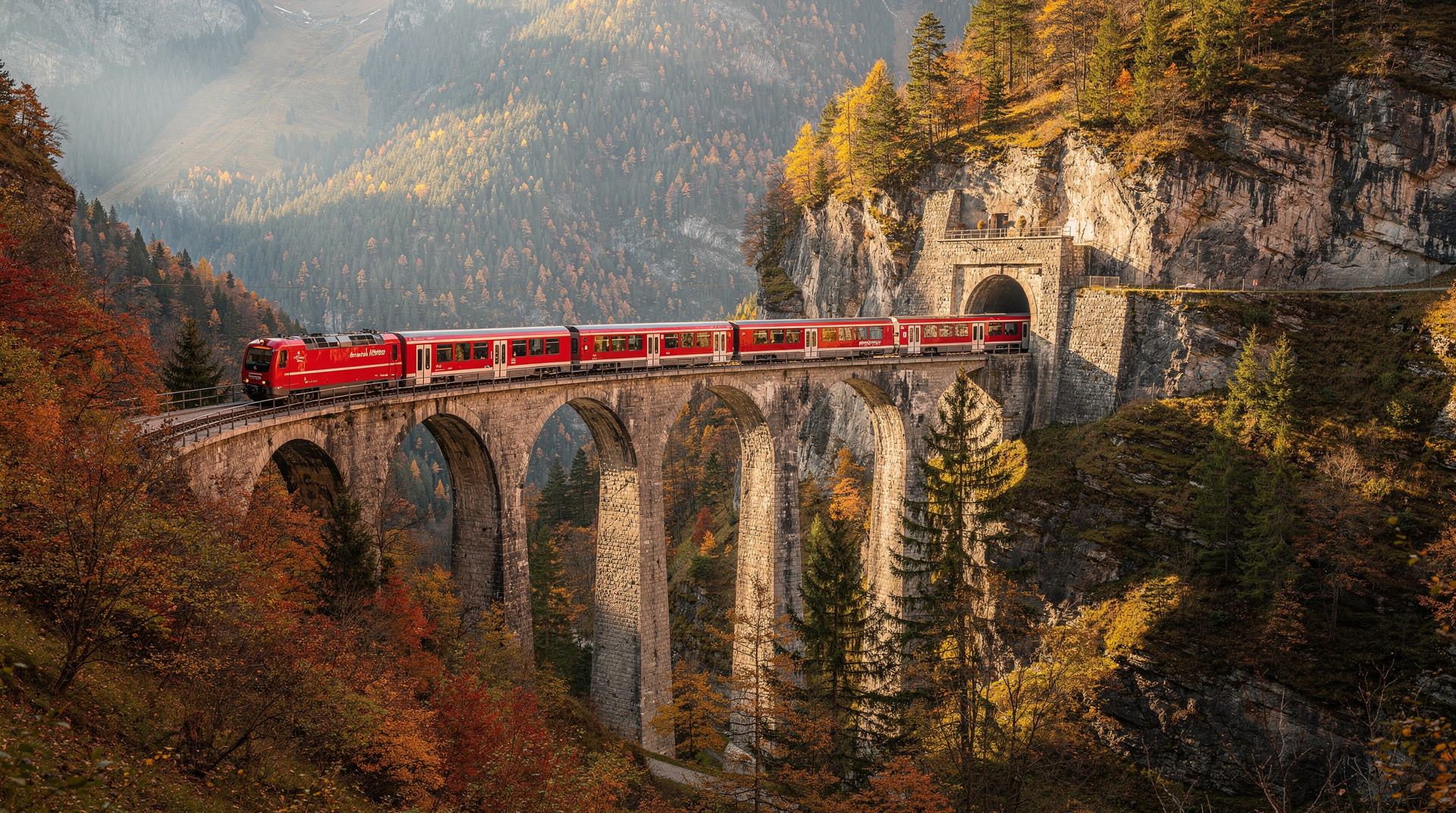
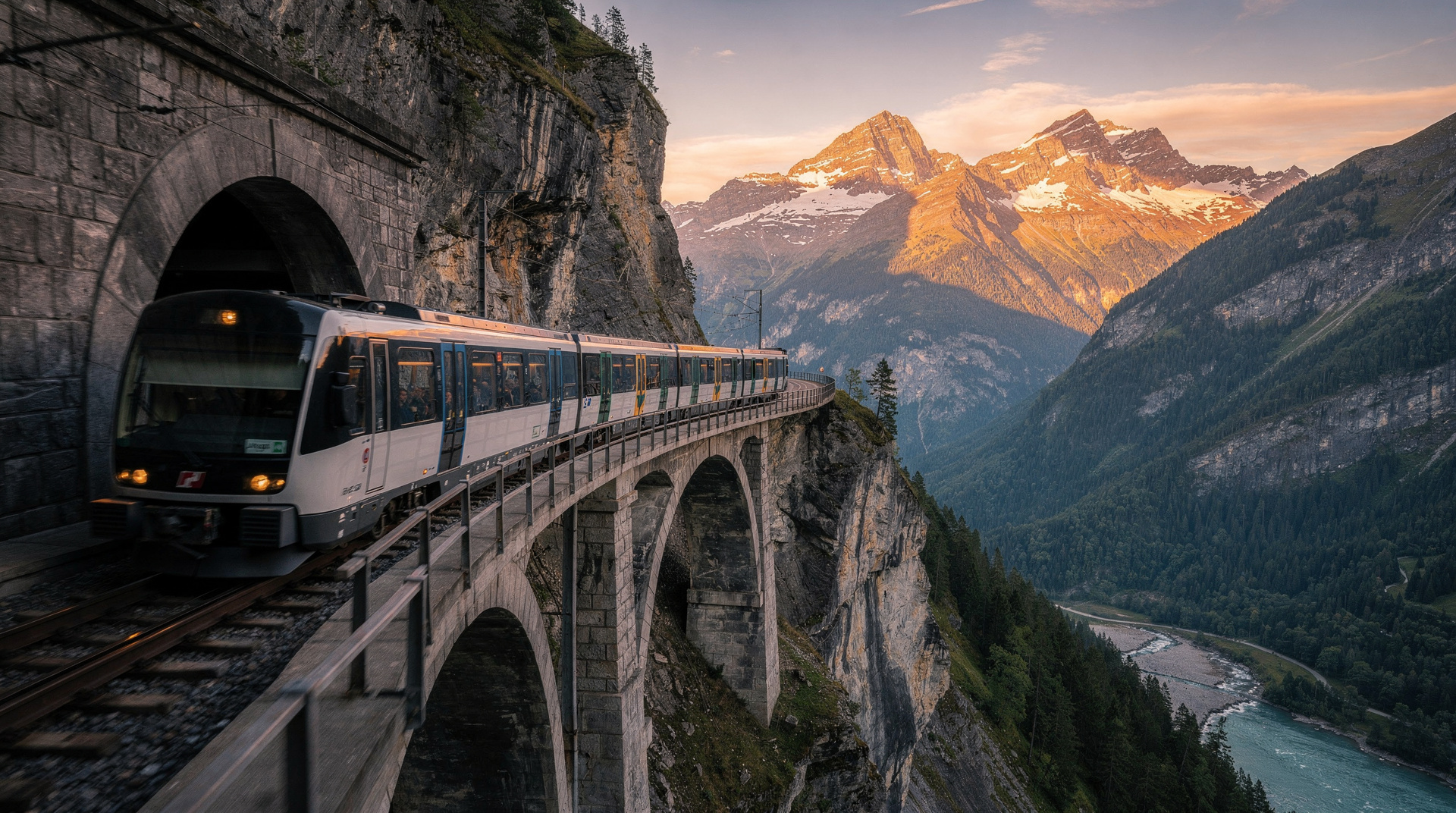
The GoldenPass Express is Switzerland’s newest scenic train route, launched in December 2022 after decades of planning. It runs between Montreux on Lake Geneva and Interlaken in the Bernese Oberland, a journey of around 3 hours through some of the most varied and beautiful landscapes in Switzerland. What makes it technically remarkable — and what makes it genuinely new despite the route existing for over a century — is that it now runs as a single through-train without requiring passengers to change trains at Zweisimmen.
The reason a change was previously necessary is that two different railway gauges exist on the route: the Montreux–Zweisimmen section uses metric gauge (1,000mm), while the Zweisimmen–Interlaken section uses normal metric gauge. Matching these required either a passenger change or an entirely new engineering solution. The GoldenPass Express uses the latter: special gauge-changing wheel sets that automatically adjust at the Zweisimmen junction, allowing the panoramic carriages to continue rolling through without interruption. Passengers stay seated. The view continues.
At a glance
| Route | Montreux to Interlaken (or reverse) |
| Duration | around 3 hours |
| Cost | roughly CHF 64-165 depending on class, plus a CHF 10-16 seat reservation (included in Prestige) |
| Swiss Travel Pass | covers 2nd/1st class base fare; Prestige supplement always payable |
| Booking window | 90 days ahead; book 3-4 weeks out for summer |
| Best time | year-round; clearest lake and mountain views June-September |
The route: Montreux to Interlaken
The journey covers around 120 kilometres through three distinct landscape zones, each with its own character.
Montreux to Zweisimmen: the mountain vineyards section
Departure from Montreux station, which sits directly on the shore of Lake Geneva. As the train climbs immediately out of the lakeside, the first remarkable sight is the Lavaux vineyard terraces — steep, hand-cultivated terraces dropping to the lake that are themselves a UNESCO World Heritage Site. The contrast between the blue expanse of Lake Geneva, the green vines, and the first alpine ridges beyond is immediate and arresting.
The line continues up through Les Avants, a village popular with Belle Epoque travellers, and across the Col de Jaman before descending into the Pays-d’Enhaut — the “high country.” This area is culturally distinct: French-speaking, pastoral, famous for cut-paper art (découpage) and artisan cheese. The village of Château-d’Oex hosts the world-famous hot air balloon festival every January.
The train climbs through Saanen (home to one of Switzerland’s most expensive villages, Gstaad, just a few minutes away by bus) and on to Zweisimmen, where the gauge-change occurs invisibly beneath the carriages.
Key stations on this section:
- Montreux (372m)
- Les Avants (975m)
- Château-d’Oex (1,000m)
- Saanen (1,004m)
- Gstaad (1,050m) — optional disembark for the resort
- Zweisimmen (958m) — gauge change point
Zweisimmen to Interlaken: Simmental and Thunersee
After Zweisimmen, the train enters the Simmental Valley — a wide, lush valley of farmhouses with enormous shingled roofs and fields full of the famous Simmental cattle breed. The valley is gentle and pastoral, a quiet counterpoint to the more dramatic mountain scenery earlier.
At Spiez, the train reaches the shore of Lake Thun (Thunersee). The lake appears suddenly and dramatically: a deep turquoise expanse with the snow-capped Bernese Oberland peaks — the Eiger, Monch, and Jungfrau — visible on clear days as a white wall to the south. The castle of Spiez sits on a promontory above the lake.
The final section skirts the lake shore before arriving at Interlaken West and then Interlaken Ost — the main station for connections to Jungfraujoch, Grindelwald, and Lauterbrunnen.
Key stations on this section:
- Zweisimmen (958m)
- Spiez (628m)
- Interlaken West (567m)
- Interlaken Ost (567m)
Ticket prices 2026
| Class | Price (one way) |
|---|---|
| 2nd class | CHF 64 |
| 1st class | CHF 104 |
| Prestige class | CHF 165 |
A seat reservation is required for the GoldenPass Express:
- 2nd class: CHF 10
- 1st class: CHF 16
- Prestige class: included
Prestige class: is it worth it?
Prestige class is the signature offering of the GoldenPass Express and one of the most original travel concepts in Swiss rail. Passengers sit in the front section of the leading carriage, behind a full panoramic glass nose — effectively riding inside the driver’s cab viewpoint, but in a separate passenger compartment.
The seats face forward in pairs, angled slightly toward the front windows. The forward view is unobstructed and extends to the horizon. For the section along Lake Thun and through the vineyard terraces, this is a genuinely extraordinary perspective.
What Prestige class includes:
- Guaranteed forward-facing panoramic seat
- Complimentary non-alcoholic welcome drink
- Dedicated service from on-board staff
- Wider, more comfortable seat than 1st class
At CHF 165 all-in (reservation included), Prestige class costs about CHF 60 more than 1st class. Whether that is worth it depends on your priorities. For a one-time special occasion or for travellers who want the best seat on the train, yes. For families or travellers on a budget, standard class panoramic windows are genuinely good.
The regular panoramic cars
Both 1st and 2nd class travel in panoramic carriages with large windows. The windows are wider and taller than on most Swiss trains, though not quite as dramatically curved as the Bernina Express panorama cars. The seats are modern and comfortable.
The key difference between 1st and 2nd class on the GoldenPass Express is seat width and carriage occupancy. First class carriages are quieter and seat fewer passengers. The window sizes are comparable.
Swiss Travel Pass coverage
The Swiss Travel Pass covers the base fare for 2nd and 1st class on the GoldenPass Express. The mandatory reservation (CHF 10–16) is not covered by the pass and must be paid separately. Prestige class requires paying the Prestige supplement even with a Swiss Travel Pass.
The Half Fare Card reduces the base ticket by 50%. The reservation is not discounted.
Booking
Book through SBB (sbb.ch) or directly with Montreux–Oberland–Bernois (MOB) railway. Reservations can be made up to 90 days in advance. For summer travel, book 3–4 weeks ahead. The GoldenPass Express is popular and does sell out, particularly Prestige class seats.
Best seats
Standard and 1st class: Sit on the right side travelling Montreux to Interlaken for the best views over Lake Geneva at the start and Lake Thun at the end. The Lavaux vineyards drop away on the left (lake side) leaving Montreux, so arguably the left side offers the best early views — the train curves enough that both sides get lake views from Montreux.
Practical advice: Book as early as possible and select specific seats during the booking process. The carriages fill up, and the best window positions go first.
What you see along the way
Lavaux UNESCO vineyards
The vineyards between Montreux and Vevey are among the most beautiful in Europe. Carved into steep south-facing terraces above Lake Geneva, they have been cultivated since the 11th century. The wines produced here — primarily Chasselas — are rarely exported but are served throughout Switzerland. The GoldenPass Express gives you a moving window onto this landscape for the first 20 minutes of the journey. If you would rather explore the terraces on foot or by road, a full-day scenic tour from Geneva through Lavaux and Montreux pairs well with the train.
Château-d’Oex and the Pays-d’Enhaut
The high country between Rougemont and Saanen is linguistically French but historically Bernese — it passed to the canton of Bern by purchase in 1555 and retains a hybrid cultural character. The farmhouses are chalet-style but the road signs are in French. The cheese is raclette-country style: rich, slightly runny, perfect. Stop here if you have a flexible rail pass and want to explore away from the tourist crowds.
Gstaad
The train stops at Gstaad station — a small, relatively unassuming station for one of the world’s most exclusive ski resorts. The village of Gstaad, a 5-minute walk from the station, is genuinely beautiful: car-free central village, old farmhouses converted to boutiques, mountain backdrop. It is worth a half-day stop if your itinerary allows.
Spiez and Lake Thun
Spiez Castle, rising above its own vineyard peninsula jutting into Lake Thun, is one of those Swiss postcard images that you almost cannot believe is real when seen from the train. The medieval castle is open to visitors from April to October and houses a museum. The lake behind it stretches deep into the Bernese Oberland. On a clear day the Niesen pyramid and the glaciated peaks beyond Kandersteg fill the southern horizon.
Practical tips
Tip 1 — Start from Montreux for the best experience. The climb out of Montreux through the vineyards works better in the morning light. Afternoon haze on Lake Geneva can reduce visibility. The morning departure from Montreux also puts you in Interlaken by lunchtime, with the afternoon free to explore or take the cogwheel railway to Jungfraujoch.
Tip 2 — Break the journey at Gstaad or Château-d’Oex. Both villages deserve more than a glance from the window. The Swiss Travel Pass allows you to hop off and continue on a later service without additional cost (just rebook the free reservation on the next train).
Tip 3 — Combine with the Lake Geneva boat. From Lucerne or Bern, travel to Lausanne or Vevey by train, take a lake boat along Lake Geneva to Montreux, and then board the GoldenPass Express. The combination of lake and mountain rail is a full day’s journey and covers extraordinary variety.
Tip 4 — The reverse direction is equally good. Many travellers base themselves in Interlaken and take the GoldenPass Express to Montreux for a day trip. The views over Lake Thun at the start of the return journey are spectacular.
Tip 5 — Consider the GoldenPass Belle Epoque. On some days, MOB railway operates special Belle Epoque carriages — restored 1930s art deco cars with wood-panelled interiors and original fittings. These run on specific dates and are worth checking if you are a railway enthusiast. They use the same route as the GoldenPass Express.
Connecting from Interlaken
Interlaken sits between two lakes (Thunersee and Brienzersee) and is the gateway to the Bernese Oberland. From Interlaken Ost:
- Jungfraujoch: Take the Bernese Oberland Railway to Grindelwald or Lauterbrunnen, then the cogwheel railway system up to Europe’s highest railway station at 3,454 metres. The full journey takes around 2.5 hours each way.
- Grindelwald: 35 minutes by train, with the Eiger directly in view.
- Lauterbrunnen and Wengen: 20–40 minutes for the valley of 72 waterfalls.
- Lucerne: The Lucerne-Interlaken Express runs in around 2 hours via the Brünig Pass — see our guide for details.
Connecting from Montreux
Montreux sits on the main SBB intercity line between Geneva and Lausanne–Bern. From Montreux:
- Geneva: 50 minutes by IC train, with Geneva Airport a further 8 minutes.
- Lausanne: 20 minutes by IC.
- Bern: 1h20 via Lausanne.
- Vevey: 6 minutes — an underrated lakeside town with the Alimentarium food museum and the Charlie Chaplin Museum.
The GoldenPass Express is the newest addition to Switzerland’s portfolio of scenic trains, and it adds a dimension that the older routes do not offer: the dramatic direct crossing from the French-speaking Riviera to the German-speaking Bernese Oberland in a single uninterrupted journey. It rewards travellers who appreciate cultural and linguistic Switzerland as much as alpine scenery.
For your broader scenic train planning, see our best scenic train routes ranking and how to book Swiss scenic trains. The Swiss Travel Pass covers the base fare on this route and is worth evaluating if you plan multiple train journeys. You can purchase the Swiss Travel Pass online before your trip for immediate activation on arrival.
Frequently asked questions about GoldenPass Express
Is the GoldenPass Express worth it compared to other Swiss scenic trains?
Yes, particularly if you want to see both French-speaking and German-speaking Switzerland in one journey. At around 3 hours it is shorter and cheaper than the Glacier Express or Bernina Express, making it a good fit if you have limited time but still want a genuine scenic-rail experience.
Do you need to reserve a seat on the GoldenPass Express?
Yes, a seat reservation is mandatory in every class — CHF 10 in 2nd class, CHF 16 in 1st class, and included in the Prestige class fare. Reservations open 90 days in advance; book 3-4 weeks ahead for summer travel since the route does sell out, especially Prestige seats.