© Swiss Travel System AG, 2018, Fotograf: Jonathan Heyer
Lucerne-Interlaken Express: a scenic shortcut
Is the Lucerne-Interlaken Express free with Swiss Travel Pass?
Yes, the Lucerne-Interlaken Express is fully covered by the Swiss Travel Pass with no reservation needed. It runs every hour and takes about 2 hours.
What is the Lucerne-Interlaken Express?
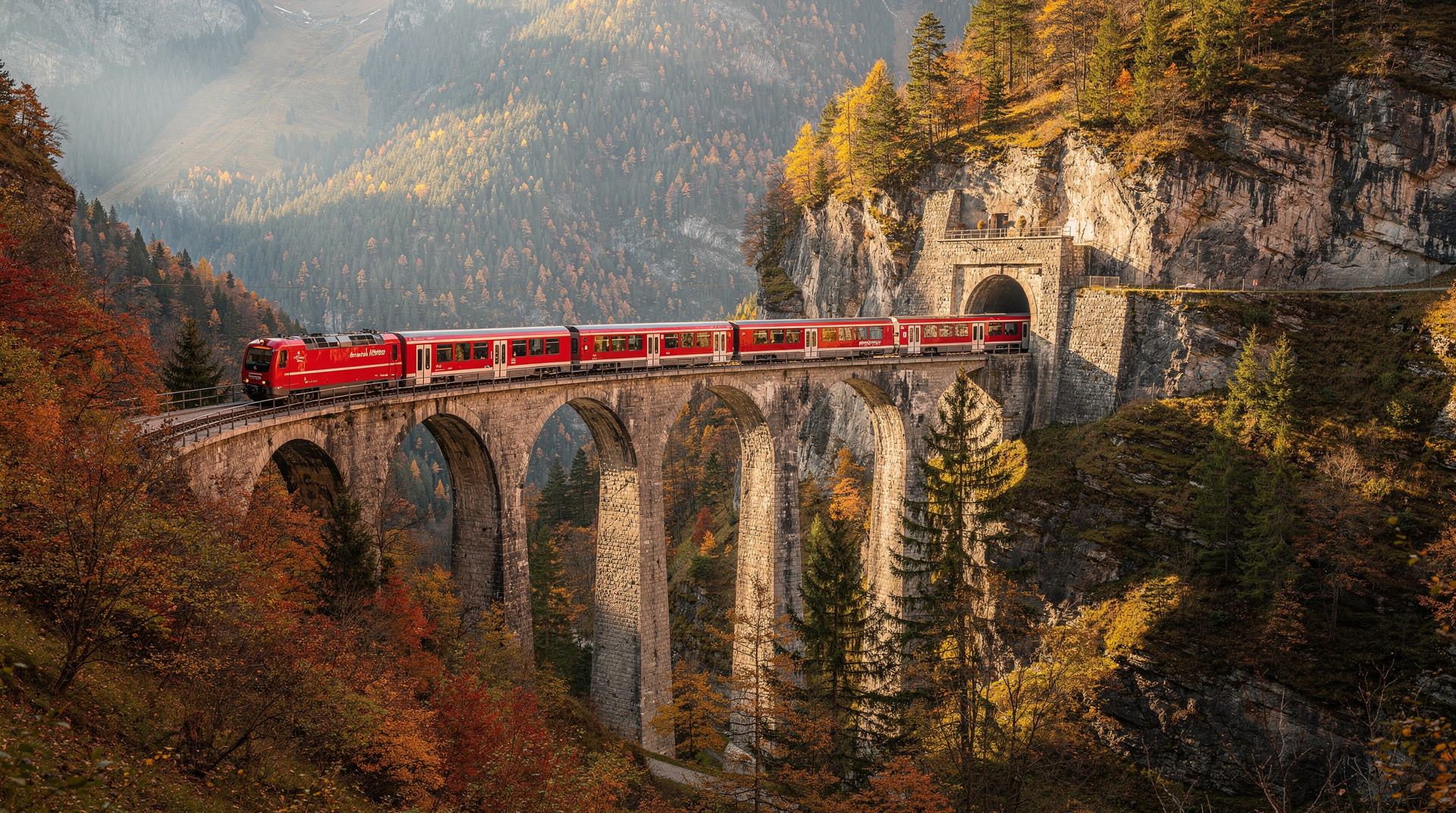
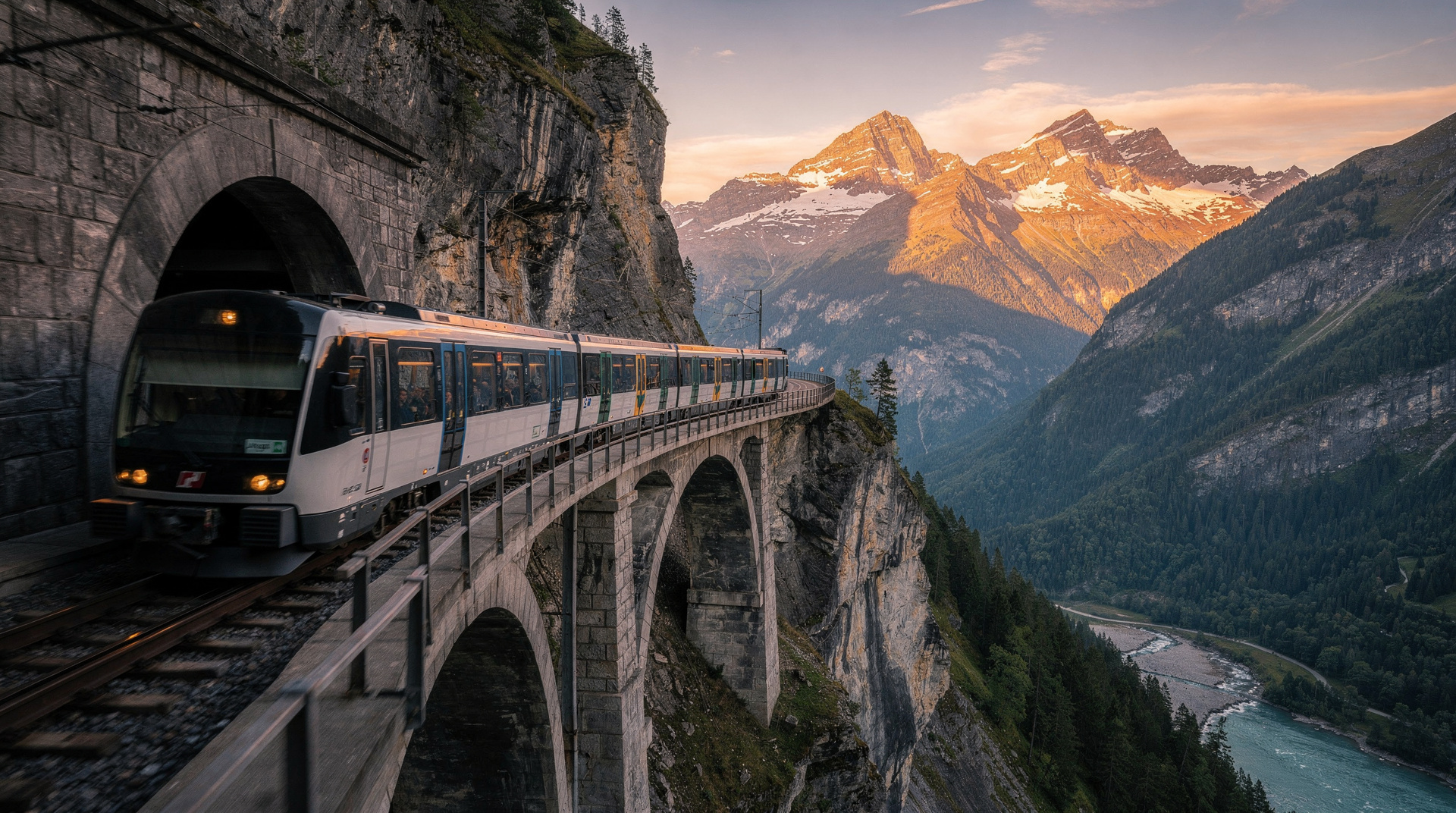
The Lucerne-Interlaken Express is a scenic regional railway that connects two of Switzerland’s most-visited cities in a 2-hour journey without any changes, passing through mountain terrain, cresting the Brünig Pass, and running along the shore of Lake Brienz before arriving in the heart of the Bernese Oberland. It is one of Switzerland’s best-value scenic train experiences: no reservation required, fully covered by the Swiss Travel Pass, and running every hour throughout the day.
| At a glance | |
|---|---|
| Where | Lucerne to Interlaken via the Brünig Pass and Lake Brienz |
| Cost | Around CHF 48 second class full fare; free with the Swiss Travel Pass |
| Time needed | About 2 hours end to end; allow a full day with a stop in Brienz or Meiringen |
| Getting there | Board at Lucerne Hauptbahnhof, no reservation needed, departures roughly hourly |
| Best time | Morning departure for the best light over Lake Brienz; summer for Ballenberg and hiking stops |
Unlike the Glacier Express or Bernina Express — which require reservations and specific departure times — the Lucerne-Interlaken Express runs as a regular scheduled service. You can board any departure, sit where you like, and travel at your own pace. This flexibility makes it a particularly good option for independent travellers who want scenic rail travel without the commitment of a fixed booking.
The train is operated by Zentralbahn (ZB) on its own metre-gauge track — a separate network from the standard SBB main lines, connecting the two cities via a mountain route that the motorway also uses but that feels very different by rail.
The route in detail
The journey covers approximately 100 kilometres between Lucerne and Interlaken, with the Brünig Pass (1,002m) as the high point. Unlike the Gotthard route or the Bernina, the Brünig is not a dramatic alpine pass — it is a forested watershed between the Aare and Reuss river systems, green and quiet. The drama comes at the start (Lake Lucerne views leaving the city) and at the end (Lake Brienz). The pass itself is gentle countryside.
Lucerne to Giswil: lakeshore and valley
Departure from Lucerne Hauptbahnhof. The train initially runs alongside Lake Lucerne (Vierwaldstattersee) through Hergiswil, where you can look back at the city’s silhouette and the Mount Pilatus backdrop. From Hergiswil, the line enters the Sarner Aa valley, following a river upstream through the small cantons of Obwalden and Nidwalden.
Sarnen (altitude 472m): Capital of canton Obwalden, a town of about 10,000. The old town centre has a handsome Rathaus and parish church. Worth a short stop if you have a flex pass and want to explore. The Landsgemeinde — the traditional open-air cantonal assembly — took place here for centuries.
Lungern (718m): A small village at the end of a dramatically beautiful lake (Lungernsee). The lake level was artificially lowered in the 19th century to create farmland, leaving a distinctive elongated shape. The village church sits directly at the water’s edge.
Giswil to Brienz: the Brünig Pass and descent
Beyond Giswil the train climbs steadily. This section uses a rack-and-pinion (Zahnradbahn) system — the same technology that powers Switzerland’s famous mountain railways — to manage the steeper gradient sections. You can sometimes hear the rack engage under the carriage as the gradient increases. The maximum gradient on the Brünig is 120 per thousand, which is steep enough to require the rack.
Brünig-Hasliberg (1,002m): The summit of the pass. A small resort village at the top. Ski lifts operate in winter; in summer this is a popular starting point for mountain bike trails and hikes into the Haslital. The restaurant at Brünig-Hasliberg station serves good food — worth a stop if you have time.
Meiringen (595m): The largest town in the Haslital valley. Meiringen claims two international distinctions: it is the birthplace of the meringue dessert (debated, but vigorously defended) and the setting of the Sherlock Holmes story “The Final Problem,” in which Holmes and Moriarty fall from the nearby Reichenbachfall waterfall. The Sherlock Holmes Museum in Meiringen is a pilgrimage site for fans. The Reichenbachfall itself can be reached by a historic funicular (separate ticket, not covered by Swiss Travel Pass).
Brienz (567m): A village on the western shore of Lake Brienz, known for two things: wood carving (the artisan tradition is still alive, with workshops open to visitors) and the nearby Giessbach Falls. The Giessbach are dramatic cascades dropping into Lake Brienz, accessible by a historic funicular from a boat landing. Brienz is also the departure point for the Rothorn Railway — a narrow-gauge steam railway (one of the last in Switzerland) that climbs to the Brienzer Rothorn summit at 2,244m for panoramic views.
Brienz to Interlaken: along the lake
After Brienz, the train runs along the southern shore of Lake Brienz (Brienzersee) to Interlaken. This section, lasting about 20 minutes, is the most consistently spectacular part of the journey. Lake Brienz is a deep turquoise-green colour, fed by glacial meltwater from the Haslital. The Bernese Oberland peaks — above Grindelwald and toward the Jungfrau — are visible on clear days rising above the far shoreline.
The train arrives at Interlaken Ost — the eastern station, which is the main departure point for cogwheel railways to the Jungfrau region.
Ticket prices 2026
This is a regular SBB/Zentralbahn service with standard point-to-point fares. Full-price adult tickets:
| Route | 2nd class | 1st class |
|---|---|---|
| Lucerne to Interlaken (full) | CHF 48 | CHF 82 |
| Lucerne to Brienz | CHF 42 | CHF 72 |
| Lucerne to Meiringen | CHF 38 | CHF 65 |
No reservation required. Board any departure, sit anywhere in the appropriate class. The train runs approximately every hour in both directions.
Swiss Travel Pass: the key advantage
The Lucerne-Interlaken Express is one of the most compelling arguments for the Swiss Travel Pass. With the pass:
- The entire route is covered at no extra cost (both directions)
- No reservation is needed — simply board any departure
- You can stop at any station (Meiringen, Brienz, Sarnen) and continue on the next train at no additional charge
- Lake cruises on Lake Brienz (connecting Interlaken Ost, Brienz, and Giessbach) are also covered by the Swiss Travel Pass
For travellers combining Lucerne with Interlaken — a natural pairing given their geographic positions — the pass covers this route, the Interlaken cogwheel system (partially), and city transport at both ends. The maths typically favour buying the pass if you plan 4 or more travel days.
Comparing with the car and bus alternatives
The main alternative to the train is driving — the A8 motorway follows a similar route via Brünig and takes around 1h30 in good conditions, slightly faster than the train. However:
- Parking in Lucerne and Interlaken is expensive and often congested in summer
- The train allows you to see the lake views and Brienz shoreline that the motorway misses
- No driver misses the scenery by watching the road
- The train drops you in Interlaken’s centre, not a peripheral parking area
Regional bus services also connect some intermediate points but are slower and less scenic. The train is the clear choice.
Best seats on the Lucerne-Interlaken Express
Sit on the right side travelling Lucerne to Interlaken for the best Lake Brienz views (right side facing south). The lake appears on the right for most of the Brienz–Interlaken section.
Travelling Interlaken to Lucerne: sit on the left — the lake is on your left heading east.
For the Brünig Pass section: Views are more evenly distributed, but slightly better on the left side climbing from Meiringen toward the pass, as the valley opens up to the south.
The train is not specifically a tourist service — it is a commuter and regional rail line. This means the carriages are standard SBB Zentralbahn stock, comfortable but not panoramic. Windows are large enough for good views, but do not expect the curved ceiling-height glass of the Bernina Express. What the service lacks in engineering drama it compensates in frequency, flexibility, and the genuine beauty of the Brienz shoreline.
Key stops worth exploring
Meiringen and the Sherlock Holmes connection
The Reichenbachfall (Reichenbach Falls) above Meiringen is where Arthur Conan Doyle chose to kill off Sherlock Holmes in 1893 — and where Holmes and Moriarty have their legendary struggle. Conan Doyle visited the falls while on holiday in Switzerland and was struck by their dramatic height and remoteness. The Meiringen Sherlock Holmes Museum occupies a replica Baker Street study inside the English church. Entry is modest (CHF 3–5) and the collection is surprisingly detailed.
The falls themselves are reached via a historic funicular from the valley floor (separate ticket, around CHF 6 return). The viewing platform is at the top of the first cascade, with a plaque marking the fictional scene. The falls drop a total of about 120 metres and are most dramatic in spring snowmelt.
Meiringen also produces excellent meringues from local cream. The debate over whether the dessert was truly invented here (competing claims come from the Swiss town of Meiringen or from a French-German confectioner named Gasparini) has never been settled, but the village embraces the connection enthusiastically.
Brienz wood carving tradition
Brienz has been a centre of wood carving since the late 18th century, when local craftsmen began producing decorative objects for the early tourist trade. The tradition continues today in around 15 workshops producing hand-carved bears, chamois, edelweiss motifs, and decorative objects ranging from small souvenir pieces to large commissioned works.
The Swiss Open-Air Museum Ballenberg is 5 kilometres east of Brienz (bus from the station). This 66-hectare museum contains around 100 historic Swiss rural buildings relocated from across the country and reconstructed in landscape zones replicating their original regions. Craftspeople demonstrate traditional skills including cheese making, bread baking, and weaving on specific days. Entry is CHF 28 for adults; covered by Swiss Travel Pass for the bus transfer, paid for entry.
Lake Brienz boat service
The Lake Brienz boat service (Brienzersee Schifffahrt) connects Interlaken Ost, Giessbach, and Brienz with steamers and cruisers throughout the summer. The service is covered by the Swiss Travel Pass. The combination of train one way and boat the other creates a circular route with entirely different perspectives on the lake.
The Giessbach boat landing is directly below the famous Giessbach Falls — you can walk up via a nature path or take the historic funicular (small extra charge) to the Grandhotel Giessbach, a beautifully preserved Victorian grand hotel dramatically positioned beside the falls. If you prefer a guided outing, there is an boat trip from Interlaken to Giessbach Falls with a hike to Iseltwald that covers the same stretch of lake.
Combining with other journeys
The Lucerne-Interlaken Express is most commonly used as a connection between two larger itineraries:
With the Gotthard Panorama Express: Arrive in Lucerne by the afternoon Gotthard Panorama Express from Lugano, spend the night, then continue to Interlaken the next morning. This creates a south-to-north-to-west arc across central Switzerland.
With the GoldenPass Express: The GoldenPass Express connects Interlaken to Montreux. Combined with the Lucerne-Interlaken Express, you can travel Lucerne → Interlaken → Montreux in a single day with two scenic trains.
With Jungfraujoch: Arriving in Interlaken Ost in the morning leaves the afternoon free for the cogwheel railway to Jungfraujoch. The first cogwheel train from Interlaken Ost to Kleine Scheidegg departs around 08:00; combining this with the Lucerne-Interlaken Express requires an early start from Lucerne (around 06:00) or a previous-day arrival.
With the Glacier Express: The Glacier Express terminates at Zermatt (west) and St. Moritz (east). Neither endpoint connects directly to Lucerne-Interlaken Express. However, travelling Glacier Express to Chur, then IC to Lucerne (2h), then Lucerne-Interlaken Express is a logical multi-day loop. See our 7-day Switzerland itinerary.
Practical tips
Tip 1 — Board in Lucerne for the morning light. Leaving Lucerne in the morning (around 08:00–09:00) catches the best mountain light over Lake Brienz and maximises time in Interlaken.
Tip 2 — Stop in Brienz for a few hours. The wood-carving workshops, the steam railway, and the lake views all reward a half-day stop. Use a Swiss Travel Pass to hop off and continue on the next hourly departure.
Tip 3 — Combine the train with the lake boat on Lake Brienz. Go by train from Lucerne to Brienz, then take the boat from Brienz to Interlaken Ost (1 hour on the lake). Both are covered by the Swiss Travel Pass. This is one of the best possible sequences of scenery per hour in the Bernese Oberland.
Tip 4 — The train is an hourly service, not a special departure. Unlike the named scenic trains, this runs every hour. If you miss one, the next is 60 minutes away. This makes spontaneous day trips from Lucerne or Interlaken entirely practical.
Tip 5 — Look for the Brienzer Rothorn steam train. From Brienz station, the old-fashioned steam-powered Rothorn railway departs for the summit (around CHF 76 return; 50% discount with Swiss Travel Pass). The 1h ascent through alpine pastures is one of the most charming narrow-gauge experiences in Switzerland.
Getting to Lucerne
Lucerne is well-connected from all major Swiss cities:
- Zurich: 50 minutes by IC
- Bern: 1h05 by IC
- Basel: 1h by IC
- Geneva: 2h50 via Bern
For budget travel tips and the best time to visit Switzerland, see our dedicated guides. The Lucerne-Interlaken Express is one of the most accessible scenic routes in the country — no advance booking, no premium surcharge, and fully covered by the Swiss Travel Pass makes it an ideal backbone for a central Switzerland itinerary. You can purchase the Swiss Travel Pass online to cover this route and all other Swiss rail, boat, and bus connections.
For a full comparison of all Swiss scenic trains ranked by value and experience, see our best scenic train routes guide.
Frequently asked questions about Lucerne-Interlaken Express
Do I need to reserve a seat on the Lucerne-Interlaken Express? No. Unlike the Glacier Express or Bernina Express, this is a regular scheduled service — board any hourly departure and sit anywhere in your class.
Can I stop along the route without buying a new ticket? Yes, with the Swiss Travel Pass or a valid through-ticket you can break your journey at Brienz, Meiringen, or Sarnen and continue on a later train at no extra cost.