© Glacier Express AG, Fotograf: Stefan Schlumpf
Glacier Express: complete booking guide
How much does the Glacier Express cost?
The Glacier Express costs CHF 153-313 depending on class. A mandatory seat reservation (CHF 54 per person) is required on top of your ticket or Swiss Travel Pass.
What is the Glacier Express?
The Glacier Express is one of the world’s most celebrated scenic railway journeys, running between Zermatt and St. Moritz in the heart of the Swiss Alps. The marketing slogan “the world’s slowest express train” is entirely accurate — this 291-kilometre journey takes roughly 8 hours, crossing 291 bridges, passing through 91 tunnels, and cresting the Oberalp Pass at 2,033 metres above sea level.
It is not a fast point-to-point commuter route. It is a mobile observation deck across some of Europe’s most dramatic mountain scenery, and planning it well makes a significant difference to your experience. This guide covers everything: the full route, 2026 ticket prices, class differences, the Swiss Travel Pass, seat selection, and the practical details that most booking sites skip over.
At a glance
| Route | Zermatt to St. Moritz (or reverse) |
| Duration | around 8 hours, one way |
| Cost | CHF 153-313 depending on class, plus a mandatory CHF 54 seat reservation |
| Reservation | mandatory on every seat, book 4-6 weeks ahead for summer |
| Swiss Travel Pass | covers the base fare, reservation still payable separately |
| Best time | June-September for full daylight; winter (Dec-Mar) for snow scenery, with a seasonal closure roughly mid-Oct to mid-Dec |
Glacier Express — 1st class seat from Zermatt to St. Moritz
Reserve your panoramic window seat on the world's most famous scenic train. Includes table dining service and complimentary audio commentary.
- Free cancellation
- from CHF 314
The full route: Zermatt to St. Moritz (or reverse)
The train runs in both directions daily. Most travellers take it westbound to eastbound — Zermatt to St. Moritz — because the most photographed scenery, including the Rhine Gorge and Landwasser area, appears on the right-hand side of the train in that direction. The reverse journey (St. Moritz to Zermatt) is equally valid and equally spectacular, just with slightly different lighting and perspective.
Key stations and timings
The full journey calls at around 20 stations. The major ones, with approximate times from Zermatt on the standard morning departure, are:
- Zermatt — departure around 09:00
- Visp — 10:00 (connection point from Brig and the main line)
- Brig — 10:20 (optional boarding point, accessible by IC from Geneva, Zurich, and Lausanne)
- Fiesch — 11:10 (gateway to Aletsch Glacier hikes)
- Andermatt — 12:45 (lunch stop, roughly 30–45 minutes)
- Disentis — 14:15 (Benedictine monastery visible from the train)
- Ilanz — 14:50 (start of the Rhine Gorge section)
- Chur — 15:50 (capital of Graubunden, optional disembark)
- Thusis — 16:20 (entry to the Albula region)
- Filisur — 17:00 (Landwasser Viaduct)
- Samedan — 17:45
- St. Moritz — arrival around 17:55
Times shift slightly by season and year — always verify with SBB or Rhaetian Railway before booking.
The three scenic highlights
1. The Oberalp Pass (2,033m): The highest point on the journey, reached around midday. In winter the train passes through walls of snow several metres high on either side. In summer, alpine meadows open up across the plateau. The pass forms the watershed between the Rhine and the Rhone river systems.
2. The Rhine Gorge (Ruinaulta): Often called the “Swiss Grand Canyon,” this section between Ilanz and Reichenau-Tamins runs through a forested limestone gorge carved by the young Rhine. The river appears far below between tall white rock faces. This is arguably the most striking 30 minutes of the journey.
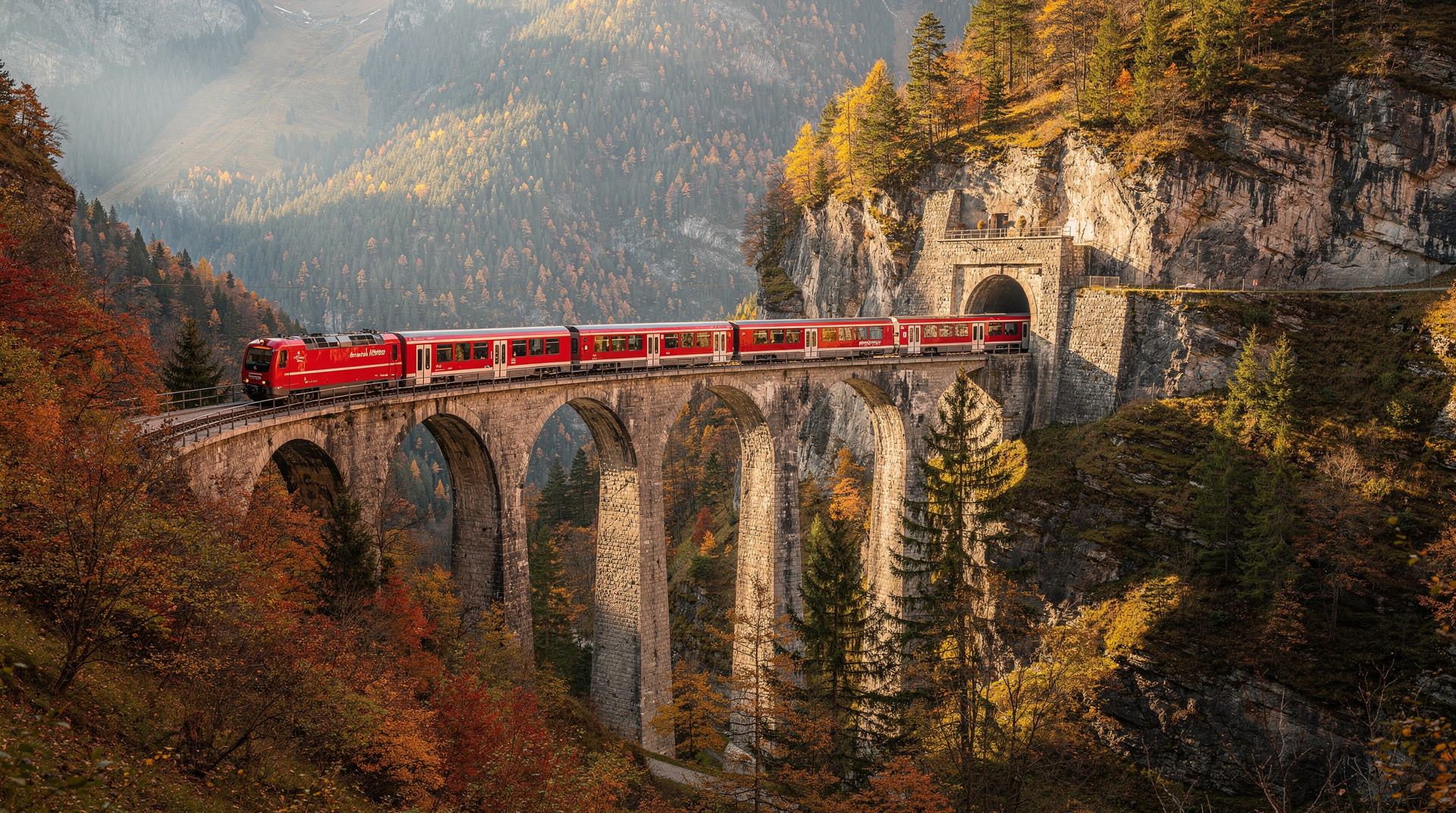
3. The Landwasser Viaduct area: The Landwasser Viaduct is one of Switzerland’s most photographed structures — a six-arch stone viaduct that curves directly into a tunnel carved into a cliff face. The Glacier Express does not cross this viaduct (that honour goes to the Bernina Express and other Rhaetian Railway services), but it runs through the same Albula Valley, which is itself a UNESCO World Heritage landscape of tunnels and loops.
Ticket prices 2026
Prices for 2026 are as follows (full-price adult fares, one way):
| Class | Price |
|---|---|
| 2nd class | CHF 153 |
| 1st class | CHF 265 |
| Excellence Class | CHF 313 (supplement over 1st class) |
These base fares cover the rail journey only. A mandatory seat reservation must be purchased on top:
| Reservation | Price |
|---|---|
| 2nd class | CHF 54 per person |
| 1st class | CHF 54 per person |
| Excellence Class | CHF 590 all-inclusive (no separate reservation fee) |
Swiss Travel Pass holders do not pay the base rail fare but must still pay the reservation fee (CHF 54 per person). This is a common source of confusion — the pass is not all-inclusive on this particular train.
Booking your tickets
Option 1: Book directly through Rhaetian Railway or SBB
The Rhaetian Railway (RhB) operates the Glacier Express jointly with Matterhorn Gotthard Bahn (MGB). You can book via the SBB website or app, or directly at rhb.ch. This is the most flexible option, as you can choose specific seats.
Option 2: Book through GetYourGuide
For convenience, particularly if you want a single checkout experience that bundles transport with other activities, GetYourGuide offers Glacier Express tickets:
If you prefer the Chur–Zermatt direction, the Glacier Express scenic routes between Chur and Zermatt covers that routing and can be combined with a stop in Andermatt.
How far in advance to book
Book at least 4–6 weeks in advance for summer travel (July–August), when the train sells out completely on popular departure dates. Spring and autumn offer more flexibility, but busy days around Swiss public holidays can still fill up. Winter departures (December–March) are surprisingly popular due to the snow scenery — book those at least 3–4 weeks ahead.
Swiss Travel Pass and the Glacier Express
The Swiss Travel Pass covers the base fare on the Glacier Express. Holders of a 2nd class pass travel in 2nd class for free; 1st class pass holders travel in 1st class for free. What it does NOT cover is the mandatory seat reservation, which you must purchase separately (CHF 54 per person).
If you have a Flex Pass, the Glacier Express counts as one travel day regardless of whether you only ride it or combine it with other trains on the same day.
The Half Fare Card reduces the base ticket by 50% but does not eliminate the reservation requirement. The reservation itself is not discounted by the Half Fare Card.
Trains run twice daily in summer (June-September) and once daily in winter.
First class vs second class: is the upgrade worth it?
Both classes have panoramic windows, though 1st class windows are noticeably larger. The key differences:
Second class:
- Standard panoramic windows
- Seats in groups of four facing each other with a table, or pairs
- Table meal service available (order from seat)
- Perfectly good for the journey — most travellers choose this
First class:
- Wider, more comfortable seats
- Larger panoramic windows with better sightlines
- Quieter, less crowded carriage
- Full table dining service included at your seat
- Recommended if you want a more relaxed, spacious experience
Excellence Class:
- Available on select departures only
- Single or double seats facing the windows with full 180-degree views
- Gourmet multi-course meal included (prepared by on-board chef)
- Welcome champagne, personalised service
- CHF 590 all-inclusive (no separate reservation or base fare required) — a significant investment, but genuinely extraordinary for a special occasion
For most travellers doing the journey once, 2nd class is entirely satisfying. The scenery is identical, and the panoramic windows deliver the experience. Upgrade to 1st class if crowds concern you, or if you want a more comfortable seat for the full 8-hour journey.
Choosing the best seats
Sit on the right side of the train travelling Zermatt to St. Moritz. This puts you on the valley side for most of the Rhine Gorge section and gives better angles for the Oberalp Pass descent. The left side is not without views — there are 8 hours of scenery on every side — but the right side captures the most celebrated moments.
Travelling St. Moritz to Zermatt? Sit on the left. The logic reverses.
Window seats vs aisle seats: The windows are large enough that even aisle seats offer decent views, but if you have a choice, take the window. Families with children often benefit from the four-seat table configurations.
Avoid seats directly next to the galley or luggage areas — these can be noisy and slightly restricted in legroom.
When booking directly through SBB or RhB, the seat map is available during the booking process. Take time to select specific seats rather than accepting random assignment.
What to expect on board
Meals and the dining experience
The Glacier Express is famous for its dining car service. A printed menu is available in multiple languages, and a trolley service also passes through the train. Meals are prepared on board and served to your seat.
Expect to pay CHF 25–45 for a main course. The food is good railway fare — not fine dining, but genuinely satisfying. The set lunch menu is good value and includes a starter, main, and dessert. Wine, beer, and non-alcoholic drinks are all available.
Breakfast service runs for the first hour or two of the journey. Lunch service peaks between 11:30 and 14:00. If you want to eat at your leisure, order early to avoid the busiest service window.
Bringing your own food and drinks on board is permitted and common. Many travellers pack a picnic from Zermatt or St. Moritz bakeries. There are no restrictions on what you bring.
Luggage
Large luggage can be sent ahead via the SBB luggage forwarding service (Reisegepäck). This costs around CHF 26–40 per item and is highly recommended if you are moving between hotels at each end. The service picks up from your hotel and delivers to your destination hotel — usually the next day.
On the train itself, luggage racks are available at the ends of each carriage and above the seats. The train gets busy in summer, so compact luggage makes life easier.
Audio commentary
The Glacier Express provides complimentary audio commentary headsets describing highlights along the route in several languages including English. These are available at the start of the journey and explain what you are seeing as the scenery changes. The commentary is genuinely informative — use it.
Wi-Fi and connectivity
Mobile signal is intermittent through the Alpine sections and tunnels. There is no on-board Wi-Fi. Download maps and reading material before departure. Consider this a feature, not a bug — the journey is the point.
Practical tips
Tip 1 — Do not try to do both directions in one day. The Glacier Express is 8 hours each way. Plan one direction, then use other transport to return if needed.
Tip 2 — Start from Zermatt for better morning light. The eastbound departure catches the best light on the valley floors in the morning hours.
Tip 3 — Book Andermatt lunch stop deliberately. The train stops in Andermatt for 30–45 minutes around midday. Step off, walk the village, and reboard. It is a genuine break and gives you your only chance to stretch your legs mid-journey.
Tip 4 — Check the weather forecast. The journey is remarkable in all weather, including fog and rain, but clear days are exceptional. If your trip allows flexibility, check a few days ahead and book the clearest day. Fog in the Rhine Gorge is atmospheric; fog at the Oberalp Pass in winter is genuinely magical.
Tip 5 — Consider breaking the journey. Andermatt, Chur, and Disentis all make compelling overnight stops if you want to explore the regions you pass through. The ticket allows you to break the journey and continue the next day, though reservation rules may require a new booking for the second leg.
Tip 6 — Combine with the Bernina Express. The classic Swiss scenic train itinerary runs the Glacier Express from Zermatt to St. Moritz, then picks up the Bernina Express from St. Moritz to Tirano (Italy) or Lugano. Together they form the most complete Alpine railway experience in Switzerland. See our full scenic trains itinerary for the suggested routing.
You can book the St. Moritz end of the Glacier Express with the Glacier Express ticket from St. Moritz to Zermatt if you are travelling in the eastbound-to-westbound direction.
When to go
Summer (June–September): The most popular window. Wildflowers in the high valleys, all mountain roads open, long daylight hours. Book well in advance.
Autumn (October–early November): Dramatically underrated. The larch forests turn golden-orange, particularly around Disentis and the Engadin Valley. Fewer crowds, easier bookings.
Winter (December–March): Snow transforms the journey. The Oberalp Pass walls of snow can reach 3–4 metres either side of the track. Cold but spectacular. Bring warm layers even though carriages are heated — the windows get cold and you will be sitting for 8 hours.
Spring (April–May): Variable. Snow is still present at altitude, but some passes and roads may be partially closed. Check conditions before booking. Can be beautifully quiet.
Important: The Glacier Express does not operate from approximately mid-October to mid-December each year. Check the official website for exact 2026 closure dates before booking.
How to get to Zermatt (the starting point)
Zermatt is car-free. You reach it by train only. From:
- Geneva: IC train to Visp (2h15), then Matterhorn Gotthard Bahn to Zermatt (1h20). Total around 3h40.
- Zurich: IC to Brig (2h00), then MGB to Zermatt (1h20). Total around 3h20.
- Bern: IC to Visp (1h30), then MGB to Zermatt (1h20). Total around 3h.
You can also join the Glacier Express at Brig or Visp rather than Zermatt if your routing makes that easier. The scenery starts immediately from either junction.
How to get from St. Moritz (the endpoint)
St. Moritz connects to the wider rail network via:
- Chur: 2 hours by Rhaetian Railway (multiple services daily), then IC to Zurich (1h10).
- Bernina Express: From St. Moritz to Tirano in Italy (2h30), connecting to Italian trains toward Milan or the Trenino Rosso del Bernina for the return.
- Postbus: Various regional bus connections to Davos, Scuol, and the Engadin Valley.
Frequently asked questions about the Glacier Express
Can children travel on the Glacier Express? Yes. Children under 6 travel free; children 6–16 with a Children’s Co-Travelcard (added to an adult pass) also travel free. The reservation fee still applies. The journey is long for young children — bring activities, and consider whether 8 hours on a train suits your family.
Is the train accessible for wheelchair users? Yes. The Rhaetian Railway has accessible carriages with designated wheelchair spaces. Book by phone or email directly with RhB to ensure the accessible carriage is reserved. Not all services have identical configurations, so confirm in advance.
What if the train is cancelled or delayed? Significant weather disruption (avalanches, storms) can cause delays or partial cancellations. In this case, SBB and RhB will reroute passengers or offer refunds. Travel insurance covering delays is worth considering for this journey, particularly in winter.
Is it better to book the whole ticket or use my pass and add the reservation? If you have a Swiss Travel Pass, using it saves you the base fare (CHF 153–265) and you only pay the reservation (CHF 54). This is almost always cheaper than buying a standalone ticket unless your pass is a Flex and you want to conserve travel days — in which case run the numbers for your specific itinerary.
Do you need to book the Glacier Express in advance?
Yes, a mandatory seat reservation is required and the train sells out completely on popular dates in summer. Book at least 4-6 weeks in advance for July and August travel. Spring, autumn, and winter departures are less pressured but still benefit from booking 3-4 weeks ahead, especially around Swiss public holidays.
Is the Glacier Express worth it?
For most travellers, yes. The 8-hour journey through the Rhine Gorge, over the Oberalp Pass, and through the Alpine valleys is genuinely spectacular and unlike any other train journey in Europe. The scenery is exceptional in every season, including winter when walls of snow line the tracks. It is a long day, but the landscape changes constantly enough to hold attention throughout.
Which side should I sit on the Glacier Express?
Sit on the right side travelling from Zermatt to St. Moritz for the best views of the Rhine Gorge and Oberalp Pass descent. If travelling in the reverse direction (St. Moritz to Zermatt), sit on the left. Both sides offer scenery throughout the 8-hour journey, but the right side (eastbound) captures the most celebrated moments.
Is food included on the Glacier Express?
Food is not included in the base ticket or reservation fee in 2nd or 1st class. A dining car serves meals at your seat (mains CHF 25-45), and a trolley service passes through the train. Bringing your own food and drinks is permitted and common. Only the Excellence Class package (CHF 590) includes a gourmet multi-course meal.
Can I break the journey on the Glacier Express?
Yes, the ticket allows you to break the journey at stations along the route. Andermatt, Chur, and Disentis are popular overnight stops. However, you will need a new seat reservation for the second leg, as the mandatory reservation is tied to a specific departure. Plan this in advance to secure seats on the following day.
Does the Swiss Travel Pass cover the Glacier Express?
The Swiss Travel Pass covers the full base fare on the Glacier Express — holders of a 2nd class pass travel in 2nd class for free, and 1st class pass holders travel in 1st class for free. The mandatory seat reservation (CHF 54 per person) is the only additional cost and must be purchased separately.
How does the Glacier Express compare to the Bernina Express?
The Glacier Express is longer (about 8 hours vs around 4) and connects Zermatt with St. Moritz through the Rhine Gorge and Oberalp Pass, while the Bernina Express is a UNESCO-listed route descending from St. Moritz into Italy. Many travellers combine both into a single multi-day Alpine rail loop — see our Glacier Express vs Bernina Express guide for the full comparison.
How does it compare to Switzerland’s other scenic trains?
If you are choosing between routes, see our dedicated Glacier Express vs Bernina Express comparison and the full best scenic train routes ranking. In short: the Glacier Express is the longest and most classically “alpine crossing” of the group, the Bernina Express is shorter with a UNESCO-listed pass and a descent into Italy, and the GoldenPass Express links French-speaking and German-speaking Switzerland in about 3 hours.
The Glacier Express is one of those rare travel experiences that genuinely lives up to its reputation. Eight hours sounds like a long time until the train enters the Rhine Gorge and you realise you have been staring out of the window in silence for the past hour. Plan well, choose your seat carefully, and let the journey do the rest.
For a broader look at how to plan your rail travel, see our scenic trains itinerary guide and how to book Swiss scenic trains.