10 days in Switzerland: the complete classic itinerary
Why ten days changes everything
Ten days is the ideal length for a first or second visit to Switzerland. It allows you to move at a civilised pace, absorb each destination properly, take a scenic train journey without feeling it eats the entire day, and include Bern — the capital — which shorter itineraries too often skip. This plan covers the arc from Zurich in the northeast to Geneva in the southwest, adding Grindelwald and the Lauterbrunnen valley as well as a full Glacier Express experience from Zermatt.
The Swiss Travel Pass covers all rail, most buses, and lake boats throughout. Book the Jungfraujoch train and the Glacier Express at least two weeks in advance in summer.
| At a glance | |
|---|---|
| Route | Zurich → Lucerne → Bern → Grindelwald/Interlaken → Zermatt → Geneva |
| Cost (excl. flights) | Around CHF 3,000-3,600 per person |
| Pace | Easy — one or two nights per stop, a single major excursion most days |
| Best for | First or second visit, couples, families wanting a comprehensive but unhurried loop |
| Best time | June or September for weather and lighter crowds; July-August is busiest |
Day 1: Zurich — arrival and the old city
Land at Zurich Airport and take the direct rail link (10 minutes) into Zurich Hauptbahnhof. Zurich rewards a full afternoon and evening on arrival. The old town is split by the Limmat river: the Niederdorf with its guild houses and tower of Grossmünster on the right bank; the Lindenhügel and Fraumünster on the left. The Chagall windows in Fraumünster — five floor-to-ceiling panels in jewel-toned blue, green, and red — are among the finest works of religious art created in the 20th century.
Walk down Bahnhofstrasse to the Bürkliplatz at the lake edge. On a clear evening the mountains visible at the head of the lake are the Glärner Alps and, on exceptional days, the Rätikon range more than 100 kilometres away.
The Lindt Home of Chocolate museum at Kilchberg (20 minutes by S-Bahn) is one of the best museum experiences in Switzerland, with a 9-metre chocolate fountain and a serious but entertaining history of Swiss confectionery. Open until 6pm most days.
Book your Lindt museum ticket to skip the entrance queue →Accommodation: 1 night Zurich. Mid-range CHF 160-250.
Day 2: Lucerne — medieval city on the lake
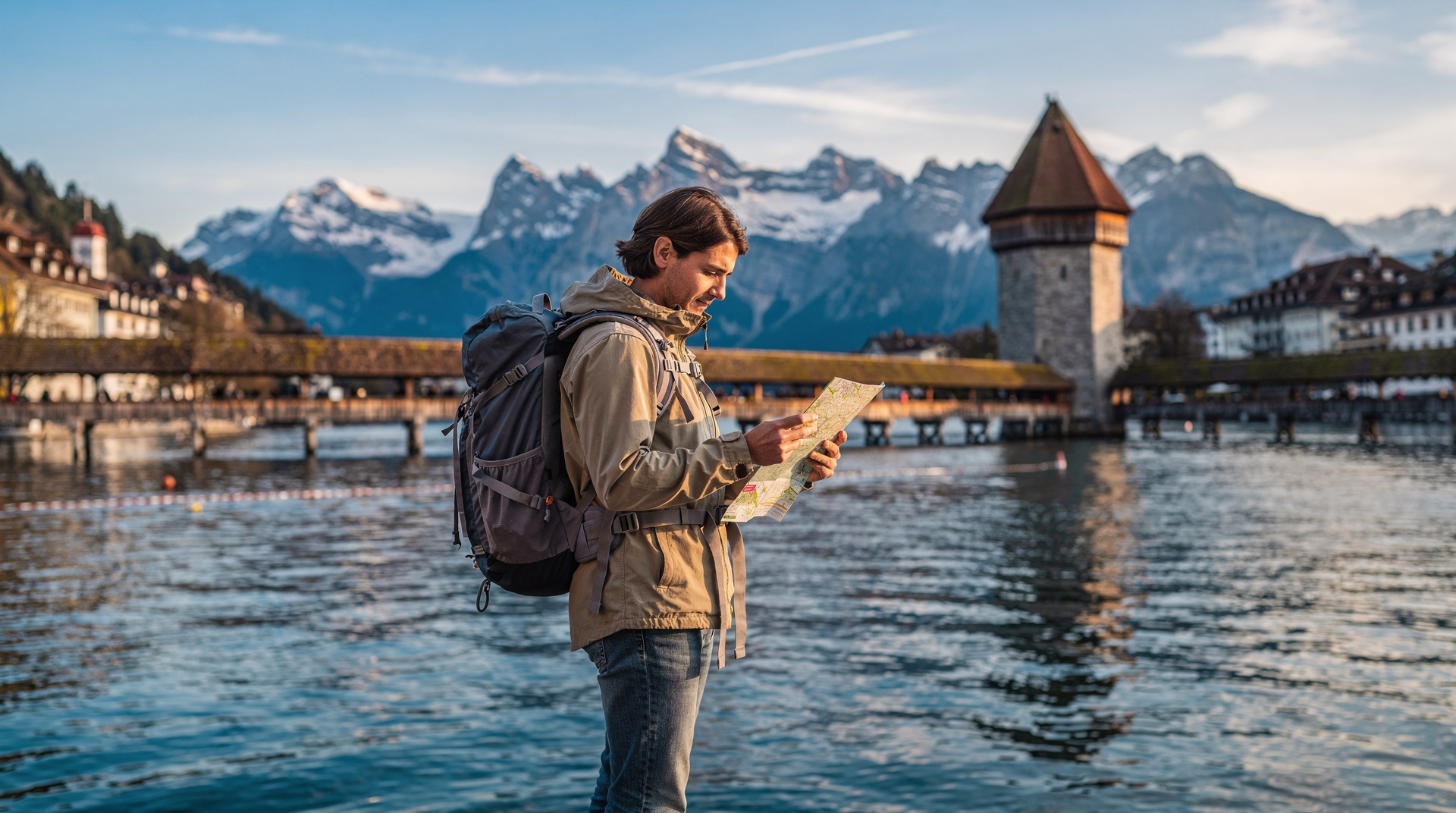
Train from Zurich to Lucerne (45 minutes). Spend the full day exploring. The Chapel Bridge (Kapellbrücke) is the natural starting point, but beyond it lies a richly detailed medieval city: Weinmarkt with painted Renaissance facades, the Jesuit Church with its pink baroque interior, and the Musegg Wall with its nine towers.
The Pilatus Golden Round Trip can be done today if the weather is clear. The combination of boat from Lucerne to Alpnachstad, world’s-steepest rack railway to the 2,132-metre summit, and cable car return takes about four hours and is one of the great Swiss mountain excursions. Alternatively, save Pilatus for Day 3 and spend all of today in the city.
Boat cruise on Lake Lucerne in the late afternoon — the paddle steamers run until evening and the Swiss Travel Pass covers them. The lake is enclosed by mountains on all sides and the shifting light on the Bürgenstock, Rigi, and Pilatus cliffs as the sun drops is extraordinary.
Reserve the Pilatus Golden Round Trip — world’s steepest rack railway →Accommodation: 1 night Lucerne.
Day 3: Bern — the federal capital
Train from Lucerne to Bern (1 hour 20 minutes). Bern is one of Europe’s most underrated capital cities — almost entirely medieval in its centre, with 6 kilometres of covered arcades (Lauben) that allow you to walk across the entire old town without being rained on. It is a UNESCO World Heritage Site and the architecture is remarkable: sandstone arcades, ornate fountains dating from the 16th century, and the Rose Garden above the Nydegg Bridge with its panorama of the Aare bend.
The Zytglogge clock tower (1530) performs an animated spectacle four minutes before each hour — mechanical bears, a golden man striking a bell, and rotating figures. The Federal Palace (Bundeshaus) can be visited on free guided tours on days when parliament is not in session. The Bear Park on the Aare bend below the old town has real bears — the emblematic animal of Bern.
The Bern Historical Museum contains the Einstein Museum (Einstein lived in Bern when he wrote his Special Theory of Relativity in 1905). The Zentrum Paul Klee on the outskirts is one of the finest single-artist museums in Europe.
Market day in Bern (Tuesday and Saturday) transforms the arcaded streets into a spectacular outdoor food market — cheese, vegetables, meat, bread, and flowers from the Bernese plateau.
Join a Bern walking tour with a local guide to unlock the city’s stories →Accommodation: 1 night Bern.
Day 4: Grindelwald and arrival in the Bernese Oberland
Train from Bern to Interlaken Ost (50 minutes), then change for Grindelwald (35 minutes). Grindelwald sits directly below the north face of the Eiger — one of the most dramatic village settings in the Alps. Check into your accommodation and spend the afternoon on the Grindelwald First plateau (reached by cable car, 6 minutes), where the Cliff Walk and observation platform give views directly into the Eiger’s north face and across the Wetterhorn, Schreckhorn, and Fiescherhorn.
The Grindelwald Glacier Gorge is a 45-minute walk from the village — a narrow slot canyon carved by the Lower Grindelwald Glacier, with walkways fixed to the cliff face above the meltwater torrent. The Swiss Travel Pass does not cover this attraction (admission CHF 7).
The village of Grindelwald itself is exceptionally well-preserved — painted wooden chalets, a Baroque church, and the backdrop of three-thousand-metre walls of limestone. Stay for two nights to make the most of it.
Book your Grindelwald First cableway and Cliff Walk ticket →Accommodation: 2 nights Grindelwald or Interlaken (Grindelwald gives more atmosphere; Interlaken gives more restaurant options).
Day 5: Jungfraujoch — top of Europe
The essential Bernese Oberland experience. Leave from Grindelwald Grund station (or Interlaken Ost) on the first morning train. The route from Grindelwald is particularly dramatic — the train climbs directly toward the Eiger’s north face before entering the tunnel at Eigergletscher. Change at Kleine Scheidegg for the final section to the summit.
Your Jungfraujoch train ticket should be booked in advance. At 3,454 metres, the Sphinx Observatory has the highest weather station in the Alps and viewing terraces on all sides. The Ice Palace carved inside the glacier, the Plateau de Glace walkway, and the views across the Aletsch Glacier are the main attractions. Allow at least four hours at the top.
Secure your Jungfraujoch Good Morning Ticket for the best views →On the descent, stop at Wengen (1,274 metres), the car-free village clinging to the cliff above Lauterbrunnen. Walk the village for an hour — it has spectacular views across the valley to the Breithorn and Tschingelhorn, and the atmosphere of a place that has not fundamentally changed since the early 20th century.
Afternoon — Lauterbrunnen valley
Descend to Lauterbrunnen and spend the afternoon in the valley. The sheer limestone cliffs — nearly 300 metres high on both sides — and the 72 waterfalls that cascade from the clifftops create one of the most otherworldly landscapes in Europe. Trümmelbach Falls (accessible by lift inside the cliff) shows the active glacier meltwater carving the rock in real time. The Staubbach Fall drops 297 metres from the cliff edge directly above the village.
Day 6: Scenic train day — Interlaken to Zermatt
Collect bags from Grindelwald or Interlaken and take the train to Zermatt via Spiez, Visp, and the Matter Valley. This is a full scenic rail day — the journey takes about two and a half hours but pass through dramatically changing landscapes. The Matter Valley section from Visp to Zermatt is one of the most impressive gorge journeys in Switzerland.
Arrive in the car-free village by midday. The Matterhorn appears at the end of Bahnhofstrasse as you exit the station — one of the great arrival moments in European travel. Spend the afternoon walking the village, visiting the Matterhorn Museum, and taking the Sunnegga funicular for the afternoon light on the peak.
Accommodation: 2 nights Zermatt.
Day 7: Zermatt — mountains and glacier
Morning — Matterhorn Glacier Paradise
The cable car system rises to 3,883 metres — the highest cable car station in the Alps. The panorama from the top encompasses 29 four-thousand-metre peaks and four countries. The Glacier Palace inside the mountain has an ice cave, sculptures, and a slide. Book the Matterhorn Glacier Paradise in advance. Swiss Travel Pass gives 25% off.
Pre-book the Matterhorn Glacier Paradise — highest cable car in the Alps →Afternoon — Gornergrat railway
The rack railway to Gornergrat (3,089 metres) departs from directly opposite Zermatt station and is the second highest open-air railway in Europe. The summit panorama includes 29 four-thousand-metre peaks including Monte Rosa, the highest point in Switzerland. Walk back down from Riffelberg to Zermatt (about 2 hours) through alpine meadows with Matterhorn views throughout.
Day 8: Glacier Express — Zermatt to Chur (partial)
The world’s most famous scenic train
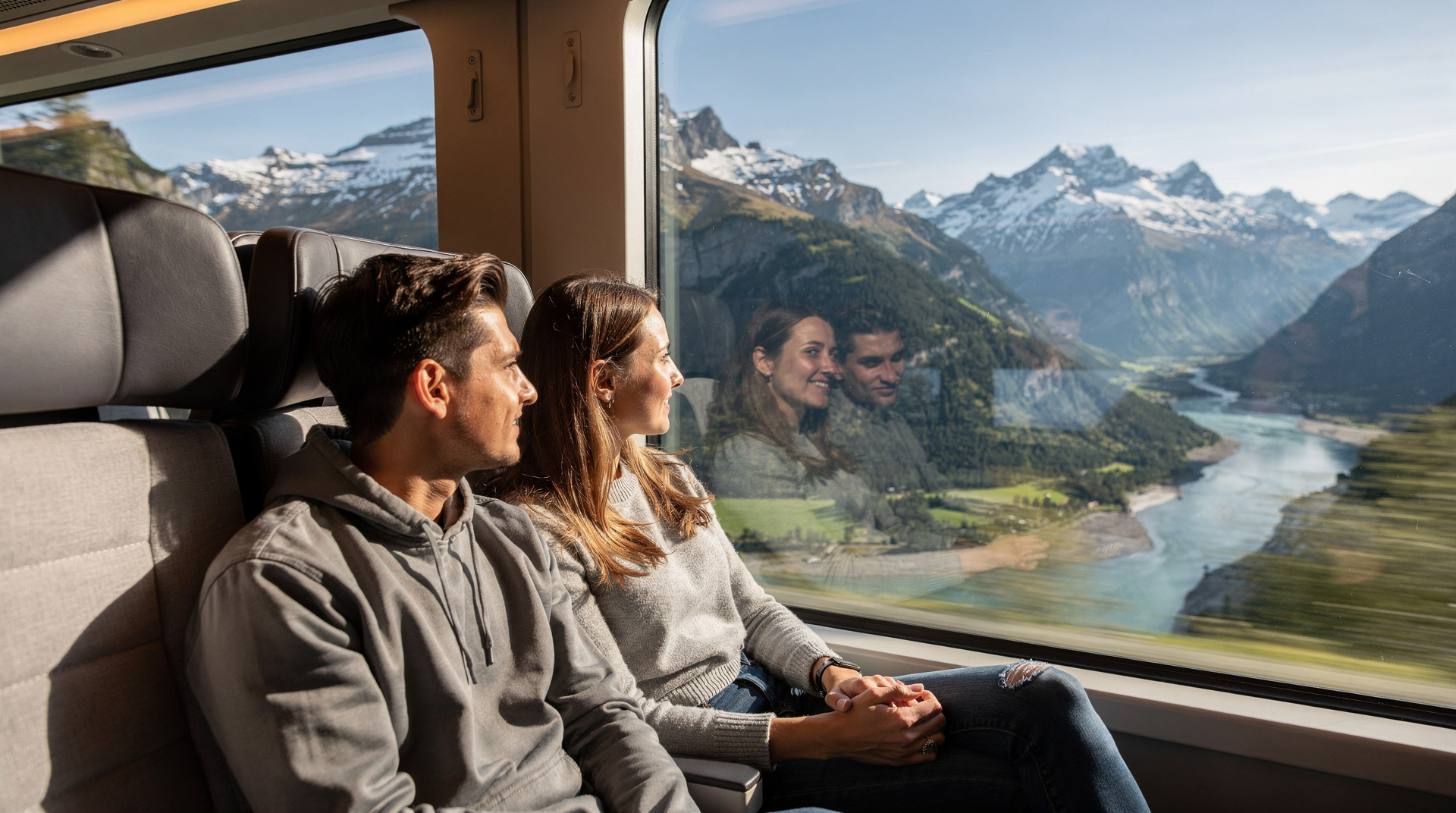
The Glacier Express from Zermatt to St. Moritz takes eight hours in first class and passes through 291 bridges, 91 tunnels, and the 2,033-metre Oberalp Pass. On this 10-day itinerary, ride the full route to Chur (about 5 hours) and connect onward to Geneva — a compromise that captures the most dramatic section of the journey (the Rhône Valley departure, the Furka and Oberalp passes, the Rhine Gorge descent) without the full day’s commitment.
The Glacier Express requires a seat reservation (approximately CHF 33 for second class, CHF 43 for first class) in addition to the Swiss Travel Pass. First class is worth the upgrade — wider seats, panoramic windows that curve up into the roof, and a dedicated dining service. Book the Glacier Express at least two weeks in advance.
Book your Glacier Express first-class seat reservation →From Chur, take the regular express train to Zurich (1 hour) and then to Geneva (2h 45min) — or stay overnight in Chur, a small Roman city with a beautiful old town.
Day 9: Geneva
Spend a full day in Geneva. The city divides naturally into the old town above the Rhône on the left bank, and the international district (Palais des Nations, CERN) on the right bank. The old town around St. Pierre Cathedral is one of the finest medieval urban environments in the French-speaking world.
The Jet d’Eau, shooting lake water 140 metres over the bay, is one of the most recognisable images in Switzerland. The Patek Philippe Museum is among the world’s finest horological museums. CERN offers guided tours (must book months in advance) of the particle physics laboratory beneath the French-Swiss border.
For an afternoon excursion, the boat to Yvoire (30 minutes, covered by pass) visits a perfectly preserved medieval French village on the opposite shore of the lake.
Accommodation: 1 night Geneva.
Day 10: Montreux, Chillon Castle, and departure
Take the morning train along the Lavaux wine terraces to Montreux (45 minutes). The Lavaux UNESCO terraced vineyards — rising steeply above the railway from Lausanne to Montreux — produce some of the finest Swiss white wines (mainly Chasselas) and are one of the great landscapes of the lake region.
Visit the Château de Chillon in the morning — it is 3 kilometres from Montreux town centre by the lakeside path (40 minutes walking) or 10 minutes by local bus. Allow two hours for the castle.
Walk back to Montreux along the flower-lined lakefront, visit the Freddie Mercury statue, and catch the train back to Geneva Airport for your departure flight. Geneva Airport is 15 minutes from Geneva Cornavin by direct train.
Book your Château de Chillon entrance ticket online →Practical information
Transport
The Swiss Travel Pass (10 consecutive days) is the best option, costing approximately CHF 445 per adult (2026). It covers all trains on this itinerary, plus lake boats and most public transport within cities. The Glacier Express seat reservation is an additional CHF 33-43.
For tips on making the most of your pass, see Swiss Travel Pass explained.
Budget summary (per person)
- Swiss Travel Pass (10 days): CHF 445
- Jungfraujoch (pass discount): CHF 145
- Matterhorn Glacier Paradise (pass discount): CHF 75
- Glacier Express reservation: CHF 43
- Accommodation (10 nights, mid-range): CHF 1,600-2,200
- Food (CHF 65/day): CHF 650
Total per person (excluding flights): CHF 3,000-3,600
What to book in advance
The Jungfraujoch, Glacier Express seat reservation, and all accommodation should be booked well ahead for summer travel. See travel tips and budget advice for strategies to reduce costs without sacrificing experiences.
For families, the family itinerary adapts this route with child-appropriate pacing and specific family-friendly activities. For couples seeking a more romantic version, the honeymoon itinerary replaces some of the mountain excursions with luxury trains and lakeside hotels.
Pacing and flexibility: how to adjust this itinerary
If you have more energy than planned
This is a relatively leisurely 10-day pace — one or two nights in each destination with a single major excursion per day. If you find yourself wanting more, add a second mountain excursion in Zermatt (Sunnegga plus Glacier Paradise on the same day is manageable), extend the Lauterbrunnen stay with a full Schilthorn day, or add a full Grindelwald day with a via ferrata excursion.
The Bernina Express from St. Moritz to Tirano (which features in the 14-day itinerary) can be added as a day 8 alternative to the Glacier Express section if you want Italian scenery and the UNESCO mountain railway experience rather than the Chur-to-Geneva positioning.
If your pace needs to slow down
This itinerary has built-in rest time on most days — the afternoons in Lucerne, the free morning in Bern, and the relaxed second day in Zermatt all give room to slow down without losing any major experience. If weather closes in on a mountain day, the city days (Zurich, Bern, Geneva) are excellent rain-day alternatives and can be swapped in the schedule.
Seasonal variations
June: The best month for this itinerary — wildflowers in the alpine meadows, long days, and before the main summer crowds arrive. The Jungfraujoch plateau often has its most photogenic snow conditions in June.
July/August: Peak season. Book everything at least 6-8 weeks in advance. Prices are higher, trails are busier, but the atmosphere in Interlaken and Grindelwald is lively and international.
September: The ideal month. Stable weather, lower crowds, harvest time in the Valais vineyards (you will pass through on the train), and the first traces of autumn colour on the Rigi and Pilatus. September is arguably the best single month for Switzerland.
October: A gamble. Lower mountain railways may be closing for the season, but the light is extraordinary, accommodation prices drop, and the cities are at their least crowded.
The Lauterbrunnen question
This itinerary includes Lauterbrunnen on Day 5 as a descent route from the Jungfraujoch. Some travellers ask whether they should stay in Lauterbrunnen rather than Interlaken. The answer depends on your priorities: Lauterbrunnen gives closer access to the valley and a more intimate alpine atmosphere (car-free from the bottom of the valley, surrounded by cliffs on both sides), but Interlaken has far more accommodation options, restaurants, and transport connections. For this 10-day itinerary, Interlaken as a base is the practical choice. If you are extending to 14 days, a night in Lauterbrunnen or Wengen gives a different and more contemplative experience of the valley.
Day-by-day summary
| Day | Base | Highlight |
|---|---|---|
| 1 | Zurich | Old town, Fraumünster, Lindt museum |
| 2 | Lucerne | Chapel Bridge, Pilatus Golden Round Trip |
| 3 | Bern | Zytglogge, Bear Park, Einstein Museum |
| 4 | Grindelwald/Interlaken | Grindelwald First, Glacier Gorge |
| 5 | Grindelwald/Interlaken | Jungfraujoch, Lauterbrunnen valley |
| 6 | Zermatt | Scenic rail day, first Matterhorn views |
| 7 | Zermatt | Matterhorn Glacier Paradise, Gornergrat |
| 8 | Geneva (via Chur) | Glacier Express (partial), Rhine Gorge |
| 9 | Geneva | Old town, Jet d’Eau, Yvoire boat trip |
| 10 | Departure | Lavaux vineyards, Château de Chillon |
Frequently asked questions about 10 days in Switzerland
Is 10 days enough for Switzerland?
Ten days is a comfortable amount of time to cover Zurich, Lucerne, Bern, the Jungfrau region, Zermatt, and Geneva without feeling rushed. It is not enough to also add Ticino or the full Bernina Express — for that, the 14-day itinerary or 21-day itinerary fit better.
Can this itinerary be done without a car?
Yes — it is designed entirely around trains, boats, and the Swiss Travel Pass, which is how most visitors do it. See driving in Switzerland if you would prefer a self-drive version of a similar route.
The Glacier Express decision
Day 8 of this itinerary includes a partial Glacier Express journey from Zermatt to Chur. Some travellers prefer to take the full eight-hour Glacier Express to St. Moritz, which requires adjusting Days 9 and 10 — spending a night in St. Moritz and then connecting to Geneva via Lugano and the Gotthard tunnel. This alternative gives a more complete scenic train experience and adds the Engadine valley to the itinerary. See the Glacier Express guide and the scenic trains itinerary for details on the full route options.