Is Switzerland really that expensive? An honest breakdown
At a glance
| Daily cost (excl. lodging) | Around CHF 60-250+/day depending on travel style |
| Biggest lever | Restaurant meals vs. supermarket food — this alone can swing your food budget by CHF 40-50/day |
| Key money-saver tool | Swiss Travel Pass for transport + museum entry |
| Best time for value | Shoulder season (late May-early June, September) — similar prices but fewer crowds, more room to negotiate |
| Currency note | Swiss francs (CHF), not euros — check your card’s foreign transaction fee before you go |
Let’s be honest about the cost
Switzerland is expensive. I’m not going to sugarcoat that or bury it under qualifications. If you’re comparing daily travel costs across Europe, Switzerland will come out near the top — usually at the top. A budget traveler who can survive on 40 euros a day in Portugal will spend 80-120 Swiss francs just to get through a modest day in Switzerland.
But “expensive” is a word that needs context. Expensive compared to what? Expensive in what ways? And how much of that cost is unavoidable versus a result of choices that can be made differently?
This is the honest breakdown. Real numbers, real trade-offs, and a realistic picture of what Switzerland actually costs different kinds of travelers.
Accommodation: the biggest variable
Accommodation is where the gap between budget and mid-range travel in Switzerland is most dramatic.
Hostels: CHF 35-60 per night for a dorm bed. Switzerland has some excellent hostels — particularly the official Swiss Youth Hostels network, which maintains genuinely comfortable, well-located properties across the country. In popular areas like Interlaken or Lucerne, dorms can sell out well ahead in summer, so book early.
Budget hotels and guesthouses: CHF 90-150 per night for a basic double room. You’re not getting luxury at this price, but you’ll have a private room, a private bathroom (usually), and breakfast often included.
Mid-range hotels: CHF 150-250 per night. This is where Switzerland starts to feel reasonably comparable to what you’d pay at a good hotel in London or Amsterdam, though the rooms are typically nicer and better maintained.
Luxury hotels: CHF 400-1,000+ per night. The grand palace hotels of Zermatt, Lucerne, and Zurich are genuinely world-class and command prices to match.
Camping: CHF 15-35 per night per person at an official campsite. Switzerland has excellent campsites, many of them spectacularly located by lakes or in mountain valleys. This is legitimately the best budget accommodation strategy in summer.
Practical tip: Look at towns adjacent to the main tourist hubs. Staying in Spiez instead of Interlaken, or Arth instead of Lucerne, can cut accommodation costs by 20-40% while still giving you easy train access to the main attractions.
Food: where smart choices make the biggest difference
Food is the area where experienced Switzerland travelers diverge most dramatically in their spending. The difference between a food budget of CHF 30/day and CHF 80/day comes almost entirely down to one choice: restaurant meals vs. supermarket food.
Restaurant breakfast: CHF 12-20 per person. Coffee, juice, bread, jam, maybe an egg. Switzerland does nice breakfast, but it costs.
Coffee: CHF 4-6 for a standard espresso or coffee. Taking a cappuccino break at a cafe is a pleasant Swiss experience but adds up fast.
Supermarket lunch (Migros or Coop): CHF 7-12. Both chains have excellent deli counters, ready-made salads, sandwiches, sushi, hot dishes, and fresh fruit. This is genuinely good food at prices that don’t hurt.
Restaurant lunch: CHF 20-30 for a main course, excluding drinks. The lunch special (Tagesmenü in German, Menu du Jour in French) is often better value — CHF 16-22 for a starter plus main.
Fast food and takeaway: CHF 12-18. McDonald’s and Burger King exist and are cheaper than sit-down restaurants. Döner kebab shops, Asian takeaways, and pizza slices are similarly priced and often far better.
Restaurant dinner: CHF 25-45 per main course in a mid-range restaurant. Wine is CHF 8-12 per glass. A full dinner for two with drinks is realistically CHF 80-120.
Street food and markets: CHF 5-12 for a bratwurst, crepe, or pastry. Swiss markets and street food stalls are good value and enjoyable experiences.
The honest summary: if you eat one meal at a restaurant and source the other two from supermarkets or street food, your daily food budget can be CHF 35-45. If you eat all three meals at restaurants with drinks, expect CHF 80-120.
Transport: investment that pays off
Swiss transport is expensive on an individual-ticket basis and excellent value if you use it strategically. A single train ticket from Zurich to Lucerne (about 50 minutes) costs around CHF 26 each way. Zurich to Geneva (around 3 hours) is CHF 53 each way. Add mountain excursions on top of that and individual tickets get very expensive very fast.
This is exactly why the Swiss Travel Pass exists and why it’s worth doing the math carefully.
A 4-day consecutive Swiss Travel Pass currently costs around CHF 244 for second class. That covers unlimited train, bus, tram, and most boat travel for four days, plus museum entry. If you’re doing Zurich-Lucerne-Interlaken-Bern in four days, that’s already CHF 150+ in train tickets alone. Add a lake cruise, some city trams, and a museum, and the pass pays for itself easily.
Book your Swiss Travel Pass here and compare options for consecutive vs. flex day passes.
Mountain excursions, however, are not fully covered by the Travel Pass and deserve their own budget line.
Mountain excursions: budget for them specifically
This is where Switzerland’s costs can genuinely shock unprepared travelers. Mountain railway tickets are expensive, and the most famous attractions are among the priciest.
Jungfraujoch (Top of Europe): CHF 205-248 round trip from Interlaken. Swiss Travel Pass gives 25% discount. Still CHF 155-185 with the pass. This is the single biggest single-day expense in Switzerland for most travelers, but it’s worth budgeting for.
Book Jungfraujoch with flexible cancellation and only go on a clear day.
Mount Pilatus from Lucerne: CHF 72-82 round trip for the Golden Roundtrip (boat + cogwheel + cable car). Swiss Travel Pass holders get free entry to much of this route.
Book the Mount Pilatus Golden Roundtrip from Lucerne.
Schilthorn (above Lauterbrunnen): CHF 100-110 round trip from Stechelberg. Swiss Travel Pass: 50% discount.
Gornergrat (above Zermatt): CHF 87-94 round trip from Zermatt. Travel Pass: 50% discount.
Budget at least CHF 100-200 for mountain excursions per person, even with the Travel Pass.
Activities and attractions: more than you’d think is free
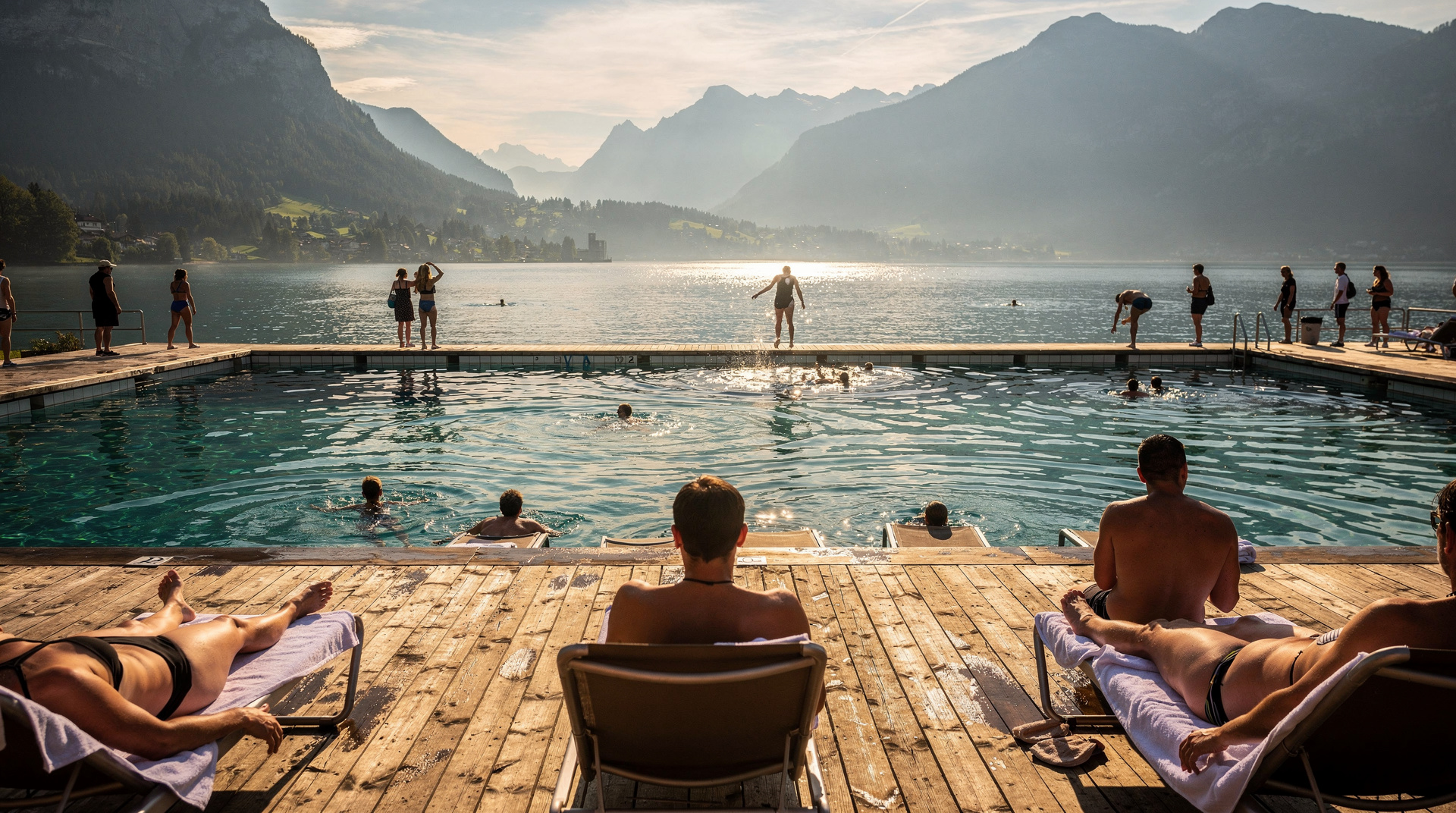
Switzerland’s most spectacular experiences are, happily, free: hiking, swimming in lakes, walking through medieval old towns, watching sunsets from mountain meadows. The best thing about Switzerland is the outdoors, and the outdoors doesn’t charge admission.
Free things: Hiking on 65,000km of marked trails. Swimming in Lake Lucerne, Lake Geneva, or any other Swiss lake. Visiting most city parks, churches, and Old Towns. Many city museums are free on the first Sunday of the month.
Worth paying for: The Lindt Home of Chocolate in Zurich is CHF 19 (entry includes tasting and a chocolate treat). The Swiss Museum of Transport in Lucerne is CHF 32. Most major art museums are CHF 15-25.
Book Lindt Home of Chocolate tickets — it’s a genuinely fun couple of hours and the CHF 150g chocolate gift included is a nice bonus.
Money-saving tools worth knowing about
Beyond the Swiss Travel Pass, a handful of other tools genuinely move the needle if you’re staying longer or traveling regularly within the country.
Half Fare Card: If you’re not doing enough travel to justify the full Swiss Travel Pass but you’re in the country a week or more, the Swiss Half Fare Card cuts most train, bus, and boat fares by 50% for around CHF 120 (roughly a month’s validity). Two or three long train journeys and it’s already paid for itself.
Regional passes: The Tell Pass and the Berner Oberland Pass cover specific regions (central Switzerland and the Bernese Oberland respectively) at a lower price than the national Swiss Travel Pass, and are worth comparing if your trip is concentrated in one area rather than criss-crossing the country.
Migros and Coop apps: Both supermarket chains have loyalty apps (Cumulus for Migros, Supercard for Coop) with regular discount coupons on prepared food — worth downloading even for a short trip, and one of several best apps for Switzerland that make daily spending easier to manage.
Staying longer, moving less: Constantly repacking and changing towns adds transport costs that a slower itinerary avoids. A budget-focused itinerary that bases in 3-4 towns rather than a new hotel every night both saves money and reduces trip fatigue.
What a realistic week actually costs
To make the daily estimates concrete, here’s a rough one-week comfortable-budget breakdown for two people doing a Zurich-Lucerne-Interlaken loop:
| Item | Approx. cost (2 people, 7 nights) |
|---|---|
| Accommodation (budget hotels) | CHF 1,200-1,500 |
| 4-day Swiss Travel Pass x2 | CHF 480-500 |
| Food (comfortable-budget style) | CHF 1,400-1,800 |
| One Jungfraujoch excursion | CHF 300-370 (with Travel Pass discount) |
| Miscellaneous (coffees, small museum, souvenirs) | CHF 200-300 |
| Rough total | CHF 3,600-4,500 |
That’s a wide range on purpose — actual spend depends heavily on how many restaurant meals you choose and which mountain excursions you add. Cross-check this against the budget itinerary if you want a day-by-day plan built around these numbers.
Frequently asked questions about Is Switzerland really that expensive? An honest breakdown
Is Switzerland more expensive than Norway or Iceland? The three are consistently ranked among Europe’s priciest destinations and trade places depending on the year and exchange rates, but day-to-day costs are broadly comparable. Switzerland’s transport network is more extensive, which can make strategic use of a pass more valuable than in Norway or Iceland.
Can you visit Switzerland on a genuinely tight budget? Yes, though it takes discipline. Hostel dorms, camping, supermarket meals, free hiking, and the Half Fare Card or Swiss Travel Pass can bring a daily budget (excluding one splurge activity) down to roughly CHF 100-120 all-in, which is tight for Switzerland but workable.
The daily budget reality check
Here’s what different types of travelers realistically spend per day in Switzerland, excluding accommodation:
Backpacker mode (CHF 60-80/day): Supermarket meals twice daily, one cafe coffee, one budget lunch or street food. Use of Swiss Travel Pass for transport (amortized). No paid activities other than hiking. This is achievable but requires discipline.
Comfortable budget (CHF 100-130/day): One restaurant meal daily (lunch special), supermarket breakfast and dinner, a coffee or two. Occasional paid activity or museum. Swiss Travel Pass transport.
Mid-range traveler (CHF 150-200/day): Two restaurant meals daily, one supermarket meal. Museum entries, occasional mountain excursion (amortized over trip). Swiss Travel Pass transport.
Splurging (CHF 250+/day): Restaurant all three meals, mountain excursions, premium activities, nice wine. Switzerland is very good at this price point.
Add accommodation on top: CHF 40 for a hostel dorm, CHF 120 for a budget hotel, CHF 200 for mid-range.
All-in daily budget estimates:
- Backpacker with hostel: CHF 100-120/day
- Comfortable with budget hotel: CHF 200-250/day
- Mid-range traveler: CHF 300-400/day
Is it worth it?
Here’s the uncomfortable truth: Switzerland is worth it in a way that’s hard to quantify. The train system is so efficient it actually saves you time and stress worth paying for. The mountains are so spectacular that the CHF 200 Jungfraujoch ticket produces memories that stick for decades. The food is genuinely good quality. The infrastructure is reliable.
And here’s the other truth: if Switzerland is at the outer edge of your budget, the strategies above genuinely help. Hostel + supermarket food + Swiss Travel Pass + strategic free activities can bring a Switzerland trip into a range that’s expensive but not outrageous. Read all our budget travel tips for more detail.
The travelers who are most disappointed by Switzerland’s costs are those who arrived without researching the numbers and discover the prices only when they’re already there. If you go in with clear eyes and a realistic budget, Switzerland won’t feel like a financial trauma — it’ll feel like a spectacular investment.