A perfect weekend in Lucerne: the complete 3-day trip report
Why Lucerne works perfectly for a weekend
Lucerne is one of those cities that makes travel writers run out of superlatives. It’s not large — the old town is walkable in an afternoon — but it manages to pack an extraordinary density of beauty, history, and mountain scenery into a very small space.
The covered wooden Chapel Bridge over the Reuss River. The medieval city walls with their watchtowers. The lion carved into a cliff face. The lake stretching south toward snow-capped peaks. The old town buildings with their painted facades. And just beyond all of it, the mountains — Mount Pilatus to the southwest, Mount Rigi to the east, Stanserhorn to the south — rising dramatically from the water.
Three days in Lucerne gives you enough time to see the city properly, take a mountain day trip, spend time on the lake, and still sit somewhere beautiful eating raclette without feeling rushed. Here’s how to spend them.
At a glance
| Where | Lucerne, central Switzerland, on Lake Lucerne |
| Time needed | 3 full days (2 is workable but rushed) |
| Getting there | Around 1 hour direct train from Zurich, roughly 2 hours from Basel or Bern, about 2h30 from Geneva |
| Cost (rough) | Mid-range hotel around CHF 200-300/night; a Pilatus or lake excursion day typically adds CHF 40-100 per person depending on pass coverage |
| Best time | Late spring and September-October for clearer mountain views and thinner crowds; summer is busiest |
Before you arrive
Lucerne is centrally located in Switzerland — about an hour by direct train from Zurich, around 2 hours from Basel or Bern, and 2h30 from Geneva. It’s a natural hub if you’re doing a broader Switzerland trip.
The Swiss Travel Pass is the smart transport option for a Lucerne weekend, covering the train in, city transport, most lake boats, and offering significant discounts on mountain excursions like Pilatus and Rigi.
Book accommodation early if you’re visiting in summer. Lucerne is deservedly popular and the good hotels fill up months in advance.
Day one: the city itself
Start slow. Lucerne rewards wandering, and the old town is best appreciated without a schedule.
Morning: the Chapel Bridge and Old Town
Begin at the Kapellbrücke (Chapel Bridge) in the morning before the day-trip crowds arrive. This 14th-century wooden covered bridge is the most photographed structure in Switzerland, and with good reason — it’s both architecturally remarkable and visually stunning, especially from the water side at the foot of the octagonal Water Tower.
The interior of the bridge is hung with 17th-century paintings depicting events from Swiss and Lucerne history. Many are damaged (a 1993 fire destroyed a significant portion of the bridge, which was subsequently rebuilt) but still worth examining as you walk across.
From the bridge, explore the old town streets. The Weinmarkt square has a beautiful Renaissance fountain and is surrounded by painted medieval facades. The surrounding lanes — Kramgasse, Metzgerrainle, Rathausgasse — are full of good cafes, independent shops, and architectural details worth looking up for.
Climb one of the accessible watchtower sections of the Museggmauer — the medieval city wall that still stands largely intact above the old town. The Zytturm (clock tower) gives a view over the rooftops that the Chapel Bridge photos can’t capture.
Afternoon: the lake and transport museum
Walk south from the old town to the lake promenade. The quays along Lake Lucerne are lined with grand belle-époque hotels that remind you how long Lucerne has been a tourist destination — wealthy Victorians were arriving here by train in the 1860s.
The Swiss Museum of Transport (Verkehrshaus der Schweiz) sits about 15 minutes east of the old town by foot or a short bus ride. It’s the most visited museum in Switzerland for good reason — it’s enormous, covers every form of Swiss transport from historic steam locomotives to modern aircraft to boats, and has enough interactive exhibits to keep you engaged for three hours. The Planetarium inside is a bonus.
If you have the Swiss Travel Pass, entry is free.
Evening: dinner in the old town
The old town has good options across all price ranges. For traditional Swiss food, look for places serving Älplermagronen (Swiss mac and cheese with potatoes and apple sauce), Rösti, or a full fondue experience. The fondue restaurants fill up in autumn and winter — book in advance.
The lake promenade has upscale hotel restaurants with views worth paying for on a clear evening.
Day two: Mount Pilatus
Clear a full day for Mount Pilatus — it’s the most dramatic excursion from Lucerne and the Golden Roundtrip makes it one of the most enjoyable travel experiences in all of Switzerland.
The Golden Roundtrip
The classic approach: take a lake steamer from Lucerne’s Bahnhofquai south to Alpnachstad (about 90 minutes on the boat, which is a lovely experience on its own). From Alpnachstad, board the world’s steepest cogwheel railway — grades up to 48% — to the summit of Pilatus at 2,132 meters. The views during the ascent are extraordinary, and the railway itself is a remarkable engineering feat.
At the top: two peaks (Pilatus Kulm and Tomlishorn), a network of cliff-side walking paths, panoramic restaurant terraces, and views that on a clear day extend across dozens of Swiss peaks and deep into Germany and France. The limestone formations and the dragon statues (Pilatus has a medieval legend involving dragons — naturally) add atmosphere.
Descend via the cable cars: aerial gondola from Pilatus Kulm to Fräkmüntegg (passing over a deep limestone gorge), then the large cable car from Fräkmüntegg down to Kriens, then bus back to central Lucerne. Total descent time: about 30 minutes versus 90 minutes on the cogwheel railway.
Book the Mount Pilatus Golden Roundtrip from Lucerne — Swiss Travel Pass holders get significant discounts on the mountain portions.
On the summit
Allow 2-3 hours at the top. The cliff path between Pilatus Kulm and Esel (the higher of the two accessible summits) takes about 20 minutes each way and gives a perspective that’s different from the main terrace. In clear conditions, you can see the Bernese Alps, the Valais peaks including the distinctive outline of the Weisshorn, and on exceptional days, far beyond.
There’s a restaurant at the top if you want lunch with a view. Prices are what you’d expect at altitude — not cheap, but the view is free with your meal.
Back in Lucerne
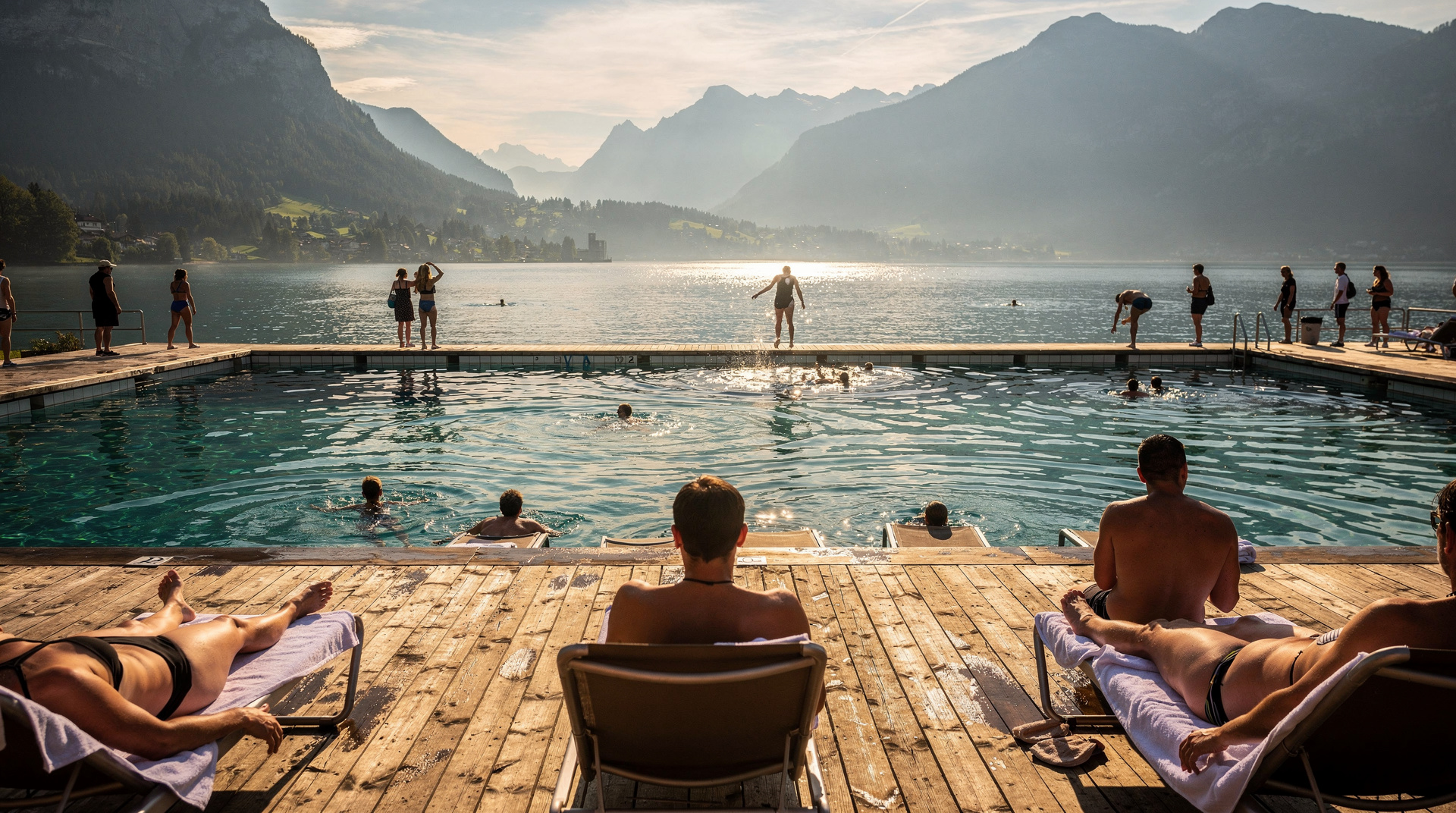
After a full mountain day, a lakeside walk and a quiet dinner is usually exactly right. The Seebad Enge — a historic lakeside lido about 20 minutes from the center — is perfect for a swim if the weather cooperates.
Day three: lake cruise and quieter pleasures
The third day in Lucerne is for the lake and the things you missed.
Morning: lake cruise
Lake Lucerne (Vierwaldstättersee — literally “Lake of the Four Forest Cantons”) is one of the most dramatic lakes in Switzerland, extending south and east from the city in a series of fjord-like arms between steep mountain slopes. It’s best seen from the water.
Book a Lake Lucerne catamaran cruise for a 1-hour circuit of the central part of the lake with excellent views of the mountains and city skyline.
Alternatively, the SGV lake steamers (covered by Swiss Travel Pass) run regular services to Weggis, Vitznau (the base of the Rigi railway), Beckenried, and Brunnen — longer journeys that give more time on the water and options for stopping off.
Midmorning: the Lion Monument and Glacier Garden
The Löwendenkmal (Lion Monument) is carved directly into a cliff face just north of the old town. Designed by Bertel Thorvaldsen and completed in 1821, it commemorates the Swiss Guards who died defending Louis XVI of France during the French Revolution. Mark Twain visited in 1879 and called it “the most mournful and moving piece of stone in the world.”
It takes about two minutes to see, but those two minutes are genuinely affecting. The carved lion — dying, a spear broken in its flank — has a quality of expression that’s hard to explain and easy to feel.
The Glacier Garden next door is more time-consuming — a geological park built around glacial potholes carved 20 million years ago, with a surprisingly good museum about Ice Age Switzerland. The historic mirror maze in the park is a slightly surreal bonus.
Afternoon: roastery, Hofkirche, and the lakeshore
Lucerne has an excellent specialty coffee scene. The Mame Coffee Roasters near the train station and several others in the old town are worth stopping into for the kind of coffee that can convert previously indifferent drinkers.
The Hofkirche — Lucerne’s main church, built on the site of a Benedictine monastery — has twin neo-Gothic towers visible from across the lake. The interior is impressive baroque and worth ten minutes.
Spend the remaining afternoon on the lakeshore. The promenade south of the city, past the boathouses and toward Meggen, is quieter than the central area and very beautiful in the afternoon light.
Evening: final dinner
If you haven’t done fondue yet, tonight is the night. A proper Swiss cheese fondue for two, with a carafe of local white wine, is one of the most satisfying evening meals in Switzerland. It takes time — fondue is inherently slow food — and it’s rich enough that you won’t want much more. Perfect for a last evening before heading home or moving on.
Practical notes for a Lucerne weekend
Getting around: Lucerne is very walkable. The old town, lake promenades, Glacier Garden, and even the Museum of Transport are all accessible on foot. City buses are cheap and frequent for longer distances.
Weather: Lucerne’s lake position creates its own microclimate — fog is common in autumn and winter, particularly in the mornings. This can affect mountain views, so check Pilatus webcams before committing to a mountain day. Summer is reliably warm and clear. October is spectacularly beautiful.
Day trips: Beyond Pilatus, Lucerne is an excellent base for Mount Rigi (the “Queen of the Mountains”), Engelberg (base for Mount Titlis, with year-round snow), and even Interlaken as a long day trip.
Pilatus or Rigi: which mountain if you only have one day
Both are classic Lucerne excursions and both are covered (partly or fully) by the Swiss Travel Pass, but they suit slightly different travellers.
| Mount Pilatus | Mount Rigi | |
|---|---|---|
| Signature experience | World’s steepest cogwheel railway, cliff-side paths | Gentler summit, wide panorama, easier walking |
| Getting up | Lake steamer + cogwheel railway (the “Golden Roundtrip”) | Cogwheel railway from Vitznau or cable car from Weggis |
| Best for | First-time visitors wanting the most dramatic single excursion | Families, slower pace, sunrise/sunset trips |
| Approx. time needed | Full day | Half day to full day |
| Crowd level | Busy but well-managed | Slightly quieter on average |
If you’re doing both Lucerne and a broader loop through central Switzerland, Pilatus fits naturally into the itinerary above and Rigi is worth adding on a fourth day or a separate future trip.
Where to stay for a Lucerne weekend
The old town puts you within walking distance of everything on Day 1 and Day 3, but rooms there book up fastest and cost the most. The area around the train station is a practical middle ground — a few minutes’ walk to the old town and to the lake steamer piers, with better value than lakefront addresses. If you’d rather have quiet evenings, look just south along the lake promenade toward Meggen; you trade a slightly longer walk for calmer nights and better sunset views back toward the mountains.
However you plan transport within the city, the same Swiss trains and transport principles that apply nationally hold here: buy the pass that matches how much moving around you’ll actually do, not the one that sounds most complete.
Crowds: The Chapel Bridge and Old Town are extremely busy from 10am to 4pm in summer. Go early (before 9am) for photography and quiet wandering. The lake and mountain excursions have their peak crowds around midday.
Three days in Lucerne leaves most people wanting to come back. The city has a quality to it — the combination of lake, mountains, medieval architecture, and Swiss efficiency — that is uniquely its own and difficult to find anywhere else in Europe.
Check the best time to visit guide if you’re still deciding when to go. And if you’re planning a broader Switzerland trip, the 7-day itinerary fits Lucerne in as a natural stop alongside Zurich and the Bernese Oberland.
If you haven’t nailed down the classic Swiss cheese fondue on Day 3, the fondue guide covers etiquette and where to find the real thing, and the best museums guide has more on the Transport Museum and where else it ranks nationally.
Frequently asked questions about perfect weekend in Lucerne
Is two days enough for Lucerne, or do you really need three? Two days works if you’re willing to choose between the city (old town, lake, Transport Museum) and a mountain excursion — you likely won’t comfortably fit both plus the lake cruise. Three days lets you do all three without rushing, which is why this itinerary is built around a long weekend rather than a quick stop.
Is Lucerne walkable, or do you need public transport? The old town, lake promenades, Glacier Garden, and even the Museum of Transport are all reachable on foot from most central hotels. You’ll only need buses or boats for the mountain excursions and longer lake trips, both of which are covered or discounted by the Swiss Travel Pass.