Lake Lucerne cruises: the complete guide
Are Lake Lucerne cruises covered by the Swiss Travel Pass?
Yes — all regular SGV (Schifffahrtsgesellschaft Vierwaldstättersee) services on Lake Lucerne are fully covered by the Swiss Travel Pass. No supplement is required for standard routes.
Why Lake Lucerne is Switzerland’s best cruise
| Where | Lucerne, Central Switzerland, with piers at Vitznau, Weggis, Alpnachstad, Brunnen, Flüelen |
| Cost | Free with the Swiss Travel Pass; individual tickets typically around CHF 15-40 depending on route |
| Time needed | 40 minutes (Lucerne–Weggis) to a full day (Lucerne–Flüelen traversal) |
| Getting there | The Lucerne pier (Schifflände) is a 5-minute walk from the main railway station |
| Best time | May-October for full paddle-steamer service; July-August for Sunday steamer departures specifically |
Lake Lucerne — Vierwaldstättersee in German, which translates as the Lake of the Four Forest Cantons — is the most complexly shaped of Switzerland’s major lakes. While Lake Geneva and Lake Zurich are simple elongated basins, Lake Lucerne spreads in a cruciform pattern: four arms reach into the valleys carved by glaciers descending from the pre-Alps, each arm with its own character, each bend in the route revealing a new configuration of peaks, cliffs, and reflections. This distinctive shape makes a Lake Lucerne cruise fundamentally different from any other boat journey in Switzerland — the scenery does not simply repeat along a single axis but continuously transforms as the vessel navigates between mountain peninsulas and narrows.
The lake spans 38 square kilometres and stretches 38 kilometres from the Lucerne harbour to Flüelen at the southern end. It sits at 434 metres above sea level, surrounded by mountains rising to over 2,000 metres — Pilatus (2,132m) to the west and Rigi (1,798m) to the east are the dominant peaks from the lake’s main basin. The Uri arm to the south, where the lake squeezes between increasingly high and steep mountain walls, has a more dramatically Alpine character than the open main basin around Lucerne.
A cruise on Lake Lucerne is not merely a tourist experience — it is an integral part of the Swiss national transport system. The lake boats have operated continuously since the steamship era, and scheduled services serve commuters, schoolchildren, and walkers as well as visitors. This working function means the timetables are dense, the boats are frequent, and the infrastructure at lakeshore villages is genuinely useful rather than merely scenic.
The operator: SGV
The Schifffahrtsgesellschaft Vierwaldstättersee (SGV) has operated the Lake Lucerne fleet since 1837 — one of the oldest continuously operating lake navigation companies in the world. The fleet comprises historic paddle steamers, modern motor vessels, and a catamaran, with different vessels assigned to different routes on different days according to a published schedule.
SGV operates from the main landing stage in Lucerne (Schifflände, directly below the Kapellbrücke) and from secondary ports at Alpnachstad, Vitznau, Beckenried, Weggis, Brunnen, Sisikon, and Flüelen. Timetables are published seasonally and coordinated with the SBB rail timetable at connecting stations.
Routes and journey times from Lucerne
Full lake traversal: Lucerne to Flüelen
The complete lake traversal from Lucerne to Flüelen takes approximately 3 hours 30 minutes southbound (the Uri arm section has slower speed limits). Flüelen, at the southern end, is the gateway to William Tell country — the Rütli Meadow (where the Swiss Confederation was founded in 1291) is accessible from the stop at Treib, a short walk below the meadow on the east shore.
The journey passes through the main lake basin (open water with Pilatus and Rigi visible), rounds the Bürgenstock peninsula, enters the narrower Gersauer Becken, passes Brunnen (junction of the Uri and Küssnacht arms), and then follows the increasingly dramatic Uri arm beneath near-vertical cliff faces. The scenery in the final hour — the lake flanked by rock walls rising 1,000 metres from the water — is the most Alpine section and the most compelling.
This is the definitive Lake Lucerne experience. Allow a full day: 3.5 hours each way is too long to do both directions in a single day comfortably; return by fast boat (approximately 2 hours) or by the Gotthard rail route via Erstfeld and back to Lucerne (about 2 hours by train).
Lucerne to Vitznau
Journey time: 50 minutes. Vitznau is the base station for the Rigi rack railway — the oldest mountain railway in Europe, opened 1871. Arriving by lake boat and ascending Rigi by rack railway is the classic combination for a Central Switzerland day excursion. Return by the Arth-Goldau rack railway (different line, different scenery, reaching the south end of Lake Zug) and train back to Lucerne. Total circuit: a full day well spent.
Lucerne to Weggis
Journey time: 40 minutes. Weggis is a lakeside village with a mild microclimate (palm trees, fig trees — a product of the lake’s moderating effect on temperatures) and the base station for the Rigi Kaltbad cable car — an alternative, more scenic route to the Rigi summit. The village has a relaxed lakefront promenade and several good restaurants.
Lucerne to Alpnachstad
Journey time: 50 minutes. Alpnachstad is the base station for the Pilatus cogwheel railway — the steepest rack railway in the world, at a maximum gradient of 48%. The Golden Round Trip combines boat from Lucerne to Alpnachstad, cogwheel railway to Pilatus summit, gondola and cable car system down to Kriens, then bus back to Lucerne — a full-day circuit that is one of the most satisfying in Central Switzerland.
Lucerne to Brunnen
Journey time: 1 hour 40 minutes. Brunnen is at the junction of the Rütli arm and the main Uri arm — the launch point for boat connections to the Rütli Meadow and Schiller Stone. The village is also the northern gateway to the Axenstrasse, the dramatic lakeside road carved through the cliff face above the Uri arm.
Cross-lake services
Several cross-lake car ferry services operate between the east and west shores — most importantly the Beckenried–Gersau and Treib–Kehrsiten services. These are primarily used by road vehicles and cyclists but also by walkers using the lake as a shortcut between hiking routes on opposite sides.
The paddle steamers
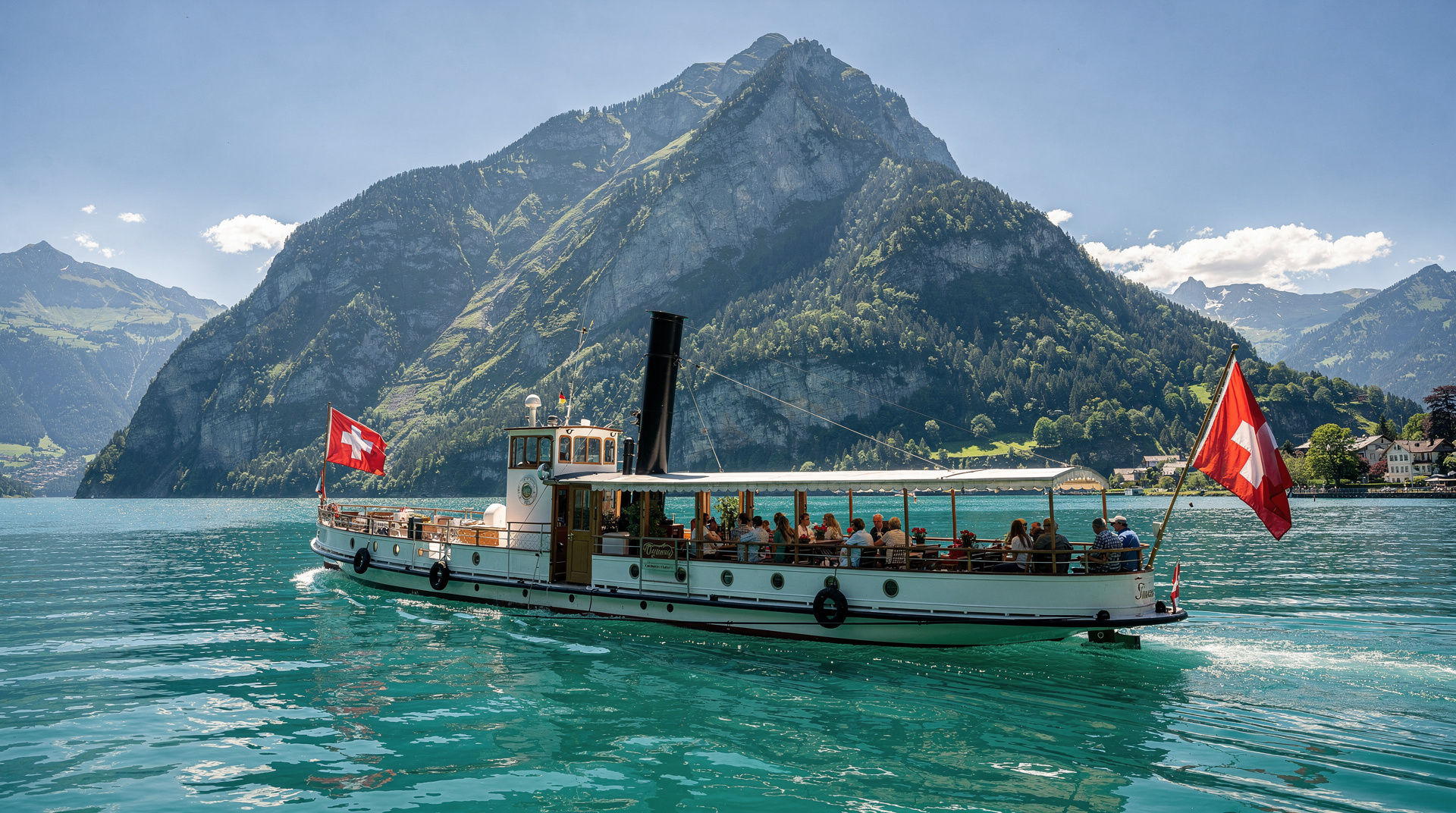
The SGV fleet includes five restored Belle Époque paddle steamers that are the finest historic vessels on any Swiss lake:
Stadt Luzern (1928): the flagship and the most commonly used for charter and special cruises. Twin-paddle design, fully restored, with a traditional deck saloon.
Uri (1901): the oldest in the fleet, a three-deck vessel with beautiful woodwork in the saloon.
Unterwalden (1902): similar profile to Uri, with a particularly fine dining saloon frequently used for charter events.
Schwyz (1954): the most recently built of the paddle steamers, with a more streamlined profile reflecting post-war design.
Wilhelm Tell (1908): slightly smaller than the main fleet vessels, used on specific routes and charter.
Paddle steamers are slower than the motor vessels (they travel at about 20 km/h versus 30+ for modern vessels) and their routes are specified in the seasonal timetable. Summer weekends and public holidays are the most reliable times to find them in operation. The SGV website and app specify vessel types by departure.
The experience of crossing Lake Lucerne on a paddle steamer — the rhythmic beat of the paddles, the wide deck saloon, the unhurried pace — is among the most evocative forms of Swiss travel and represents a continuity with the era of grand Alpine tourism that is largely gone elsewhere.
Seasonal schedule
Summer (May to October)
Full network operation with maximum frequency. All paddle steamers in active service. Evening cruises with dining (fondue cruises, candlelight cruises) operate on specific dates throughout the summer. Frequency on main routes: hourly or better from Lucerne to major stops.
The fondue cruise — a 2-hour evening departure from Lucerne with a fondue dinner served on board — is one of the most popular summer bookings and sells out well in advance for Friday and Saturday evenings. Book through the SGV website or at the Lucerne boat landing stage.
Autumn (October to November)
Reduced but serviceable schedule; the lake is beautiful in autumn with mist and golden larch on the hillsides. Some paddle steamers retire for winter maintenance. Evening cruises cease after October.
Winter (December to March)
Winter schedule operates with motor vessels on main routes; frequency is reduced. The lake is rarely frozen (it is too large and deep) but conditions can be raw. The Lucerne–Vitznau–Weggis circuit operates year-round. Special Christmas and New Year cruises run in December.
Spring (April to May)
Services rebuild through April; the full summer schedule typically begins in May. Spring is a beautiful season on the lake — the hillsides are turning green, wildflowers appear on the lower slopes, and the mountains retain significant snow above 1,500 metres.
Booking options
Swiss Travel Pass
The Swiss Travel Pass covers all regular SGV services at no additional charge. This is the most economical approach for visitors using public transport for a Switzerland itinerary. The pass does not cover charter cruises, special dining cruises, or tourist-only vessels designated as supplements.
Individual tickets
Point-to-point tickets can be purchased at the Lucerne boat terminal or at major lakeshore stops. Day passes (covering unlimited travel on the lake) are available and represent good value for a full-day lake exploration.
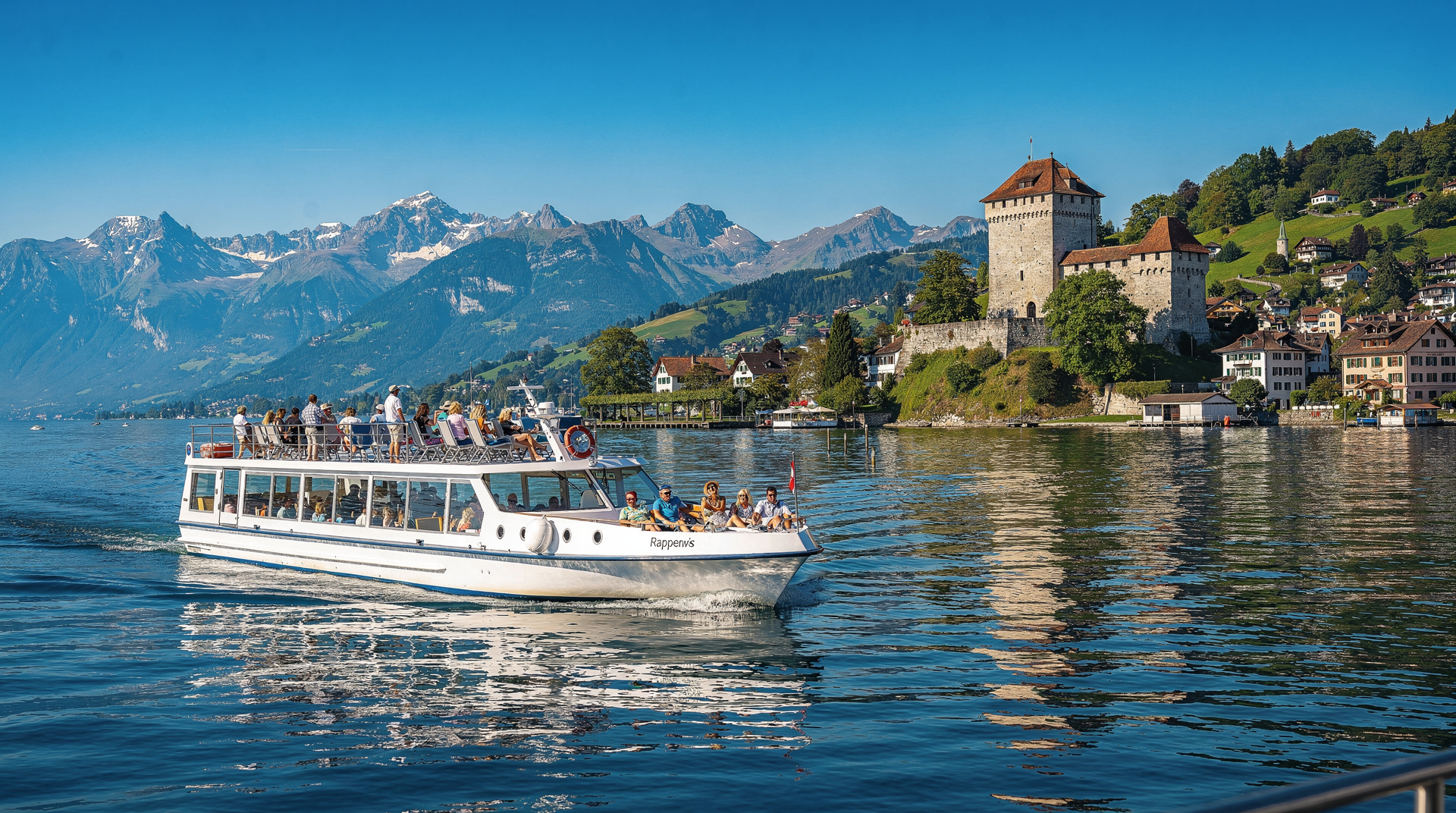
Book a 1-hour catamaran cruise on Lake Lucerne Book a Lake Lucerne 1st class cruise with 3-course lunchThe catamaran cruise is the best option for a fast, modern one-hour introduction to the lake and the Lucerne panorama. The 1st class lunch cruise offers a more leisurely experience on a larger vessel with a full meal — ideal for a special occasion or when time allows a longer lake experience.
Best shore excursions from the lake
Rütli Meadow
The Rütli is a small meadow on the western shore of the Uri arm, accessible by boat from Treib, Brunnen, or the dedicated Rütli landing. The founding oath of the Swiss Confederation was sworn here in August 1291 — the date is commemorated annually on 1 August (Swiss National Day) with a ceremony attended by the Federal Council. The meadow is an anti-climax visually (a meadow is a meadow) but carries a weight of symbolic meaning for Swiss national identity that makes the visit meaningful in context. The views across the Uri arm from the Rütli terrace are genuinely fine.
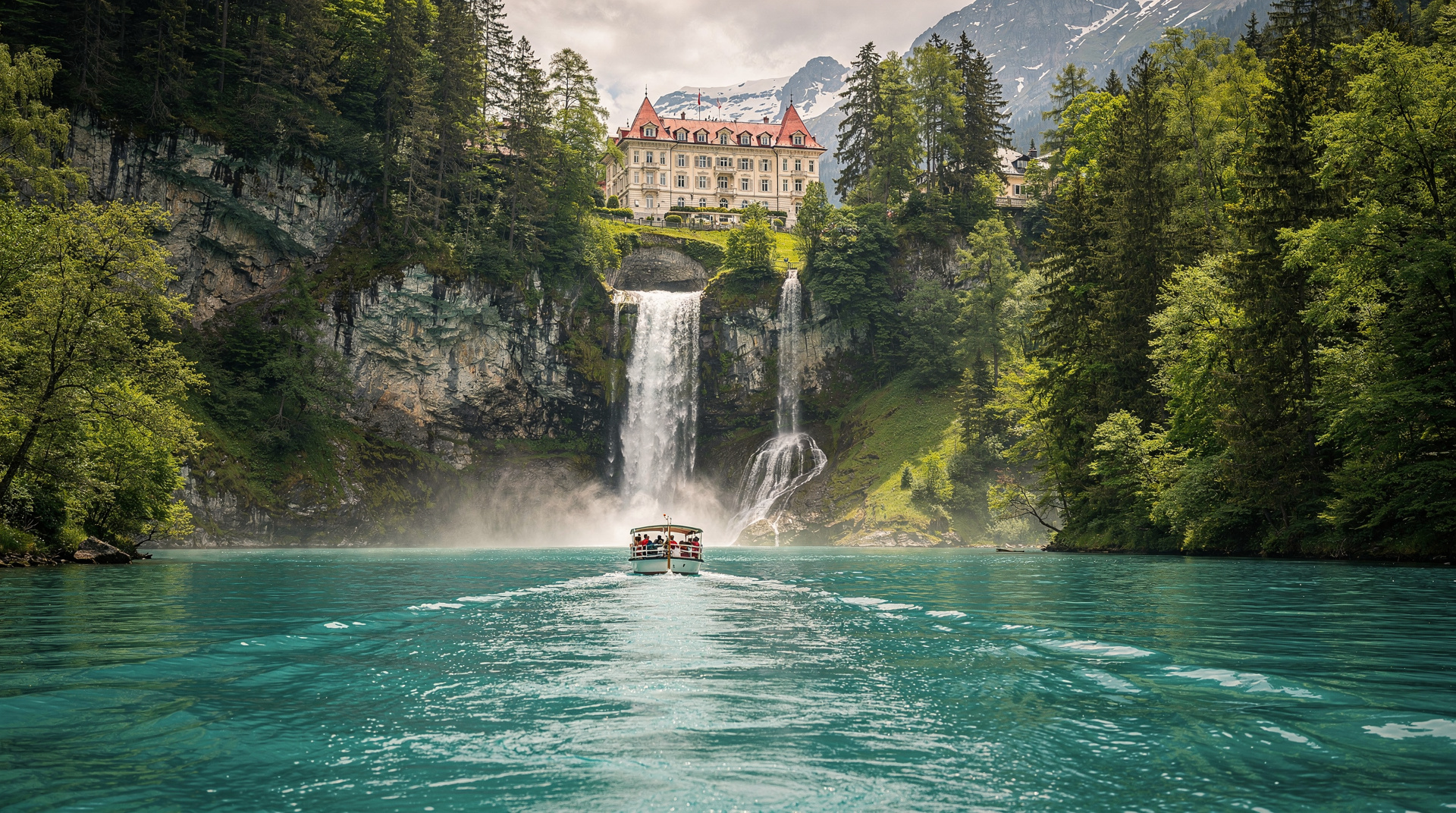
Giessbach Falls, Brienz arm
Note: Giessbach is on Lake Brienz rather than Lake Lucerne, but visitors based in Lucerne can reach it via a day trip combining the lake boat to Brienz and then local boat to Giessbach. See the Lake Thun and Brienz cruises guide for details.
Bürgenstock
The Bürgenstock is a limestone plateau rising from the west shore of the main lake basin to 874 metres, with cliff walks and views that are among the finest accessible without mountain equipment. The Hammetschwand Lift — the highest exterior elevator in Europe, carrying visitors 152 metres up the cliff face — connects the lake-level landing stage to the plateau. The Bürgenstock Resort above has a luxury hotel and spa; the cliff path to the Hammetschwand is free and spectacular.
Combining with mountain excursions
The lake boats integrate seamlessly with the mountain railway and cable car systems at lakeshore stations. The classic circuits:
Pilatus Golden Round Trip: Lucerne boat to Alpnachstad (50 min), cogwheel railway to Pilatus summit (40 min), gondola and cable car to Kriens (30 min), bus to Lucerne (15 min). Total: full day.
Rigi circuit: Lucerne boat to Vitznau (50 min), rack railway to Rigi Kulm (35 min), rack railway to Arth-Goldau (40 min), S-Bahn to Lucerne (1 hour via Zug). Total: full day.
Titlis day trip: Lucerne to Engelberg by train (45 min), Titlis cable car system (top station at 3,020m), return. Can combine with a short lake cruise on return if time allows.
Practical tips
Arrive early at Lucerne’s boat terminal during summer weekends — popular paddle steamer departures can fill the outdoor deck quickly, particularly the first Sunday departures of July and August.
The upper deck is always preferable for views but exposed to wind; bring a layer even in summer, as the lake breeze is cooling.
Meals on board: the larger vessels have restaurant service; the smaller motor vessels have snack kiosks. For the Lucerne to Flüelen full traversal, it is worth having lunch on board rather than at a shore stop, as it maximises viewing time.
Weather: Lake Lucerne weather can change rapidly. Clear mornings in summer often develop afternoon thunderstorms; plan mountain excursions for early in the day and return lake crossings for mid-afternoon.
Language: boat announcements in German; most crew speak functional English for tourist queries.
Matching a route to your time
| If you have… | Take | Journey time |
|---|---|---|
| Under an hour | Lucerne–Vitznau or Lucerne–Weggis | 40-50 minutes |
| Half a day | Lucerne–Vitznau plus the Rigi rack railway | ~5-6 hours round trip |
| A full day | Lucerne–Flüelen full traversal | ~3h30 one way |
| A full day, mountain-focused | Pilatus Golden Round Trip | full day |
Anyone deciding between Lucerne and the Bernese Oberland lakes as a base should also read the Interlaken vs Lucerne comparison, since both regions pair a lake cruise naturally with a mountain railway day.
Combining the cruise with an old town visit
Lucerne’s old town sits directly at the boat terminal, so a lake excursion can bookend a walk through the covered Kapellbrücke, the Musegg Wall towers, and the painted merchant houses of the Altstadt without any additional transport. Visitors staying nearby should also check where to stay in Lucerne for neighbourhoods within easy reach of the Schifflände pier.
Getting to Lucerne
Lucerne is one of the most accessible Swiss cities: 45 minutes from Zurich by direct train, 70 minutes from Zurich Airport, 1 hour 10 minutes from Bern. The boat terminal is a 5-minute walk from the main station. For more on the city and its surroundings, see the Central Switzerland region guide.
For lake cruise comparisons across all Swiss lakes, see the lake cruises overview. The Swiss Travel Pass guide explains how to cover lake boats as part of a broader Switzerland transport pass. For multi-day itinerary planning, the 7-day Switzerland itinerary typically includes a Lake Lucerne cruise as one of the week’s highlights.
Frequently asked questions about Lake Lucerne cruises
Is the Lucerne to Flüelen boat trip worth the full day? For most first-time visitors, yes — the Uri arm’s final hour beneath near-vertical cliffs is the single most dramatic stretch of water in Central Switzerland, and returning by the Gotthard rail route via Erstfeld keeps the round trip to a manageable day rather than requiring two boat legs.
Do I need to book a specific paddle steamer sailing in advance? Regular scheduled sailings don’t require booking, but if you want a specific historic vessel like the Stadt Luzern or Uri, check the SGV timetable for that day’s vessel assignment — the same route can run on a modern motor vessel on other departures.