Lake cruises in Switzerland: the complete guide to all five lakes
Are lake cruises in Switzerland covered by the Swiss Travel Pass?
Yes — regular lake cruise services on all major Swiss lakes are fully covered by the Swiss Travel Pass. Dinner cruises, special panoramic boats, and tourist-only services may require supplements.
Lake cruises in Switzerland: a complete guide to the five great lakes
| Where | Five lake systems: Lucerne, Geneva, Zurich, Thun/Brienz, Lugano — spread across German, French, and Italian Switzerland |
| Cost | Free with the Swiss Travel Pass on regular services; individual tickets typically around CHF 20-40 for a 1-2 hour section |
| Time needed | From 40 minutes (short hops) to a full day (Lucerne–Flüelen full traversal) |
| Getting there | All main lakes have a lakeshore rail station a few minutes’ walk from the boat pier |
| Best time | June-September for full services and paddle steamers; shoulder months for lighter crowds and comparable views |
Switzerland has 1,484 lakes. Only five of them are large enough to support scheduled passenger boat services with the frequency, infrastructure, and scenic quality to be considered major cruise destinations. These five — Lake Lucerne (Vierwaldstättersee), Lake Geneva (Lac Léman), Lake Zurich (Zürichsee), Lake Thun and Lake Brienz in the Bernese Oberland, and Lake Lugano (Lago di Lugano) — are among the most beautiful stretches of water in Europe, each with a distinct character shaped by the mountains around it, the culture of the surrounding cantons, and the history of the settlements on its shores.
A lake cruise in Switzerland is not simply a tourist activity. The lake boat services have operated continuously since the steamship era, and regular routes serve commuters and schoolchildren as well as visitors. The boats — many of them beautifully restored paddle steamers or modern catamarans — are part of the Swiss national transport system and are fully integrated with rail connections at the lakeshore stations. The Swiss Travel Pass covers regular boat services on all five lakes, making a cruise an essentially free activity for pass holders.
This guide covers all five lake systems in detail: the routes, the best views, the key stops, the vessel types, seasonal services, and the most attractive ways to combine cruises with scenic train journeys and shore excursions.
Lake Lucerne 1st class cruise with 3-course lunch
Cruise the most dramatic lake in Switzerland aboard a historic vessel with a three-course Swiss lunch. Pilatus, Rigi, and the Uri Alps as your backdrop.
- Free cancellation
- from CHF 89
Lake Lucerne (Vierwaldstättersee)
Overview
Lake Lucerne is the most dramatically situated of the Swiss lakes — not a simple elongated basin but a cruciform shape with four arms stretching between the pre-Alps of Central Switzerland. The lake’s shape reflects the glacial history of the region: four different valleys were carved by ice descending from the Alps, their floors filled with meltwater to create the complex lake we see today.
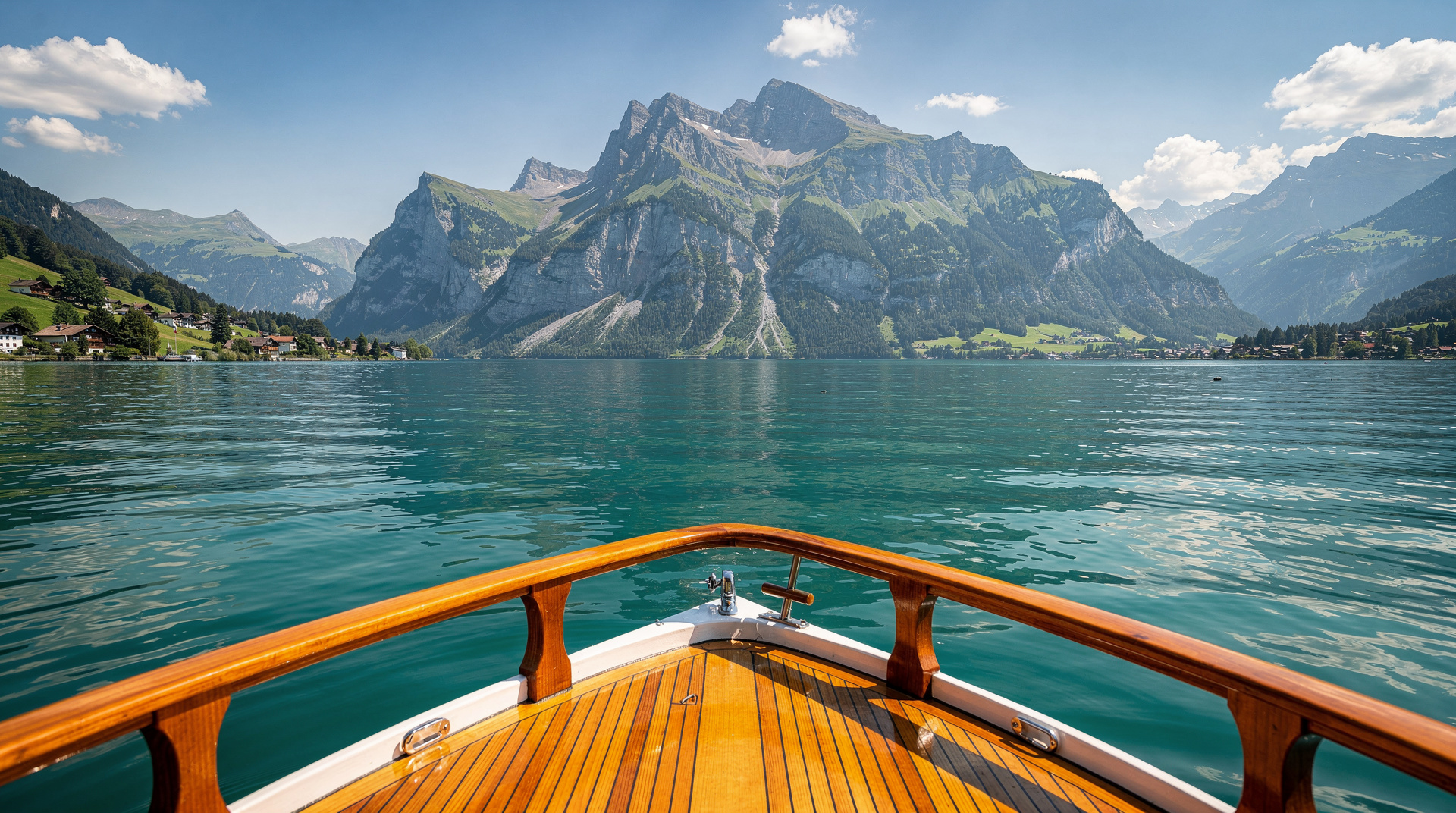
The result is a lake that presents continuously changing mountain scenery. No single viewpoint takes in the full extent of the water; as the boat rounds each promontory, a new configuration of mountains and reflections opens out. On a clear day, the view from the middle of the lake includes Pilatus (2,132m), Rigi (1,798m), and the Uri Alps to the south — a panorama of distinctive peaks assembled around the water.
Lucerne is the main port, and it is one of Switzerland’s most beautiful lakeside towns: the Chapel Bridge, the Water Tower, the painted façades of the old town, and the backdrop of Pilatus are among the most photographed ensembles in Switzerland.
Routes and journey times
The Schifffahrtsgesellschaft Vierwaldstättersee (SGV) operates the Lake Lucerne fleet. Key routes from Lucerne:
- Lucerne to Flüelen (full lake traversal, southern arm): approximately 3 hours 30 minutes. Flüelen is the departure point for the William Tell legend, and the Uri lake arm is the most Alpine section of the lake — steeper sides, more dramatic scale.
- Lucerne to Vitznau: 50 minutes. Vitznau is the base station for the Rigi rack railway (oldest in Europe, opened 1871).
- Lucerne to Weggis: 40 minutes. Gateway to the Rigi Kaltbad spa (see best spas guide).
- Lucerne to Brunnen: 1 hour 40 minutes. Brunnen is the northern gateway to the Schiller Stone and the founding site of the Swiss Confederation.
- Lucerne to Alpnachstad: 50 minutes. Base station for the Pilatus cogwheel railway (steepest in the world at 48% gradient).
The paddle steamers
The Lake Lucerne fleet includes several restored Belle Époque paddle steamers — the Stadt Luzern (1928), the Uri (1901), and others — that operate on summer routes alongside modern diesel and catamaran vessels. These historic boats are more elegant, slower, and considerably more atmospheric than the modern fleet. SGV specifies which vessels operate which routes on specific days; check at lucerne.ch or sbb.ch.
Book a 1-hour catamaran cruise on Lake LucerneSwiss Travel Pass coverage
Full coverage on all SGV regular services. The Tell-Pass (regional pass for Central Switzerland) also covers boats plus mountain railways — worth considering for multi-day stays focused on the lake region.
Best cruise on Lake Lucerne
The classic Lucerne to Flüelen full traversal, taken on a paddle steamer in summer, remains the finest Lake Lucerne experience — the progression through the lake’s arms, the changing mountain character, and the arrival at Flüelen below the dramatic Uri backstop is about 3.5 hours of sustained scenic quality. Return by fast boat or by the Gotthard rail route via Erstfeld.
Lake Geneva (Lac Léman)
Overview
Lake Geneva is the largest lake in Western Europe — 73 km long, 14 km wide at maximum, covering 580 square km. Unlike Lake Lucerne, it is a simple elongated basin oriented southwest to northeast, with the Alps visible on both shores (French Savoie to the south, Swiss Vaud and Valais to the north). The scale is oceanic by Swiss standards — on a hazy day, the opposite shore is not visible from the main cities.
The lakeshore cities are remarkable: Geneva at the western end, where the Rhône leaves the lake, with its UN institutions, watchmaking tradition, and French cultural tone; Lausanne on the north shore, the Swiss capital of the International Olympic Committee; Montreux at the eastern end, where the Lavaux vineyards descend to the water and the Chillon Castle stands on a rocky promontory over the lake.
The CGN fleet
The Compagnie Générale de Navigation (CGN) operates Lake Geneva’s passenger services. Like Lake Lucerne, the fleet includes several beautifully preserved Belle Époque paddle steamers — the Rhône (1927), the Simplon (1920), the Savoie (1914) — maintained in working order and operating on summer routes alongside modern vessels.
Routes and journey times
- Geneva to Lausanne: 3 hours 30 minutes (regular service). The direct train takes 35 minutes, which puts the relative experience in perspective — the boat is for the journey, not the destination.
- Geneva to Montreux: 4 hours 30 minutes by regular service.
- Lausanne to Montreux: 1 hour 30 minutes (passing the Lavaux vineyards).
- Montreux to Chillon Castle: 10 minutes. The castle is visible from the boat before and after the brief stop.
- Geneva short cruise (50 minutes): A round trip from Geneva covering the central lake, the Jet d’Eau, and the lakefront — the most popular tourist option for those without time for a longer journey.
Swiss Travel Pass coverage
Full coverage on all CGN regular services. The Léman Pass covers unlimited boat and rail travel in the Lake Geneva region.
For an enhanced Geneva lake experience, the scenic Lake Geneva cruise with snacks and wine is a popular choice, or the Geneva Grand Tour 2-hour lake cruise for a more comprehensive circuit.
Best cruise on Lake Geneva
The Lausanne to Montreux section in the late afternoon, passing below the Lavaux vineyards as the light turns golden on the terraced slopes, with the Chablais Alps reflecting in the still water to the south. This 1.5-hour section captures the finest visual combination of the lake. Return by train in 25 minutes.
Lake Zurich (Zürichsee)
Overview
Lake Zurich is the most populous lakeshore in Switzerland — 83 municipalities border it, including Switzerland’s largest city at the northwestern tip. The lake stretches 40 km southeast from Zurich’s Bürkliplatz, narrowing as it enters the Zurichsee Obersee above Rapperswil. The surrounding hills are green and settled, the Alps visible at the far end in clear conditions.
By Swiss lake standards, the scenery is more pastoral than dramatic — this is not the rock-and-glacier environment of Lake Lucerne or the Alpine massif framing Lake Geneva. The appeal is gentler: the pleasant residential shore villages, the vineyards on the eastern bank (Zürichsee Wein), the historic town of Rapperswil with its castle, and the simple pleasure of being on the water near one of Europe’s finest cities.
The ZSG fleet
Zürichsee-Schifffahrtsgesellschaft (ZSG) operates Lake Zurich services. The fleet is predominantly modern, with one historic paddle steamer (Stadt Rapperswil) operating on special runs.
Key routes and journey times
- Zurich (Bürkliplatz) to Rapperswil: 1 hour 30 minutes to 2 hours depending on service. Rapperswil has a 12th-century castle, a Capuchin monastery, and a rose garden. The weekly market and the old town are worth 90 minutes.
- Zurich to Horgen or Wädenswil: Short crossings on the lower lake, 20-30 minutes. These are functioning commuter services as much as tourist boats.
- Circular cruise from Zurich: 1.5-3 hours depending on route. These tourist circuits show both shores of the lake without requiring a specific destination.
Swiss Travel Pass coverage
Full coverage on all ZSG regular services. City transport passes (ZVV day tickets) also cover the lower lake services.
Tips for Lake Zurich
The view from the lake back toward Zurich’s skyline — the old town spires, the two main churches (Grossmünster and Fraumünster), and the Uetliberg hill behind — is among the most attractive urban views in Switzerland. Take the boat out 20-30 minutes then return to Bürkliplatz for this perspective.
Lake Thun and Lake Brienz (Bernese Oberland)
Overview
The two lakes of the Bernese Oberland — Thun and Brienz, connected by the Aare river through Interlaken — are together the most dramatically situated lakes in Switzerland. Viewed from above (by paraglider or from the Harder Kulm above Interlaken), they appear as twin mirrors set in a valley flanked by the Bernese Oberland peaks to the south and the Thun plain to the north.
Lake Thun has a more populated, gently rolling western shore with the town of Thun at its northwestern end. Lake Brienz has a wilder, less developed character, with steep forested walls rising directly from the water on the southern shore and the village of Brienz at its eastern end (departure point for the Rothorn steam rack railway).
Both lakes are turquoise in colour — the result of glacial flour suspended in the water from Alpine meltwater.
Thunersee Schifffahrt
The Thun lake boats operate primarily between Thun and Interlaken, with stops at Spiez, Faulensee, Merligen, and Beatenbucht (below the Beatenberg ridge where paragliding takes place).
Brienzsee Schifffahrt
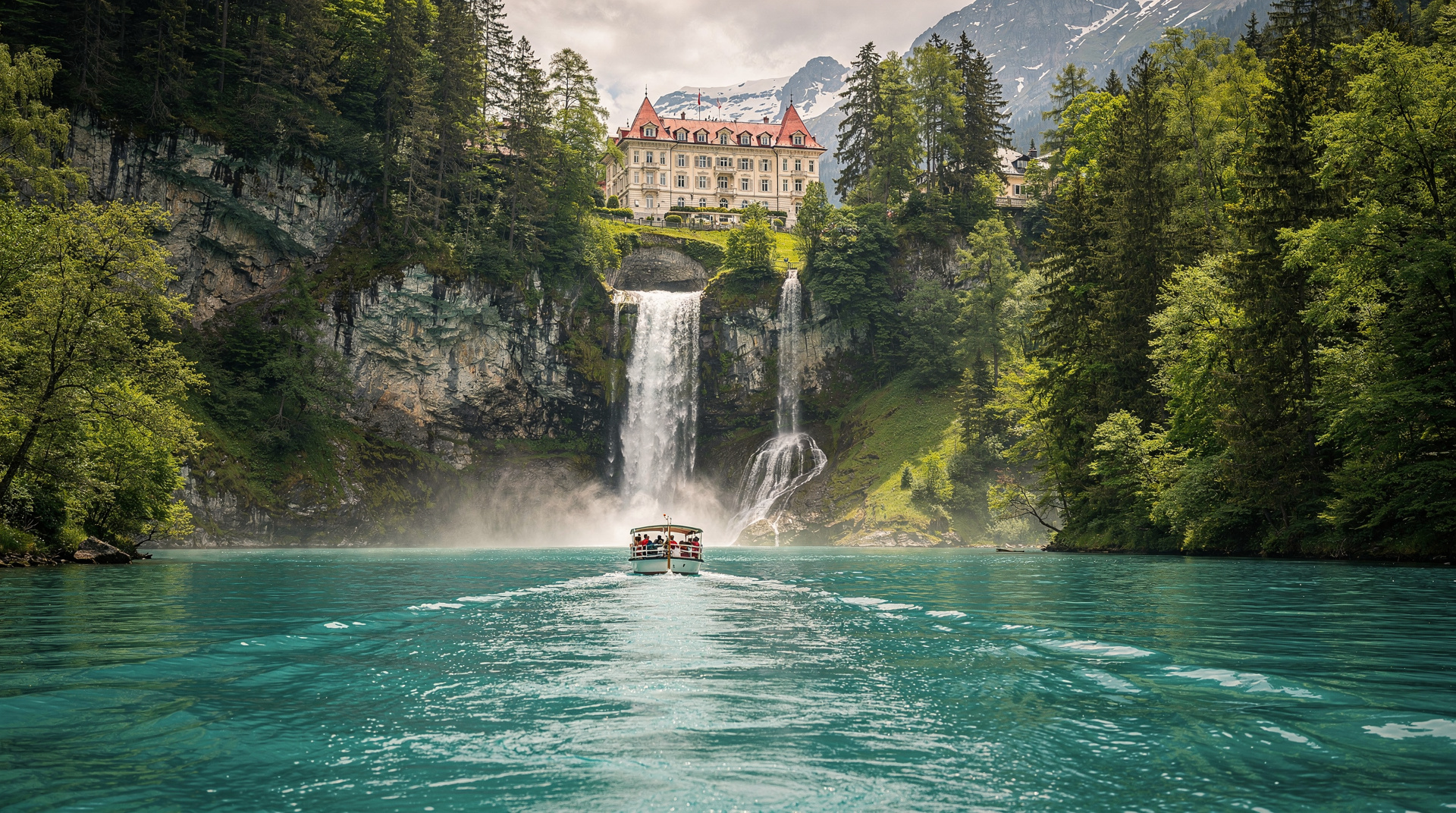
The Brienz lake service runs between Interlaken Ost and Brienz, with stops at Ringgenberg, Goldswil, and Giessbach (where the boats pull to a landing stage below the historic Grandhotel Giessbach and its spectacular waterfall staircase).
Key routes and journey times
- Interlaken Ost to Thun (via Lake Thun): approximately 2 hours
- Interlaken Ost to Brienz (via Lake Brienz): approximately 1 hour 15 minutes
- Interlaken boat day pass: Unlimited travel on both lakes
Swiss Travel Pass coverage
Full coverage on regular services on both Lake Thun and Lake Brienz. The Bernese Oberland Regional Pass provides unlimited coverage on local services and discounts on mountain railways.
Best cruise in the Bernese Oberland
The Giessbach landing on Lake Brienz is the finest single boat stop in the Bernese Oberland: the boat ties up below a funicular that ascends to the historic Grandhotel Giessbach, and the waterfall that cascades past the hotel in a series of falls is audible from the water. In the right light, the spray catches the sun and creates a permanent rainbow above the landing stage. This is the Switzerland of 19th-century Romanticism, preserved and accessible.
Lake Lugano (Lago di Lugano)
Overview
Lake Lugano is Switzerland’s southernmost lake, sitting in a complex of hills and promontories on the Swiss-Italian border. It is largely surrounded by Switzerland (canton of Ticino) but the eastern arm of the lake crosses into Italy, giving the region its unusual cross-border character.
The scenery is Mediterranean-influenced: steep, forested hills rising from warm blue water, the lakeside promenade of Lugano lined with palms, oleanders, and the café terrace culture of northern Italy. Monte San Salvatore (912m) and Monte Brè (925m) rise sharply above the city. The atmosphere is completely different from the German-Swiss or even the Lake Geneva experience.
Società Navigazione del Lago di Lugano (NLL)
The NLL operates Lake Lugano’s passenger services, connecting Lugano with Gandria (Switzerland), Campione d’Italia (Italian enclave), Porto Ceresio (Italy), and Morcote (the most beautiful lakeside village in Ticino, on a wooded promontory south of Lugano).
Key routes and journey times
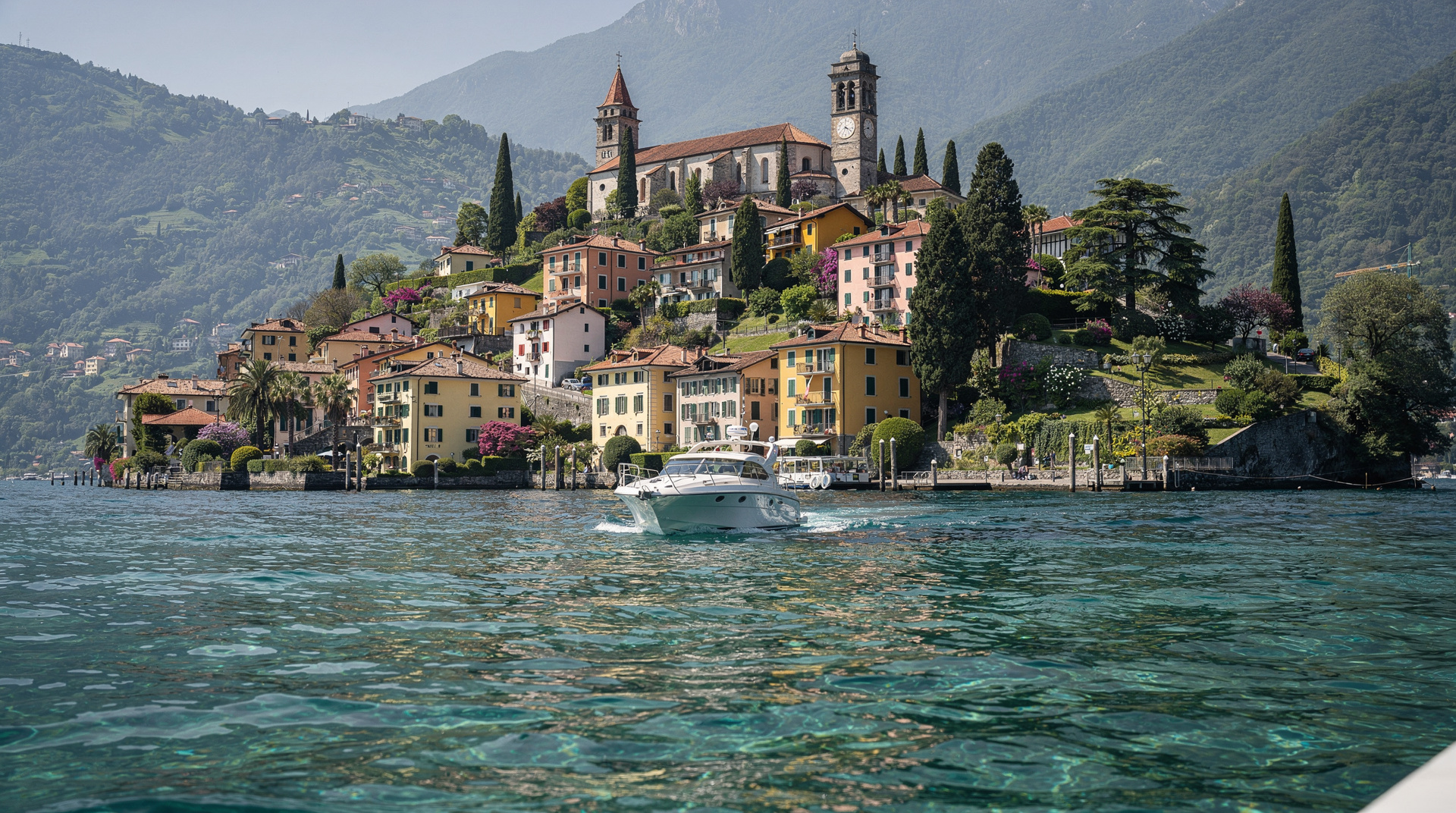
- Lugano to Morcote: approximately 1 hour. Morcote’s terraced streets, frescoed church on the cliff above the village, and lakeside arcades make this the finest single destination on Lake Lugano.
- Lugano to Gandria: 40 minutes. A tiny fishing village with medieval character and an olive grove — one of the most charming settlements in all of Ticino.
- Lugano round trip (full lake circuit): 2-3 hours depending on route.
Swiss Travel Pass coverage
Swiss Travel Pass holders travel free on the Swiss sections of Lake Lugano services. Routes crossing into Italy may require a supplement or Italian supplement pass — check at the Lugano pier.
For a guided approach to Lake Lugano, the Lake Lugano cruise to Morcote combines the boat crossing with sightseeing in the village.
Tips for Lake Lugano
The view from the boat heading south toward Morcote — the church tower on the cliff, the village under the wooded slopes, and Monte San Giorgio rising behind (a UNESCO World Heritage site for its Triassic fossil record) — is the finest visual image the lake offers. The Morcote-Lugano boat connection is the recommended approach; returning by bus No. 431 from Morcote via the lakeshore villages gives a different perspective.
Which lake should you choose?
If time only allows one lake, the choice depends on what you want from it. Here’s how the five compare side by side:
| Lake | Character | Best single route | Paddle steamers | Good for |
|---|---|---|---|---|
| Lucerne | Dramatic, cruciform, mountain-ringed | Lucerne–Flüelen (~3h30) | Yes, 5 in service | First-time visitors, Central Switzerland base |
| Geneva | Vast, Riviera-style, vineyard shore | Lausanne–Montreux (~1h30) | Yes, 5 historic vessels | Wine country, French-speaking side |
| Zurich | Gentle, pastoral, urban skyline | Zurich–Rapperswil (~1h30-2h) | Limited (one steamer) | A relaxed half-day near a big city |
| Thun/Brienz | Turquoise, twin-lake, wild south shore | Interlaken–Brienz (~1h15) | No | Bernese Oberland, waterfall scenery |
| Lugano | Mediterranean-feel, cross-border | Lugano–Morcote (~1h) | No | Ticino, a different cultural register |
For readers deciding between the two most-asked-about options, the Lake Geneva vs Lake Lucerne comparison goes deeper into which suits a given trip style.
How lake cruises compare to scenic trains
Switzerland’s scenic train routes get more attention than the lakes, but the two are complementary rather than competing. A train like the Glacier Express or the GoldenPass Express covers ground fast with a fixed, panoramic seat; a lake boat is slower, open to the air, and lets you get on and off at will along the shore. Many of the best Switzerland weeks combine both — a lake crossing in the morning, a mountain railway in the afternoon. The how to book scenic trains guide covers reservation logistics that also apply to some premium boat services.
Planning a lake cruise itinerary
The Swiss Travel Pass makes a multi-lake cruise itinerary straightforwardly practical. A suggested 7-day cruising program:
- Day 1-2: Lake Lucerne (full lake traversal to Flüelen; Rigi excursion from Vitznau)
- Day 3: Lake Zurich (Zurich to Rapperswil; old town visit)
- Day 4-5: Bernese Oberland (Lake Thun and Lake Brienz; Giessbach; combine with Harder Kulm panorama)
- Day 6-7: Lake Lugano (Lugano to Morcote; Gandria; Monte Brè)
- Lake Geneva can be added as a separate section or combined with a Lausanne/Geneva city visit
For a multi-destination approach linking lakes with scenic trains, the Glacier Express connects Zermatt to the Graubünden — which can be combined with a Lake Lucerne arrival at Flüelen, continuing south by train over the Gotthard. The 7-day itinerary suggests specific combined programs.
Seasonal notes
Summer (June-September): Full services on all lakes. Paddle steamers operate more frequently. Evening dinner cruises available on Lake Lucerne, Lake Geneva, and Lake Zurich (separate booking required; dinner cruises are not typically covered by the Swiss Travel Pass).
Autumn (October): Services continue but frequencies reduce. The lake colours are often finest in October — the surrounding forests are in autumn colour, the water has deepened from summer to a darker blue.
Winter (November-March): Reduced services on all lakes. Some routes operate weekends only. Paddle steamers are typically in winter maintenance. Lake Lucerne and Lake Geneva maintain regular services throughout winter; smaller lake services (Lake Brienz, sections of Lake Lugano) may have very limited winter operation — check before planning.
Spring (April-May): Services rebuild from winter reduction. Full summer schedules typically resume in late May or early June.
For all lake cruise booking and timetable information, the primary sources are: sbb.ch (national timetable including all boat services), and the individual operating companies: SGV (Lucerne), CGN (Geneva), ZSG (Zurich), BLS Schifffahrt (Thun and Brienz), NLL (Lugano). The Swiss Travel Pass page covers which services are included and at what level.
Comprehensive guides to each lake destination are linked from the lakes section of this site.
Frequently asked questions about Lake cruises in Switzerland
Do I need to book lake cruises in advance? Regular scheduled services on all five lakes do not require booking — buy a ticket at the pier or simply board with a valid Swiss Travel Pass. Only paddle-steamer dinner cruises, fondue cruises, and other special departures need advance reservation, as these sell out on summer weekends.
Which Swiss lake cruise is best for someone with only one day? The Lucerne–Vitznau or Lucerne–Weggis short routes give a strong taste of Lake Lucerne’s mountain scenery in under an hour each way and connect directly to the Mount Rigi or Mount Pilatus railways for a combined half-day excursion.