Switzerland with a baby or toddler: the complete family guide
Is Switzerland good for travelling with a baby or toddler?
Yes — Switzerland is exceptionally well set up for families with very young children. SBB trains have low-floor carriages and family wagons, changing tables are standard at major stations, and under-6s travel free on public transport. Stick below 2 000m for babies under 12 months and you will find the infrastructure outstanding.
Why Switzerland works so well with very young children
| At a glance | |
|---|---|
| Best base | Lucerne or Bern — flat old towns, lake access, low altitude |
| Altitude ceiling (under 12 months) | Stay below around 2,000m; ideally under 1,500m |
| Under-6 transport | Free on SBB trains, boats, and most mountain railways with an adult |
| Cot / travel kettle | Request at booking — not automatic in all hotels |
| Best season for a first trip | Spring or autumn — mild valley temperatures, quieter trains |
Parents who have travelled Europe with an infant often arrive in Switzerland bracing for the worst: a country famous for precision, quiet restaurants, and steep terrain. What they find is quite different. Swiss public infrastructure was redesigned systematically over the past two decades with buggies and mobility in mind. Low-floor trams serve every major city. SBB’s Intercity and Interregio trains have dedicated family wagons with a small play area. Changing tables appear not just in airports but in most motorway service areas, large train stations, and the majority of family-oriented restaurants.
This guide is specifically for parents of babies (0–12 months) and toddlers (1–3 years). Children who can walk longer distances and handle more altitude open up a different set of options — see the best family activities guide for broader coverage.
Getting around: trains with a stroller
The Swiss Federal Railways (SBB) network is genuinely stroller-friendly in ways that take visitors by surprise. Key points:
Low-floor carriages: Most Intercity and Regionalexpress trains include at least one low-floor carriage with wide doors and a designated bicycle/pram area. Look for the pram symbol when boarding. The space accommodates full-size prams, not just compact buggies.
Family wagon: Long-distance trains — particularly the IC6 (Zurich–Geneva) and IC8 (Zurich–Chur) — include a Familienwagen or family carriage. This is a standard-class carriage modified with a small indoor play area: climbing frames, benches, and a more relaxed noise environment. Children love it; parents appreciate that there is no pressure to keep a toddler quiet.
Luggage: SBB allows prams free of charge. You do not need to fold a stroller to board — ramp assistance is available at major stations if asked.
Free travel for under-6s: Children under 6 travel completely free on all SBB services, including lake boats and most mountain railways included in the travel pass network, when accompanied by an adult. No ticket is needed — nothing to carry or validate.
Junior Card / Family Card (ages 6–16): Once your child turns 6, the SBB Junior Travelcard (CHF 30/year) allows free travel on all public transport when accompanied by any adult, whether a parent or not. If you hold a Swiss Travel Pass, children 6–16 travel free with it automatically.
City transport: Zurich, Geneva, Basel, Bern, and Lucerne all operate low-floor trams and buses as standard. Platforms are level with doors. You can roll a pram on without lifting.
Altitude considerations: keep it low for very young children
This is the most important safety note for parents of babies and toddlers.
Under 12 months: Paediatric guidance recommends avoiding altitudes above 2 000m for babies under one year. The reduced oxygen pressure at altitude, combined with the respiratory adjustment required, creates meaningful risk for very young infants. Switzerland’s most celebrated mountain destinations — Jungfraujoch at 3 454m, Glacier 3000, Matterhorn Glacier Paradise at 3 883m — are firmly off-limits.
12 months to 2 years: Toddlers can generally manage up to 2 500m with appropriate acclimatisation and if the child is healthy. Ascend gradually. Watch for unusual irritability, poor feeding, or unusual pallor — these can indicate altitude sickness in children who cannot yet describe how they feel.
Practical ceiling for most families with babies: Keep to valleys and destinations below 1 500m. The vast majority of Switzerland’s most enjoyable family destinations — Lucerne (435m), Bern (542m), Zurich (408m), Interlaken (566m), Montreux (395m) — sit well below any altitude concern.
What to skip: The Jungfraujoch excursion is spectacular but at 3 454m is inappropriate for babies. The full Glacier Express route is very long (8 hours) and tedious for toddlers. Save these for a return visit when children are older.
The best destinations for families with babies and toddlers
Lucerne
Lucerne is the single most accessible Swiss city for families with very young children. The old town is almost entirely flat and stroller-friendly. The lakeside promenade runs uninterrupted for several kilometres. The Swiss Museum of Transport — the country’s most visited museum — is purpose-built for children, with real vehicles to climb into, sensory experiences, and the Swiss Chocolate Adventure ride-through display. The museum is free for children under 16 with a Swiss Travel Pass.
Lucerne’s lake boats accept prams. A short cruise on Lake Lucerne is one of the easiest family experiences in Switzerland: the boats are wide-decked and stable, the scenery is extraordinary, and a toddler who falls asleep on your lap is simply enjoying a scenic cruise.
Bern
Bern has the Bear Park (Bärenpark) — a free outdoor bear enclosure on the banks of the Aare where live brown bears roam a forested hillside. Toddlers are reliably transfixed. The old town is largely paved with wide arcade-covered walkways (Lauben) that make stroller navigation straightforward in any weather. The Rose Garden above the city offers a flat loop with spectacular views over the rooftops and the Bernese Alps — no entrance fee.
Ballenberg open-air museum
The Ballenberg Open-Air Museum near Brienz in the Bernese Oberland is one of Switzerland’s most underrated family destinations. The sprawling site — over 100 historic Swiss farmhouses, chalets, and barns relocated from across the country — is set across gently rolling meadows with farm animals throughout. Children can pet goats and cows, watch cheese being made in period-accurate conditions, and explore the farmhouse interiors.
The paths are wide gravel and packed-earth tracks, largely negotiable with a sturdy all-terrain pram. Allow a full day. The site is extensive but benches and rest points are distributed throughout. Entry is CHF 28 for adults; children under 16 are free.
Zoo Zürich and Zoo Basel
Both Zurich and Basel have excellent zoos with strong educational programming and good stroller infrastructure. Zoo Zürich has a spectacular Madagascar house and the Lewa Savannah, an African habitat with giraffes and zebras. The zoo is hilly in places but managed with paved paths throughout. Zoo Basel is flatter and more compact, making it marginally easier with a pram.
Trümmelbach Falls, Lauterbrunnen valley
The Trümmelbach Falls in the Lauterbrunnen valley are ten glacial waterfalls inside a mountain, accessible via a lift carved into the rock. The falls carry the meltwater of the Jungfrau massif — up to 20 000 litres per second at peak season — and the roaring darkness is genuinely extraordinary. The paths through the caverns are narrow and steep in places; a carrier/sling is better than a pram for this attraction. Well-suited for older babies from about 6 months who can sit supported.
Aquaparc, Le Bouveret
Aquaparc at Le Bouveret on Lake Geneva is the best waterpark in Switzerland for families with mixed ages. It has indoor heated pools, gentle water features and splash areas designed specifically for toddlers aged 18 months–4 years, and more demanding slides for older visitors. The toddler zones are warm (32°C water), enclosed, and staffed throughout the season. Aquaparc operates year-round — the indoor section is particularly popular during the shoulder months.
Lakeside Badis (outdoor swimming areas)
Switzerland’s public swimming areas (Badi) are a summer institution. Most towns and villages on lakes and rivers maintain a public Badi — a grassed area with a designated swimming section, changing rooms, and usually a kiosk. They are free or very cheap (CHF 3–6 per adult; children free or minimal). For families with babies, the Badis on Lake Zurich, Lake Thun, and Lake Brienz offer shallow, warm shoreline areas where toddlers can play safely. Water temperatures reach 22–24°C in late July and August.
Lavaux promenade, Lake Geneva
The Lavaux vineyard terraces above Lake Geneva are UNESCO-listed and stunning. The main walking trail from Cully to Lutry — approximately 5km — follows the vine-striped hillside with lake views throughout. It is paved and manageable with a good pram. Push slowly uphill on the return; the gradient is gentle but sustained. Best in May (with wildflowers between vine rows) or October (harvest season).
Baby-friendly cable cars and cogwheel railways
Not all mountain railways are equal for families with very young children. Some are genuinely pushchair-compatible; others are not.
Good choices:
- Stanserhorn CabriO gondola (near Lucerne): An open-top double-decker gondola. Spacious, scenic, accessible. Altitude 1 898m — manageable for healthy toddlers from 12 months.
- Mount Rigi cogwheel railway: The oldest mountain railway in Europe runs from Vitznau on Lake Lucerne to Rigi Kulm at 1 752m. The station platforms are level with carriage floors. A pram fits. The top station has a wide terrace.
- Harder Kulm funicular, Interlaken: A short, steep funicular (8 minutes) to 1 322m with a panoramic restaurant and platform. The altitude is entirely safe for any age.
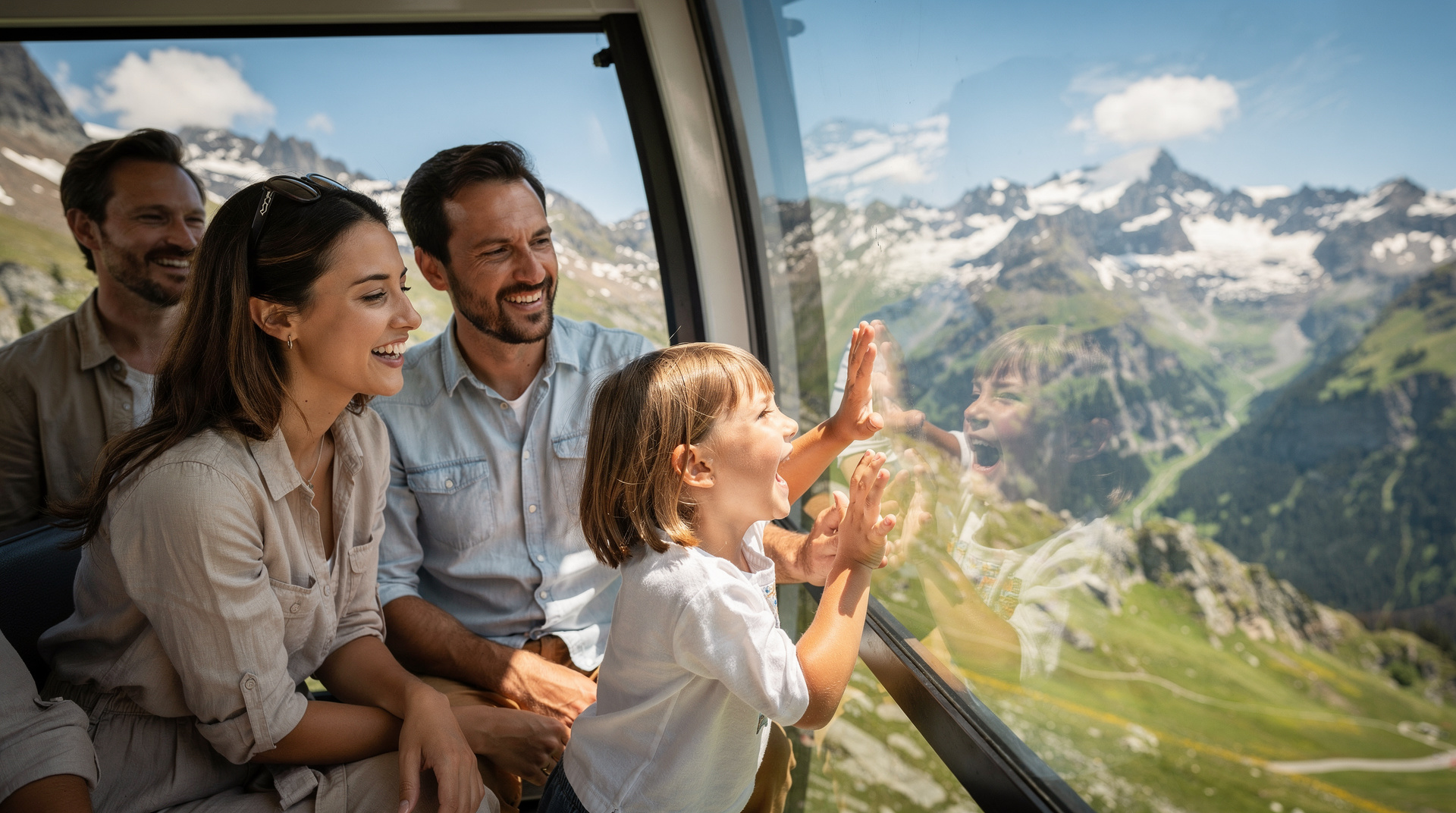
- Grindelwald First gondola: The cable car to Grindelwald First (2 168m) is large enough for prams. The altitude is at the upper limit for cautious parents of babies, but generally fine from 12 months.
Skip for very young children: Any railway above 2 500m — this rules out Jungfraujoch, Matterhorn Glacier Paradise, and Glacier 3000.
Pram-friendly walks and promenades
Switzerland has a national walking path network (Wanderwege), and the easier sections are generally kept in excellent condition. For pushchairs, look for paths marked as Kinderwagen-tauglich (pram-compatible) in the Schweizmobil app or at Swiss hiking offices.
Best pram-friendly walks:
- Rhine waterfront, Basel: The wide pedestrian path along both banks of the Rhine is flat, paved, and lined with café terraces. Several kilometres in each direction from the Mittlere Brücke — Basel’s most photogenic bridge.
- Lake Thun and Lake Brienz promenades: From Thun, the lakeside path to Hünibach is flat and paved (5km, pushchair-compatible). The Brienzersee lakeside walk from Brienz toward Iseltwald follows a largely flat path beside the turquoise water.
- Zurich lakeside promenade: From Bürkliplatz south to Wollishofen is 6km along the lake — entirely flat, paved, and shaded by lime trees in summer. Multiple Badi access points with changing facilities.
- Genève waterfront (Quai du Mont-Blanc to Parc des Eaux-Vives): A long, flat lakeside promenade with views of the Jet d’Eau and the Alps — entirely stroller-friendly.
Accommodation tips for families with babies
Swiss Family Hotels label: Switzerland Tourism operates the “Family Hotels Switzerland” certification for hotels that meet a specific set of standards: babysitting services, cot availability, family rooms (which in Switzerland genuinely means separate sleeping areas, not just a sofa bed), children’s menus, and on-site play facilities. The label is reliable. Search at myswitzerland.com under Family Hotels.
What to request when booking:
- Cot (Kinderbett/lit bébé/lettino): Available in most hotels but request at booking. Usually CHF 10–25/night or free.
- Baby bath or changing mat: Less automatic — specify when you contact the hotel.
- Bathtub rather than shower-only bathroom: Some Swiss hotel rooms are shower-only; request a bathtub if you are bathing an infant.
- Ground-floor room: Useful for stroller access, particularly in older buildings without lifts.
- Kitchen access or kitchenette: Swiss apartments and many family hotels have self-catering units that make feeding a baby significantly easier. Look at VRBO and Airbnb for family apartments with kitchens, particularly in resort areas.
Food, formula, and nappies
Tap water: Swiss tap water is among the cleanest in the world — safe to drink everywhere, including for preparing infant formula. Public drinking fountains (Brunnen) are safe. No need to buy bottled water for formula preparation.
Formula: Available in every large Migros and Coop supermarket (the two main Swiss chains, present in every town). Major European brands are stocked. Infant formula (Säuglingsmilch) is in the baby aisle alongside follow-on milk. Pharmacies carry specialist hypoallergenic formulas.
Nappies and wipes: Readily available in Migros, Coop, and pharmacies. Major brands (Pampers, Huggies, Libero) are standard stock. Travel sizes are available in airport shops.
Breastfeeding: Accepted without issue in Switzerland in most public settings. Large train stations have dedicated nursing rooms (Stillzimmer) at Zurich HB, Geneva Cornavin, Basel SBB, and Bern. In restaurants, staff will move you to a quieter table if asked — most are accommodating.
Children’s menus: Most family-oriented restaurants offer a Kinderteller (children’s plate) for CHF 10–14. Portions are reasonable — not enormous. For Swiss restaurants in rural areas, the children’s menu often consists of pasta, rösti, or a smaller version of the main menu. Pizza restaurants throughout Switzerland offer half-portions on request.
Cultural note: Swiss restaurants tend toward the quiet side. A crying baby will attract glances. This is not hostility — Swiss people are genuinely reserved — but it means that outdoor terrace seating and family-specific restaurants are more comfortable environments than formal dining rooms.
Seasonal advice for travelling with a baby
Spring (April–June): Excellent. Lower valley temperatures are warm without being hot. Wildflowers are at their peak in May. Mountain snow keeps most high-altitude areas closed, which naturally keeps the focus on valley and lake destinations perfect for young children. The Switzerland in May guide covers the conditions in detail.
Summer (July–August): Best for lake swimming (Badi culture is in full swing). Busy — pre-book accommodation and train reservations. City temperatures can reach 30°C+; keep babies in shade and take advantage of the lake water. The family wagon on trains is popular — arrive early at your departure platform.
Autumn (September–October): Underrated. Lower crowds than summer, pleasant temperatures, and the vineyard landscapes are especially beautiful. Mountain railways remain open through October. Baby-appropriate for all valley destinations.
Winter (November–March): Switzerland in winter is magical, especially around Christmas markets (Christmas markets guide). Keep to low-altitude destinations — Zurich, Bern, Basel, Lucerne, Geneva — where temperatures hover around 0–5°C. Dress babies in layers; Swiss station buildings are heated throughout. For toddlers from about 18 months, gentle snow play at lower resort altitudes (Arosa, Villars, Leysin) is achievable with appropriate clothing.
Lake Lucerne catamaran cruise — ideal for families with very young children
A one-hour cruise on Lake Lucerne aboard a modern catamaran. Wide decks, stable ride, and breathtaking scenery — toddlers love watching the mountains and boats. No altitude concerns.
- Free cancellation
Top family activities bookable via GetYourGuide
Beyond the transport experiences, several bookable activities work particularly well for families with babies and toddlers:
Chocolate factory visits: The Lindt Home of Chocolate in Zürich is the most family-friendly of all Swiss chocolate experiences. Book Lindt Home of Chocolate tickets here — the guided tour includes a ride-through museum display and unlimited chocolate at the end; toddlers are welcome and there is a generous cloakroom for prams.
Paddle-steamer cruises on Lake Lucerne: The historic Belle Époque paddle steamers operated by SGV have wide open decks and indoor saloons. They are accessible with prams and have changing facilities on board. Book through the SGV website directly or look for lake cruises on Lake Lucerne for scheduling information.
Cable car to Stanserhorn or Rigi: These are manageable family mountain days that stay well below the altitude limit for young children. The Lucerne to Rigi guide covers the practical details of the cogwheel railway route.
Packing essentials for Switzerland with a baby
- All-terrain pram: Swiss cobblestones and gravel paths demand proper wheels. A lightweight umbrella stroller will frustrate you in old-town streets.
- Baby carrier / sling: For mountain paths, waterfalls (like Trümmelbach), and busy city situations where a pram is impractical.
- Layers: Alpine weather changes quickly. Even in July, a fleece and waterproof layer for the baby is sensible above 1 000m.
- Sun protection: UV exposure increases significantly at altitude. High-SPF sunscreen, a sun hat, and if possible a pram sun cover for open-air gondola terraces.
- Travel kettle: For formula preparation in accommodation that lacks a full kitchen. Most Swiss hotels can provide one on request.
Health, pharmacies, and emergencies with a baby
Switzerland’s healthcare system is excellent but expensive without travel insurance — confirm your policy covers paediatric consultation and medication abroad before you leave. Pharmacies (Apotheke/pharmacie) are well-stocked and pharmacists are trained to advise on common infant complaints (fever, teething, mild digestive upset) without needing a doctor’s visit. Every town of any size has at least one pharmacy with extended or rotating night hours — ask your hotel for the nearest “pharmacie de garde”/“Notfallapotheke.”
For anything beyond minor issues, Swiss hospitals have paediatric emergency departments in all major cities (Zurich, Geneva, Bern, Basel, Lucerne). The emergency number is 144. Travel insurance with a low or no excess for children under 2 is worth checking specifically, since infant consultations and any overnight observation can be costly at Swiss private rates.
Car seats and taxis: Switzerland requires child seats for children under 12 (or under 150cm) in private cars, but taxis are commonly exempt from carrying one — bring a lightweight travel car seat or booster if you plan on taxis with an infant, since many Swiss taxi firms do not provide one on request.
Realistic daily pace with a baby or toddler
Families travelling with very young children get more out of Switzerland by planning fewer, calmer stops rather than a packed itinerary. A workable daily rhythm: one significant activity in the morning (a lake boat, a flat old-town walk, a zoo), a long lunch break that doubles as nap time, and a gentle late-afternoon activity close to where you’re staying. Trains between bases should be treated as part of the day’s fun rather than “dead time” — the family wagon and window views usually keep a toddler content for an hour or two, but avoid stringing together two long train legs and an excursion in a single day.
Frequently asked questions about Switzerland with a baby or toddler
Do I need to declare a stroller or car seat when flying into Switzerland? No — prams, strollers, and car seats are typically checked free of charge on most airlines flying into Zurich, Geneva, or Basel, separately from your baggage allowance. Confirm with your airline, but this is standard practice and not a Swiss-specific requirement.
Can a baby travel on the Glacier Express or Bernina Express? Yes, but these are long panoramic routes (up to 8 hours for the full Glacier Express) better suited to toddlers who can be entertained for longer stretches than to very young babies. A shorter scenic leg — for example a single stage of the Bernina Express — is a gentler introduction to Switzerland’s scenic trains with an infant.
Switzerland rewards families who plan thoughtfully and keep altitude in mind for young babies. The infrastructure is genuinely excellent, the natural environments are extraordinary even at valley level, and the family-specific labelling on transport and accommodation takes much of the guesswork out of planning. Start with Lucerne and Bern, add a lake boat, and save the high-altitude ambitions for a return visit in a few years.