Zurich to the Black Forest and Rhine Falls: day trip guide
How do you get from Zurich to the Black Forest?
Take the train from Zurich to Schaffhausen or Freiburg im Breisgau (about 1.5-2 hours), then connect into the Black Forest by regional train or bus. A guided day tour from Zurich is the most convenient option.
The Black Forest from Zurich: an underrated cross-border day trip
| At a glance | Details |
|---|---|
| Where | Titisee and the southern Black Forest, Germany, via Basel/Freiburg |
| Cost | Around CHF 40-60 (Swiss leg) plus EUR 30-50 (German leg, entries, food) independently; CHF 80-120 for a guided tour |
| Time needed | Full day (around 10-11 hours door to door) |
| Getting there | Zurich HB to Basel (about 1 hour), then onward by German rail to Freiburg and Titisee, or by guided bus tour |
| Best time | Late spring or autumn for the forest itself; December for Freiburg’s Christmas markets |
Switzerland and Germany share a border for much of the way from Basel eastward to Lake Constance, and the distance from Zurich to Germany’s Black Forest is surprisingly short. The Schwarzwald — its German name, meaning Black Forest — is one of the most evocative landscapes in central Europe: dense spruce and fir forests stretching across rolling ridges, traditional half-timbered farmhouses, cuckoo clock workshops, and the famous Titisee lake tucked into a glacially carved basin.
For Swiss visitors, the Black Forest offers something genuinely different from the Alpine scenery of their own country: softer hills, thicker forest, a distinct culinary tradition (Black Forest gateau, smoked ham, Spätzle egg noodles), and the novelty of being in a different country without spending more than an hour in transit.
For visitors using Zurich as a base, the Black Forest combines naturally with a stop at Rhine Falls — Europe’s largest waterfall just across the Swiss-German border near Schaffhausen. The two destinations in the same day make for one of the most varied day trips available from Zurich.
Getting from Zurich to the Black Forest
Option 1 — Independent by train:
The most practical independent route goes via Basel:
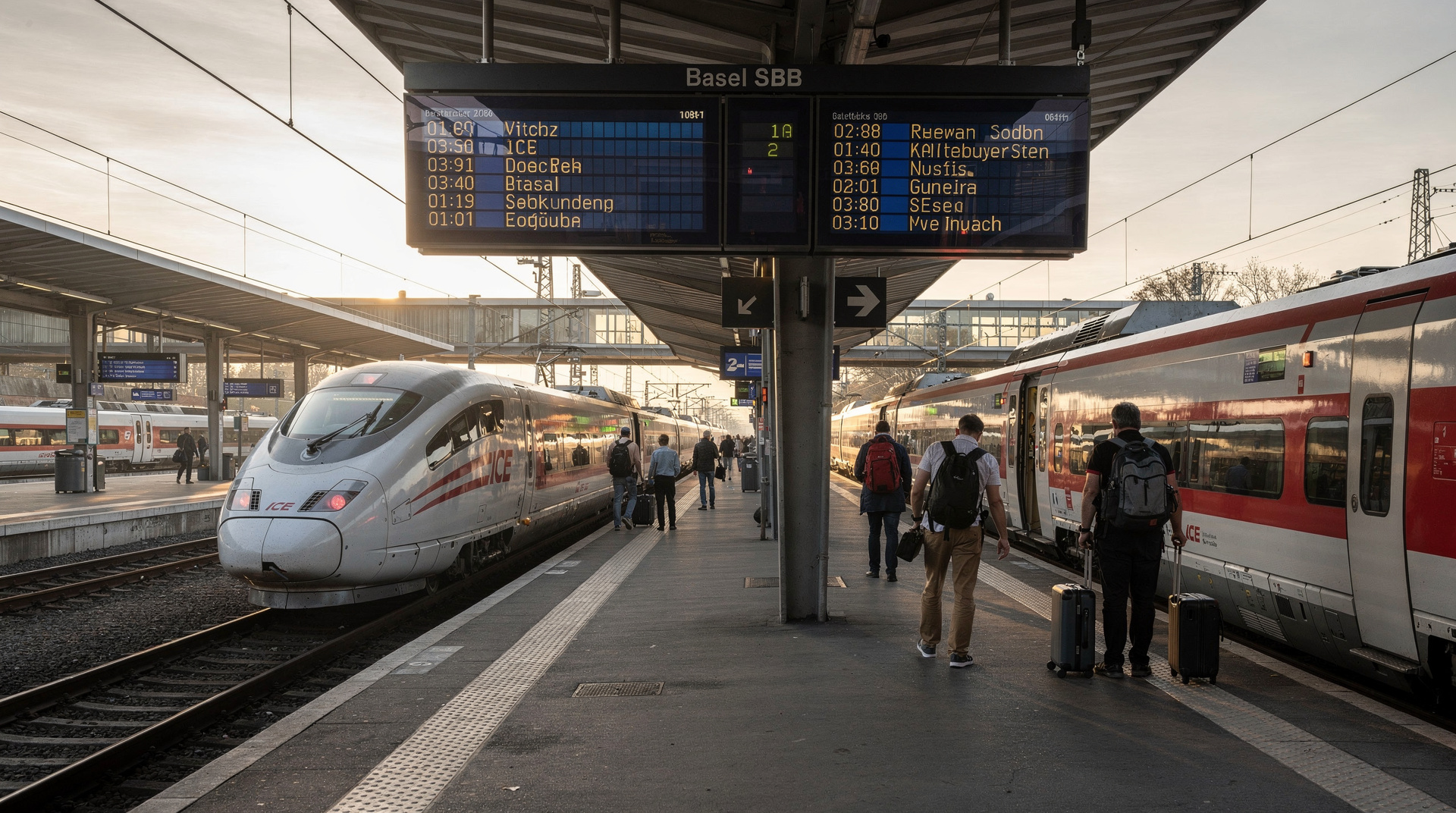
- Zurich HB → Basel SBB: 54 minutes by InterCity. Trains run several times per hour.
- Basel SBB → Freiburg im Breisgau: 45 minutes by German ICE or regional train.
- Freiburg → Titisee: 45 minutes by regional train (Höllentalbahn line — “Hell Valley Railway,” one of the most scenic rail lines in southern Germany).
Total journey Zurich to Titisee: approximately 2 hours 15 minutes.
Swiss Travel Pass: Covers Zurich to Basel. German section requires a separate Eurail Germany pass, a BahnCard, or point-to-point DB (Deutsche Bahn) ticket. Border formalities are minimal — Switzerland and Germany have an open border agreement.
Return from Titisee to Zurich via Rhine Falls:
- Titisee → Freiburg → Basel → Schaffhausen → Rhine Falls (about 2.5 hours including connections)
- Or reverse: go to Rhine Falls first, then continue to the Black Forest
Option 2 — Guided day tour from Zurich:
A guided bus tour from Zurich is the most popular way to do this trip and, practically speaking, the most convenient. The buses handle the border crossing, the parking logistics, and the tight connections. Most tours stop at Rhine Falls (1-1.5 hours), Titisee lake (1-1.5 hours), a cuckoo clock workshop, and sometimes a village in the forest itself.
Book the Zurich to Black Forest, Titisee and Rhine Falls bus day trip — this is the most popular option and includes comfortable coach transport, a stop at Rhine Falls, and time at Titisee with a local guide.
What to see in the Black Forest
Titisee lake
The Titisee is a small, deep lake (2 kilometres long, 40 metres deep) in a glacially carved basin at 840 metres above sea level. The water is clear, the surroundings are forested, and the lakeside town has a pleasant waterfront promenade with boat hire, cafés, and a beach area.
In summer, pedal boats and rowboats are available for hire (around CHF 10-12 per hour). The lake is clean enough for swimming and has a designated bathing area on the northern shore. The surrounding trails into the forest are well-marked and easy — even a 30-minute walk through the spruce trees gives you the authentic Black Forest atmosphere.
The town of Titisee-Neustadt is notably commercialised, with a high street of cuckoo clock shops, souvenir stands, and cafés. Prices are in euros and notably cheaper than Switzerland.
Triberg and the waterfalls
Triberg, roughly 30 kilometres north of Titisee, has Germany’s highest accessible waterfall (163 metres total, in a series of seven cascades) and claims to be the birthplace of the cuckoo clock. The waterfall walk is excellent — a 2-kilometre path through forest leads past each cascade, taking around 45 minutes to climb. Entry to the waterfall park costs around EUR 5.
Triberg also has two competing “World’s Largest Cuckoo Clock” attractions (both genuine, both worth a brief look if you are interested in horology), and several traditional clock makers who offer demonstrations.
The Schwarzwald Hochstrasse (High Road)
The B500 road runs along the main ridge of the northern Black Forest, with viewpoints, hiking trailheads, and traditional inns at regular intervals. The Hornisgrinde (1,163 m) is the highest point of the northern Black Forest, accessible by road with a short walk to the summit and a large viewing platform across the Rhine valley to the Vosges mountains of France.
This section of the Black Forest is best explored by car or on a guided bus tour — public transport coverage is sparse.
Freiburg im Breisgau
The university city at the western edge of the Black Forest is worth time in its own right. Freiburg’s old town has an impressive Gothic cathedral (the Freiburger Münster), a pedestrian zone with distinctive bächle (small water channels running along the streets), and a lively market. It functions as the “gateway to the Black Forest” for most visitors arriving by rail.
If using the train, plan 1-2 hours in Freiburg on the outward or return journey. The cathedral square (Münsterplatz) and the old town market are 10 minutes walk from the train station.
Rhine Falls: combining with the Black Forest
Rhine Falls is the obvious first or last stop on a Black Forest day trip from Zurich. Schaffhausen, the nearest Swiss city to the falls, is 50 minutes from Zurich by train and 1 hour 20 minutes from Freiburg.
Rhine Falls from the north bank (Neuhausen): Boat rides, cliff-top viewing platforms, and the central rock experience. See the detailed Zurich to Rhine Falls guide for full information. If you prefer a standalone Swiss day, a Rhine Falls cruise and Schaffhausen city tour covers the falls and the old town without any border crossing.
Combining the two: The guided bus tour linked above does this automatically. Independently, the most logical sequence is:
- Morning at Rhine Falls (09:30-11:30)
- Train to Basel (via Schaffhausen and Zurich, or directly via Waldshut in Germany if you have a Eurail pass)
- Afternoon in Freiburg and Titisee (13:00-17:00)
- Return to Zurich via Basel
This involves a long but feasible day — roughly 5-6 hours of combined travel and 5-6 hours at the destinations.
Black Forest food and drink
Schwarzwälder Kirschtorte (Black Forest gateau): The original version — layers of chocolate sponge, kirsch-soaked cherries, and cream — is genuinely different from most versions sold elsewhere. Order it at a traditional Konditorei (cake shop) in Triberg or Titisee. Price: around EUR 4-6 per slice.
Schwarzwälder Schinken (Black Forest ham): Air-dried and smoked over fir branches, this is one of the great German regional foods. Buy it at a butcher shop rather than a tourist stall.
Spätzle: Egg noodles, typically served with cheese (Käsespätzle) or as a side to Sauerbraten (pot roast). Order in any traditional Gasthaus.
Kirschwasser: Cherry schnapps from the Black Forest, produced from the same Schwarzwald cherries used in the gateau. Very strong (around 40% ABV), very local. Small bottles make a compact souvenir.
Beer: Baden-Württemberg (the German state encompassing the Black Forest) has a strong brewery tradition. Rothaus Tannenzäpfle is the local craft beer, brewed at 1,000 metres on the plateau — it is excellent and available throughout the region.
Border crossing practicalities
The Switzerland-Germany border is an open land border for EU and Schengen Area passport holders — you drive or walk across with no checkpoint in most places. For non-EU visitors:
Passport: Required. Non-EU nationals should carry their passport even though border posts are often unstaffed.
Currency: Germany uses euros; Switzerland uses Swiss francs. Most tourist shops in the Black Forest will accept Swiss francs but at an unfavourable exchange rate. Bring euros or use a card.
VAT refund: Swiss VAT (MWST) is different from German VAT (MwSt). If you are buying goods in Germany and exporting them home, you may be eligible for German VAT refund at the border — this is mainly relevant for large purchases.
Shopping: Consumer goods (electronics, clothing, some foods) are generally cheaper in Germany than Switzerland. The exchange rate in 2026 makes German purchases good value. Note Swiss customs limits on re-importing goods into Switzerland: CHF 300 per person per day of goods before duty applies.
Suggested itinerary: Zurich to Black Forest and Rhine Falls
Guided tour option (recommended): Most tours depart Zurich between 08:00-09:00, arrive back by 18:00-19:00. The tour operator handles all logistics. Book in advance — summer tours fill up fast.
Independent option:
- 08:00 — Depart Zurich HB toward Schaffhausen (S-Bahn S33)
- 08:35 — Arrive Neuhausen am Rheinfall, walk to Rhine Falls
- 08:45-10:30 — Rhine Falls: boat to rock, both banks
- 10:45 — Train from Schaffhausen toward Basel
- 12:00 — Arrive Basel, change to Freiburg train
- 12:45 — Arrive Freiburg. Lunch near the cathedral (30-45 minutes)
- 13:45 — Regional train Freiburg → Titisee (Höllentalbahn)
- 14:30 — Arrive Titisee
- 14:30-16:30 — Titisee lake: boat, walk, coffee, lakeside atmosphere
- 16:45 — Train Titisee → Freiburg
- 17:30 — Train Freiburg → Basel
- 18:15 — Train Basel → Zurich HB
- 19:10 — Arrive Zurich HB
Seasonal considerations
Spring (April-May): The Black Forest is beautiful in spring — wildflowers and fresh green. Rhine Falls at peak snowmelt flow. The forest trails can be muddy.
Summer (June-August): Peak tourist season at Titisee. Warm enough to swim. Crowded at Rhine Falls on weekends.
Autumn (September-October): Arguably the best season for the forest itself — the deciduous trees among the spruce provide autumn colour. Fewer tourists than summer.
Winter (November-March): Snow at altitude is possible but not guaranteed at Titisee level. Triberg waterfall is particularly dramatic with ice formations. The Christmas markets in Freiburg (late November to December 24) are excellent.
The cuckoo clock: history and where to buy
The cuckoo clock did not, despite popular belief, originate in Switzerland — it was invented in the Black Forest region of Germany in the early 18th century. The first documented cuckoo clock dates to around 1730 and was made in the village of Schönwald, near Triberg. The combination of the Black Forest wood-carving tradition, the availability of timber, and the isolated long winters (which gave craftsmen time to develop intricate mechanisms) created the ideal conditions for the industry.
Today, authentic Black Forest cuckoo clocks bear the “VDS” certification mark of the Black Forest Clock Association — a guarantee that the movement was made in the Black Forest using traditional techniques. Many of the cheaper clocks sold throughout Switzerland and tourist Europe are made in Asia — if authenticity matters to you, look for the certification mark.
Where to buy in Triberg: The House of 1000 Clocks (Haus der 1000 Uhren) and the Triberg Souvenir House (which also claims the “World’s Largest Cuckoo Clock”) both have extensive selections at various price points. A traditional carved wooden clock with a quality Black Forest movement starts at around EUR 100-150; hand-carved intricate models with music boxes can reach EUR 500-1,000 or more.
In Titisee: The lakeside shops have large selections of cuckoo clocks at all price points, but the competition means prices are similar across most vendors. Compare a few before buying. The larger shops (Uhren Eble, Drubba) have staff who can explain the movement types and give certificates of authenticity.
The Höllentalbahn: Germany’s most scenic short railway
The train from Freiburg to Titisee uses the Höllentalbahn — Hell Valley Railway — which climbs 800 metres in 30 kilometres through a dramatic gorge (the Höllental, Hell Valley) carved by the Dreisam river. The ascent uses a rack section (the only place in Germany where a rack-and-pinion rail system is used on a standard-gauge main line) to climb a gradient of 57 per mille through the deepest section of the gorge.
The gorge section, between Hirschsprung and Hinterzarten, is genuinely beautiful — vertical rock walls, rushing water, and forest so dense it nearly blocks the sky. The train emerges onto the plateau at Hinterzarten (900 m) and continues through open agricultural land to Titisee.
This 45-minute journey is a secondary attraction in its own right. Sit on the right side of the train departing Freiburg for the best views into the gorge. The Hirschsprung station (where the rack section begins) is named after a local legend — a stag that escaped hunters by leaping across the impossibly narrow gorge.
Comparing the Black Forest with nearby Swiss destinations
The Black Forest is best understood not as an alternative to Swiss mountains but as a complement — a softer, more forested, culturally distinct landscape that offers things Switzerland does not:
- Genuine cuckoo clock manufacturing tradition (in its actual home region)
- Black Forest cuisine in its authentic regional context
- German wine (Baden wines, especially Pinot Noir, are excellent)
- Lower prices than Switzerland across food, transport, and accommodation
- A sense of crossing a cultural and linguistic border even over a short distance
The practical cost of a Black Forest day from Zurich is higher than a Rhine Falls day (which requires no currency exchange and no international transport) but comparable to a Jungfraujoch or Titlis day — and provides a genuinely different experience.
Practical tips
Language: German. Most tourist-facing staff in Titisee and Freiburg speak English. Further into the forest, English is less common — a basic phrase of German (Entschuldigung, sprechen Sie Englisch?) goes a long way.
What to buy: Cuckoo clocks, Black Forest gateau (most can travel unrefrigerated for a day), kirsch, locally printed scarves and textiles. Prices for cuckoo clocks range from EUR 30 for a small souvenir piece to several hundred for a handmade traditional model.
Budget: A guided tour from Zurich costs around CHF 80-120 per person including transport. Independent costs: around CHF 40-60 for Swiss travel plus EUR 30-50 for German transport, entry fees, and food.
Is the Black Forest worth it as a day trip from Zurich?
Of all the day trips covered on this site, the Black Forest is the one that takes you out of Switzerland entirely, which is both its main appeal and its main practical complication (currency, a second rail system, in some cases a separate transport pass). For visitors who have already done the classic Swiss excursions — Lucerne and Pilatus, Rhine Falls — the Black Forest offers something the rest of this guide can’t: a different country, cuisine, and price level, reached in under two hours.
The trade-off is complexity. Independent travel involves at least three train changes and two currencies; even with careful planning, delays cascade more easily than on a single-country trip. This is one of the few day trips from Zurich where the guided bus tour genuinely simplifies the day rather than just adding convenience — it removes the connection risk entirely.
Combining with a longer German itinerary
If a single day in the Black Forest whets your appetite, Freiburg im Breisgau makes a comfortable overnight base for a 2-3 day extension into the wider region, including Baden-Baden’s thermal spas and the Bodensee (Lake Constance) further east. This is a natural add-on for a multi-country itinerary built around Switzerland, since the rail connections from Basel reach deep into Germany and France without needing a car.
Frequently asked questions about Zurich to the Black Forest and Rhine Falls
Do you need a passport for a Zurich to Black Forest day trip? Non-EU nationals should carry their passport even though the Switzerland-Germany border is open with no routine checkpoint. EU/Schengen passport holders typically cross without any formality.
Is it cheaper to book a guided tour or go independently to the Black Forest? Independent travel is usually cheaper on paper (around CHF 40-60 plus EUR 30-50), but a guided tour (CHF 80-120) removes the connection risk of a multi-train, cross-border itinerary and includes commentary — many travellers find the price difference worthwhile for a first visit.
Related guides
- Zurich to Rhine Falls — detailed Rhine Falls guide
- Day trips from Zurich — all options compared
- Swiss Travel Pass — coverage on the Swiss portion
- Budget travel in Switzerland — keeping costs reasonable
- Lucerne — another easy day trip from Zurich