Why autumn is the best season to visit Switzerland
The season most travelers overlook
Ask ten Switzerland visitors when they went, and seven will say summer. The other three will say winter. Barely anyone says autumn — and those who do tend to say it with the quiet confidence of people who know something the others don’t.
Autumn in Switzerland is extraordinary. It is, in the opinion of many experienced Switzerland travelers, the single best time to visit. And the fact that most people overlook it means that you get to experience this exceptional country at its most beautiful and most atmospheric without competing with the July and August crowds.
Here’s the case for autumn.
| At a glance | |
|---|---|
| Where | Best concentrated in the Engadin, Zermatt/Saas-Fee, Valais, and Bernese Oberland — but genuinely good everywhere |
| Cost | Typically 20-30% below summer peak-season rates at mountain hotels |
| Time needed | A week is enough for a good mix of cities, larches, and one or two hikes; two weeks lets you chase peak color across regions |
| Getting there | Same access as any Swiss trip — fly into Zurich or Geneva |
| Best time | Late September through mid-October for peak golden larches; October specifically for the Lavaux grape harvest |
The golden larch forest phenomenon
This is the thing that autumn Switzerland travelers talk about most, and it’s genuinely something that photographs can’t fully capture.
Switzerland’s Alps are covered in European larch trees — a conifer that does something very unusual: it loses its needles in winter, like a deciduous tree. And before it does, in late September and October, the needles turn gold. Not a mild yellow-gold, but a deep, rich, almost luminous golden color that seems to glow in low autumn light.
When these golden larches are combined with the dark green of Swiss stone pines, the grey of granite peaks, the blue of mountain lakes, and the first fresh snow on the upper slopes of the highest mountains — the combination is something that has stopped hikers in their tracks and turned casual visitors into devoted autumn-Switzerland converts.
The best places to see the golden larches: the Engadin Valley in Graubünden (particularly around St. Moritz and Pontresina), the area around Zermatt and Saas-Fee, the Lötschental in Valais, and the Bernese Oberland above Lauterbrunnen. Peak color typically runs from late September in higher elevations to mid-October at the tree line.
First snow, last flowers
The transition timing in autumn is perfect for photographers and hikers. At high elevation (above 2,500m), first snow starts falling in September — sometimes as early as mid-August on the very highest peaks. By October, peaks above 3,000 meters are typically white. This fresh snow, sitting on golden larch forests against blue autumn skies, is the most photographically spectacular condition Switzerland offers.
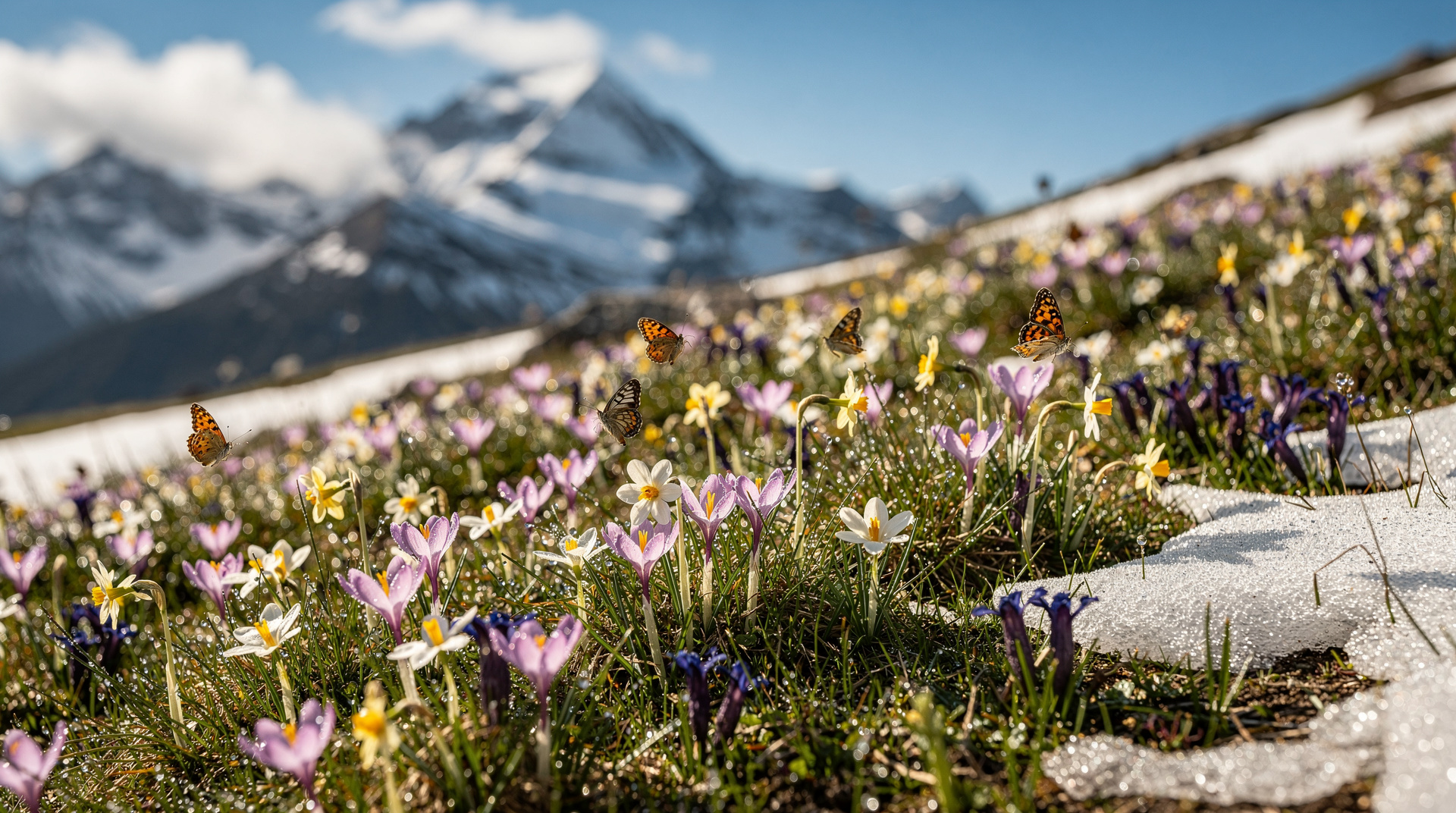
At the same time, alpine flowers are still blooming at lower elevations well into September. Gentians — those extraordinary deep-blue flowers that seem almost too vivid to be natural — persist into October in sheltered spots. The combination of autumn color, first snow, and late flowers in a single hike is unique to this season.
The hiking sweet spot
July and August are the most popular months for Swiss hiking for obvious reasons — guaranteed warmth, maximum daylight, all trails open. But they’re also the months when trail traffic is heaviest, mountain huts are booked solid weeks in advance, and the most popular routes can feel congested.
September and October offer most of the same advantages with almost none of the crowds. Trails that were shoulder-to-shoulder in August are quiet enough that you can spend an hour on a ridge without seeing another person. Mountain huts (Berghütten) are typically open until mid-October and have space available on short notice. The weather is often superb — high pressure systems that produce clear, cold, still days with air so clear the mountains look sharper than they do in hazy summer heat. If you would rather not plan the route yourself, a guided full-day hike in the Swiss Alps from Lucerne is an easy way to catch the autumn colors.
The hiking conditions are excellent into October for trails below about 2,000 meters. Above that, fresh snow can appear by late September — this isn’t necessarily a problem for experienced hikers with appropriate footwear, but it closes some routes and changes the character of others.
Autumn in the cities
The appeal of autumn isn’t confined to the mountains. Switzerland’s cities in September and October have a particular quality — the light is lower and more golden, the air is crisp, and the cultural calendar fills up in ways it doesn’t in summer.
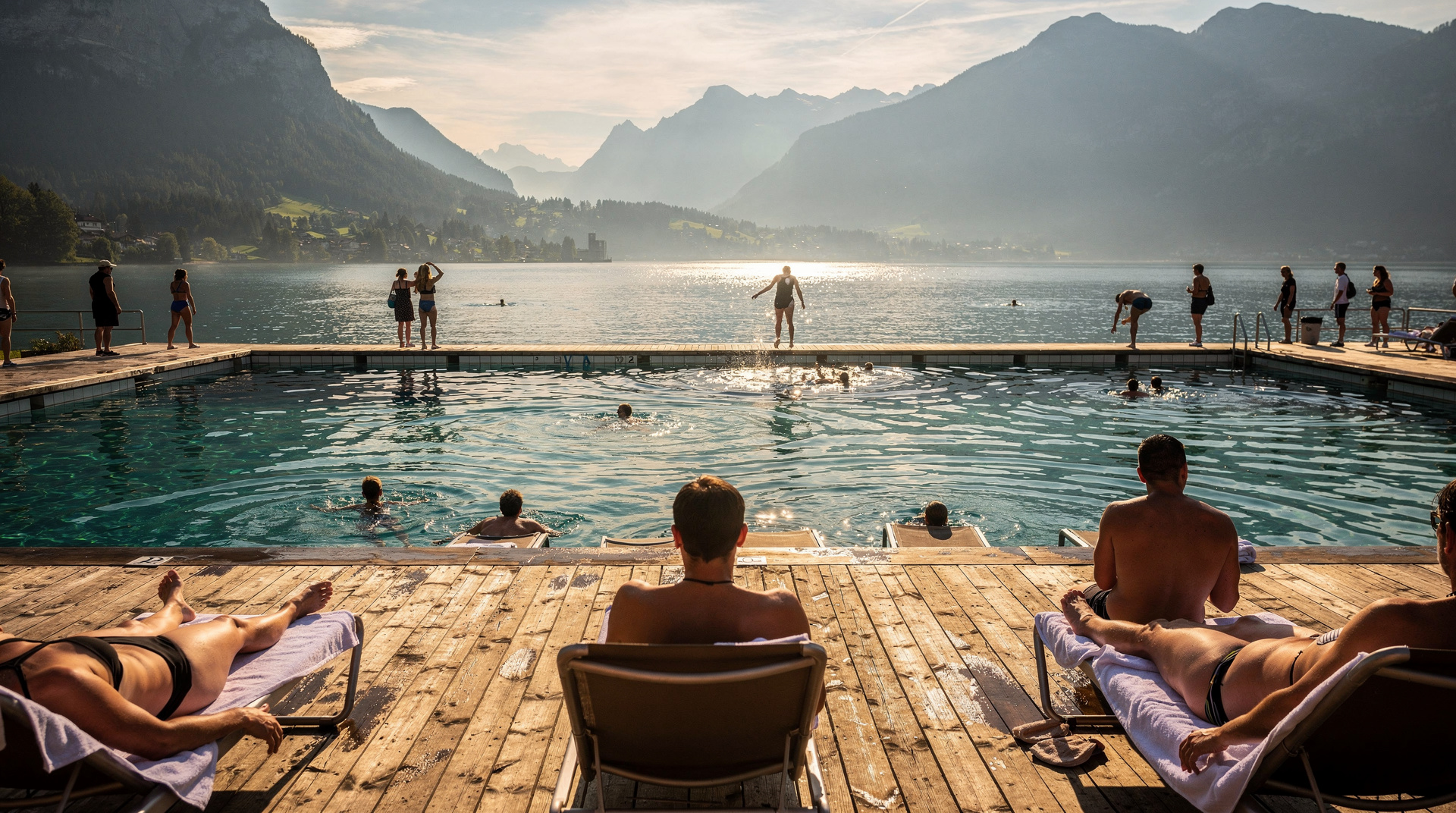
Zurich in autumn is excellent: the Zurich Film Festival runs in late September, the art scene is active, and the lake takes on a different quality in October light — calmer, more mysterious, with mist on the mornings after cold nights.
Lucerne is perhaps at its best in October. The foggy mornings over the lake, when the medieval towers of the old town emerge from mist while the mountains above are clear and snow-dusted, are among the most atmospheric sights in Swiss tourism. The city is quiet enough that you can walk the Chapel Bridge and the old town lanes in peace.
The Lavaux vineyards above Lake Geneva are in full harvest mode in October — probably the best single month to visit this UNESCO-listed wine region, when the grapes are being picked, the cellars are open for tastings, and the golden vines against the blue lake are at their peak visual glory.
Autumn food: the season of mushrooms, game, and new wine
Swiss autumn cooking is exceptional. The mountain and forest larder comes into its own in September and October.
Mushrooms: Switzerland has a serious mushroom culture, and autumn is the season. Chanterelles (Pfifferlinge), porcini (Steinpilze), and various other species appear on restaurant menus from late August through October. A mushroom risotto or mushroom pasta in a Swiss mountain restaurant in October is one of those meals you remember specifically.
Game: Swiss hunting season runs from September through November, and game (Wildbret) appears on menus across the country. Venison (Hirsch), chamois (Gämse), and wild boar (Wildschwein) all feature in traditional dishes — braised in rich sauces with root vegetables, served with Spätzle and cranberry compote. This is hearty, warming alpine food at its finest.
New wine: The Valais and Lake Geneva wine regions harvest in late September and October. Some producers sell Süssmost (unfermented grape juice) and Federweisser (partially fermented new wine) directly from cellars during harvest. The Fête des Vendanges (Grape Harvest Festival) in Neuchâtel and other wine towns usually falls in late September and is well worth catching.
Fondue season: Fondue, officially, is autumn and winter food. The first cold weather signals fondue season, and Swiss restaurants that might serve lighter summer menus in August have their fondue pots out by late September. There’s nothing better than fondue on a cold October evening in a mountain village after a day of golden-larch hiking.
Check the fondue guide for the best fondue restaurants by region.
Practical advantages of autumn travel
Beyond the beauty and atmosphere, autumn has concrete practical advantages.
Lower prices: Swiss accommodation, particularly mountain resorts, prices drop noticeably after the summer peak season ends (roughly mid-August). The savings are real — you can often find the same hotel at 20-30% less than it cost in July. The major exception is the Christmas-New Year period.
Fewer crowds: The visitor numbers in September and October are substantially lower than July and August. The famous attractions — Jungfraujoch, Mount Pilatus, the Chapel Bridge — still have visitors, but the lines and the crowding are manageable. The most popular photography spots can be reached without jostling for position.
Better mountain hut availability: Swiss alpine huts (Berghütten) are booked months in advance for summer weekends. In September and October, the same huts often have space on one or two days’ notice. Spending a night in a mountain hut — simple dinner, bunk beds, spectacular sunrise — is one of the great Switzerland experiences, and autumn makes it accessible.
Clearer views: Summer heat creates haze in valley air that reduces long-distance visibility. Autumn air is sharper and colder, and after the summer atmospheric humidity drops, the mountains stand out with a clarity that summer visitors don’t always get. The views from Jungfraujoch, the Pilatus summit, or the Schilthorn are often better on a clear October day than on a warm July one.
Book Jungfraujoch with flexible cancellation — weather still matters in autumn, so flexibility remains important.
What to pack for autumn
Autumn weather in Switzerland is genuinely variable and changes with elevation. The basic principle: pack more layers than you think you need and include waterproofs.
Lower elevations (below 1,500m), cities: September feels like late summer — temperatures of 15-22°C, pleasant and mild. October brings the first cold spells, with temperatures dropping to 5-12°C and frequent rain. A waterproof jacket, light fleece, and walking shoes are the minimum.
Mid-elevation (1,500-2,500m): September temperatures are 8-15°C during the day. October brings cold nights and possible snow. Proper hiking boots, insulating layers, gloves, and a hat are necessary.
High elevation (above 2,500m): Can snow any time from September onwards. Bring everything.
The best time to visit page has a full seasonal breakdown with specific temperature data.
The autumn calendar
September: Best combination of summer reliability and autumn character. Golden larches beginning at highest elevations. Harvest festivals in wine regions. Zurich Film Festival in last week of September.
October: Peak golden larch color across the Alps. Harvest complete, wine cellars open for tasting. Mountains fresh with first snowfall. Fewer visitors than any other month except January-February. Best photography conditions of the year.
November: Early winter arriving. Some mountain lifts and attractions close for maintenance before ski season. Christmas market preparations begin in cities. Good month for cities and lower-elevation walks, less ideal for mountain hiking.
Plan your autumn trip
A good autumn Switzerland trip combines city days (Zurich, Lucerne, Bern) with mountain access (Bernese Oberland, Zermatt region, Engadin) and some wine country (Valais, Lake Geneva).
The 7-day itinerary works well in autumn with minor modifications — check specific opening dates for mountain lifts and attractions, as some close in mid-October or November. The Swiss Travel Pass is as valuable in autumn as any other season, and you can book the Swiss Travel Pass for unlimited train, bus and boat travel ahead of your trip.
Those who discover autumn Switzerland have a tendency to come back for it specifically — not because they can’t find the summer’s charms, but because the golden larches and clear mountain air of October become an annual need. It’s that kind of beautiful.
Autumn month by month
| Month | Weather | Larch color | Crowds |
|---|---|---|---|
| September | Mild, 15-22°C in cities, 8-15°C mid-elevation | Just beginning at highest elevations | Moderate, still summer-adjacent |
| October | Cooler, 5-12°C in cities with rain likely | Peak across the Alps | Low — one of the quietest months of the year |
| November | Cold, early winter arriving | Past peak, trees bare above treeline | Very low |
What autumn itineraries suit this season
A dedicated autumn trip doesn’t need a special route — it needs the right modifications to a standard one. The 7-day itinerary adapts well with earlier sunset times factored into the daily pace, and travellers chasing mountain scenery without ski-season prices should also look at the scenic trains itinerary: the Glacier Express and Bernina Express both run through peak larch color in October and are markedly less booked-out than in summer.
Solo travellers considering an autumn trip will find hostels quieter but still open — see the solo itinerary for a route that works well in the shoulder season crowds this article describes. For hikers specifically chasing the larches, the best hikes guide and the multi-day treks guide both have autumn-specific notes on trail closures above the snowline.