Geneva to Lavaux: day trip guide (UNESCO vineyard walk)
How do you get from Geneva to the Lavaux vineyards?
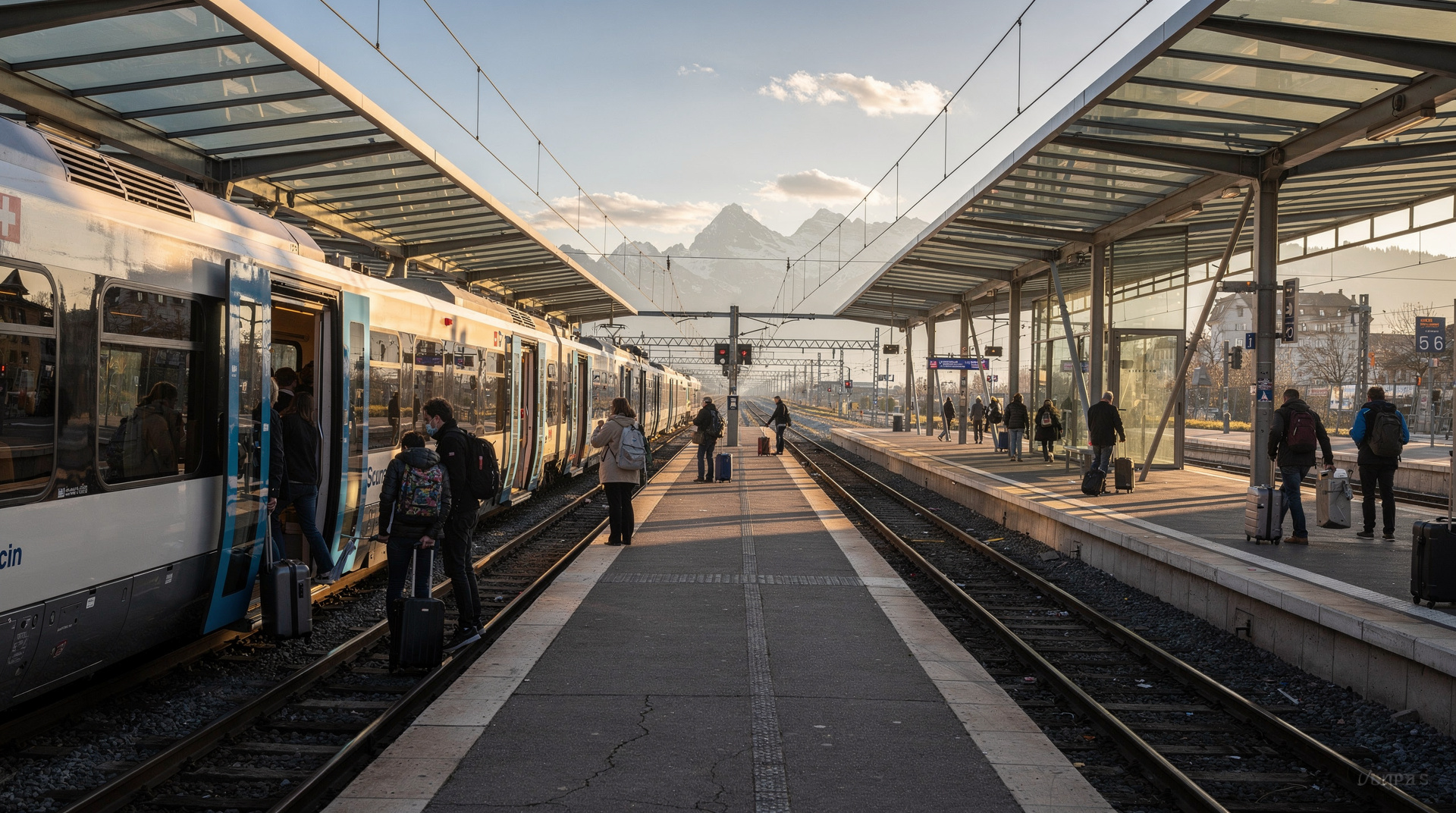
Take the train from Geneva to Lausanne (35 min), then a regional train to Lutry, Cully, Epesses, or Rivaz (5-10 min more). The Lavaux vineyard walk runs between Lausanne-Ouchy and Vevey through these villages. All covered by Swiss Travel Pass.
The Lavaux vineyard walk from Geneva
The Lavaux is one of the most beautiful landscapes in Switzerland — 830 hectares of terraced vineyards climbing the steep hillside above Lake Geneva between Lausanne and Vevey, designated a UNESCO World Heritage Site in 2007. The vines — predominantly Chasselas, producing the region’s signature white wine — grow on stone-walled terraces that have been cultivated continuously for over 1,000 years.
Walking through the Lavaux in spring or autumn, with the lake below, the French Alps across the water, and the vines in various stages of the cycle, is one of the great slow-travel experiences of Switzerland. The path between the vineyard villages is well-marked, moderately challenging (some steep sections between terraces), and passes through some of the most photographed scenery in the Lake Geneva region.
From Geneva, the Lavaux is just 35 minutes away by train to Lausanne, making it one of the closest full-day natural experiences available. The combination of beautiful scenery, good wine, excellent lakeside restaurants, and easy train connections at each end of the walk makes this an ideal choice for a relaxed day away from the city.
| Where | Between Lausanne and Vevey, on the Lake Geneva shore, canton Vaud |
| Cost | Free walking; wine tastings around CHF 5-9/glass; short segment needs only a train ticket |
| Time needed | 1.5-2 hours for the Cully-St-Saphorin highlight, 4-5 hours for the full Lausanne-Vevey route |
| Getting there | Train from Geneva to Lausanne (around 35 min), then a short regional connection; covered by the Swiss Travel Pass |
| Best time | September-October for harvest colours; April-May for fresh green vines and quieter cellars |
Understanding the Lavaux landscape
The Lavaux covers the hillside between Lausanne and Vevey, facing south and southeast over Lake Geneva. The orientation — sun from the south, warmth reflected from the lake surface, and additional warmth absorbed by the stone terrace walls — creates three suns as local winemakers describe it: the sun directly above, the reflected sun from the lake, and the radiated heat from the stones.
This triple-sun effect and the well-drained limestone soils produce Chasselas grapes with unusually complex mineral character — a wine style very different from the thicker, more alcoholic whites of warmer wine regions. Lavaux Chasselas is delicate, slightly sparkling (pétillant), and best drunk young and cold. It is almost unknown outside Switzerland because very little is exported.
The Lavaux has been cultivated by Cistercian and Augustinian monks from at least the 12th century. The current stone terrace system was largely built in medieval times and has been maintained — and in some places rebuilt — continuously since. Walking through it is walking through 900 years of agricultural history.
Getting from Geneva to the Lavaux
By train:
The regional trains that run between Lausanne and Vevey stop at all the main Lavaux villages:
- Geneva Cornavin → Lausanne: 35 minutes by InterCity or RegioExpress. Trains run every 15-20 minutes.
- Lausanne → Lutry (start of Lavaux walk): 5 minutes by regional S31 train
- Lausanne → Cully (middle of Lavaux): 12 minutes
- Lausanne → Epesses: 16 minutes
- Lausanne → Rivaz: 19 minutes
- Lausanne → St-Saphorin: 22 minutes
- Lausanne → Vevey (end of walk): 25 minutes (or direct from Geneva: 50 minutes)
Swiss Travel Pass: Covers all these journeys in full — Geneva to Lausanne, and Lausanne to any of the vineyard villages. Also covers the return train from Vevey or wherever you end the walk.
Individual ticket: Geneva to Vevey return: approximately CHF 38.
Guided tour option: Book a guided Lavaux vineyard experience from Lausanne — this includes a guided walk through the terraces, visits to a cave (wine cellar), and a structured tasting of Lavaux wines with a local sommelier or winegrower.
The vineyard walk: route options
Full Lavaux walk (Lausanne-Ouchy to Vevey)
The complete Lavaux path covers approximately 13 kilometres between Lausanne-Ouchy and Vevey, with around 400-500 metres of total ascent and descent across the terraces. Allow 4-5 hours at a leisurely walking pace, including stops in villages and for wine tasting.
This is a genuine hike — comfortable walking shoes are required, and parts of the path are steep. The route is well-marked with yellow hiking signs throughout.
Suggested direction: West to east (Lausanne to Vevey) in the morning gives you the early light on the vines and means you arrive at Vevey with the option of taking the lake steamer back to Lausanne or continuing to Montreux.
Shorter segment walk (Cully to St-Saphorin)
The most scenic and manageable section is between Cully and St-Saphorin — approximately 5 kilometres with around 200 metres of ascent/descent. This takes 1.5-2 hours and passes through the heart of the UNESCO zone, with the best combination of views, terraces, and village architecture. Take the train to Cully from Lausanne, walk to St-Saphorin, then train back from Rivaz or St-Saphorin to Lausanne or Vevey.
This shorter section is suitable for anyone with reasonable fitness and comfortable shoes — it does not require hiking experience.
Lavaux Panoramic Express (electric train)
A small tourist train (the Lavaux Panoramique) runs through the vineyard terraces in summer, stopping at key viewpoints. It is accessible from Chexbres or Cully and is a good option for those who want the vineyard scenery without the walking. Runs May to October, check current timetables at lavaux-panoramic.ch.
Key villages on the route
Lutry
The western entry to the Lavaux from Lausanne, Lutry is a prosperous wine village with a beautiful Rue du Bourg (main street), several excellent wine cellars, and a château surrounded by vineyards. The village hosts one of the Lavaux’s most photogenic annual events: the Fête de Lutry wine harvest festival in October.
Good entry point if you want to avoid starting in the busier Lausanne-Ouchy area.
Cully
The central village of the Lavaux, Cully has the most restaurants and wine cellars of any village on the route. It sits at the foot of the steepest section of terraces and has a small harbour on the lake. The Fête du Cully festival in March is the most famous wine event in the Lavaux, but Cully is pleasant in any season.
Wine tasting in Cully: Several cellars in and around Cully offer tastings by appointment or walk-in (look for “dégustation” signs). The wines of Cully are some of the finest Lavaux Chasselas, with notable mineral character from the limestone soils.
Epesses
A tiny village perched in the vines above the lake — the highest village on the Lavaux walk. Epesses produces some of the most sought-after Lavaux wines; the Clos du Boux (a walled single vineyard above the village) is among the most prestigious addresses in Swiss viticulture. The views from Epesses across the lake to the French Alps are exceptional.
Rivaz and St-Saphorin
Adjacent villages at the eastern end of the Lavaux, connected by a short vineyard path. St-Saphorin is the most characterful — a cluster of stone buildings around a Roman-era church, a tiny main street with one restaurant and one wine cellar, and a sense of having barely changed since the 17th century. The restaurant here (the Auberge de l’Onde) has an excellent wine list and is one of the better dining destinations on the entire walk.
Wine tasting in the Lavaux
The Lavaux produces almost entirely white wine (Chasselas) with small amounts of Pinot Noir on higher terraces. Here is what to expect:
Chasselas characteristics: Dry, light, mineral, with low alcohol (typically 11-12%). Very slight natural effervescence in good years. Best drunk within 2-3 years of harvest. Pairs with lake fish (perch, fera, pike), fondue, and mild cheeses.
Village classifications: Lavaux wines are classified by village appellation — Lutry, Epesses, Cully, Chardonne, etc. — and by sub-appellation for premier cru vineyards. The most prestigious are the Premiers Crus of Dezaley and Calamin, both with Grand Cru status.
Where to taste: Most Lavaux winegrowers offer tastings either by appointment (most reliably) or at their cellar door on summer weekends. The Maison du Terroir in Cully is a good starting point — they stock wines from multiple producers and offer walk-in tastings. If you would rather not arrange cellar visits yourself, you can join a guided wine tour of the Lavaux vineyards. For more on the region, see our guides to wine tasting in Lavaux and the Lavaux wine region.
Price: A glass of Lavaux Chasselas costs approximately CHF 5-9 in a cellar setting. A bottle from the producer: CHF 15-25 for village level, CHF 30-50 for Premier Cru.
Lausanne: worth 1-2 hours en route
Since the Lavaux walk typically starts or ends in Lausanne, and Geneva to Lausanne is only 35 minutes, it is easy to build in time in Lausanne on the outward or return journey.
What to see in Lausanne:
- The Gothic cathedral on the hilltop — free entry, remarkable interior
- The old town lanes around the Place de la Palud (15th-century fountain, town hall)
- The Olympic Museum at Ouchy (CHF 20, excellent for sports fans and general visitors alike)
- The Musée de l’Élysée (photography museum, moved to new premises in 2022)
- The Ouchy lakefront and Vidy beach area
Lausanne is hilly — comfortable shoes are a must. The funicular (Metro M2) connects the lakefront at Ouchy to the old town in 6 minutes. Covered by Swiss Travel Pass.
Suggested itinerary: Geneva to Lavaux and back
Option A (half-day walk, Cully to St-Saphorin):
- 09:00 — Depart Geneva Cornavin
- 09:35 — Arrive Lausanne. Quick coffee at the station
- 09:50 — Regional train to Cully (12 minutes)
- 10:05 — Start vineyard walk at Cully
- 12:00 — Arrive St-Saphorin (2 hours walking with stops for photos and views)
- 12:30 — Lunch at Auberge de l’Onde, St-Saphorin
- 14:00 — Train from Rivaz to Vevey (5 minutes), then browse Vevey market (Tuesday, Friday) or lakefront
- 15:00 — Train from Vevey to Geneva via Lausanne
- 15:50 — Arrive Geneva
Option B (full-day walk + Lausanne):
- 08:00 — Depart Geneva Cornavin
- 08:35 — Arrive Lausanne. Cathedral visit (30 minutes) and old town
- 10:00 — Regional train from Lausanne to Lutry (start of full walk)
- 10:15 — Begin vineyard walk: Lutry → Cully (1.5h) → Epesses → Rivaz → St-Saphorin → Vevey
- 14:30-15:30 — Arrive Vevey. Late lunch or Chaplin’s World museum
- 16:00 — Train from Vevey toward Lausanne and Geneva
- 17:00 — Arrive Geneva Cornavin
Chasselas: Switzerland’s signature white grape
Chasselas is the dominant white grape of the Lake Geneva region and one of the most misunderstood wines in the world. Outside Switzerland, it is largely unknown — over 60% of Swiss wine production is consumed within the country, and Swiss wines are rarely exported in significant volumes. Within the Lavaux, it reaches its highest expression.
The grape itself is ancient — genetic analysis suggests it is one of the oldest cultivated Vitis vinifera varieties, possibly originating in the Middle East and reaching Switzerland through monastic wine culture in the early medieval period. The Lavaux has grown Chasselas for at least 1,000 years and the vine is so well adapted to the limestone terraces, the lake reflection, and the microclimate that other varieties have almost never been seriously cultivated here.
Chasselas characteristics that distinguish it from other white wines:
- Delicate, low tannin, never sweet
- Mineral — the soil character is directly perceptible in the wine
- Low alcohol (typically 11-12.5%)
- Natural slight effervescence (perlant) in good vintages
- Best drunk within 1-3 years of harvest; rarely improves significantly with age
The challenge for wine buyers outside Switzerland is finding Lavaux wines at all. Most wine shops in Zurich and Geneva carry some selection; specialist importers occasionally bring small quantities to the UK and USA. If you are in the Lavaux itself, buy directly from the producer — quantities are limited, prices are fair, and you are supporting a tradition that has survived 1,000 years.
The UNESCO designation: what it means in practice
The Lavaux was added to the UNESCO World Heritage List in 2007 under the category of Cultural Landscape — the same category as the Aletsch Glacier area, Bellinzona’s castles, and Monte San Giorgio. The designation recognises both the physical landscape (the terraces themselves, the stone walls, the specific arrangement of vine, path, and settlement) and the living cultural tradition that created and maintains it.
In practical terms, UNESCO status means that significant changes to the landscape require cantonal and federal approval with UNESCO review. The building regulations in the Lavaux are strict: no new structures on the terraces, no modification of the stone walls except for maintenance, no changes to the historic village centres. This has successfully preserved the landscape over the past two decades against development pressure that has transformed other Swiss lakeside areas.
The designation also means the Lavaux appears on Tentative Lists of other UNESCO programmes — it is regularly cited in international conservation discussions as a model of preserving living agricultural landscapes that continue to function economically while meeting heritage standards.
Lausanne as the gateway city
Since the Lavaux walk typically begins or ends in Lausanne, and the city is just 35 minutes from Geneva by InterCity train, Lausanne deserves more than a passing mention.
The city was founded as a Roman settlement (Lausonna) on the lakeside in the 1st century CE, then moved uphill to its current position on the promontory between the rivers Flon and Louve in the medieval period. The old town is built on three hills connected by bridges and the central valley — navigation requires the funicular (Metro M2) or patient climbing.
Essential Lausanne:
The cathedral of Notre Dame (completed 1275) is the finest Gothic cathedral in Switzerland — French-influenced, with an elaborately carved portal and extraordinary stained glass in the choir. It is also the only Swiss cathedral that still maintains the tradition of the guet (nightwatchman) calling the hours from the tower between 22:00 and 02:00, a custom unbroken since 1405. Entry is free.
The Collection de l’Art Brut (outsider art) is one of the most unusual museums in Switzerland — a collection of art made by self-taught creators, many of them psychiatric patients, prisoners, or otherwise outside mainstream society. Founded by the artist Jean Dubuffet, it is now one of the world’s most important collections of its type. Entry CHF 12.
The lakefront at Ouchy — the starting point for both the Lavaux walk and CGN steamer services — has a pleasant promenade, the Olympic Museum (CHF 20), and several outdoor cafés. The funicular from Ouchy to the old town takes 6 minutes and is covered by the Swiss Travel Pass.
Seasonal tips
Spring (April-May): Vines are budding, the green is fresh and intense. Weather can be cool — bring a layer. Great for photography. Wine cellars are quieter.
Summer (June-August): Peak tourist season. Walk early in the morning before heat builds (30°C+ is possible on south-facing terraces in July). Lake swimming at Vidy beach in Lausanne or Vevey beach is possible.
Autumn (September-October): Harvest season — the most beautiful time in the Lavaux. Vines turn gold and red. Harvest festivals in several villages. Wine cellars offer the new vintage. Highly recommended.
Winter (November-March): The Lavaux is quiet but not closed. The terraces without leaves reveal the stone wall architecture. No wine tastings generally available at cellars. Good for reflective walking without crowds.
Practical tips
Footwear: Comfortable, grippy walking shoes are essential. The terrace paths are uneven stone with steep sections. Trainers work fine; trail shoes are better for the longer route.
Sun protection: The south-facing terraces get intense afternoon sun. Hat and sunscreen in summer.
Carrying wine home: If you buy wine at a cellar, ask for a padded bag or bring your own wine carrier. Most Swiss trains have luggage racks — bottles travel fine.
Photography: Best light on the Lavaux is morning (direct sun on south-facing vines) and late afternoon (warm golden light, long shadows). The classic shot — vines in foreground, lake below, Alps behind — is best from the terrace paths between Cully and Epesses.
Related guides
- Day trips from Geneva — full overview
- Geneva to Montreux and Chateau Chillon — extending the day to Montreux
- Geneva to Gruyeres — cheese and chocolate
- Swiss Travel Pass — full coverage on this route
- Budget travel in Switzerland — keeping costs reasonable
- 7-day Switzerland itinerary — planning a longer Lake Geneva stay
Full walk vs. short segment: which to choose
| Full walk (Lausanne-Ouchy to Vevey) | Short segment (Cully to St-Saphorin) | |
|---|---|---|
| Distance | Approximately 13 km | Approximately 5 km |
| Time | 4-5 hours with stops | 1.5-2 hours |
| Fitness needed | Moderate, some steep sections | Comfortable for most walkers |
| Best for | A dedicated day trip, keen walkers | Combining with Lausanne sightseeing or another stop |
| Wine cellars passed | All villages, most tasting options | Cully and St-Saphorin, still excellent |
Most visitors staying based in Geneva do better with the short segment plus time in Lausanne — it leaves room to also see the cathedral and old town without a rushed finish, and it is the version most families and less experienced walkers should pick. Save the full walk for a day when the vineyard walk itself is the whole point.
Frequently asked questions about Geneva to Lavaux
Do you need to book vineyard wine tastings in advance?
Most Lavaux cellars accept walk-ins on summer weekends, but tastings by appointment are more reliable, especially outside peak season or for smaller producers. The Maison du Terroir in Cully is the easiest walk-in option since it represents multiple producers under one roof.
Is the Lavaux walk suitable for young children or those with limited mobility?
The terrace paths involve uneven stone surfaces and some steep sections, making the full walk unsuitable for strollers or limited mobility. The short Cully to St-Saphorin segment is more manageable, but for genuinely flat, accessible options, the Lavaux Panoramic Express tourist train or a lakeside walk in Lausanne itself are better choices.