Renting a car in Switzerland: the complete guide
Do I need a car in Switzerland?
Usually no. Switzerland's public transport is exceptional and covers almost everywhere tourists want to go. A car is most useful for the Bernese Oberland valleys, the Ticino countryside, and wine regions. Buy the CHF 40 motorway vignette at any petrol station, post office, or border crossing.
Do you actually need a car in Switzerland?
| At a glance | Details |
|---|---|
| Where | Most useful in the Ticino countryside, remote Alpine valleys, and wine regions |
| Cost | Around CHF 350-450/week rental plus CHF 40 vignette, fuel, and parking |
| Time needed | Book ahead for peak summer; pick-up takes 20-30 minutes at airport counters |
| Getting there | Major rental desks at Zurich, Geneva, and Basel airports |
| Best time | June-October for mountain pass driving; winter tyres required November-March |
This is the first question to answer honestly, because Switzerland is one of the rare countries where the honest answer for most tourists is no. The Swiss public transport network is among the best in the world — trains run every 30 minutes or hourly between virtually every town, buses serve villages in mountain valleys, and lake boats connect lakeside destinations. The Swiss Travel Pass covers almost all of it. You can reach Interlaken, Lucerne, Zermatt, Grindelwald, and hundreds of other destinations without ever touching a steering wheel. Even mountain excursions such as Mount Pilatus by cable car, cog railway, and lake cruise are easy to do from Lucerne without a car.
A car is genuinely more useful — sometimes significantly so — in specific situations:
A car is worth considering if:
- You are touring the Ticino countryside (small villages between Lugano and Locarno not well-served by rail)
- You want to explore remote Alpine valleys (Simmental, Haslital, Val Müstair)
- You are visiting vineyards along the Lavaux or in Valais
- You have young children with pushchairs, significant luggage, and fixed daily plans
- You are travelling in a group of 3–4 people and the per-person cost of a car is lower than multiple rail passes
A car is probably not worth it if:
- Your itinerary focuses on Zurich, Bern, Basel, Lucerne, Geneva, or Lausanne
- You plan to visit ski resorts (most are car-free or have expensive parking)
- You want to drink wine and eat fondue without worrying about driving
- You are on a typical 7-14 day tourist circuit of Swiss cities and mountains
The getting around Switzerland guide gives a full overview of train, bus, and boat options.
The motorway vignette (Autobahnvignette)
If you drive any vehicle on a Swiss motorway (Autobahn / autoroute), you are legally required to display a motorway vignette. This is a sticker, sold annually, that covers unlimited use of all Swiss motorways for the calendar year.
Cost: CHF 40 (approximately EUR 42 / GBP 35 at 2026 rates)
Period: Valid for the calendar year (January to December 31)
Where to buy:
- At Swiss border crossings (from border officials or vending machines)
- At any Swiss petrol station
- At post offices in Switzerland
- Online at shop.ezv.admin.ch (but allow mailing time if ordering in advance)
The vignette is a physical sticker that must be affixed to the inside of your windscreen, not hung from the mirror or loose in the car. It is non-transferable — if you rent a car, check whether the rental car already has a current year’s vignette; most Swiss rental companies include it.
Penalties for driving without a vignette are significant: CHF 200 fine plus the compulsory purchase of the CHF 40 vignette. Enforcement cameras check vignettes automatically on motorway entries.
What the vignette covers: All motorways marked with green signs bearing the motorway symbol. It does not cover cantonal roads or mountain pass roads, which are toll-free anyway. It also does not cover the tunnel tolls for the Grand-Saint-Bernard tunnel (CHF 30 one-way) or the Munt La Schera / Ofenberg tunnels, which have separate tolls.
Speed limits
Swiss speed limits are strictly enforced by a dense network of fixed and mobile radar cameras. Fines are high, and at significant exceedances, your driving licence can be confiscated on the spot.
| Road type | Speed limit |
|---|---|
| Motorways (green signs) | 120 km/h |
| Semi-motorways / dual carriageways (green) | 100 km/h |
| Cantonal roads outside built-up areas | 80 km/h |
| Within towns and built-up areas | 50 km/h |
| Zones 30 (residential/pedestrian priority) | 30 km/h |
Speed cameras often give no advance warning. Following the posted limits closely, particularly in urban areas and in the 80 km/h road sections, is strongly advised.
The drink-driving limit is 0.5 per mille blood alcohol (lower than the UK’s 0.8 per mille, the same as most EU countries). For drivers under 18 or with less than 3 years of licence: zero tolerance.
Mobile phone use while driving (handheld) is illegal and fined at CHF 100. Using a phone in any way while driving — even stopped in traffic — is a violation.
Fuel costs
Fuel in Switzerland is generally 10–20% cheaper than in neighbouring France and roughly comparable to Germany, though prices fluctuate. As of 2026:
- Petrol (95 octane): approximately CHF 1.65–1.85 per litre
- Diesel: approximately CHF 1.70–1.90 per litre
Most Swiss petrol stations accept credit and debit cards, including international cards. Some unmanned 24-hour stations require a Swiss bank card or specific card types — carry some CHF for these if travelling at night.
Switzerland is increasingly well-equipped for electric vehicles. Fast-charging stations (CCS/Type 2) are found at motorway service areas, many supermarket car parks, and in urban areas. The Migros and Coop supermarket networks both operate charging stations.
Parking
Parking in Swiss cities is expensive and regulated. The colour-coded zone system:
White zones: Unlimited free parking (rare in city centres; more common in rural areas)
Blue zones: Time-limited free parking, typically 1 hour. You must display a parking disc (free blue cardboard clock disc, required by law; car rental companies should provide one, or buy at any petrol station or kiosk). Set the disc to your arrival time.
Yellow zones: Loading only, or private reserved parking.
Paid parking bays (grey/white with meter): Pay at the parking meter for the displayed time. Most accept coins and credit cards.
Parking garages (Parkhaus / parking) in city centres cost approximately CHF 3–6 per hour, or CHF 20–40 per day. Pre-book where possible in cities like Zurich, Basel, or Bern on busy days. If you are spending time in Zurich, the ZurichCard covers local public transport and many attractions, so you can leave the car parked.
Mountain resort parking varies significantly. Car-free resorts like Zermatt, Wengen, Mürren, and Saas-Fee do not permit private cars inside the village — you park in the valley (at Täsch for Zermatt, Grütschalp or Lauterbrunnen for Wengen and Mürren) and take the train or cable car up. Parking fees at valley car parks range from CHF 10–20 per day.
Mountain passes
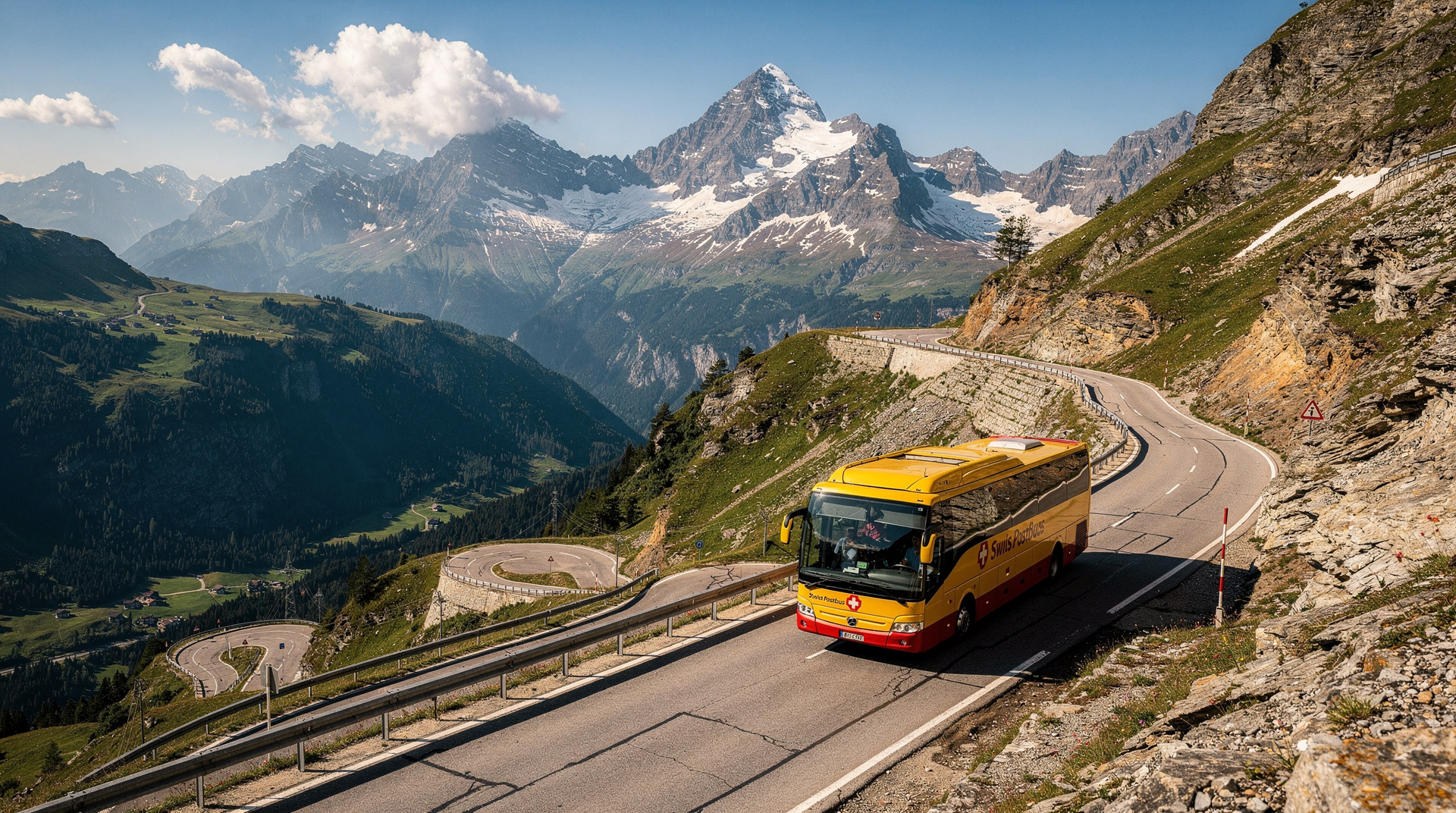
Switzerland’s mountain passes are among the most dramatic roads in Europe and a significant draw for motorcyclists and driving enthusiasts. Key practical information:
Season: Most high Alpine passes are open only from approximately June to October, depending on snow conditions. Some close as early as late October; others are kept open as long as possible with ploughing. Check the current status at viasuisse.ch.
Major passes and their character:
- Susten Pass (2,224 m): Beautifully engineered road connecting Innertkirchen and Wassen. Moderate traffic, excellent scenery.
- Furka Pass (2,429 m): Connects Gletsch and Realp. Famously featured in James Bond’s Goldfinger. Narrow sections, dramatic glacier views.
- Grimsel Pass (2,164 m): Near the Furka, connecting the Haslital with the Goms valley. Hydroelectric lakes and extreme rockface scenery.
- Gotthard Pass (2,106 m): The historic St Gotthard route. The modern Gotthard road tunnel (16.9 km) is used by most traffic; the pass road itself is open in summer and much more scenic.
- San Bernardino Pass (2,065 m): Connecting the Graubünden valleys with Ticino. Less famous than the Gotthard, but excellent road.
- Julier Pass (2,284 m): Key route into the Engadin valley and for St Moritz access. One of the highest passes kept open all year.
Driving technique on mountain passes:
- Uphill traffic generally has right of way on single-lane sections — but local rules vary; use common sense and passing places
- Honk gently before blind corners (it is expected and appreciated, not rude)
- Use low gears on long descents to protect brakes
- Watch for cyclists — they use passes extensively and have the right to the road
Winter driving
If you plan to drive in Switzerland in winter (November to March) or in mountain areas at any time, winter tyres are strongly recommended and in many mountain cantons effectively required by law in winter conditions. Some cantons require snow chains on specific mountain roads when conditions demand it.
Rental cars in Switzerland should come with winter tyres fitted from approximately November to March — confirm this when booking.
The national road conditions service (TCS) provides real-time information on road closures, conditions, and chain requirements at tcs.ch and via the TCS app.
Car rental in Switzerland: practical notes
Minimum age: Most rental companies require drivers to be at least 21. Drivers aged 21–24 typically pay a young driver surcharge (CHF 15–25 per day).
International Driving Permit (IDP): Required if your driving licence is not in Roman script (Latin alphabet). EU, UK, Australian, US, and Canadian licences are accepted directly. Licences in Arabic, Chinese, Russian, Thai, etc. require an IDP.
Major rental companies all operate at Zurich, Geneva, and Basel airports: Hertz, Avis, Europcar, Sixt, Enterprise. Swiss domestic options include Mobility (car-sharing, by the hour or day).
One-way rentals: Available but expensive. Renting in Zurich and returning in Geneva carries a significant surcharge; plan accordingly if this is your itinerary. The train is almost always cheaper for one-way inter-city travel.
Car vs. train: a cost comparison
The comparison depends heavily on group size and itinerary. A rough guide:
For a solo traveller doing 7 days visiting Zurich, Lucerne, Interlaken, Bern, and Geneva:
- Swiss Travel Pass (7 consecutive days, 2nd class): approximately CHF 520
- Car rental (7 days, basic car): approximately CHF 350–450 + fuel (CHF 60–100 for the distance) + vignette (CHF 40) + parking (CHF 100–200 for city days) = approximately CHF 550–790
For a couple, the Swiss Travel Pass (two passes) would be about CHF 1,040, while the car would be the same (parking and vignette do not change with passengers), making the car significantly more competitive.
For a family of four, the car clearly wins on transportation cost — but not if hotel/parking costs in cities are factored in.
The Swiss Travel Pass guide and budget guide both help with these calculations in more detail.
When the train beats the car
There are specific situations where the train is genuinely faster than driving:
- Zurich to Bern: Train 57 minutes. Driving: 1 hour 15+ minutes (depending on traffic, parking at destination adds another 15+ minutes)
- Geneva to Lausanne: Train 35 minutes. Driving: 55 minutes + parking
- Zurich to Basel: Train 55 minutes. Driving: 1 hour + traffic on A3/A2
- Lucerne to Interlaken: Train 1 hour 50 minutes. Driving: 1 hour 30 minutes (marginal gain, but parking in Interlaken is paid and the train goes directly to the mountain railways)
The Swiss rail network consistently outperforms driving on city-to-city journeys when you account for parking, traffic, and travel to/from city-centre parking garages.
Summary: car rental decision guide
Get a car if you are: exploring remote valleys, staying in rural guesthouses without train access, travelling with a family where luggage and small children make public transport cumbersome, or planning a dedicated mountain pass driving circuit.
Use the train if you are: doing city-to-city travel, visiting ski resorts, spending time in major urban areas, doing day trips from a fixed base, or on a budget where the pass represents good value.
The airport transfers guide covers how to get from Swiss airports to city centres without a car. The getting around Switzerland guide has the full overview of all transport options, passes, and regional variations.
Scenic driving routes in Switzerland
If you do decide to hire a car, Switzerland offers some of the most spectacular driving in the world. These routes are worth considering specifically because they showcase what a car enables that a train does not:
The Three Passes circuit
A classic summer circuit, typically done from Andermatt or Lucerne: Susten Pass (2,224 m) — Grimsel Pass (2,164 m) — Furka Pass (2,429 m). This loop covers three of the Alps’ most dramatic pass roads in a single day. The Grimsel landscape is particularly stark and extraordinary — hydroelectric dams among ancient granite rockscapes. The Furka Pass road was used in James Bond’s Goldfinger (1964) and the visual impact is undiminished.
Allow a full day for the Three Passes circuit with stops. The passes are typically open June to mid-October.
The Engadin valley and Julier Pass
From Chur in eastern Switzerland, the Julier Pass (2,284 m) leads into the high Engadin valley — the region around St Moritz, Pontresina, and Silvaplana. The valley sits at around 1,800 metres, with a high-altitude feel and light quality unlike anywhere else in Switzerland. The road continues south over the Maloja Pass into Italy (Val Bregaglia) — one of the most dramatic pass descents in the Alps.
Ticino and the San Bernardino
From central Switzerland, the San Bernardino Pass (2,065 m) leads into Italian-speaking Ticino with its Mediterranean light, palm trees, and completely different cuisine. The descent from the pass into the Moesa valley is dramatic and the contrast between alpine and Mediterranean Switzerland, within a single day’s drive, is one of Switzerland’s most striking geographic transitions.
The Bernese Oberland valleys
The road up the Haslital (from Meiringen to the Grimsel) and the Simmental (from Spiez toward Zweisimmen and Gstaad) are both excellent driving routes through authentic Swiss farming country — traditional Bernese farmhouses, grazing cattle, and mountain scenery without the tourist infrastructure of Grindelwald or Interlaken. These are areas where a car genuinely opens access that trains do not reach.
Rules for driving in tunnels
Switzerland has several major road tunnels that drivers need to know about:
Gotthard Road Tunnel (16.9 km): Europe’s second-longest road tunnel, connecting Göschenen to Airolo. Often has queues in summer (up to 2 hours in peak weeks). A new second tube is under construction. The tunnel is toll-free (covered by the annual motorway vignette).
Grand-Saint-Bernard Tunnel: Connects Martigny in Valais with Aosta in Italy. Has a toll (approximately CHF 30 one-way). The pass road alternative is open summer only but spectacular.
San Bernardino Tunnel: Connects Graubünden with Ticino. Free for motorway vignette holders.
In all Swiss tunnels: keep headlights on, maintain adequate following distance, observe the 80 km/h speed limit.
Electric vehicles and charging
Switzerland has an excellent and expanding EV charging network. Key facts for visitors:
- The MOVE network (run by Swiss energy companies) covers motorway service areas with fast chargers (150–350 kW CCS)
- Migros and Coop supermarkets operate widespread charging networks at moderate speed
- Most hotels in tourist areas have at least a few charging points
- Apps: Chargemap and ABRP (A Better Routeplanner) both work well for finding Swiss charging stations
Range anxiety is manageable in Switzerland’s geography — no destination is so remote that charging is genuinely difficult, though charging planning in advance for mountain circuits is prudent.
If renting an electric vehicle, confirm the rental company’s charging adaptor and network access before setting off.
Driving with children
Switzerland is generally well-set-up for family car travel:
- Child seats are mandatory for children under 12 years or under 150 cm height. Rental companies can provide child seats for an additional fee (book in advance).
- Motorway service areas (Raststätten) are clean, well-equipped, and have good food options.
- Picnic areas (Rastplätze) alongside main roads are frequent, free, and often have play equipment. Switzerland’s roadside picnic areas are among the most pleasant in Europe.
- Most Swiss roads are in excellent condition. Even mountain passes are well-maintained and signposted clearly.
Useful apps and tools for driving in Switzerland
- Via Michelin or Google Maps: Both provide good Swiss road navigation. Google Maps is generally accurate for Swiss roads and includes real-time traffic.
- TCS app (Touring Club Switzerland): Road conditions, traffic updates, nearest assistance.
- Via suisse (viasuisse.ch): Official Swiss traffic information including mountain pass status, road closures, and live traffic cameras.
- Park and Ride finder: Many Swiss cities have Park + Ride facilities at the urban periphery where you can leave the car and continue by public transport — useful for city visits.
For budget planning that includes car costs, see the Switzerland budget guide. For visitors planning to combine driving with public transport on different days, the Swiss Travel Pass guide covers how the pass can complement a mixed transport approach.
Insurance and what to check before driving off
Swiss rental agreements typically include third-party liability and basic collision damage waiver (CDW), but excess/deductible amounts vary widely — often CHF 1,000-2,500 unless you pay for a reduced-excess option. Before leaving the rental desk:
- Photograph the car’s exterior and interior for your own record, even if the staff also do so.
- Confirm winter tyres are fitted if driving between November and March, especially toward the Bernese Oberland or Graubünden.
- Check that the current year’s motorway vignette is already on the windscreen — most Swiss agencies include it, but it is worth confirming rather than assuming.
- Ask specifically about mountain pass restrictions — some rental contracts exclude driving on unpaved roads or restrict cross-border travel into Italy or France without prior notice.
A couple more car rental questions
Can I drive a Swiss rental car into neighbouring countries? Usually yes, but confirm with the rental company first — some contracts restrict travel into specific countries or require advance notice, particularly for one-way border crossings or Italy/France border regions near Geneva and Ticino.
Is it cheaper to rent at the airport or in the city center? Airport rentals are often slightly more expensive due to airport surcharges, but the convenience of picking up on arrival usually outweighs a modest price difference. Compare both if your itinerary allows a day or two in the city before you need the car.