© PostAuto AG, 2014, Fotograf: Mike Niederhauser
Getting around Switzerland: trains, buses, boats, and cars
What is the best way to get around Switzerland?
Trains are the best way. Switzerland has one of the world's best rail networks with trains running every 30 minutes on major routes. A Swiss Travel Pass gives unlimited access to trains, buses, and boats.
Getting around Switzerland: a complete transport guide
Switzerland has one of the world’s best public transport systems. Trains, buses, trams, funiculars, boats, and cable cars are integrated into a single timetable. A connection anywhere in the country is coordinated so that you step off one vehicle and board the next within minutes. The punctuality is legendary — Swiss trains run on time to within seconds.
For most visitors, the train network is the backbone of any Swiss trip. But understanding how all the pieces work together — and when a boat, PostBus, or even a car makes more sense — can transform how you experience the country.
| At a glance | |
|---|---|
| Main network | SBB/CFF/FFS trains, plus PostBus, lake boats, trams, and cable cars, all on one timetable |
| Cost | Full-price tickets are expensive; a Swiss Travel Pass (around CHF 244-513) or Half Fare Card (around CHF 150) usually saves money over multi-day trips |
| Frequency | Every 30 minutes on main rail routes, hourly on regional lines |
| Best planning tool | The SBB app or sbb.ch, which covers trains, buses, and boats in one search |
| Best time to book scenic trains | Weeks ahead in July-August; mandatory reservations sell out fastest for the Glacier Express |
The Swiss train network (SBB/CFF/FFS)
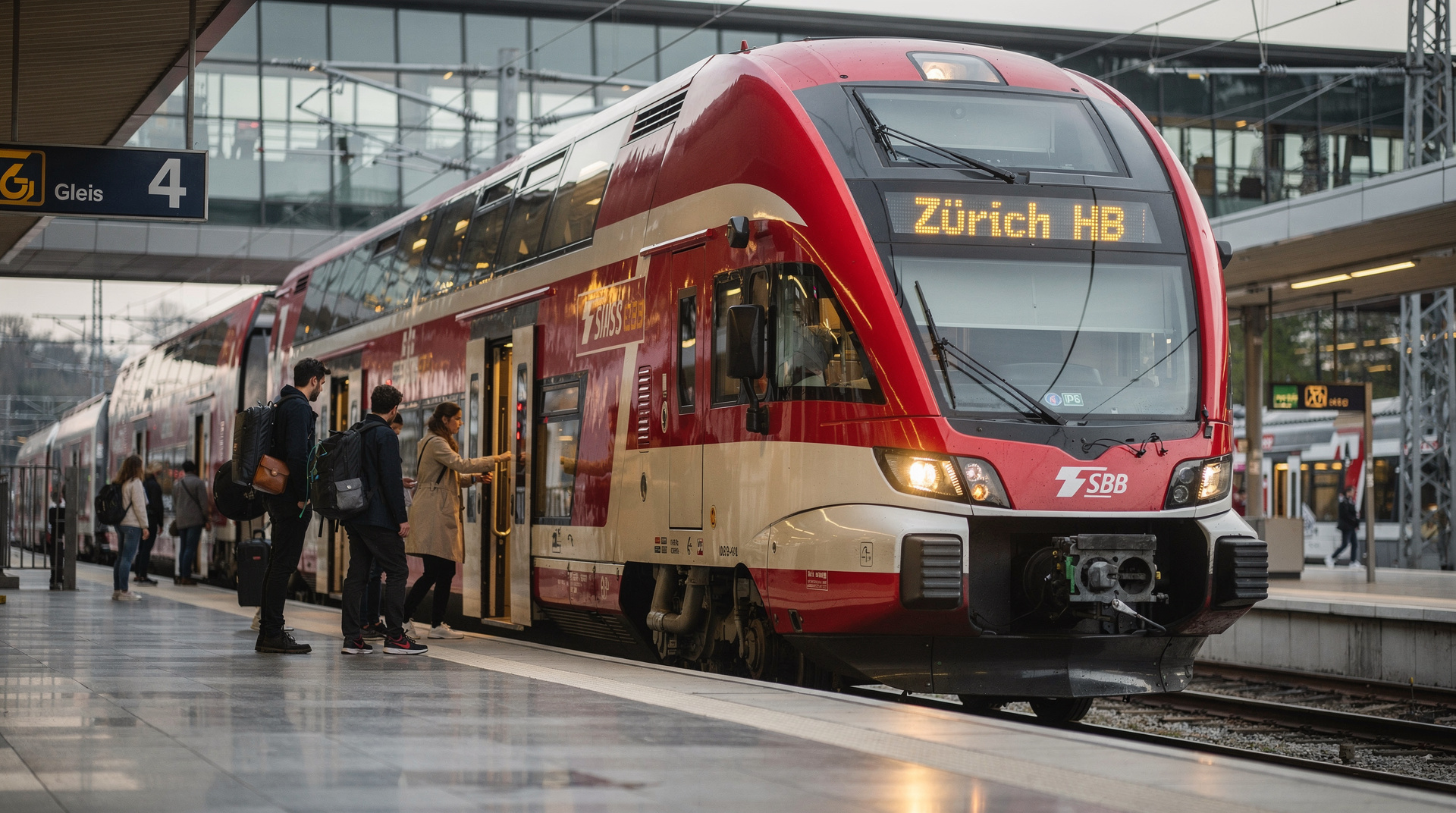
Switzerland’s national railway is operated by SBB (Schweizerische Bundesbahnen in German, CFF in French, FFS in Italian). The network covers every city and most large towns. Trains run every 30 minutes on main routes (and every 60 minutes on regional lines), 365 days a year from approximately 6am to midnight, with night services on weekends.
Key features of the Swiss rail system:
Integrated connections: The national timetable is designed around coordinated connections. At major interchange stations, trains from different directions arrive just before and depart just after the main scheduled connection time. Missing a connection is rare — usually only if your incoming train is significantly delayed.
Punctuality: SBB consistently posts on-time performance rates above 90%. When delays occur, they’re usually just a few minutes. This makes planning reliable: if the timetable says a connection is 8 minutes, it genuinely works.
Cleanliness and comfort: Swiss trains are clean, well-maintained, and comfortable. First and second class are both acceptable; first class offers wider seats, more space, and quieter carriages.
Frequency: Major routes like Zurich-Bern, Zurich-Lucerne, and Geneva-Lausanne run at least every 30 minutes, with faster InterCity (IC) trains running alongside slower regional trains. The fast trains take 45 minutes from Zurich to Bern; the slower ones take about 70 minutes.
Buying train tickets
SBB app (recommended): Download the official SBB Mobile app. It has a live journey planner, real-time departure boards, ticket purchasing, and seat reservation. You can link your Swiss Travel Pass or Half Fare Card to the app for automatic discounts.
SBB website: sbb.ch works on desktop and mobile. More options for complex journeys.
Ticket machines at stations: Green-and-grey machines at every station. Available in German, French, Italian, and English. Takes cards and cash.
Ticket counters: Staffed desks at major stations. Open regular business hours. Best for complex pass purchases, scenic train bookings, and general advice.
Super Saver tickets: Discounted tickets available through the SBB app and website for specific trains booked in advance. Savings of 50-70% on some routes. Non-flexible — the departure time is fixed.
Passes for getting around
Two main pass options cover all or most of Swiss transport:
Swiss Travel Pass: Unlimited travel on SBB trains, most private railways, PostBus routes, lake boats, and city transport in 90+ cities. Also includes free entry to 500+ museums. Costs CHF 244-513 for 3-15 days (second class, adult). Available through GetYourGuide or SBB.
Half Fare Card: CHF 150 for one month. 50% off all trains, buses, boats, mountain railways, and most city transport. Read our full Half Fare Card guide.
For help deciding which to buy, see the Swiss Travel Pass vs Half Fare Card comparison.
| Pass | Best for | Roughly breaks even at |
|---|---|---|
| Swiss Travel Pass | Multi-region trips with several long train days and museum visits | Around 2-3 long journeys plus museum entries over the pass duration |
| Half Fare Card | Longer stays, slower trips, or trips based mostly in one region | Most journeys, once you’re buying more than a handful of tickets over a month |
| Neither (pay full fare) | Very short trips (1-2 days) with a single city visit | Rarely worth comparing against a day pass for the city itself |
Travellers extending into eastern Switzerland sometimes also weigh the Tell Pass, a regional alternative covering central Switzerland only.
PostBus: getting to the places trains don’t reach
Switzerland’s PostBus network (PostAuto in German, CarPostal in French) is the yellow-liveried bus system that serves mountain villages, valleys, and smaller communities not connected to the rail network. It’s a vital part of the transport ecosystem.
Key facts about PostBus:
- Runs to over 900 destinations across Switzerland, including remote Alpine villages
- Fully integrated with the rail timetable — buses wait for connecting trains
- Covered by the Swiss Travel Pass (unlimited travel) and Half Fare Card (50% off)
- Famous for its horn signal (legally required before mountain switchbacks — a charming Swiss detail)
- Very punctual on flat routes; mountain routes add buffer for weather
The PostBus is how you reach places like Appenzell, Gruyeres, the Val Mustair, and the upper reaches of many Alpine valleys. For travelers exploring off the main train routes, it’s indispensable.
Lake boats: slow, scenic, and underused by tourists
Switzerland’s lakes — Geneva, Lucerne, Zurich, Thun, Brienz, Constance, Maggiore, and others — all have scheduled boat services. These are not tourist cruises (though those exist too) but regular scheduled transport connections, fully integrated into the national timetable.
What this means practically:
- A boat from Lucerne to Flüelen connects with a train to Andermatt and the Gotthard route
- A boat across Lake Thun from Interlaken to Spiez is a viable transport option, not just a scenic add-on
- Lake Geneva boats connect Lausanne, Montreux, Vevey, and Nyon
- All scheduled boats are covered by the Swiss Travel Pass and Half Fare Card (50% off)
The William Tell Express, which combines a boat across Lake Lucerne with a train over the Gotthard pass to Lugano, is one of Switzerland’s most iconic transport experiences. Taking a lake boat instead of (or in addition to) trains adds variety and often spectacular scenery to your journey.
Practical note: Boat schedules are more limited than trains — typically every 1-2 hours rather than every 30 minutes. Check timetables in advance using sbb.ch, which includes boat schedules.
Mountain railways and cable cars
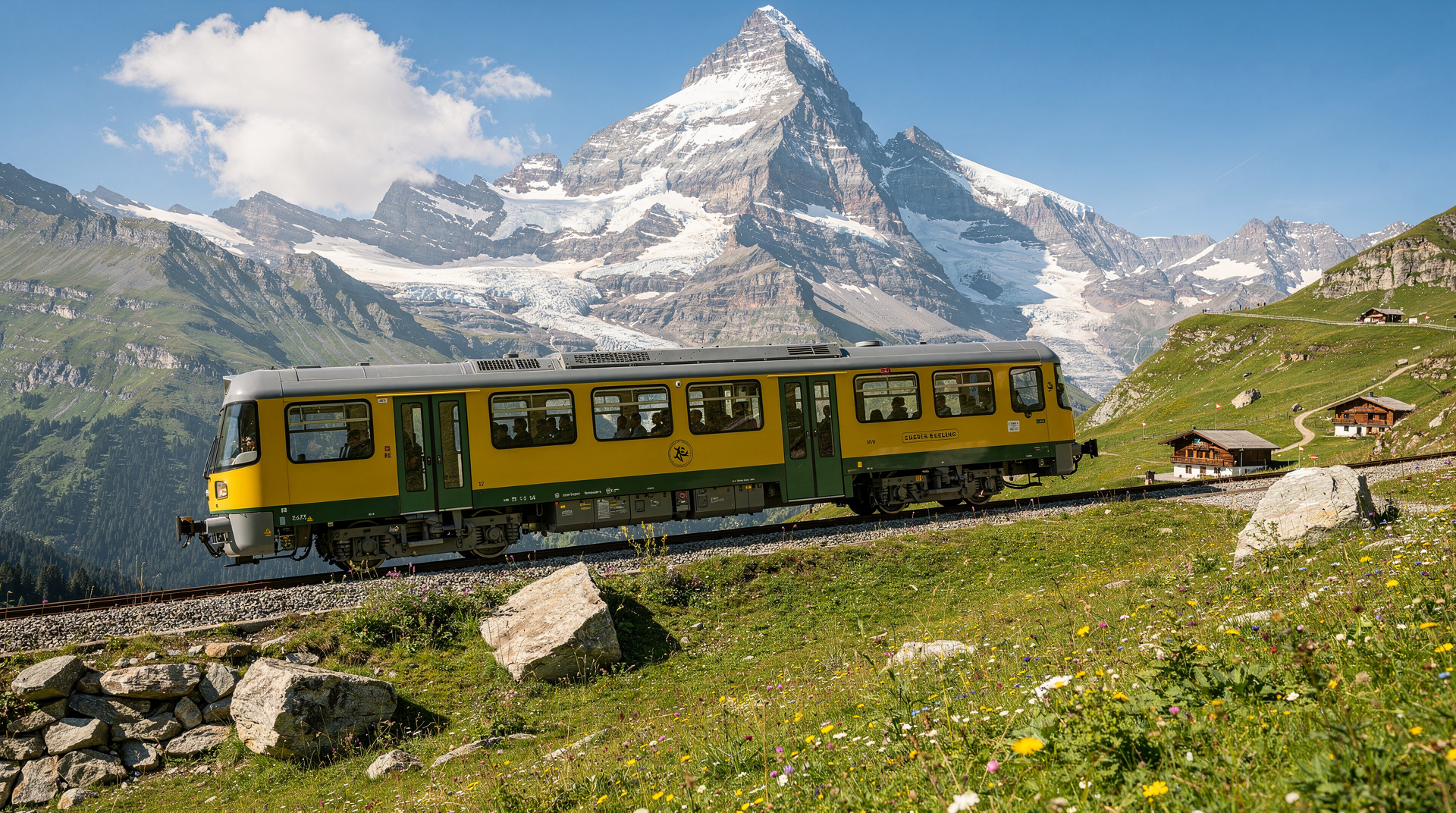
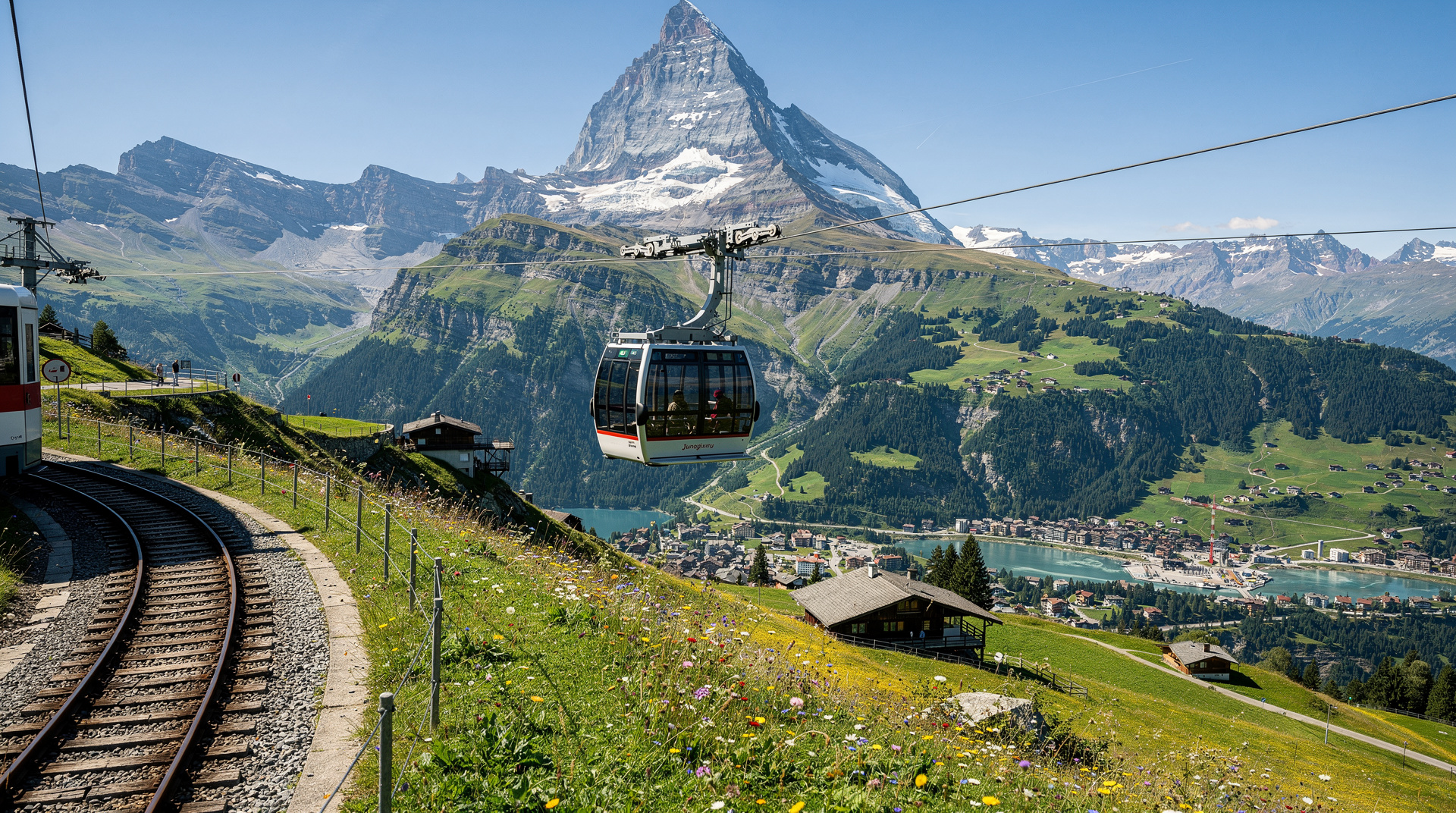
Switzerland’s mountain transport infrastructure is extraordinary. Cogwheel railways (rack-and-pinion trains that climb steep mountain gradients), aerial cable cars, and funiculars give access to viewpoints and villages that would otherwise require serious mountaineering.
Key mountain railways and their access:
- Jungfraujoch (3,454m): Train from Grindelwald terminal or Wengen/Lauterbrunnen. 25% off with Swiss Travel Pass, 50% off with Half Fare Card. You can also pre-book a Jungfraujoch round-trip railway ticket from Grindelwald.
- Mount Pilatus (2,132m): World’s steepest cogwheel railway from Alpnachstad; gondola from Kriens/Hergiswil. Cogwheel section free with Swiss Travel Pass.
- Rigi (1,797m): Cogwheel railway from Vitznau or Goldau. Free with Swiss Travel Pass.
- Schilthorn (2,970m): Cable car from Stechelberg via Gimmelwald, Mürren, Birg. 50% off with Swiss Travel Pass.
- Matterhorn Glacier Paradise (3,883m, near Zermatt): Cable car from Zermatt. 50% off with Swiss Travel Pass and Half Fare Card.
- Titlis (3,020m, near Engelberg): Cable car from Engelberg. 50% off with Swiss Travel Pass.
Mountain railways and cable cars have specific operating seasons and schedules. Always check opening dates and first/last departure times before planning your visit.
City transport: trams, buses, and metro
Every Swiss city has efficient, clean urban transport:
Zurich: Comprehensive tram and bus network plus the S-Bahn suburban rail. Trams run from about 6am to midnight, night buses on weekends. Zone 10 (city center) single ticket: CHF 2.70. Day pass zones 10+21: CHF 8.80. If you plan to visit several attractions, the ZurichCard bundles local transport with attraction discounts.
Geneva: Trams, trolleybuses, and buses. The D-line tram connects the main station to the old town and waterfront. Single ticket: CHF 3.50. Day pass: CHF 10.
Lucerne: Mostly buses, covering the city and surrounding areas. Single ticket: CHF 3. Day pass: CHF 10.
Bern: Excellent tram and bus network with many routes running through the old town. Single ticket: CHF 2.60.
Basel: One of Switzerland’s best city transport systems. Trams run well into the surrounding towns. BVB (city) and BLT (regional) networks integrate seamlessly.
All city transport is covered free with the Swiss Travel Pass. With the Half Fare Card, you pay 50% of face value. In Zurich particularly, where day passes are often good value, the Swiss Travel Pass’s free city access is a meaningful saving.
Renting a car in Switzerland
Cars are not necessary for most Switzerland trips. The public transport network reaches everywhere worth going (and many places cars can’t go). But there are situations where renting a car makes sense:
When a car is useful:
- Exploring very rural areas in Ticino or Graubünden not well-served by PostBus
- Having complete flexibility to stop at unmarked viewpoints and small villages
- Families with lots of luggage and young children
- The Bernese Oberland back roads between passes in summer
When a car is counterproductive:
- Visiting any major city (parking is expensive and limited: CHF 5-8/hour in Zurich and Geneva)
- Zermatt (car-free, you cannot drive in)
- Mürren and Wengen (no road access)
- Anywhere the train goes — trains are often faster and always cheaper than driving and parking
Practical car information:
- Motorway vignette (Autobahnvignette): CHF 40, mandatory for all vehicles using Swiss motorways. Sold at border crossings, gas stations, and post offices. Valid for one calendar year.
- Speed limits: 50 km/h in towns, 80 km/h on main roads, 120 km/h on motorways.
- Mountain pass roads: most are open June-October. Check the state of passes at passes.ch.
- Rental prices: CHF 60-120/day for a basic car. Most major international companies have desks at Zurich and Geneva airports.
- Driving license: Most international licenses valid. International Driving Permit may be required for non-European licenses — check your country’s rules.
Cycling
Switzerland has a well-developed national cycling route network with 9 main national routes and many regional routes. Cycling is popular from April to October.
Bike rental:
- PubliBike: national bike-sharing scheme available in 40+ cities. CHF 5/30 minutes or CHF 38/day. E-bikes available.
- SBB stations: many larger stations have bike rental desks.
- Local shops: usually the cheapest for full-day or multi-day rentals, especially in tourist areas.
Taking bikes on trains: You can take a bicycle on most SBB trains with a bike reservation. Costs CHF 6-18 per journey. Not all trains accept bikes, and the bike slot must be reserved. Folding bikes can usually be taken free without reservation.
Cycling terrain: The Swiss Plateau (between the Jura and Alps) is ideal for cycling — gently rolling with excellent paths. Alpine valleys offer beautiful but hilly cycling. E-bikes have transformed mountain valley cycling and are widely available.
Timetable tips and apps
SBB app: Essential. Comprehensive real-time timetable, platform numbers, delay alerts, and ticket purchase. Works offline once you’ve downloaded your tickets. Free.
SBB website (sbb.ch): Desktop-friendly version. Same timetable data, useful for planning complex multi-leg journeys.
Google Maps: Works surprisingly well in Switzerland for transit directions, though the SBB app has more detail and is more reliable for real-time information.
Reading timetable boards: Swiss departure boards show time, train number or service, destination, and platform. Connecting services are listed below the main departure. Platform numbers can change — always confirm on the board before boarding.
Luggage storage and transport
Baggage storage: All major Swiss stations have automatic luggage lockers. Costs CHF 5-9 per locker per day. Useful for leaving bags while exploring a city before check-in or after check-out.
Luggage transfer (Fly Luggage): SBB’s “Fly Luggage” service lets you send your bags from most Swiss stations to Geneva or Zurich airports for CHF 22 per bag. Available the day before your flight. Check-in your bags at the station and don’t touch them again until you’re at your destination. An excellent service for avoiding airport queuing.
Registered luggage (“Gepäck”): You can also send luggage between Swiss train stations for CHF 12 per bag (standard size). Arrives the same day or next morning. Great for moving between cities without carrying bags on trains.
Tips for using Swiss transport
Always validate: On many city transport systems (buses, trams), you need to validate your ticket before boarding. Just buying it isn’t enough if using an older-style magnetic ticket. With the SBB app and Swiss Travel Pass, digital validation happens automatically.
Platform numbers matter: Swiss platforms (Gleis) are numbered. Wrong platform = wrong train. Check the departure board.
Connections of 3-5 minutes are safe: The Swiss timetable is designed around these short connections. If the app says 4-minute connection at Bern, it genuinely works — trains are held if an incoming connection is late.
First class on short routes is worth it: Upgrading to first class on scenic routes (Zurich-Lucerne, the Rigi, the Bernina line) is relatively affordable and the comfort and space are noticeably better.
Check Sundays: PostBus services run on reduced schedules on Sundays. Some mountain railway frequencies decrease. Plan accordingly, especially for early starts.
For more, see our complete guide to Swiss trains and our advice on saving money on Swiss transport.
Comparing driving vs. renting a car
If you are weighing whether to rent a car at all, the honest answer for most itineraries is that it adds cost and hassle without adding much reach. Trains, PostBus, and boats already cover the destinations most visitors want — including places a car cannot go, like Zermatt, Murren, and Wengen. The exception is genuinely rural touring in Graubunden or Ticino, where public transport exists but is sparser, and stopping spontaneously at unmarked viewpoints has real value.
For anyone deciding between the two main options, see also our dedicated driving in Switzerland guide, which covers vignette rules, mountain pass closures, and parking in detail.
Transport within mountain resorts
Many Swiss mountain resorts have their own internal transport systems distinct from the main SBB network:
Zermatt: A car-free village. Electric taxis and hotel shuttles operate within the village. The Zermatt shuttle bus runs between the train station and various parts of town. Free or included with many hotel stays.
Grindelwald: Has a valley bus connecting the train station with Grindelwald Terminal (for the Eiger Express gondola to Jungfraujoch). Included with the Bernese Oberland regional bus pass.
Mürren and Wengen: These villages have no road access at all. Mürren is reached by cable car from Stechelberg or by train from Lauterbrunnen. Wengen by train from Lauterbrunnen. No cars, no buses — just trains and walking.
Saas-Fee: Car-free above the village entry point. Electric buses and taxis operate within the village.
Most resort internal transport is either free for guests or very low cost. Ask your accommodation what’s included.
Scenic transport as an experience in itself
Some of Switzerland’s transport connections are destinations in their own right:
Lake steamers: The old paddle steamers on Lake Lucerne (Uri, Unterwalden, Schiller) and Lake Geneva are lovingly maintained historical vessels that date back to the early 20th century. Taking a scheduled lake crossing on one of these is a genuine historical experience, not a tourist add-on.
Funiculars in cities: Zurich has several funiculars connecting hilltop areas to the city. The Polybahn connecting Central square to Polyterrasse takes 1 minute and gives a view over the city center. The Rigiblick funicular connects the Zurich tram network to a hilltop neighborhood. Both are short, cheap, and operationally charming.
The Appenzeller Bahnen: The narrow-gauge trains serving the Appenzell region in eastern Switzerland are some of the most charming rail journeys in the country. The route from St. Gallen through Appenzell to Wasserauen passes through rolling hills, small villages, and traditional Swiss farmland. Covered by the Swiss Travel Pass.
PostBus mountain routes: The PostBus Furka Pass route (summer only) and the route from Andermatt over the Gotthard to Airolo are among the most dramatic road journeys in the Alps. The PostBus driver navigates hairpin bends while the landscape shifts from ice and snow to Italian warmth.
Transport for skiers
Switzerland’s ski areas have excellent lift infrastructure, but getting from the train to the lifts efficiently takes some knowledge:
Train to ski resort: Most major resorts have a train station at or near the base. Zermatt, Wengen, and Saas-Fee are directly served. Others like Verbier require a gondola or bus from the nearest train station (Martigny or Le Châble).
Ski passes vs. public transport: The mountain lift passes (ski passes) at major resorts are separate from the Swiss Travel Pass. A ski day pass costs CHF 75-95 at most major resorts. The Swiss Travel Pass does not include ski lifts (it covers some mountain railways for sightseeing, but not ski area lift networks).
Car and ski rental: If you’re ski-focused and have specific resort preferences, picking up a rental car at Zurich or Geneva airport and driving to the resort can make sense if you’re staying a full week. Park-and-ride systems exist at resort peripheries. That said, train access to most major Swiss ski areas is excellent enough that a car is often unnecessary.
Navigating language zones
Switzerland’s transport system seamlessly crosses language borders, but the signage and announcements shift:
- In German-speaking areas: “Gleis” (platform), “Abfahrt” (departure), “Ankunft” (arrival), “Ausgang” (exit)
- In French-speaking areas: “Voie” (platform), “Départ” (departure), “Arrivée” (arrival), “Sortie” (exit)
- In Italian-speaking areas: “Binario” (platform), “Partenza” (departure), “Arrivo” (arrival), “Uscita” (exit)
All SBB ticket machines and apps are available in English. At major stations, platform announcement screens typically show German, French, and Italian depending on the region, plus English for international services.
Planning your transport route
The most efficient way to plan Swiss transport is:
- Identify your bases (which cities/resorts you’ll sleep in)
- Identify your day trip destinations from each base
- Use sbb.ch to check travel times for each leg
- Calculate total transport costs at full price
- Compare Swiss Travel Pass vs. Half Fare Card costs for your specific journeys
- Book the better option
This process takes 30-60 minutes and can save CHF 100-300. For detailed help, see our Swiss Travel Pass vs Half Fare Card comparison and our full Switzerland trip planning guide.
Switzerland’s transport system is genuinely one of the best in the world. Once you understand how it works — the integrated timetable, the connection logic, the different pass options — using it becomes effortless and even one of the pleasures of traveling here.