Verbier vs Zermatt: which Swiss ski resort should you choose?
Should I ski in Verbier or Zermatt?
Zermatt is better for reliable snow, year-round skiing, and iconic Matterhorn views. Verbier is better for challenging off-piste terrain, a younger après-ski scene, and the vast 4 Vallées network. Both are world-class. Serious off-piste skiers generally prefer Verbier; beginners and families Zermatt.
Verbier vs Zermatt: two world-class ski resorts
| At a glance | |
|---|---|
| Where | Both in canton Valais, roughly 2-2.5 hours from Geneva by train |
| Cost | Premium either way; 6-day lift pass around CHF 360-390 |
| Time needed | A week is typical; long weekends (3-4 days) also common |
| Getting there | Train via Geneva/Zurich to Visp (Zermatt) or Martigny (Verbier); Verbier also reachable by car |
| Best time | Peak snow reliability January-March; Zermatt skiable into spring on the glacier |
Verbier and Zermatt are Switzerland’s two most internationally renowned ski resorts, and they attract a broadly similar demographic of wealthy international skiers. Both offer exceptional skiing, excellent infrastructure, and a quality of mountain experience that justifies their premium prices. But they are very different resorts with different strengths, different atmospheres, and different ideal visitor profiles.
If you are choosing between them for your ski holiday, this guide will help you make the right decision.
Verbier vs Zermatt at a glance
| Verbier 4 Vallées, Val de Bagnes | Zermatt Matterhorn, Valais | |
|---|---|---|
| Best for | Expert off-piste, party scene | Intermediates, families, iconic views |
| Ski terrain | 412 km (4 Vallées network) | 360 km; connects to Cervinia |
| Après-ski | Lively — Farm Club, Farinet bar | Relaxed — great dining |
| Snow reliability | Good above 2,000 m; lower runs patchy | Excellent; year-round glacier skiing |
| From Geneva | ~2.5 hours | ~2.5 hours |
| Cost level | Premium | Premium (marginally higher) |
| Book | Get Swiss Travel Pass on GYG | Book Glacier Paradise on GYG |
Location and getting there
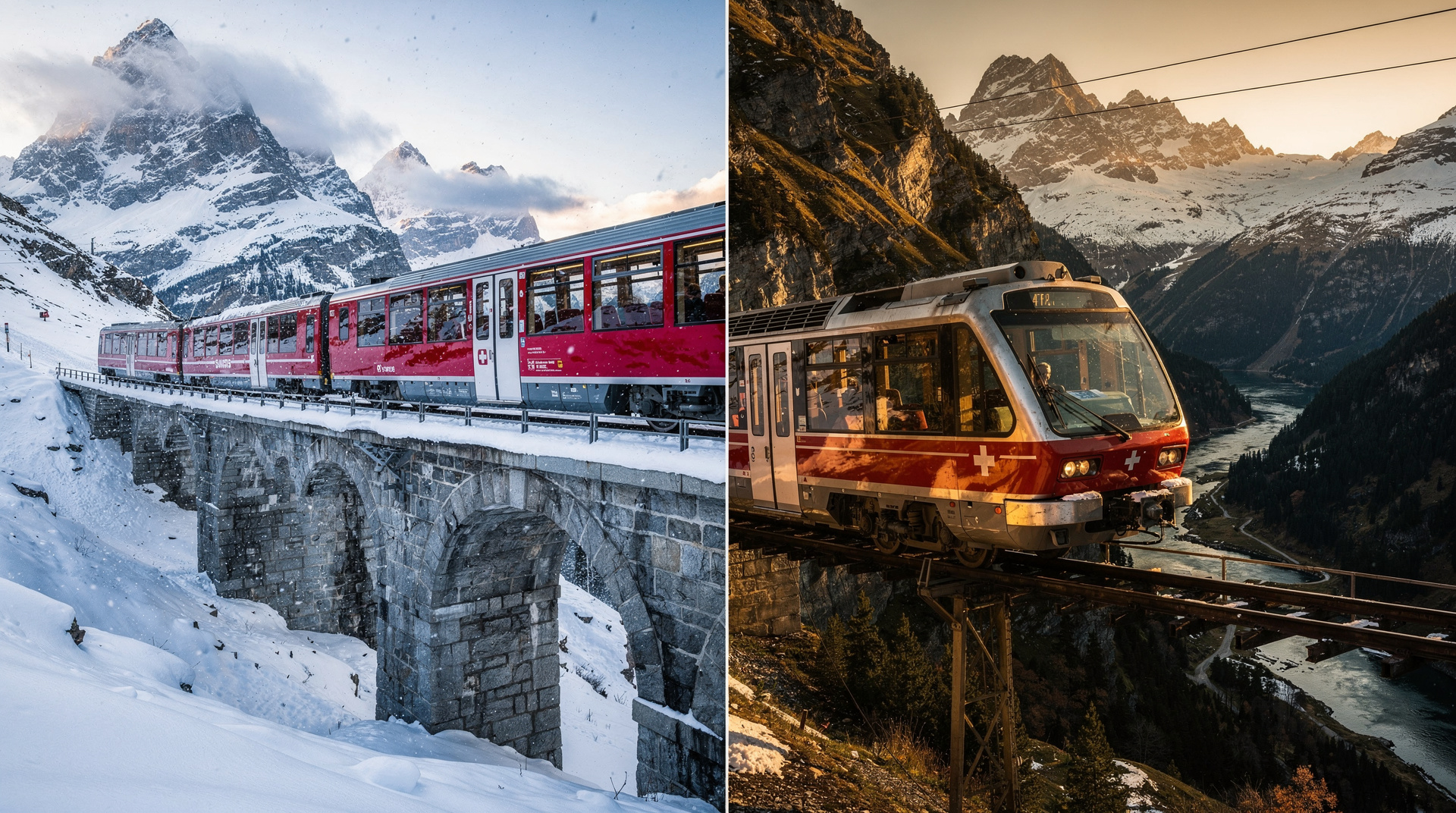
Zermatt sits in the Mattertal valley in canton Valais at 1,608m. It is car-free. The standard approach is by train: fly into Geneva (2.5 hours total to Zermatt) or Zurich (3.5 hours). The final leg uses the Matterhorn Gotthard Bahn from Täsch or from Visp. The Glacier Express provides a spectacularly scenic connection to St. Moritz.
Book the Glacier Express from ZermattVerbier sits in the Val de Bagnes in canton Valais at 1,500m. Access by car is common (drive to Le Châble or directly to Verbier). By train: Geneva to Martigny (45 min), then local train/gondola to Verbier. Total from Geneva approximately 2.5 hours. London to Verbier via Eurostar and TGV is feasible in under 8 hours — popular with British skiers.
Verdict on access: Both are well-served by train from Geneva. Verbier is slightly easier for car travel and Eurostar connections. Zermatt’s car-free policy requires planning but rewards it with a better village atmosphere.
Ski terrain
Zermatt
Zermatt’s ski area covers 360km of marked runs across its three main ski zones: Rothorn (2,939m), Stockhorn (3,405m), and Klein Matterhorn/Matterhorn Glacier Paradise (3,883m — the highest lift-served point in the Alps). The resort also connects to Cervinia in Italy via the Klein Matterhorn, effectively extending the skiable area further.
Zermatt’s terrain breakdown is approximately:
- Beginners: 10% (gentle runs in Riffelalp and near the village)
- Intermediates: 63% (the majority, with excellent blue and red circuits)
- Advanced/expert: 27%
Year-round skiing is available on the glacier terrain above 3,500m. Snow reliability at altitude is essentially guaranteed throughout winter, and even in April and May the highest terrain holds well.
Zermatt’s strengths: Snow reliability, altitude, scenic Matterhorn backdrop from virtually every run, Italian connection via Cervinia.
Verbier
Verbier is part of the 4 Vallées (Four Valleys) network, which at 412km of marked runs is the largest lift-served ski area in Switzerland. The four valleys (Verbier, Nendaz, Véysonnaz, and La Tzoumaz) provide enormous variety, though not all sectors are immediately connected and getting between them involves some planning.
Verbier’s own ski area around Mont Fort (3,328m) is its highest point. The Col des Gentianes area is excellent for advanced terrain.
Verbier’s terrain breakdown:
- Beginners: 30% (more beginner terrain than Zermatt’s proportionally)
- Intermediates: 40%
- Advanced/expert: 30%
Verbier’s strengths: Off-piste reputation, vast network (4 Vallées), diversity of terrain, very challenging runs for experts.
The off-piste question
If off-piste skiing is your priority, Verbier wins clearly. The resort has one of the most revered off-piste reputations in the Alps — the Vallon d’Arbi, the Stairway to Heaven, and the classic Tortin run are legendary. The annual Verbier Xtreme freeride competition showcases the terrain. The mountain guides in Verbier are world-class specialists in off-piste guiding.
Zermatt has good off-piste terrain, but it is not what defines the resort’s reputation. Its strength is reliable groomed conditions across a vast vertical range.
The Matterhorn factor
The Matterhorn is Zermatt’s defining advantage and cannot be overstated. Skiing with the most iconic peak in the Alps as a constant backdrop is an experience that Verbier, for all its excellence, cannot replicate. The visual drama of a clear day in Zermatt — with the Matterhorn’s pyramid shadow falling across the ski runs — is unlike anything else in skiing.
Book the Matterhorn Glacier ParadiseAprès-ski and nightlife
Verbier is one of the liveliest après-ski scenes in Switzerland — a reputation built over decades and reinforced annually. The Farm Club, Farinet bar, and venues along the Rue de Medran have an energy and sophistication that attract a young, international, party-oriented crowd. Verbier’s social scene extends well into the evening in a way that is unusual for Swiss resorts, which tend toward the earlier, more family-oriented end of après-ski.
Zermatt has good bars and restaurants and a lively evening scene, but it is notably calmer than Verbier’s party atmosphere. The resort attracts a slightly older, more couple and family-oriented clientele. Papperla Pub and Hennu Stall are the most famous après-ski venues. The evening dining scene is exceptional — Zermatt has some of the finest mountain restaurants in Switzerland.
Verdict on nightlife: Verbier for a party-focused trip. Zermatt for relaxed evenings and exceptional dining.
Village atmosphere
Zermatt is a coherent, atmospheric village despite its size. The car-free policy, the horse-drawn sleighs, and the backdrop of the Matterhorn give it a character that no amount of tourist development has entirely erased. The historic village (Hinterdorf) preserves old Valaisanne architecture. The main street (Bahnhofstrasse) is inevitably commercial but the side streets are genuinely charming.
Verbier is a purpose-built resort town — it lacks Zermatt’s historic village character and is a 20th-century ski development from top to bottom. This gives it a functional efficiency but less visual charm. The views from Verbier over the Grand Combin and Valais mountains are excellent, but the village itself is less atmospheric.
Verdict on village: Zermatt clearly. The atmosphere of Zermatt village is part of the reason people return.
Cost comparison
Both resorts are expensive, but there are differences.
Accommodation: Similar ranges at the luxury end. Mid-range and budget options are marginally more available in Verbier. Zermatt’s car-free policy drives up delivery costs, which flow through to prices.
Lift passes: Comparable. Zermatt’s 6-day pass approximately CHF 370-390. Verbier 4 Vallées 6-day pass approximately CHF 360-380.
Restaurants and bars: Zermatt’s restaurant scene is extensive and expensive. Verbier has slightly more mid-range dining options.
Overall: Comparable total costs. Zermatt may be marginally more expensive at the mid-range level.
The Swiss Travel Pass covers train transport to and between both resorts, which is a significant saving compared to driving or taking taxis.
Get your Swiss Travel PassSnow reliability
Zermatt has a clear advantage in snow reliability due to its higher base elevation (1,608m) and access to glacier terrain at 3,883m. The resort guarantees some skiing on the glacier year-round. Early-season openings (November, sometimes October) are more reliable than at Verbier.
Verbier at 1,500m is more susceptible to poor snow years at lower elevations. The higher terrain (Col des Gentianes, Mont Fort at 3,328m) is reliable, but the runs into the village can be patchy in low-snow years.
Verdict on snow: Zermatt, clearly. If you are visiting early or late season, or if there is any uncertainty about snow conditions, Zermatt is the safer choice.
Family suitability
Zermatt offers excellent family skiing with a dedicated beginners area in Riffelalp and the Sunnega sector, plus non-ski activities (ice skating, snowshoeing) for mixed-ability families. The car-free village is safe for children. Strong ski school.
Verbier has good beginner areas but the resort’s overall reputation and atmosphere skew toward intermediate and advanced skiers. Families are absolutely welcome but the vibe is more adult-oriented than Zermatt.
Verdict for families: Zermatt has the edge.
Which should you choose?
Choose Zermatt if:
- Iconic mountain scenery (Matterhorn) is important to you
- Snow reliability is a priority
- You are an intermediate or mixed-ability group
- You want year-round skiing (or early/late season)
- A quieter, more atmospheric village appeals
- You want to combine with the Glacier Express journey
Choose Verbier if:
- Off-piste skiing is your primary motivation
- You want the most challenging, expert terrain in Switzerland
- An active après-ski scene is important
- You are a strong or advanced skier
- You prefer to arrive by Eurostar/car from western Europe
If you cannot decide:
Visit Zermatt. For most skiers — including those who don’t prioritise extreme off-piste or intense nightlife — Zermatt delivers the better overall experience. The Matterhorn views, snow reliability, and village atmosphere give it an advantage that matters enormously when you are actually there.
Non-skiing activities: a comparison
Both resorts cater reasonably well to non-skiers, but differently.
Zermatt for non-skiers:
- The Matterhorn Glacier Paradise cable car to 3,883m provides high-altitude access without skiing
- The village itself is beautiful and walkable with a genuine Swiss character
- Snowshoeing routes from the village are excellent
- Winter hiking on designated groomed trails
- Horse-drawn sleigh rides through the village
- Spa and wellness facilities in the major hotels
Verbier for non-skiers:
- The 4 Vallées area has winter walking trails and snowshoe routes
- The Mont Fort cable car can be taken for views without skiing down
- Less infrastructure specifically designed for non-skiing visitors than Zermatt
- The village’s restaurant and nightlife scene is more developed
In general, Zermatt is the better choice for non-skiing companions in a ski party.
Getting to Zermatt and Verbier with Swiss passes
Zermatt: The Swiss Travel Pass covers the train from Zurich (to Visp or Brig) and the Matterhorn Gotthard Bahn local train to Zermatt. The Glacier Express passes are included (reservation fee required).
Book the Glacier Express from ZermattVerbier: The Swiss Travel Pass covers the train from Geneva/Lausanne to Martigny. The Mont-Fort cable car and local lift pass are purchased separately at the resort. The local train to Le Châble (at the base of the Verbier gondola) may or may not be covered — check current STP coverage.
Get your Swiss Travel PassSummer visits: a different calculus
Both resorts operate in summer, and the comparison shifts somewhat in summer conditions.
Zermatt in summer: One of Switzerland’s finest hiking destinations. The Five Lakes Walk (Fünf-Seen-Wanderung) is one of the great Alpine hikes. The Gornergrat rack railway gives panoramic views across the glacier and Matterhorn. Glacier skiing continues on the Klein Matterhorn. Less crowded than in peak winter.
Verbier in summer: Mountain biking is well developed in the 4 Vallées area. Hiking trails are good but not at the level of Zermatt’s extensive summer route network. The village is quieter and more relaxed.
Summer verdict: Zermatt is significantly the better summer destination.
If you cannot decide — final verdict:
Visit Zermatt. For most skiers — including those who don’t prioritise extreme off-piste or intense nightlife — Zermatt delivers the better overall experience. The Matterhorn views, snow reliability, and village atmosphere give it an advantage that matters enormously when you are actually there.
For our full guides, see Zermatt and our winter itinerary. Budget context: Switzerland budget guide | When to go: best time to visit Switzerland.
Compare with other mountain villages: Zermatt vs Grindelwald | St. Moritz vs Davos
Destination guides: Zermatt guide | Compare with: Zermatt vs Grindelwald | St. Moritz vs Davos | winter itinerary
For general Switzerland travel information and planning resources, start with our best time to visit Switzerland overview guide.
Whether you are planning a short city break, a week of skiing, or a longer Swiss adventure, the destinations covered in this guide represent some of the finest experiences available anywhere in Europe. Use the linked itinerary guides and destination pages to build a trip that matches your interests, budget, and available time.
Which resort for which trip type
Honeymoons and couples: Zermatt’s dining scene and Matterhorn backdrop make it the more romantic choice; see the honeymoon itinerary guide for how a Zermatt stay fits a wider Swiss trip.
Families: Zermatt again has the edge for logistics and beginner terrain, but Verbier’s beginner zones are perfectly workable for confident families; the family ski resorts guide and family itinerary guide cover both in more depth.
First trip to the Verbier region specifically: Pair it with time in Lausanne or along Lake Geneva on the way in or out, since Verbier itself has limited non-ski infrastructure.
Comparing across the whole resort landscape: The best ski resorts guide puts Verbier and Zermatt in context alongside Davos, St Moritz, and the Jungfrau region resorts.