St. Moritz vs Davos: which luxury resort should you choose?
Should I visit St. Moritz or Davos?
St. Moritz is more glamorous, with better luxury infrastructure, world-famous events, and exceptional sunshine. Davos is larger for skiing (most piste km in Switzerland), more understated, and slightly more affordable. For a luxury experience, St. Moritz. For maximum ski terrain, Davos.
St. Moritz vs Davos: comparing Switzerland’s elite mountain resorts
St. Moritz and Davos are the two most internationally recognised luxury mountain resorts in Switzerland. Both attract a wealthy international clientele, both host world-level events, and both sit in the stunning Graubünden canton of eastern Switzerland. But they have very different characters, and the right choice depends on what you are looking for from a mountain resort stay.
| At a glance | |
|---|---|
| Where | Both in Graubunden, eastern Switzerland — St. Moritz in the Upper Engadin, Davos in the Landwasser valley |
| Cost | Both expensive; Davos typically around 15-25% cheaper than comparable St. Moritz accommodation |
| Time needed | 3-4 nights minimum to justify the travel and get a feel for either resort |
| Getting there | From Zurich: around 3 hours to St. Moritz, around 1.5 hours to Davos, both via the Rhaetian Railway |
| Best time | February for the classic winter season and events; June-September for lake walks and hiking in either |
St. Moritz vs Davos at a glance
| St. Moritz Upper Engadin, 1,822 m | Davos Landwasser valley, 1,560 m | |
|---|---|---|
| Best for | Glamour, luxury, iconic events | Maximum ski km, understated style |
| Ski terrain | ~350 km across 3 ski areas | 320 km (Davos-Klosters area) |
| Vibe | Glamorous, celebrity-friendly | Understated, business-oriented |
| From Zurich | ~3 hours (scenic Albula line) | ~1.5 hours |
| Signature event | White Turf polo on ice (Feb) | Spengler Cup ice hockey (Dec) |
| Glacier Express | Yes — eastern terminus | No connection |
| Book | Book Glacier Express on GYG | Get Swiss Travel Pass on GYG |
Overview
St. Moritz sits in the Upper Engadin valley at 1,822m above sea level, surrounded by a chain of five turquoise lakes and framed by the Bernina massif. It is perhaps the world’s original luxury ski resort — winter tourism here began in the 1860s when hotel owner Johannes Badrutt famously bet visiting British guests that they would enjoy the winter climate as much as summer, and offered their stays for free if they did not. They stayed, loved it, and luxury alpine winter tourism was born.
The resort claims over 300 days of sunshine per year (the Engadin’s high altitude and protected geography deliver exceptional solar exposure). It has hosted the Winter Olympics twice (1928 and 1948), the Alpine Ski World Championships multiple times, and the famous Cresta Run and bobsled track — one of only two natural ice bobsled tracks in the world — since 1884.
Davos is Europe’s highest city at 1,560m in the Landwasser valley of Graubünden. It is best known internationally as the host of the World Economic Forum (WEF) — the annual gathering of global political and business leaders that takes place each January. In skiing, Davos is known for quantity: the shared Davos-Klosters ski area, at 320km of marked runs, is the largest in Switzerland.
Davos has a more institutional character than St. Moritz — partly because of the WEF, partly because of the large sanatorium tradition that once drew tuberculosis patients to its clean mountain air, and partly because it is a genuine small city rather than a purpose-built resort.
Setting and atmosphere
St. Moritz: Glamorous, celebrity-friendly, and unapologetically luxurious. The Corviglia ski area directly above the lake chain and village is one of Switzerland’s most prestigious. The Via Serlas shopping street has flagships of every major Swiss and international luxury brand. Helicopter landings at the heliport near the lake are a common sight. The Lake Parade event in summer and the Winter Polo World Cup on the frozen lake in January/February define St. Moritz’s reputation for spectacle.
Davos: More understated, more business-oriented, and with a slightly different social character. The Davos Promenade (main street) is functional rather than glamorous — hotels, banks, conference venues. WEF week in January transforms the town completely, with security cordons and the arrival of world leaders. Outside of WEF week, Davos has a more relaxed Swiss resort feel.
Verdict on atmosphere: St. Moritz for luxury glamour. Davos for a more understated resort character.
Skiing: terrain and quality
St. Moritz:
- Three main ski areas: Corviglia (3,057m), Corvatsch (3,451m), Diavolezza (2,978m)
- Total marked runs: approximately 350km (including Pontresina connections)
- Best for: intermediates on Corviglia’s groomed pistes, advanced on Corvatsch’s challenging runs, off-piste around Diavolezza
- Snow reliability: excellent due to high altitude and north-facing terrain on key runs
- Famous runs: the Women’s World Cup course on Corviglia, Diavolezza to Morteratsch glacier run
Davos:
- Shared area with Klosters: Parsenn, Madrisa, Jakobshorn, Pischa, Rinerhorn
- Total marked runs: 320km, the largest ski area in Switzerland
- Best for: intermediates across the vast Parsenn area, expert skiers on Jakobshorn, beginners on Pischa
- Snow reliability: good but the lower Parsenn runs into Davos can suffer in warm years
- Famous runs: the Parsenn Bowl, the 12km World Cup Downhill course, the Schatzalp run
Verdict on skiing: Davos for pure quantity of terrain. St. Moritz for consistent quality and high-altitude snow reliability (particularly Corvatsch and Diavolezza).
The Glacier Express connection
Both St. Moritz and Zermatt are termini of the Glacier Express — one of the world’s great train journeys. If you plan to take the Glacier Express, St. Moritz is the natural eastern terminal, making it an excellent start or end point for a Glacier Express journey to Zermatt.
Book the Glacier Express between Zermatt and St. MoritzDavos does not have a Glacier Express connection, though it is accessible from Zurich via the scenic Landwasser Viaduct line.
Events and activities
St. Moritz events:
- Engadin Skimarathon (March): One of Europe’s largest cross-country skiing marathons, with up to 14,000 participants skiing 42km across the Engadin lakes
- White Turf polo on ice (February): International polo on the frozen Lake St. Moritz, one of the world’s most unlikely and spectacular sporting events
- Cresta Run (January-February): The legendary ice toboggan run from St. Moritz to Celerina, in operation since 1884
- Bobsled track (one of two natural ice bobsled tracks in the world)
- Summer golf, polo, and sailing on the Engadin lakes
Davos events:
- World Economic Forum (January): This defines Davos’s global profile and transforms the town for one week annually
- Spengler Cup (December 26-31): The world’s oldest international ice hockey tournament, hosted at the Davos arena
- Parsenn ski racing season events
Verdict on events: St. Moritz is the more spectacular event calendar for tourism purposes. The polo on ice and Cresta Run are genuinely unique. Davos’s WEF is famous but of limited interest to tourists (access is restricted).
Non-ski activities
St. Moritz:
- Engadin lake walks (the chain of five lakes is extraordinary in all seasons)
- Cross-country skiing on the Engadin network (the Skimarathon route)
- Dog sledding
- Curling
- Helicopter excursions
- High-end shopping and spa resorts
- Bernina Express scenic train (connection through to Lugano or Tirano, Italy)
Davos:
- Davos-Klosters area hiking in summer
- Nordic skiing on extensive cross-country trail network
- Davos lake (Davosersee) for skating in winter
- Congress centre for cultural events
Cost comparison
Both are expensive. St. Moritz has Switzerland’s highest hotel and restaurant prices. A five-star hotel in St. Moritz in peak season (February) will cost CHF 500-1,500+ per night. Davos is expensive but typically 15-25% cheaper than comparable St. Moritz accommodation.
Food and beverage prices in St. Moritz are at the Swiss maximum. Mountain restaurant lunches on Corviglia can be exceptional and exceptionally priced. Davos is expensive by any standard but more mid-range than St. Moritz.
Budget accommodation exists in both towns (hostel in St. Moritz, various budget hotels in Davos) but neither is a budget destination.
The Swiss Travel Pass covers the trains from Zurich to both resorts.
Get your Swiss Travel PassAccessibility
St. Moritz:
- From Zurich: approximately 3 hours (Zurich to Chur, then Rhaetian Railway to St. Moritz)
- The train journey via the Albula Railway (a UNESCO World Heritage Railway) is itself spectacular
- Nearest airport: Zurich (ZRH) or Milan Malpensa (approximately 2.5 hours by car)
Davos:
- From Zurich: approximately 1.5 hours (Zurich to Landquart, then Rhaetian Railway to Davos)
- More accessible from Zurich than St. Moritz
- Nearest airport: Zurich (ZRH)
Verdict on access: Davos is significantly easier to reach from Zurich.
Summer visits
Both resorts operate year-round with excellent summer programmes.
St. Moritz in summer: The Engadin lakes are spectacular. Sailing, swimming, hiking, and cycling in the high valley are excellent. The St. Moritz Golf Club (1,800m altitude) is one of Europe’s most unusual courses. The Engadin Cycling Marathon takes place in June. The overall summer atmosphere is more relaxed and affordable than winter.
Davos in summer: Mountain biking (the Davos area has excellent trail infrastructure), hiking, and the alpine lake. Quieter and more local-feeling than in WEF winter season.
Which should you choose?
Choose St. Moritz if:
- Luxury, glamour, and the quintessential alpine resort experience appeal
- You want to take the Glacier Express (St. Moritz is the logical eastern terminus)
- Unique events (polo on ice, Cresta Run) interest you
- You want the best-quality ski terrain for intermediates and experts
- The Bernina Express scenic train connection to Lugano/Tirano is on your itinerary
- You are combining with a luxury budget
Choose Davos if:
- Maximum ski terrain (320km) is your priority
- You prefer a less glamorous, more understated resort atmosphere
- You are travelling from Zurich and want shorter transfer time
- The Spengler Cup (late December ice hockey) appeals
- You want slightly more affordable options within a luxury context
In practice:
For most visitors who want one classic Swiss luxury mountain resort, St. Moritz is the more memorable choice. Its setting, events, and history give it a distinction that Davos, for all its qualities, doesn’t match.
If you are a serious skier who wants maximum terrain and easier Zurich access, Davos is an excellent choice that many Swiss visitors consider underrated.
Combining St. Moritz with other Swiss destinations
St. Moritz’s position in Graubünden makes it a natural combination with several other Swiss experiences:
The Glacier Express: St. Moritz is the eastern terminus of the Glacier Express to Zermatt. Including the Glacier Express in a St. Moritz trip — either arriving or departing via this route — creates one of the great Swiss travel experiences.
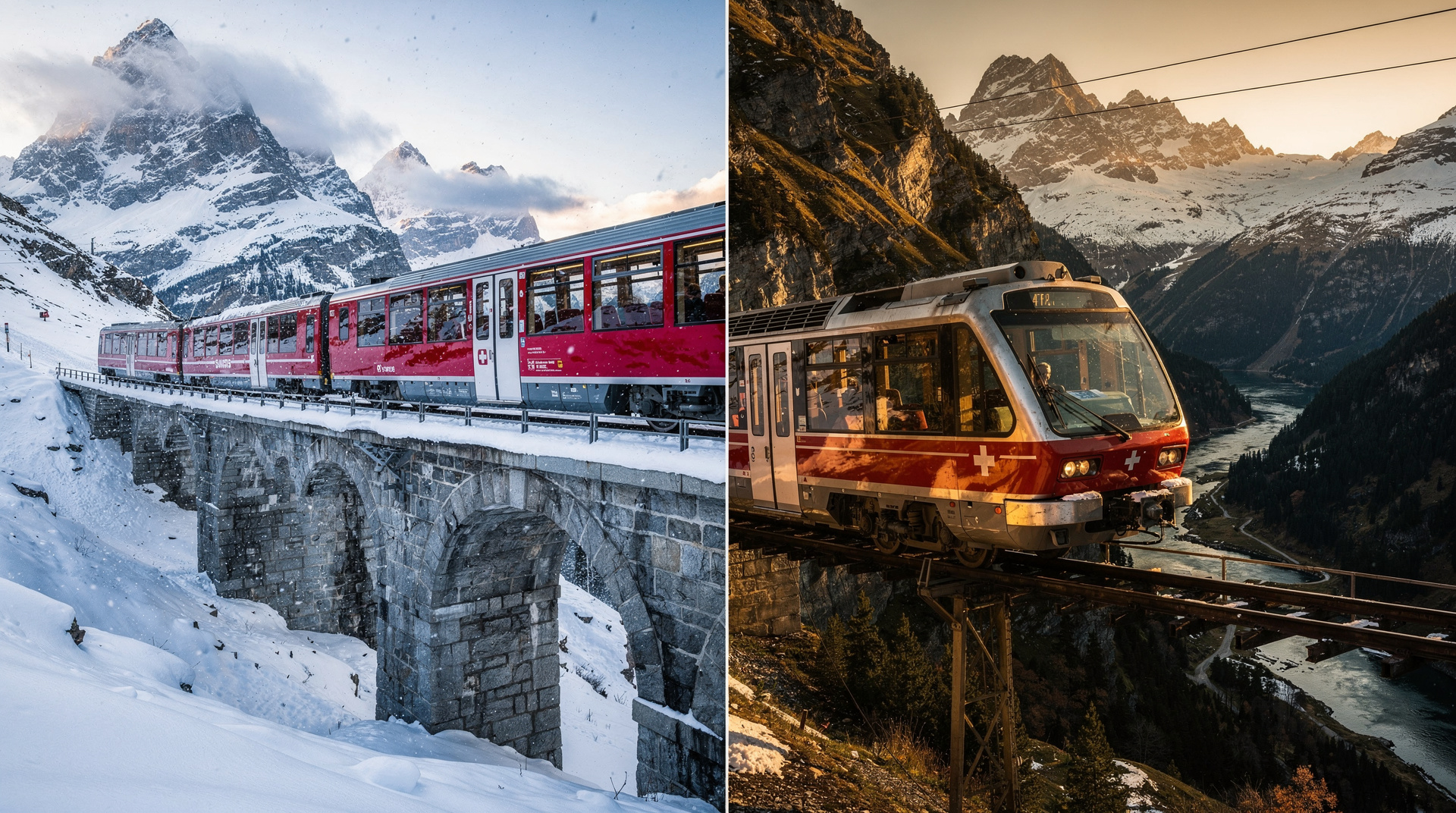
Book the Glacier Express between Zermatt and St. MoritzThe Bernina Express: From St. Moritz, the Bernina Express passes over the spectacular Bernina Pass (2,253m) and descends to Tirano in Italy, or continues to Lugano in Switzerland. The Landwasser Viaduct, the spiral tunnels, and the mountain pass scenery make this one of the world’s great train journeys. UNESCO World Heritage status.
The Albula Railway: The route from Chur to St. Moritz via the Albula Pass (UNESCO World Heritage Railway) is spectacular in both winter and summer. The train spirals upward through tunnels and viaducts in one of the most extraordinary feats of alpine railway engineering.
Combining Davos with other Swiss destinations
Davos’s position in the Landwasser valley gives it different connection options:
Davos to Klosters: The two resorts share a ski area and are connected by train. Klosters has a smaller, more exclusive village character and was famously favoured by the British royal family.
Davos to Filisur and Thusis: The train from Davos to Filisur passes through the dramatic Landwasser Viaduct area. At Filisur, you connect to the Albula Railway and onward to St. Moritz or Chur.
Davos to Arosa: A scenic narrow-gauge railway connects Chur to the mountain resort of Arosa via the gorges above the Rhine valley. Arosa-Lenzerheide has a combined ski area with Lenzerheide that is excellent.
Accommodation overview
St. Moritz luxury: Badrutt’s Palace Hotel (the original palace-hotel, operating since 1896), Kulm Hotel (where winter tourism began), Grand Hotel des Bains, Carlton Hotel.
St. Moritz budget/mid-range: Jugendherberge (youth hostel in the village), Hotel Languard, various holiday apartments and chalets in surrounding villages (Pontresina is more affordable).
Davos luxury: Steigenberger Grandhotel, Intercontinental Davos, Mountain Plaza Hotel.
Davos budget/mid-range: Greater range than St. Moritz. Several three-star hotels and Bed and Breakfast options are available within walking distance of the ski lifts.
Getting there with the Swiss Travel Pass
Both St. Moritz and Davos are accessible by Swiss Federal Railways from Zurich. The Swiss Travel Pass covers all mainline trains and the Rhaetian Railway connections.
Get your Swiss Travel PassSki lift passes are purchased separately at the resort. The STP does not cover ski lift access at either St. Moritz or Davos.
Frequently asked questions about St. Moritz vs Davos
Can I visit both St. Moritz and Davos on the same trip? Yes — both are in Graubunden and connected by the Rhaetian Railway network via Filisur, making a combined visit practical. Many visitors split a week between the two, or add a day trip to Arosa or Chur along the way.
Is one resort better for non-skiers? St. Moritz has more to offer non-skiers: the Engadin lake walks, the polo on ice, the Cresta Run as a spectator event, and easy access to the Bernina Express. Davos is more skiing-focused, though its hiking and mountain biking network is excellent in summer.
For families or groups mixing skiers and non-skiers, see the family ski resorts guide for resort options with a gentler learning curve than either St. Moritz or Davos.
The honest final verdict
St. Moritz is the more complete experience. Its scenery, history, events calendar, and the combination of skiing with the Glacier Express and Bernina Express connections make it worth the extra travel time from Zurich. If you only visit one luxury Graubünden resort in your lifetime, St. Moritz is the right choice.
Davos is excellent for serious intermediate-to-advanced skiers who want maximum terrain, quicker Zurich access, and a slightly less glamorous atmosphere. Its scale and the variety of the Davos-Klosters area make for a very full ski week.
For trip planning: 7-day Switzerland itinerary | winter itinerary | budget planning | compare with: Verbier vs Zermatt | Zermatt vs Grindelwald