How to avoid crowds in Switzerland: beating overtourism
At a glance
| Worst months | July, August, Christmas/New Year week |
| Best “quiet” window | Late May–early June, or September–early October |
| Best time of day | Before 8am or after 5pm at any famous site |
| Cost to avoid crowds | Usually none extra — sometimes cheaper (shoulder-season rates) |
| Key tool | Book the first cogwheel/gondola departure of the day where reservations exist |
Switzerland’s crowd problem is real
Walk across Lauterbrunnen’s main street on a Tuesday in August and you’ll understand immediately. The meadow below the falls is dense with visitors. The Instagram shots are being recreated in real time, one group after another positioning at the same spot. The cafes have queues. The parking area is full.
Switzerland has always been a popular destination, but the post-pandemic surge in demand — combined with the relentless social media amplification of a small number of photogenic locations — has created genuine overtourism pressure at a handful of specific spots. Lauterbrunnen, Grindelwald, Lucerne’s Chapel Bridge, the Matterhorn view from Zermatt, and a few others are handling visitor volumes that were unimaginable a decade ago.
The solution isn’t to avoid Switzerland. The solution is to understand why certain places are crowded, when they’re busiest, and what the alternatives are — because for every overwhelmed Instagram hotspot, there are ten similarly beautiful places nearby that most visitors never find.
Understanding the crowd pattern
Swiss tourism crowds follow predictable patterns that you can plan around.
When it’s busiest:
- July and August school holidays (particularly the last two weeks of July and first two weeks of August)
- Christmas and New Year week
- February school half-terms (varying by country)
- Golden week Japan and Chinese national holidays create distinctive crowd spikes at certain Asian-favoured spots (Lauterbrunnen and Interlaken in particular)
When it’s quietest (and often most beautiful):
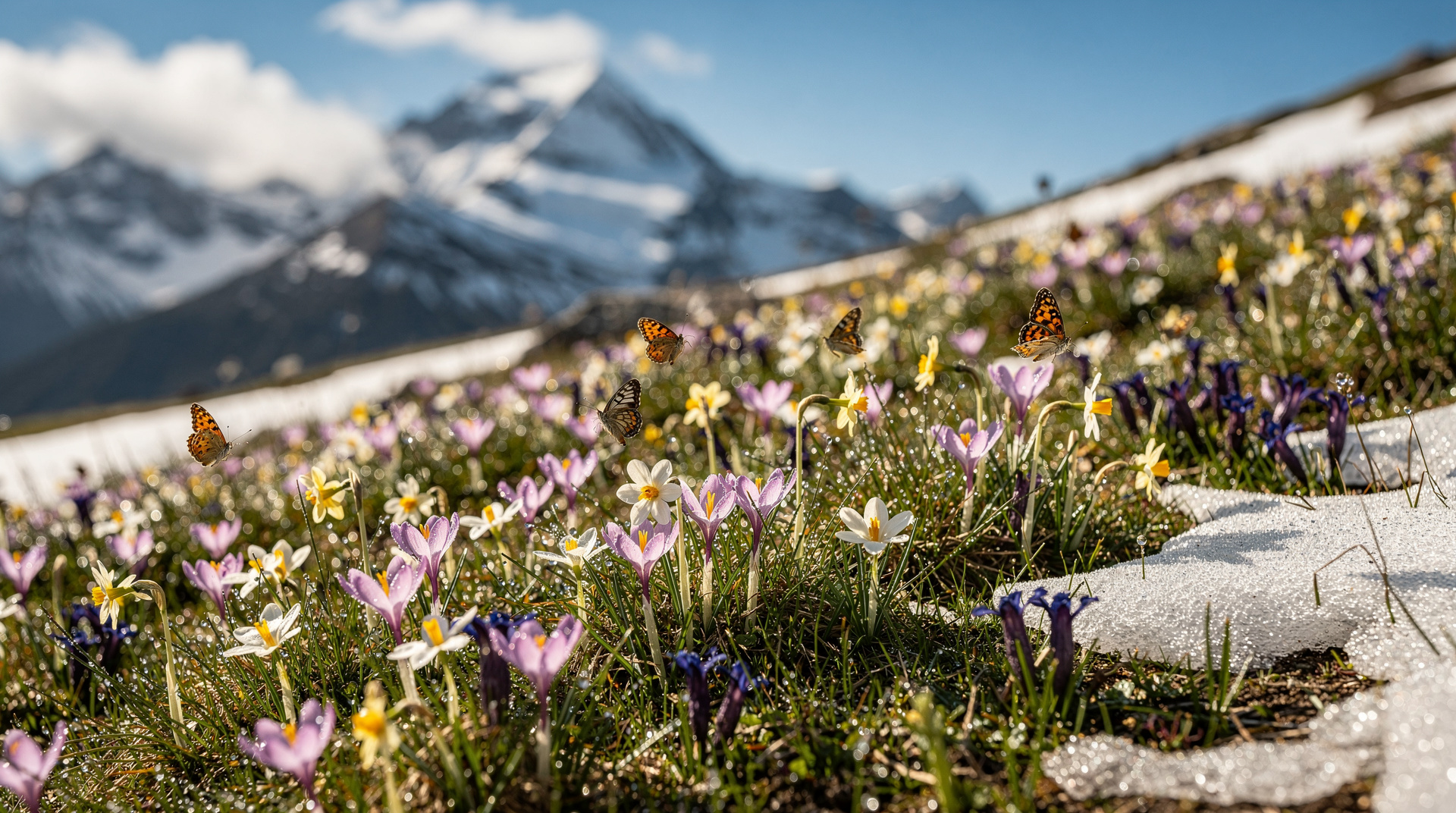
- Late May and early June: wildflower season, long days, moderate temperatures, dramatically fewer visitors
- September and early October: excellent light, cooler but pleasant temperatures, harvest season, and noticeably thinner crowds
- November and early December: the shoulder-season sweet spot before ski season begins
The best time to visit Switzerland from a crowd-avoidance perspective is late May or September. These months also frequently offer better value on accommodation.
Timing strategies for popular spots
Even during peak season, crowds follow daily patterns that you can exploit.
Arrive early. This is the single most effective strategy. The Chapel Bridge in Lucerne at 7am is a genuinely beautiful experience. At 11am, it’s a procession. The Matterhorn view from Zermatt at dawn, with pink light on the peak and almost no one around, is extraordinary. By 9am the gondola queues are building.
Stay late. Many day-trip visitors leave popular spots by late afternoon to catch transport. After 5pm, the intensity drops markedly. Evening light is often the most beautiful anyway.
Visit popular mountain areas on weekdays. Weekends bring Swiss domestic visitors alongside international tourists, creating compound crowd pressure. Tuesday and Wednesday are generally the quietest days at mountain attractions.
Book timed entry where available. The Jungfraujoch now operates a partial reservation system for specific departure times. Booking a morning slot (first cogwheel train departure) gets you there before the mass of day-trippers arrives and secures your spot when the weather window is typically clearest.
Alternative destinations to the famous ones
The most effective crowd avoidance strategy isn’t timing — it’s going somewhere different entirely. Switzerland’s beauty is so densely distributed that the second-tier destinations are often as spectacular as the famous ones, with a fraction of the visitors.
Instead of Lauterbrunnen: try Gasterntal
The Gasterntal is a wild, cliff-lined valley accessed from Kandersteg in the Bernese Oberland. It has the same waterfall-and-cliff-face character as Lauterbrunnen — arguably more dramatic — but a tiny fraction of the visitors. Kandersteg itself is a lovely village with excellent hiking, a high alpine lake (Oeschinensee, which does attract some visitors but far fewer than Lauterbrunnen), and a slow-travel feel.
The Oeschinensee can be reached by cable car from Kandersteg and is genuinely beautiful — turquoise water below limestone cliffs with the Blüemlisalp peaks behind. Even in midsummer, mornings here are manageable.
Instead of Grindelwald: try Mürren
Mürren is a car-free village perched on a cliff ledge above the Lauterbrunnen Valley, facing the Eiger-Mönch-Jungfrau triumvirate at close range. It’s accessible only by gondola and cogwheel railway, which naturally limits visitor numbers. Staying in Mürren rather than Grindelwald gives you the same views, the same mountain access (the Schilthorn is directly above), and a more genuinely alpine village experience with far less traffic.
Wengen, similarly car-free and on the opposite side of the valley, has the same advantage — accessible only by rail, it stays calmer than the road-accessible alternatives.
Instead of Lucerne in August: try Biel/Bienne or Solothurn
Both are beautiful small Swiss cities with old towns comparable to Lucerne’s in character but a fraction of the visitors. Solothurn’s baroque old town is one of the finest in Switzerland and is genuinely under-visited. Biel/Bienne sits on a lake and has the additional interest of being officially bilingual (French and German), creating a distinctive cultural mix.
If you need Lucerne (and the lake, Pilatus, and Rigi access make it genuinely non-replaceable), go in May or September, stay for at least two nights so you can access the early mornings, and plan to visit the Chapel Bridge before 8:30am.
Instead of Zermatt at peak: try Saas-Fee
Saas-Fee is Zermatt’s quieter neighbour — also car-free, also surrounded by 4,000-metre peaks (the Dom, Alphubel, and Allalinhorn), also high-altitude, and with a Matterhorn-calibre centrepiece in the Fee Glacier hanging visibly above the village. It’s smaller, less famous, and noticeably calmer even in August.
The village has excellent infrastructure, year-round glacier skiing, and access to the Mittelallalin revolving restaurant at 3,500 metres. Prices, while still Swiss, are generally lower than equivalent Zermatt options.
Crowd levels by region, at a glance
| Region | Peak-season crowd level | Quieter alternative |
|---|---|---|
| Lauterbrunnen Valley | Very high | Gasterntal, Kandersteg |
| Grindelwald | Very high | Mürren, Wengen |
| Lucerne old town | High | Solothurn, Biel/Bienne |
| Zermatt | High | Saas-Fee |
| St. Moritz | Moderate-high | Val Bregaglia, Guarda, Val Müstair |
| Appenzell village | Low-moderate | (already a quiet alternative itself) |
Lesser-known regions worth exploring
Appenzell: The rolling green hills, traditional farmhouses, and extraordinary cheese culture of Appenzell in northeastern Switzerland see a fraction of the visitors who go to the Bernese Oberland or Valais. The village of Appenzell itself is absurdly picturesque, with painted facades, traditional costume culture, and the best Appenzeller cheese you’ll ever eat. Nearby Säntis mountain provides alpine views without Jungfrau-level crowds.
Ticino: Switzerland’s Italian-speaking canton gets overlooked by visitors focused on the Alpine north. But Ticino has the Verzasca Valley, the Centovalli, Lugano’s Mediterranean lakeside, Bellinzona’s three UNESCO castles, and a food culture that’s distinctly different from the German-speaking north. Late spring and early autumn are excellent here.
Graubünden beyond St. Moritz: St. Moritz is famous and crowded accordingly. But Graubünden canton is enormous and mostly unvisited by international tourists. The Val Bregaglia south of the Maloja Pass, the Engadine Valley villages like Guarda and Ardez, and the remote Val Müstair near the Austrian border are spectacularly beautiful and almost deserted.
The Valais beyond Zermatt: The Valais is the highest canton in Switzerland and contains the most dramatic Alpine terrain, yet outside Zermatt and Verbier the valley remains largely undiscovered. Saas-Fee (mentioned above), the Val d’Hérens, the Val d’Anniviers, and the remote Lötschental valley all offer extraordinary scenery with minimal crowds.
Practical strategies for crowded spots you can’t avoid
Some places are genuinely irreplaceable and you’ll visit them regardless — the Jungfraujoch, the Matterhorn, the Chapel Bridge. Here’s how to manage them:
Book everything in advance. The Jungfraujoch first train of the day (from Kleine Scheidegg) is the best strategy — book this slot specifically, arrive at Kleine Scheidegg the night before if possible, and you’ll have the summit largely to yourself for the first hour. A round-trip railway ticket from Grindelwald to the Jungfraujoch lets you lock in an early departure.
Stay rather than day-trip. Day-trippers make up the bulk of crowd pressure at famous spots. Staying overnight in Zermatt, Grindelwald, or Mürren means you can access the locations at dawn and dusk — the quiet hours — while day visitors are still on trains.
Use less-famous access routes. Grindelwald can be accessed via Grosse Scheidegg from Meiringen — a dramatically quieter approach than the main Interlaken route. Zermatt’s less-used gondola sections (the lower Sunnegga network, for instance) are significantly quieter than the Klein Matterhorn gondolas.
Eat away from the main tourist restaurants. In every famous Swiss location, there are restaurants clearly aimed at tourists and restaurants where locals eat. The latter serve the same or better food at lower prices with better service and shorter waits. Ask your accommodation for genuine local recommendations rather than the places listed in the tourist brochures.
Rethinking your itinerary around crowds
If avoiding crowds matters more to you than ticking off the famous names, it’s worth building your trip differently from the start rather than retrofitting workarounds. A family itinerary or a solo trip built around Appenzell, Ticino, and Graubünden rather than the Bernese Oberland headline sights will naturally run quieter throughout — same country, same quality of scenery, a fraction of the visitor density. Rail logistics work identically either way, so the Swiss Travel Pass remains just as useful, and you can book a Swiss Travel Pass for unlimited train, bus and boat travel ahead of time.
Scenic train travel is another lever. The Bernina Express runs through Graubünden’s under-visited valleys, and boarding at an off-peak time or a quieter station cuts the crowd exposure of the journey itself compared to the more Instagrammed Glacier Express departures from Zermatt or St. Moritz in peak week.
Frequently asked questions about How to avoid crowds in Switzerland
Is Switzerland too crowded to visit in summer? No — summer (especially July/August) is simply the busiest season at a small number of famous spots. Most of the country, including entire regions like Appenzell and Graubünden, stays comfortably manageable even in peak summer.
What is the single best month to avoid crowds without bad weather? September is the standout choice: cooler but still pleasant temperatures, excellent light, and a marked drop in visitor numbers compared to July-August, without the shorter days and colder mountain weather of late autumn.
The mindset shift
Part of the solution is simply adjusting expectations. Switzerland in August is busy. The Instagram version of these places — perfectly empty, golden light, not another person in sight — is photographed at 5am or in shoulder season. The real version, in summer school holidays, involves other people.
Other people aren’t the enemy. Sharing these places with visitors from across the world who have come specifically to see them is, in some ways, part of the experience. The Chapel Bridge is extraordinary even with 200 other people on it. The view of the Matterhorn remains jaw-dropping even from a crowded viewing platform.
But if solitude matters to you — if you want the mountains to yourself, the stillness of an empty alpine lake, the sense of discovery in a village where you’re clearly not on any itinerary — then plan around the crowds rather than resenting them. The tools are all here: go early, go in shoulder season, choose the second-tier destination, stay longer in fewer places.
For budget planning and using the Swiss Travel Pass to move flexibly between locations, the linked guides have the practical detail. The 7-day itinerary can be adjusted to incorporate these alternative destinations while keeping the essential Swiss experiences intact.
Switzerland off the beaten path is still spectacularly Switzerland. And it’s a great deal more peaceful.