Swiss cheese experiences: dairies, tastings and making your own
Where can I see Swiss cheese being made?
La Maison du Gruyère in Gruyères and the Emmental Show Dairy in Affoltern are the two best public cheese-making experiences. Both have daily demonstrations and tastings included in entry.
Swiss cheese experiences: beyond the fondue bowl
| At a glance | |
|---|---|
| Where | Gruyeres valley (Fribourg), Emmental (near Bern), Appenzell (northeastern Switzerland) |
| Cost | Around CHF 4-7 entry per dairy; tastings usually included |
| Time needed | Around 1-1.5 hours per dairy visit, longer if pairing with the village or castle |
| Getting there | All three dairies are reachable by train, typically 20-90 minutes from Geneva, Bern, or Zurich |
| Best time | Weekday mornings, when active production is running (some dairies pause on weekends) |
Switzerland produces over 700 varieties of cheese. The most famous — Gruyère, Emmental, Appenzeller, Raclette — are recognised worldwide, but tasting them in Switzerland, particularly in the specific valleys and dairies where they have been made for centuries, is a fundamentally different experience from buying them abroad. The milk is different (Alpine herds grazing at altitude produce milk with a specific fatty acid profile that affects flavour), the production methods carry centuries of local knowledge, and the affinage (cave ageing) conditions in Swiss mountain cellars cannot be replicated elsewhere.
A cheese tour in Switzerland is also a landscape tour. The Gruyères valley, the Emmental hills, and the Appenzell plateau are three of Switzerland’s most beautiful rural landscapes, and visiting the dairies within them provides a genuine connection between the food on your plate and the pastoral scenery outside the window. This guide covers the three main experiences in detail, plus practical information on tastings, workshops, and how to structure a visit.
La Maison du Gruyère, Gruyères
Overview
La Maison du Gruyère sits at the foot of the medieval hilltop village of Gruyères, in the pre-Alps canton of Fribourg. This is not simply a museum — it is a functioning dairy that produces authentic Gruyère AOP (Appellation d’Origine Protégée) cheese daily, and visitors can watch the complete production process through large windows into the production hall.
Gruyère production follows a strict AOP protocol that has been formalised since 2001 (the geographical indication existed long before). Authentic Gruyère must be produced within a specific region of the cantons of Fribourg, Vaud, Neuchâtel, Jura, and Berne. The milk must come from cows in this region, fed primarily on fresh grass and hay (no silage). The cheese is aged for a minimum of five months, with “Réserve” grade requiring twelve months minimum.
What to see
Production at La Maison du Gruyère takes place in the morning (from around 09:00, typically finished by 11:00). Arriving between 09:00 and 11:00 on a working day (the dairy is closed Sunday and some public holidays) allows you to watch the full process through the observation windows:
- Milk delivery and temperature check: Fresh milk arrives from the cooperating farms within the AOP zone.
- Vat preparation: Copper vats (each holding 400-600 litres) are filled with the morning milk, and the previous evening’s milk is added.
- Culture addition: Whey cultures and rennet are added. The cultures used at La Maison du Gruyère are proprietary to the cooperative and have been maintained for decades.
- Cutting the curd: After the milk coagulates, large wire frames are used to cut the curd into fine granules (roughly the size of a grain of rice). This determines the moisture content of the final cheese.
- Cooking: The vat is gently heated while the curd is stirred continuously.
- Pressing and moulding: The curd mass is transferred into large round moulds and pressed for several hours.
- Brining: Wheels are immersed in brine baths to form the rind and add salt.
- Affinage (ageing): Wheels go to the underground cellars, where they are turned and washed with brine for months or years.
The affinage cellar at La Maison du Gruyère is accessible during the tour, and seeing hundreds of wheels in various stages of ageing — the younger wheels pale and smooth, the older ones deep brown and complex — is one of the most visually striking parts of the visit.
Tasting and shop
The entry includes a tasting of multiple Gruyère ages: a fresh Gruyère (5-6 months), a classic (8-10 months), and a Réserve (12+ months). The flavour evolution across these three is dramatic and educational — the fresh version is mild and milky; the Réserve is complex, nutty, crystalline, and intense.
The shop sells the full range of La Maison du Gruyère production, including the estate-produced young and aged varieties, plus fondue mixes, raclette cheese, and local food products.
Practical details
- Location: Place du Château 4, 1663 Pringy (adjacent to Gruyères village)
- Train: Direct from Bulle to Gruyères station (5 minutes); La Maison du Gruyère is 300m from the station
- Entry: Adults CHF 7; children (6-16) CHF 3; under 6 free
- The Swiss Travel Pass covers the train to Gruyères
Gruyères village
La Maison du Gruyère pairs perfectly with a visit to the medieval hilltop village of Gruyères, 10 minutes’ walk up the hill. The cobblestoned main street is lined with restaurants serving fondue and raclette, the 13th-century castle is open to visitors, and the views across the valley toward the pre-Alps are exceptional. Combine with Maison Cailler in nearby Broc for a full-day food heritage experience in the same valley — see the chocolate tours guide for details.
Emmental Show Dairy, Affoltern
Overview
The Emmental Show Dairy (Schaukäserei) in Affoltern im Emmental is located in the Emmental valley east of Bern — the specific landscape that gave Emmental cheese its name and its visual identity. The rolling green hills, scattered farmhouses with their deep-eaved roofs, and orderly orchards of the Emmental are as recognisable a Swiss landscape as any Alpine panorama.
The show dairy operates as a living demonstration of traditional Emmental production. This is not a reconstructed heritage attraction — the dairy produces real Emmental AOP cheese using traditional methods, and visitors observe the complete cycle from milk delivery to pressing.
Emmental cheese: the one with holes
Emmental is the Swiss cheese most internationally recognised, partly because of its distinctive large holes (called “eyes” in the trade). The holes are produced by Propionibacterium freudenreichii, a bacterial culture that consumes lactic acid during secondary fermentation and releases CO2 gas. The gas forms bubbles — eyes — in the cheese mass during the first few weeks of aging. The size and distribution of the eyes is an indicator of production quality and is regulated under AOP standards.
Authentic Emmental AOP must be produced in the Emmental region using milk from cows fed without silage. The minimum aging is four months; “cave-aged” Emmental can mature for over twelve months and develops an intensity that mild supermarket Emmental does not suggest.
What to see at Affoltern
The show dairy runs demonstrations in the morning production session. The facility includes:
- The production hall with viewing gallery overlooking the large copper vats
- The ageing cellar, where the large 90-100 kg wheels are stored on spruce boards
- An exhibition covering the history and geography of Emmental cheese production
- A restaurant serving Emmental-focused dishes: fondue, raclette, cheese platters, and traditional Swiss lunch
The cheese shop sells the dairy’s own production in all stages of aging, plus the full range of Swiss regional cheeses.
Practical details
- Location: Lochbach 5, 3416 Affoltern im Emmental
- By train: Bern to Burgdorf (20 minutes), then bus to Affoltern (15 minutes) or taxi
- By car: 35 minutes from Bern; free parking
- Entry: Adults CHF 4; children free
- Open daily (production on weekdays only; weekend visitors see the facility without active production)
Appenzell: the most intensely flavoured Swiss cheese
Overview
Appenzeller is Switzerland’s most aromatic cheese — a semi-hard, washed-rind variety produced exclusively in the cantons of Appenzell Innerrhoden and Ausserrhoden in northeastern Switzerland. The characteristic pungency comes from the herbal brine used to wash the cheese during affinage. The precise formulation of this brine (known as “Sulz”) is a secret kept by the Association of Appenzeller Cheese, and it is this herbal wash that gives Appenzeller its unmistakable flavour.
The Appenzell region is also one of Switzerland’s most distinctive landscape and cultural areas. The rolling hills, painted farmhouses, and traditional cantonal assembly (the Landsgemeinde, where citizens vote by show of hands outdoors) give Appenzell a character unlike any other Swiss region.
The Appenzeller Schaukäserei
The show dairy in Stein, Appenzell Ausserrhoden, provides the most comprehensive public introduction to Appenzeller production. The facility is modern and well-designed, with multi-language audio guides explaining the production process, the history of the cheese, and the mystery of the Sulz. The small museum section is genuinely interesting — the herbal brine vault, which visitors are allowed to inspect but not photograph, is presented with appropriate mystique.
Cheese tastings include the three grades of Appenzeller: Classic (3+ months), Surchoix (4-6 months), and Extra (6+ months). The Extra in particular is intense enough that it rewards comparison with milder cheeses to understand how much character the aging process adds.
- Location: Dorf 1, 9063 Stein AR
- Train: St. Gallen to Stein-Appenzell (40 minutes)
- Entry: Adults CHF 5; children CHF 2
- Restaurant on site serving Appenzeller fondue and raclette
Understanding Swiss cheese classifications
Switzerland has over 450 cheese varieties. The AOP (Appellation d’Origine Protégée) designation protects those tied to specific geography and traditional methods. The main AOP cheeses are:
- Gruyère AOP: Cantons of Fribourg, Vaud, Neuchâtel, Jura, Berne. Hard, nutty, fruity. Used in fondue and eaten on its own.
- Emmental AOP: Emmental region. Large-format hard cheese with eyes. Milder than Gruyère.
- Appenzeller: Appenzell cantons. Washed-rind semi-hard. Aromatic and intense.
- Raclette du Valais AOP: Valais canton. Semi-hard, melting cheese. Used specifically for raclette (see fondue and raclette experiences).
- Sbrinz AOP: Central Switzerland. Extra-hard, like Parmesan. Grated or eaten in thin shavings.
- Tilsiter: Eastern Switzerland. Semi-hard, mild to medium. A good everyday cheese.
How Swiss cheese is made: the process explained
Understanding the cheesemaking process makes a visit to a working dairy significantly more engaging. The basic steps are the same across Swiss hard cheeses, with the key variations coming in culture selection, curd cutting fineness, cooking temperature, pressing time, and affinage conditions.
Milk
The quality of Swiss AOP cheese begins with the milk. AOP regulations require milk from cows fed primarily on fresh grass and hay, with no silage (fermented fodder) permitted. The fat composition of mountain-grazed milk differs from intensive barn-fed milk — higher in conjugated linoleic acid and with a different omega fatty acid profile that affects both flavour and meltability. A wheel of Gruyère made from Fribourg summer-milk tastes different from a wheel made from winter milk, which cheesemakers and affineurs track carefully.
At La Maison du Gruyère, milk arrives fresh from cooperating farms within the AOP zone. It is not pasteurised — authentic AOP Gruyère and Emmental are made from raw (unpasteurised) milk, which preserves the native microflora that contribute to the cheese’s complex flavour.
Starter cultures
After the milk is placed in the copper vats and brought to working temperature (around 32 degrees Celsius), two additions are made: a starter culture of thermophilic lactic acid bacteria, and liquid rennet. The starter culture is a blend of bacteria specific to the dairy — at La Maison du Gruyère, the culture has been maintained from their own previous production, creating a degree of flavour continuity across batches. At the Appenzeller dairy, the culture is part of the same proprietary tradition that contributes to the cheese’s distinctive character.
Rennet causes the milk to coagulate (set) into a gel within 30-40 minutes.
Curd cutting
The set curd is cut by large wire frames (a harp-like tool) drawn through the vat. The fineness of the cut determines moisture content: very fine cuts (rice-grain size, as used in Gruyère) produce a low-moisture, firm cheese; coarser cuts produce softer, higher-moisture cheeses. Emmental uses a somewhat coarser cut than Gruyère, which contributes to its more open texture.
Cooking
After cutting, the vat is gently heated (to 52-55 degrees Celsius for Gruyère) while the curd is stirred continuously. The combination of heat and agitation expels whey from the curd particles, firming them. Higher cooking temperatures produce firmer, lower-moisture cheeses suited to extended ageing.
Pressing and brining
The curd mass is drawn from the vat in a cloth, transferred to the large round mould, and pressed for several hours to remove remaining whey. After pressing, the wheel is immersed in a brine bath for 1-2 days, which forms the rind and adds salt. At this stage, a Gruyère wheel weighs approximately 28-35 kg.
Affinage
The wheels go to the cave (ageing cellar) on spruce boards. They are turned daily for the first weeks, then less frequently as the rind develops. The cave conditions — temperature, humidity, airflow — are carefully controlled. For Gruyère, the minimum is five months; for Gruyère Réserve, twelve months. During this time, cheesemakers brush the surface with brine and monitor for quality. The wheels lose approximately 10-12% of their weight in moisture during standard ageing.
At the Emmental dairy, a specific secondary fermentation by Propionibacterium freudenreichii produces the characteristic CO2 that forms the eyes (holes). The temperature management of the cave during the “warm room” phase (where the wheels are kept at 22-24 degrees for several weeks) controls eye formation.
Buying Swiss cheese to take home
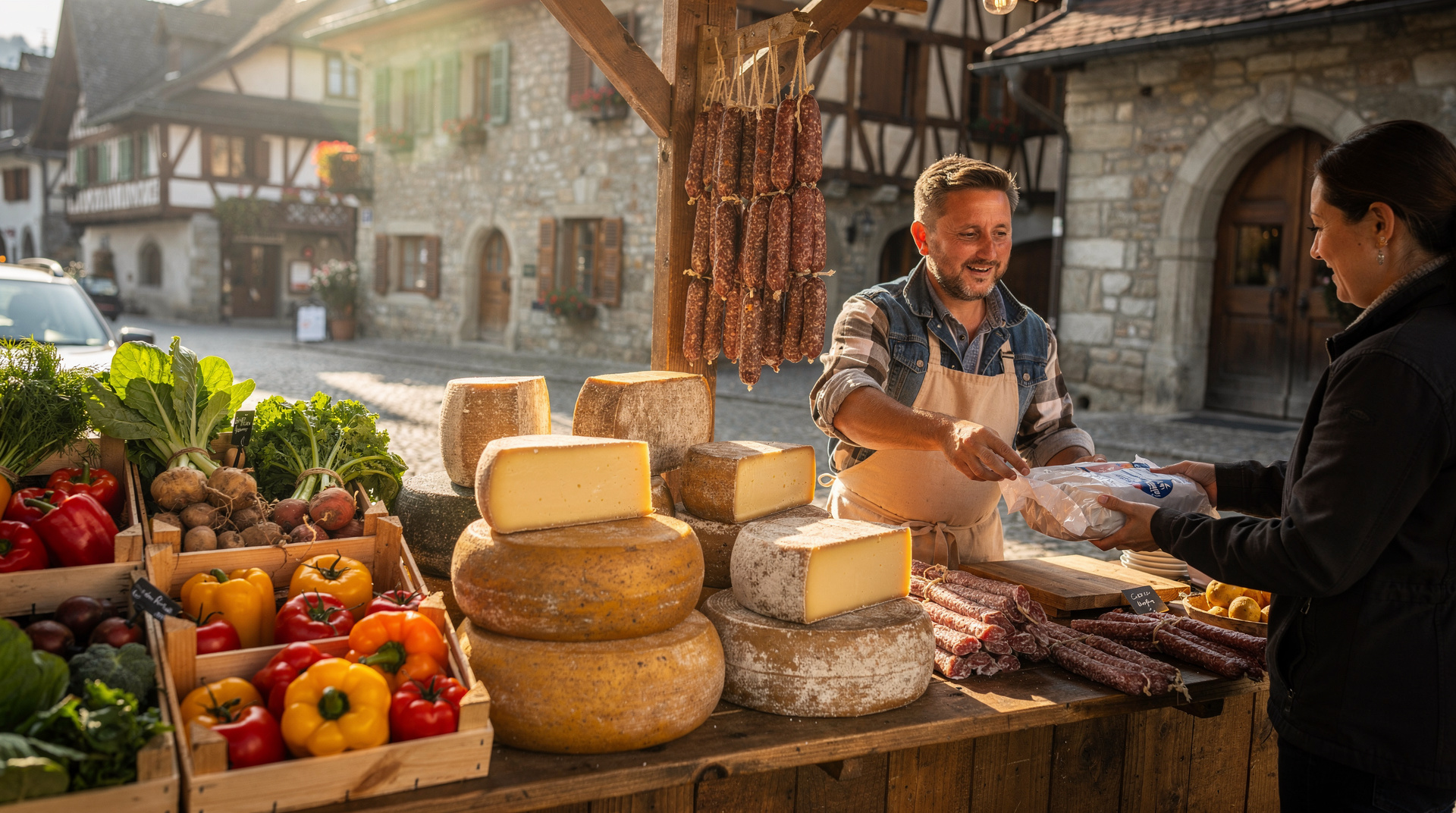
Swiss cheese at source is typically better value and significantly fresher than the same product purchased abroad. La Maison du Gruyère, the Emmental Show Dairy, and the Appenzeller Show Dairy all sell their own production directly at the facility. Prices at the dairy are competitive with major Swiss supermarkets.
Vacuum-packed hard cheese (Gruyère, Emmental, Appenzeller) travels well for 3-4 weeks without refrigeration if kept cool. Vacuum packing is available at all these shops. For longer journeys or warm climates, pack ice or a coolbag — the customs declarations for dairy products entering non-EU countries should also be checked if you are continuing beyond Switzerland.
Swiss supermarkets (Coop and Migros) carry an excellent range of regional and AOP cheeses at standardised prices across the country — often the most convenient option for visitors who have not visited the specific dairies. The quality in Swiss supermarkets is notably higher than what is typically available under the same brand names internationally.
Cheese tasting tips
When tasting Swiss cheeses:
- Temperature: Cheese should be at room temperature, not cold from a refrigerator. Cold suppresses flavour compounds.
- Order: Move from mild to intense — start with young Gruyère, move to Emmental, finish with Appenzeller Extra.
- Pairings: Swiss wines from the Lavaux or Valais pair well with all Swiss hard cheeses. For a non-alcoholic pairing, apple juice or pear juice from the Emmental works surprisingly well.
- Texture: Good aged hard cheese should have small white crystals (tyrosine) visible in the paste. These are a sign of proper aging, not a defect.
Combining cheese experiences with a broader Swiss food tour
A three-day Swiss cheese route is genuinely viable with Switzerland’s excellent public transport. Day one: Geneva or Lausanne to Gruyères (La Maison du Gruyère and Maison Cailler); Day two: Bern region to Affoltern (Emmental Show Dairy); Day three: St. Gallen to Appenzell (Appenzeller Show Dairy). The Swiss Travel Pass covers all the train connections.
For a single-day food experience from Geneva, the Gruyères valley combines both cheese and chocolate within 90 minutes of the city. From Zurich, the Appenzell show dairy is the most accessible option (90 minutes by train to St. Gallen, then the Appenzell line). From Interlaken, this private cheese and chocolate tasting day tour covers a similarly indulgent food route through the Bernese Oberland for those already based in the Jungfrau region.
The full food and drink section covers all Swiss food experiences, and the Swiss cuisine guide provides a comprehensive overview of all the dishes and ingredients that make Swiss food culture distinctive.
Comparing the three main Swiss cheese experiences
| Dairy | Cheese | Best for | Cost | Time |
|---|---|---|---|---|
| La Maison du Gruyère | Gruyère AOP | Combining with Gruyeres village, castle, and chocolate at Maison Cailler | Around CHF 7 | 1-1.5 hours |
| Emmental Show Dairy | Emmental AOP | A quieter, more rural landscape and traditional farmhouse scenery | Around CHF 4 | 1 hour |
| Appenzeller Schaukäserei | Appenzeller | The most intensely flavoured cheese and a distinctive regional culture | Around CHF 5 | 1 hour |
If choosing just one, La Maison du Gruyère offers the easiest logistics for most visitors (day trip from Geneva or Lausanne) and pairs naturally with a chocolate visit at Maison Cailler in the same valley. The Emmental and Appenzeller dairies suit travellers already based near Bern or St. Gallen respectively.
Do you need to book ahead?
None of the three main show dairies require advance booking for general entry — walk-up visits are standard, and tastings are included in the entry price. The exception is combined day tours from Geneva or other cities that bundle transport with the cheese (and often chocolate) visit; these are worth booking a few days ahead in peak summer months, particularly for weekend departures.
Frequently asked questions about Swiss cheese experiences
Do I need to book in advance to visit a Swiss cheese dairy? No, walk-up entry is standard at La Maison du Gruyère, the Emmental Show Dairy, and the Appenzeller Schaukäserei. Only combined day tours from cities like Geneva typically require advance booking.
What is the difference between Gruyère and Emmental? Gruyère is a harder, nuttier cheese aged a minimum of five months with no visible holes, produced under strict AOP rules in the Fribourg region. Emmental is milder, has the characteristic large “eyes” (holes) from a secondary bacterial fermentation, and is aged for a minimum of four months.