Switzerland in July: weather, activities, and tips
Is July a good time to visit Switzerland?
July is peak summer in Switzerland — warm (25-30C in valleys), everything is open, and the Montreux Jazz Festival is one of the world's great music events. It is also the most crowded and most expensive month. Book everything months in advance.
Switzerland in July: what to expect
July is the most popular month to visit Switzerland, and for good reason. The weather is warm and reliable, every attraction and mountain railway is running, the days are long, and the country presents itself at its most spectacular — green valleys, snow-capped peaks, crystalline lakes. The Montreux Jazz Festival brings world-class music to the shores of Lake Geneva. Swiss National Day on August 1 is approaching, and the atmosphere of celebration is building.
The challenge is managing expectations around crowds and cost. July in Switzerland means crowded train carriages, Jungfraujoch queues measured in hours, restaurants at capacity, and hotel prices at their annual peak. If you are flexible, you can mitigate this by travelling midweek, visiting popular sites early in the morning, and choosing less famous alternatives to the most crowded destinations.
None of this should discourage you. July’s Switzerland — with its extraordinary landscapes, warm evenings, outdoor swimming, and festival atmosphere — is genuinely wonderful. It just requires advance planning.
July at a glance
| Where to base yourself | Interlaken/Grindelwald or Zermatt for hiking; Montreux/Lausanne for the jazz festival |
| Typical cost | Peak pricing for hotels across the country |
| Time needed | 7 days for a classic summer circuit; 4-5 for a single-region focus |
| Getting there/around | Fly into Zurich or Geneva, then train — see the Swiss Travel Pass guide |
| Best for | Hikers, swimmers, and festival-goers who don’t mind crowds and book well ahead |
July weather in Switzerland
Valley cities (Zurich, Geneva, Basel, Bern): Daytime temperatures of 25-30C, occasionally exceeding 35C in heat wave conditions. Nights warm, typically 16-20C. Sunshine is generous but afternoon thunderstorms are frequent and sometimes intense.
Interlaken and Lucerne: 22-28C. The mountain backdrop is at its most dramatic — snow on the summits, impossibly blue lakes, green valley floors.
Mountain resorts (1,500-2,000m): 15-22C. Warm and sunny, excellent for hiking. Snow patches remain on north-facing slopes and above 2,500m.
High alpine (above 3,000m): 0-8C. Still cold enough to require proper winter layers. Jungfraujoch temperatures typically around -3 to 2C in July.
Daylight: July begins with about 16 hours of daylight per day, tapering slightly toward the end of the month. Sunset is not until after 21:00.
Events and festivals in July
Montreux Jazz Festival (early to mid-July): One of the world’s most famous music festivals, held on the shores of Lake Geneva for approximately two weeks. Despite the name, the programming covers jazz, rock, pop, blues, and soul — major international artists perform every year. Free concerts take place along the lakeside promenade daily. Lake Geneva’s setting — with the Alps as a backdrop — makes it one of the most atmospheric festival venues anywhere. Book accommodation in Montreux and nearby towns (Lausanne, Vevey) months in advance.
Paléo Festival Nyon (late July): One of Switzerland’s largest music festivals, near Geneva. Six days of international and Swiss acts across multiple stages. Very popular with locals and international visitors.
Zürich Openair (late July): Outdoor music festival in Zurich’s Rote Fabrik district.
Open Air Frauenfeld (July): Europe’s largest hip-hop festival, near Zurich. Draws massive crowds.
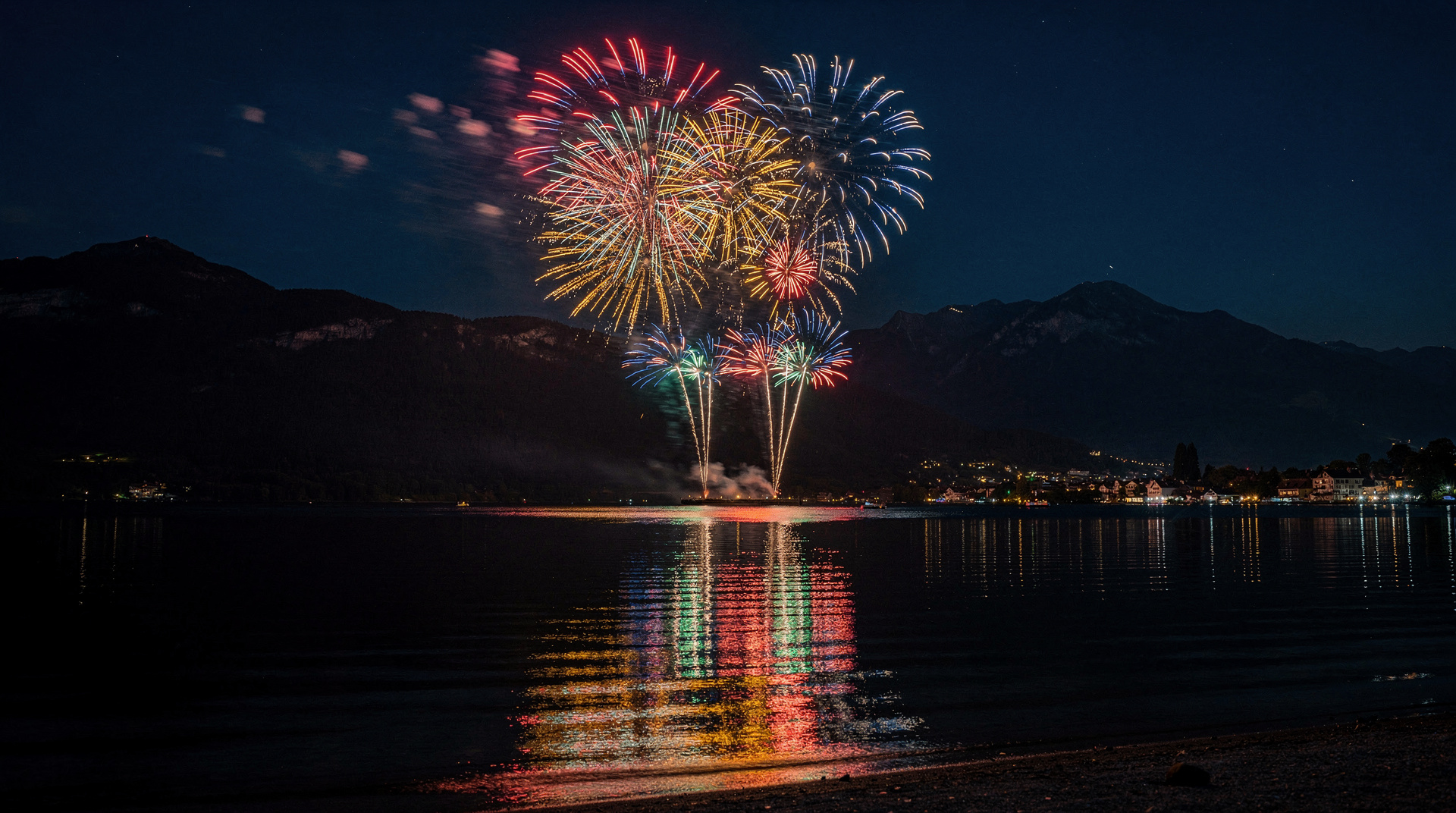
Swiss National Day preparations (August 1 approaching): Communities across Switzerland are preparing bonfires, fireworks, and celebrations. The atmosphere builds throughout July.
Tour de Suisse (June/July, varies): Switzerland’s major cycling race is a warm-up for the Tour de France and passes through spectacular mountain scenery.
Best activities for July
Hiking
July is peak hiking season. All trails above 2,000m are clear of snow, mountain huts are open, and the combination of long days and warm temperatures makes ambitious multi-day routes possible.
The most popular hikes in July:
The Eiger Trail (Grindelwald): Beneath the famous north face, this trail offers jaw-dropping views for relatively modest effort.
Haute Route (Zermatt to Chamonix): A multi-day classic. July is the prime month.
Via Alpina (national trail across Switzerland): The Swiss long-distance hiking network is in perfect July condition.
Rigi Panorama Trail: Around Lake Lucerne’s mountain, this route is accessible and spectacularly rewarding.
Engadin lakes walks (St. Moritz area): Around the chain of lakes near St. Moritz, flat valley walks with extraordinary alpine backdrops.
Swimming
Swiss lake swimming in July is exceptional. The lakes reach temperatures of 19-23C — genuinely warm for swimming. Zurichsee, Lake Geneva, Lake Thun, Lake Lugano, and dozens of others all have public Badi (swimming areas) that are free or inexpensive to use.
Aare river swimming in Bern is a local institution — you enter upstream and let the current carry you through the city, using the dedicated swimmers’ route.
Mountain excursions
All mountain excursions are at maximum capacity. To avoid the worst queues:
Jungfraujoch: Take the Good Morning Ticket, departing before 08:00. Queue at Grindelwald Terminal rather than Interlaken Ost. Book in advance online.
Mount Pilatus: The cogwheel railway and gondola both run — take the cogwheel up and gondola down (or vice versa) for the classic golden round trip.
Mount Titlis: Accessible from Engelberg in under an hour from Lucerne.
Book Jungfraujoch tickets in advance Book the Pilatus golden round trip Discover Mount Titlis glacierAdventure sports
July is peak season for every adventure sport Switzerland offers. Interlaken’s operators run at full capacity with canyoning, river rafting, paragliding, skydiving, bungee jumping, and Via Ferrata.
Book tandem paragliding over InterlakenGlacier Express
The Glacier Express at its scenic summer best. Book a seat reservation far in advance as summer trains fill completely.
Book the Glacier ExpressGrindelwald First
The cliff walk and adventure activities at Grindelwald First are in full summer operation.
Book Grindelwald First cliff walkJuly costs
July is peak pricing season. Expect hotel prices to be at their annual maximum, particularly in popular mountain destinations and cities. Book hotels 3-6 months in advance if visiting popular areas during school holiday periods.
The Swiss Travel Pass pays for itself quickly in July given the volume of transport most visitors use.
Get your Swiss Travel PassManaging July crowds
The key strategies:
Go early: Most tourist sites are significantly quieter before 09:00. The Jungfraujoch, Chapel Bridge in Lucerne, and Rhine Falls near Schaffhausen are all far more enjoyable in early morning light before tour groups arrive.
Midweek over weekends: Weekend crowds at mountain destinations are intense. If your schedule allows, travel Tuesday to Thursday.
Explore alternatives: While tourists queue for Jungfraujoch, Mount Rigi, Schilthorn, and Harder Kulm above Interlaken offer equally spectacular mountain experiences with far fewer people.
Choose less-visited destinations: The Engadin valley, Graubünden mountains, Ticino lakes, and Jura region all receive a fraction of the Bernese Oberland’s tourist volume.
Packing for July in Switzerland
Clothing: Light summer clothes (shorts, t-shirts) for valley days. Fleece and waterproof jacket for mountain excursions.
Swimwear: You will use it — at the lake, at the outdoor pool, possibly in the river.
Hiking gear: Good hiking shoes or boots for trail days. Sandals for lake and city evenings.
Rain gear: July thunderstorms are common and can be torrential. A packable waterproof is useful.
Mountain layers: No matter how hot it is in Interlaken, bring warm layers for Jungfraujoch. A winter jacket, hat, and gloves are needed above 3,000m.
Suggested July itinerary
7-day summer classic: 1 night Zurich (arrive, lake swim), 1 night Lucerne (Chapel Bridge, lake cruise), 2 nights Interlaken (adventure sports, Jungfraujoch), 1 night Grindelwald (hiking, cliff walk), 2 nights Zermatt (hiking, Matterhorn).
See our full 7-day Switzerland itinerary.
Pros and cons of visiting in July
Pros:
- Warm weather, everything open
- Montreux Jazz Festival
- Long days — maximum outdoor time
- Swimming in lakes and rivers
- Best hiking conditions
Cons:
- Most crowded month of the year
- Peak hotel prices
- Afternoon thunderstorms disrupt outdoor plans
- Jungfraujoch queues can be very long
- Book everything months in advance
Getting the most from July in Switzerland
The Swiss Travel Pass in July
The Swiss Travel Pass is strongly recommended for July. The volume of transport you will use — trains between cities and mountain destinations, boats on lakes, mountain railways and cable cars — adds up quickly. The 25-50% discounts on mountain excursions and free unlimited use of all standard trains and boats make the pass economical for any itinerary lasting 4 days or more.
Get your Swiss Travel Pass for JulyTackling afternoon thunderstorms
July Alpine thunderstorms are a fact of life rather than a reason to alter your plans. The standard strategy: plan mountain hikes and outdoor activities for the morning, aiming to be back at the valley or on a mountain terrace by noon. The storms typically build through the afternoon (often starting between 14:00 and 16:00) and clear by early evening, frequently leaving spectacularly clear skies and alpenglow on the peaks.
If you are on a high trail when storms approach, descend immediately. Lightning on alpine terrain is genuinely dangerous.
Less-visited alternatives for July
If the Jungfraujoch queues and Grindelwald crowds feel overwhelming, several excellent alternatives deliver comparable mountain experiences with far fewer visitors:
Schilthorn (2,970m): Reached from Mürren (car-free village accessible via cable car from Stechelberg). The revolving Piz Gloria restaurant at the summit was used for the James Bond film On Her Majesty’s Secret Service. Views across to the Eiger, Mönch, and Jungfrau are superb. Considerably less crowded than Jungfraujoch.
Harder Kulm above Interlaken: Only 10 minutes by funicular from Interlaken itself. A viewpoint at 1,322m giving the famous view of Eiger, Mönch, and Jungfrau framed by the two Interlaken lakes. An excellent early morning option before the day heats up.
Mount Rigi from Lucerne: The “Queen of Mountains” at 1,797m is less dramatic than Jungfraujoch or Titlis but offers extraordinary panoramas over multiple lakes and is significantly less crowded in July. The rack railway from Vitznau (lakeside) is a classic Swiss experience.
July vs June: which suits your trip
| June | July | |
|---|---|---|
| Crowds | Lower, especially early in the month | Highest of the year |
| Prices | Rising toward peak | Peak throughout |
| High-altitude trails | Some snow lingers early on | Fully open and clear |
| Signature event | Alpaufzug cattle drives | Montreux Jazz Festival |
| Best for | Wildflowers, lighter crowds | Guaranteed warm weather, full trail access |
If crowds and cost are your main concern, our Switzerland in June guide covers the quieter shoulder-season alternative with a very similar climate.
Swiss food and drink in July
July evenings in Switzerland call for outdoor eating. Most mountain resort restaurants open their terraces, lakeside restaurants extend their seating to the water’s edge, and cities animate their squares and parks with temporary outdoor dining. The Swiss tradition of Grillieren (barbecue) is at its peak in July — many lakeside areas have free public barbecue grills (Grillstellen) for anyone to use.
Try a Gerstensuppe (barley soup) at a mountain hut, a Rösti at a ski-area restaurant that doubles as a summer hiking destination, or a fresh Zander (pike-perch) at a lakeside restaurant — Swiss lake fish is underrated and at its best in summer.
Quick tips for July visitors
Book accommodation, the Glacier Express, and Jungfraujoch tickets well in advance. July fills up fast, especially around Montreux Jazz Festival dates and Swiss National Day (August 1 approaching).
The Good Morning Ticket for Jungfraujoch (depart before 08:00, return by 13:00) is not just cheaper — it is the best weather window and avoids the worst afternoon queues. Buy it online before your visit.
Download the SBB (Swiss Federal Railways) app before your trip. It handles ticketing, real-time timetables, and seat reservations for scenic trains.
See our complete when to visit Switzerland guide and budget planning page for July-specific cost information. For itinerary planning, our 7-day Switzerland itinerary works well as a July framework.
Destination guides for July: Zermatt | Grindelwald | Interlaken | Lucerne
Switzerland’s train network connects all these destinations reliably and comfortably year-round. The Swiss Travel Pass covers unlimited travel on all standard Swiss trains, boats, and provides discounts on mountain excursion railways — making it the most efficient way to explore the country for most visitors. See our getting around Switzerland guide for full transport details, and our Switzerland budget guide for current cost benchmarks across all seasons and destinations.