Switzerland in spring: weather, activities, and tips
Is spring a good time to visit Switzerland?
Spring (March to May) is one of the smartest times to visit. May in particular offers beautiful wildflowers, most services open, warm temperatures, and significantly fewer crowds than summer. Prices are lower than peak season throughout spring.
Switzerland in spring: an overview
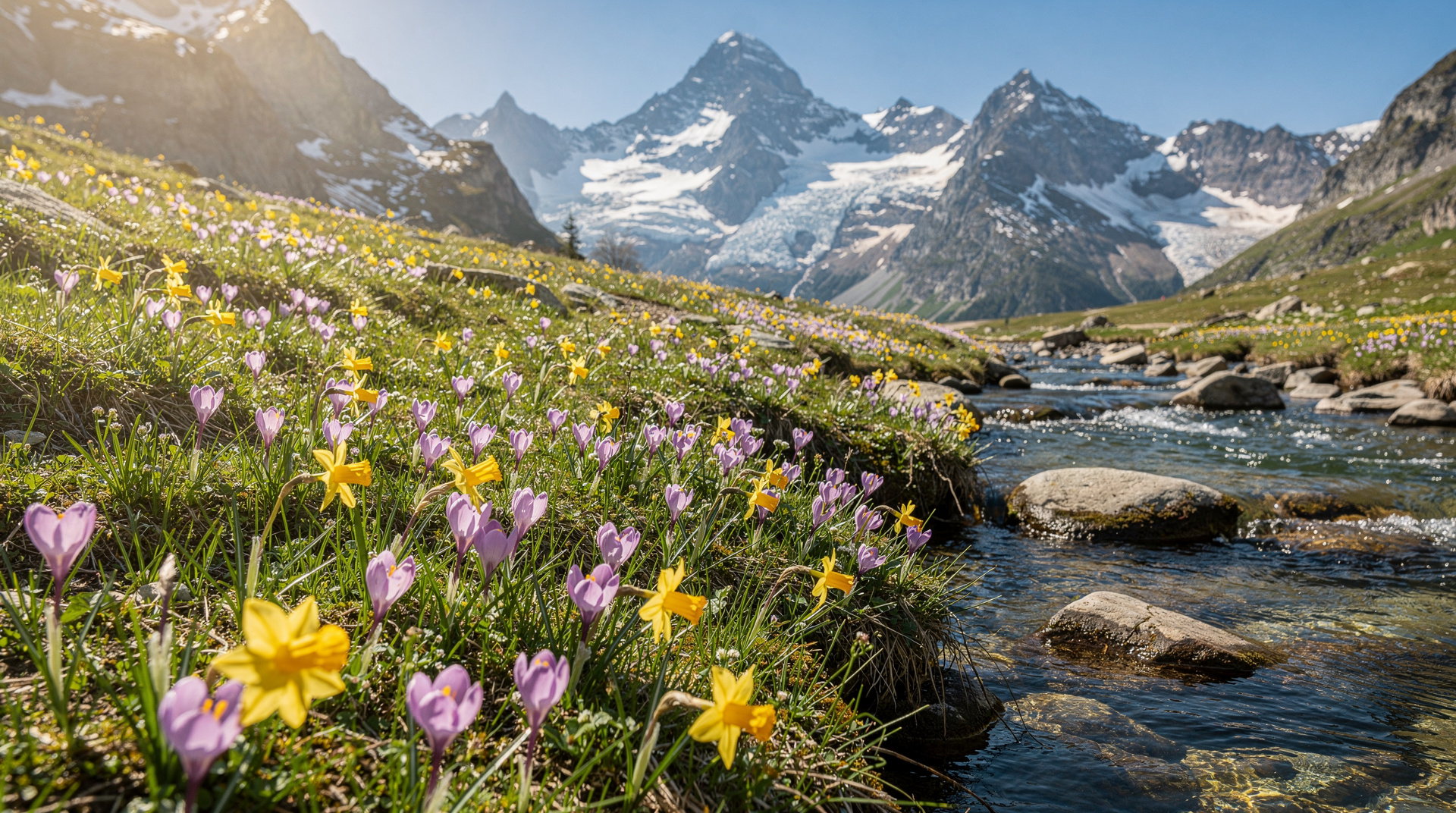
Spring in Switzerland — covering the months of March, April, and May — is one of the most beautiful and underappreciated periods in the Swiss travel calendar. The country transitions from winter with a kind of unhurried elegance: orchards blossom in the Valais, wildflowers carpet Alpine meadows at progressively higher elevations, the lakes shift from their winter stillness to summer brightness, and the mountains remain snow-capped throughout, providing a dramatic contrast against the greening valleys.
For travellers, spring offers compelling advantages. Crowds are a fraction of summer volumes. Hotel prices are significantly lower than in July and August. By May, most summer infrastructure is operational. And the natural scenery — wildflowers, snowmelt waterfalls, emerald valleys — is arguably at its most beautiful.
Each spring month has its own distinct character.
At a glance
| Spring in Switzerland | |
|---|---|
| Where | Valais and Ticino warm up earliest; the Jungfrau region and Engadin stay wintry longest |
| Cost | Typically 15-25% below August rates; March/April are the cheapest of the year outside skiing |
| Time needed | A week covers the classic route comfortably; 10 days if combining a city stay with hiking |
| Getting there | Zurich or Geneva airport, then trains via the Swiss Travel Pass |
| Best time within the season | Mid-to-late May for the best balance of open infrastructure, wildflowers, and manageable crowds |
March in Switzerland
March is the transitional month. At altitude, winter is still very much in command — ski resorts are running their final weeks of the season, snowpack is deep, and spring skiing conditions (firm morning snow, sunshine, mountain terraces) are excellent. In the valleys, the first tentative signs of spring appear: crocuses, the odd warm afternoon, days that stretch noticeably longer than in February.
After the school holiday rush ends (typically mid-February to mid-March, varying by country), March delivers excellent skiing at reduced prices and with smaller crowds. This combination — good conditions, lower prices, fewer people — makes late March one of the best-kept secrets in Swiss winter sports travel.
The fog (Hochnebel) that blankets Swiss valleys in winter begins to break more regularly in March, allowing more days of genuine sunshine in the valley cities.
March highlights: Late ski season at high-altitude resorts, spring skiing conditions, first valley wildflowers, Fasnacht carnival in Basel and Lucerne (depending on the Easter calendar).
For the detailed month guide, see Switzerland in March.
April in Switzerland
April is Switzerland’s quiet month and offers some of the year’s best value. The ski season has ended at most resorts, summer tourism hasn’t started, and the result is a relaxed, uncrowded Switzerland that moves at its own pace.
The wildflower season moves upward through the month — by late April, Alpine meadows at 800-1,200m are covered in blooms. The Lauterbrunnen valley near Interlaken is spectacular, with its 72 waterfalls running at full power from snowmelt and the valley floor covered in wildflowers. Orchards in the Valais and Ticino are in full blossom.
April weather is unpredictable — warm spring afternoons can be followed by cold, rainy evenings. Layer up and carry rain gear. The advantage is that when the weather is good, it is truly good: sharp, clear, with a quality of light that summer heat softens.
Key April events include Zurich’s Sechseläuten spring festival (guild parade and burning of the Böögg snowman) and Easter celebrations across the country.
April highlights: Wildflowers and blossoms at valley level, Sechseläuten in Zurich, Easter markets, affordable prices, very low crowds.
For the detailed month guide, see Switzerland in April.
May in Switzerland
May is the finest spring month for most travellers and one of the best months in the entire Swiss calendar. Most summer infrastructure reopens through May — the Mount Pilatus cogwheel railway (typically the second week of May), summer cable cars, mountain restaurants, boat services at full summer timetables, and hiking trails at progressively higher elevations.
Temperatures in the valley reach a genuine warmth — 17-22C by mid-May — while the mountains remain capped in snow, creating Switzerland’s most dramatic natural contrast. Wildflower season peaks at middle elevations (1,500-2,000m) in May, making mountain hikes through carpets of bloom one of the great experiences Switzerland offers.
Crowds are noticeably lower than June, July, and August. Popular sites like Chapel Bridge in Lucerne and the Jungfraujoch feel manageable. Booking ahead is still sensible for popular accommodation, but the frantic advance planning of peak summer is not necessary.
May highlights: All services opening, wildflowers at altitude, excellent hiking, warm valley temperatures, manageable crowds, better prices than summer.
For the detailed month guide, see Switzerland in May.
Spring weather by region
Zurich and northeast Switzerland: March cool (5-10C) warming through April (10-14C) to May warmth (15-22C). Occasional fog in March fading through spring. Rain possible throughout.
Geneva and Lake Geneva region: Slightly warmer, particularly in May. Geneva and the Leman basin enjoy a more Continental climate with fewer fog days than the Swiss plateau. May often sees 20C+ days in Geneva.
Lucerne and central Switzerland: Classic valley weather patterns. March fog transitioning to spring sunshine. May consistently pleasant with mountain backdrop.
Interlaken and Bernese Oberland: Interlaken’s bowl location makes it prone to temperature inversions, but spring brings beautiful conditions. The waterfalls from snowmelt in April and May are at their most dramatic.
Valais: One of Switzerland’s sunniest regions. Spring arrives early in the warm valley. Apricot and cherry orchards near Sion blossom spectacularly in April.
Ticino: Switzerland’s Italian-speaking canton has a Mediterranean character. Spring arrives weeks earlier than the plateau. Mimosa, camellia, and cherry blossom in March; full spring warmth in April; summer-like conditions in May.
Graubünden and Engadin: Higher, cooler, and more reliably snow-covered later into spring. The high Engadin valley near St. Moritz may still have full winter conditions in April.
What’s open in spring
The spring reopening calendar is important to understand:
Open year-round (including all spring): Jungfraujoch, Mount Titlis, all city museums, restaurants, and transport, Glacier Express and scenic trains, Zermatt (lifts year-round).
Reopening in March: Paragliding operations resume in Interlaken (weather dependent), boat services start limited spring schedules.
Reopening in April: Boat services on major lakes moving to fuller schedules, some lower-elevation hiking routes clear.
Reopening in May: Mount Pilatus cogwheel railway (typically second week of May), Schynige Platte railway, most summer cable cars, mountain restaurants at middle elevations, outdoor swimming pools (Badi), full boat service summer timetables.
Still closed in May: Some very high-altitude hiking routes (above 2,500m may have snow), a few remote cable cars on summer-only schedules that open in June.
Spring activities
Hiking
Spring hiking follows the snowmelt upward. In March, concentrate on valley paths below 800m. In April, trails up to 1,200m become accessible. By May, beautiful hiking is available up to 1,800-2,000m.
The Lauterbrunnen valley is exceptional in April — the waterfalls are at maximum volume, the valley floor is green, and the snow remains dramatically white above. The Rhine valley paths, Lavaux wine terraces above Lake Geneva, and paths around the Lucerne lakes are all excellent spring walking.
By May, the Jungfrau region’s mid-elevation paths (Grindelwald to First, the Schynige Platte area, paths around Wengen and Mürren) are superb. The Pilatus summit trails open with the cogwheel in May and offer some of the finest spring panoramas in Switzerland.
Book Grindelwald First cableway and cliff walkMountain excursions
All three major excursion mountains are excellent in spring, with significantly lower visitor numbers than summer:
Book Jungfraujoch — Top of Europe Book the Mount Pilatus golden round trip (from May) Discover Mount Titlis glacierGlacier Express in spring
The Glacier Express from Zermatt to St. Moritz shows a beautiful transition in spring — snow-covered mountain passes with green valley floors beginning to appear.
Book the Glacier ExpressAdventure sports (May onwards)
Paragliding, canyoning, and rafting in Interlaken open progressively through spring. By May, most operators are fully operational.
Book tandem paragliding over InterlakenCity tourism
Spring is excellent for Switzerland’s cities. Zurich’s outdoor life begins with the warming of May — street café culture, lakeside walking, the Zurichsee promenade. Geneva’s old town is charming in spring. Basel’s museum quarter rewards extended exploration.
Spring costs
Spring represents excellent value compared to summer. March and April are at their most affordable. May prices begin to creep upward as the season becomes more popular, but remain 15-25% below August peaks for most destinations.
The Swiss Travel Pass is efficient year-round and particularly good value in spring when you will be combining trains, mountain railways, and boat services.
Get your Swiss Travel PassSpring packing guide
March: Full winter layers remain essential for mountain excursions and mountain towns. Pack as for winter with the option to remove layers as the month progresses.
April: Transitional. Light base, fleece, packable waterproof jacket covers most situations. Proper rain gear essential — April showers are real.
May: Spring clothing with lightweight layers. A packable down jacket or warm fleece for evenings and altitude. Hiking boots for trail days.
Year-round spring: Sunscreen essential at altitude even in early spring. UV is strong on snow-covered terrain. Quality waterproof footwear for all three months.
Recommended spring itinerary
7-day May trip (ideal): Fly into Zurich — 1 night Zurich (settle in, old town), train to Lucerne — 1 night (Chapel Bridge, Mount Pilatus day, lake cruise), train to Interlaken — 2 nights (Jungfraujoch, Lauterbrunnen walk, paragliding), train to Grindelwald — 1 night (hiking, Grindelwald First), train to Zermatt — 2 nights (Matterhorn views, village, hiking).
This route uses the Swiss Travel Pass efficiently. See our 7-day Switzerland itinerary for full details.
Pros and cons of spring in Switzerland
Pros:
- Beautiful wildflowers and blossoms at all elevations
- Far fewer crowds than summer
- Significantly lower prices than peak season
- Most summer services open by May
- Long days by May (15+ hours daylight)
- Switzerland at its most dramatically colourful
Cons:
- Unpredictable weather, particularly in March and April
- Some services still closed in March and April
- High mountain trails snow-covered until May or June
- March valley fog still possible
Spring events calendar summary
March:
- Fasnacht (Basel and Lucerne, depending on Easter date) — Switzerland’s great carnival
- World Cup ski racing finals at Lenzerheide and Crans-Montana
- Geneva International Motor Show (mid-March)
April:
- Sechseläuten in Zurich (third Monday of April) — guild parade and Böögg burning
- Landsgemeinde in Appenzell (last Sunday of April) — open-air democratic parliament
- Easter markets in Basel, Zurich, and Bern
- Easter hiking (lower alpine paths opening)
May:
- Ascension Day and Whit Monday (public holidays)
- Alpaufzug cattle drives begin
- Mount Pilatus cogwheel railway reopening (typically second week of May)
- Full summer boat service timetables resume
Spring versus other seasons: the honest comparison
Spring vs Summer: Spring wins on value (lower prices), crowds (significantly fewer), and conditions at altitude in May (wildflowers, accessible trails). Summer wins on temperature (swimming season), daylight, and maximum infrastructure operation. The sweet spot is late May to mid-June — the best of both.
Spring vs Autumn: Both are excellent shoulder seasons. Spring has better mountain snowpack for contrast with blossoming valleys; autumn has better foliage colours. May and September are closely matched for overall experience quality.
Spring vs Winter: Winter is best for skiing. Spring is best for everything else.
Spring food and wine
Spring food in Switzerland follows the season’s logic. April and May bring the first local asparagus — Swiss white asparagus (Spargel) is a seasonal highlight, appearing on menus across the country for a few precious weeks. Wild garlic (Bärlauch) is gathered in forests and appears in spring soups, pasta, and salads.
The Valais wine region releases its new vintages in spring. White wines from the Valais — Fendant (Chasselas), Petite Arvine, Heida — are at their freshest in May. Wine bars in Sion and Martigny are an excellent addition to any spring Valais visit.
Cheese continues to be excellent throughout spring — this is the season when the lowland herds are still producing the milk that will become next winter’s aged cheeses.
Quick seasonal comparison
If you are trying to decide between spring and other seasons, see our full when to visit Switzerland guide, which compares all months in detail. For budget planning across seasons, visit our Switzerland budget guide.
Individual month guides: March | April | May
Destination guides for spring travel: Interlaken | Grindelwald | Lucerne | Zermatt
Spring itinerary: 7-day Switzerland itinerary
Spring month by month
| Month | Weather | What’s open | Best for |
|---|---|---|---|
| March | Cold at altitude, mild in valleys; fog breaking up | Ski resorts still running; few summer services | Late-season skiing, Fasnacht carnival |
| April | Unpredictable, layer-dependent | Boats and low trails reopening; Pilatus still closed | Wildflowers at valley level, Lauterbrunnen waterfalls |
| May | Warm valleys (17-22C), snow-capped peaks above | Nearly all summer infrastructure reopens | Mid-elevation wildflower hikes, best all-round value |
Frequently asked questions about Switzerland in spring
Is it warm enough to hike in the Alps in April? Below roughly 1,200m, yes — trails clear progressively through the month. Anything higher is still likely to hold snow; check conditions for specific routes like those around Lauterbrunnen before setting out.
Does the Mount Pilatus cogwheel railway run in spring? It typically reopens in the second week of May after winter closure; in March and April, reach Pilatus via the aerial cableway instead, or plan your Mount Pilatus day for after the cogwheel reopens.