Swiss currency and tipping guide
Do I need cash in Switzerland?
Cards are accepted almost everywhere in Switzerland. Visa and Mastercard work best. Cash (Swiss francs) is useful for small purchases and mountain huts. Tipping is not expected but rounding up is appreciated.
Swiss currency and money: a practical guide
Switzerland uses the Swiss franc (CHF), and despite being surrounded by eurozone countries, it stubbornly maintains its own currency. For visitors, this means one currency to use regardless of which region you’re in — and one of the world’s most stable and strong currencies to work with.
This guide covers everything about money in Switzerland: exchange rates, where to get francs, card payment everywhere vs. where you actually need cash, ATM fees, and the somewhat confusing world of Swiss tipping customs.
At a glance
| Currency | Swiss franc (CHF) — not the euro, despite bordering the eurozone |
| Cash needed | Around CHF 50-100 as a buffer for mountain huts, markets, small bakeries |
| Cards | Visa/Mastercard near-universal; contactless and Apple/Google Pay widely supported |
| Tipping | Not expected; rounding up or 5-10% for good service is typical |
| ATMs | At every station and airport; choose “charge in CHF” to avoid dynamic-conversion markup |
The Swiss franc (CHF)
The official currency of Switzerland is the Swiss franc, abbreviated CHF (from the Latin “Confoederatio Helvetica Franc”). Locally it’s sometimes called “Franken” (German), “Franc” (French/Italian), or simply “Stutz” in colloquial Swiss German.
Coins: 5, 10, 20, and 50 centimes (Rappen), and CHF 1, 2, and 5 coins.
Banknotes: CHF 10, 20, 50, 100, 200, and 1,000 bills. Swiss banknotes are distinctive (horizontal on one side, vertical on the other) and often cited among the world’s most beautiful designs.
Exchange rate (approximate, April 2026):
- 1 CHF ≈ 1.05 USD
- 1 CHF ≈ 0.95 EUR
- 1 CHF ≈ 0.85 GBP
The Swiss franc is traditionally a “safe haven” currency — in times of global economic stress, demand for CHF rises and the currency strengthens. This means the exchange rate can be less favorable for visitors during geopolitically turbulent periods.
Does Switzerland accept euros?
The short answer: sometimes, but not reliably, and often at unfavorable rates.
Some tourist businesses near borders (Zurich Airport, Geneva, Basel) accept euros informally. Larger tourist hotels occasionally accept euros. But:
- Most Swiss shops, restaurants, and transport operators only accept CHF
- When euros are accepted, the exchange rate is usually poor (often 1 EUR = 1 CHF, regardless of the actual rate)
- ATMs dispense CHF, not euros
- Getting euros “back as change” from a CHF transaction never happens
Conclusion: Euros are not practical as your primary currency in Switzerland. Get CHF and use it. The few places that accept euros will take you for less than the real exchange rate.
How to get Swiss francs
ATMs (recommended)
ATMs are the best way to get CHF for most travelers. You’ll find them at every airport, major train station, and in every town. Banks typically offer better exchange rates than currency exchange offices.
ATM tips:
- Use bank ATMs rather than independent ATMs (found in tourist areas) — independent ATMs often charge high fees
- Your home bank will charge an international withdrawal fee (typically USD 3-7 or 1-3%). Some accounts waive this fee — Charles Schwab checking (USA) and Starling/Monzo (UK) are commonly recommended for fee-free withdrawals abroad
- Withdraw in larger amounts to minimize per-transaction fees (CHF 200-300 at a time rather than CHF 50)
- When prompted, choose to be charged in CHF (not your home currency) — this avoids the “dynamic currency conversion” markup that costs 3-7% extra
Switzerland ATM availability:
- Airport arrivals halls: Swisscom and PostFinance ATMs
- Train stations: always have at least one ATM
- Post offices (Poste): PostFinance ATMs with good rates
- UBS, Credit Suisse, Raiffeisen, Cantonal banks: widespread
Currency exchange
If you exchange cash, use banks or the official exchange desks at SBB train stations (operated by Change Group or similar). Avoid:
- Airport currency exchange booths before customs — rates are poor
- Hotels (convenient but expensive)
- Independent exchange offices in tourist areas
The SBB exchange offices at Zurich HB, Geneva Cornavin, and Bern HB are convenient and have reasonable rates.
Get some CHF before you arrive
If your home bank can order CHF in advance (many can with 3-5 business days notice), having CHF 100-200 on arrival is convenient for immediate needs (transport from the airport, coffee, etc.) without scrambling for an ATM. Rates from banks in your home country are usually reasonable.
Paying with cards
Switzerland is one of the most card-friendly countries in the world. Card payment is accepted at:
- Virtually all hotels and restaurants
- All supermarkets (Coop, Migros, Aldi, Lidl)
- All train station ticket machines and counters
- All chain stores and pharmacies
- Most mountain restaurants and cable car stations
- Taxis and rideshares
- Parking meters in cities
Best cards to use:
Visa and Mastercard: Both are universally accepted. Either works at the vast majority of Swiss businesses.
American Express (Amex): Less widely accepted than Visa/Mastercard. Most major hotels, restaurants, and department stores take it. Many smaller restaurants, bakeries, and convenience stores do not.
Contactless (NFC): Contactless payment (including Apple Pay and Google Pay) is widely accepted across Switzerland. Most payment terminals support it. Tap-and-go payments work seamlessly.
Debit vs. credit cards: Both work. Credit cards have the advantage of consumer protection and some offer travel benefits (no foreign transaction fees, travel insurance, etc.). Debit cards linked to your bank account work fine but check your bank’s international usage fees.
Cards with no foreign transaction fees: If your card charges a “foreign transaction fee” (typically 1.5-3% on international purchases), consider getting one that doesn’t before your trip. Options by country:
- US: Chase Sapphire, Schwab Investor Checking, Capital One Venture
- UK: Starling, Monzo, Halifax Clarity
- Australia: 28 Degrees, Bankwest Zero
Where you genuinely need cash
Despite Switzerland’s card-friendliness, cash is necessary or highly preferable in these situations:
Alpine mountain huts (SAC huts): Swiss Alpine Club huts in the mountains are remote and may not have card terminals. They increasingly accept cards, but cash is often required or preferred. If planning overnight hiking or high-Alpine routes, carry CHF 100-200 in cash.
Small village bakeries and cafes: Rural Swiss bakeries often have a minimum card purchase (CHF 10-15) or prefer cash. Having some coins for a pastry and coffee is useful.
Markets and street food: Most outdoor markets and food stalls operate cash-only.
Public toilets: Some automated public toilets (especially at train stations) require coins (CHF 0.50-2.00).
Small ski lifts and resorts: While major ski resorts are fully card-enabled, some smaller lifts and mountain services in less-touristy areas may be cash-only or have limited card options. For more on winter costs and logistics, see our Swiss ski season planning guide.
Emergency situations: Dead phone, technical failure at a card terminal, closed ATM — having CHF 50-100 in cash avoids being stranded.
Recommended cash amount: Keep CHF 50-100 in cash as a buffer. Replenish when it drops. You don’t need to carry large amounts — but zero cash is occasionally inconvenient.
Swiss tipping customs
Tipping in Switzerland operates differently from the US and slightly differently from most of Europe. For a deeper look, see our dedicated guide to tipping in Switzerland. Understanding the customs prevents both under-tipping (leaving staff feeling disrespected) and over-tipping (an unnecessary expense given already-high Swiss wages).
The basics
Service is included: Swiss restaurants do not add a service charge as a separate line item. The prices on the menu are the prices you pay. Swiss restaurant workers are paid proper full-time wages (Swiss minimum wage requirements apply), so there is no obligation to tip to compensate for low wages as in the US.
Tipping is not expected: Swiss people themselves often do not tip, or tip very modestly. A waiter or taxi driver will not look at you strangely for not tipping.
What is done: Swiss people commonly “round up” the bill to the nearest franc or round number. If your coffee costs CHF 4.30, handing over CHF 5 and saying “Merci” or “Danke” is normal. If a restaurant bill is CHF 47, leaving CHF 50 is a generous but common gesture.
By service type
Restaurants: Rounding up to the nearest CHF 5 or leaving 5-10% for very good service is appreciated and appropriate. Nothing is expected. Leaving 15-20% (the US standard) is genuinely over-tipping in the Swiss context.
Cafes and bakeries: Round up or leave the change. Nothing formal expected.
Taxis: Round up to the nearest franc or CHF 5, depending on the journey length. A CHF 18 taxi ride might become CHF 20. CHF 50+ rides might get a 5% tip.
Hotel porters: CHF 1-2 per bag is a standard gesture if a porter carries your luggage. Not obligatory but appreciated.
Hotel housekeeping: CHF 2-5 per day left on the pillow or desk at the end of your stay is a kind gesture, particularly for longer stays. Not standard practice but appreciated.
Tour guides: CHF 5-20 depending on the length and quality of the tour. Group tours with guides often have a collective tip. For private guides, 10% of the tour cost is generous.
Ski instructors and mountain guides: CHF 20-50 per day for individual lessons or guiding. Group lesson instructors often receive nothing. Private guides providing safety-critical mountain services often receive generous tips.
Hairdressers and spas: Round up or leave a modest tip (5-10%) for good service.
How to leave a tip
Switzerland has moved largely to card payment. Tips on cards work differently:
At a card terminal: When the terminal asks for the amount, enter the total you wish to pay (including any tip). For example, if the bill is CHF 43 and you want to leave CHF 47, enter 47 when prompted for the total.
In cash after card payment: Hand cash directly to the server after paying by card. Simply say “Das ist für Sie” (German) or “C’est pour vous” (French) — “That’s for you.”
The “stimmt so” custom: In German-speaking Switzerland, when paying with cash, telling the cashier or server “stimmt so” (“it’s fine” or “keep the change”) is the common way to indicate you don’t need change back and the remainder is theirs. Widely understood.
Currency and budget planning
For a mid-range traveler budget of CHF 200-350/day, here’s roughly how the spending breaks down:
- Accommodation: CHF 100-150 (largest single cost)
- Food: CHF 60-80 (one restaurant meal, bakery/supermarket otherwise)
- Transport: CHF 40-60 (transport pass amortized)
- Activities: CHF 20-40 (one paid activity or museum)
- Incidentals: CHF 15-25 (coffee, tips, small purchases)
See our full Switzerland travel budget guide for detailed category breakdowns and options at every budget level.
Currency exchange rates and monitoring
The Swiss franc has historically been strong and has appreciated against the euro and dollar over the long term. For trip planning, use xe.com or Google’s currency converter for current rates. Booking accommodation and activities priced in CHF means you know your costs in local terms — just convert to your home currency at booking time to budget in what you’re used to.
For money-saving strategies beyond currency, see our guide to saving money in Switzerland.
For all practical travel planning, see our first-time visitors’ guide and our step-by-step trip planning guide.
Paying for transport: specific notes
Buying train tickets with cards
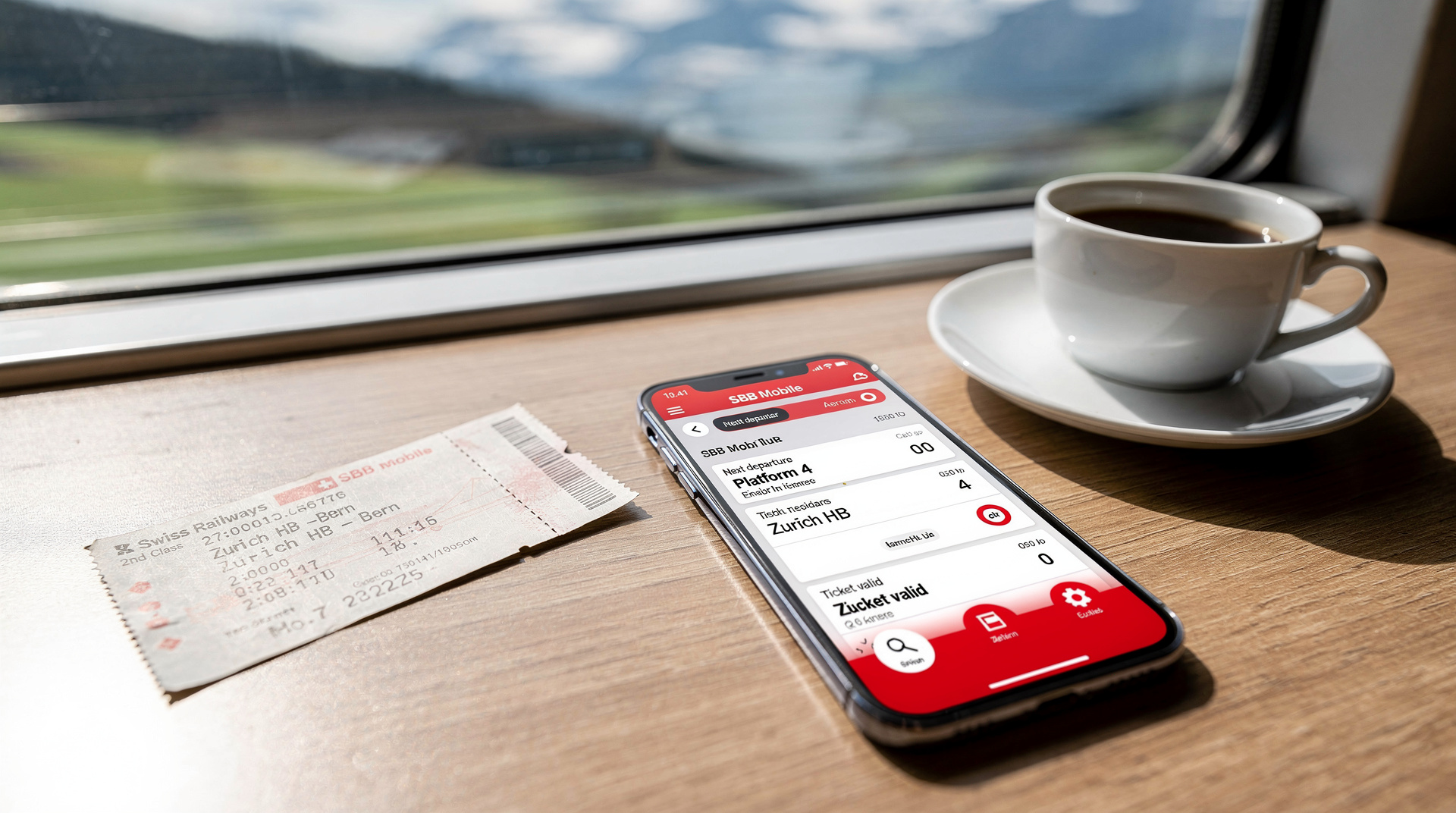
SBB ticket machines at all stations accept Visa, Mastercard, and Maestro. They do not always accept American Express. If your card is rejected at a machine (unusual but possible), try another machine or go to the staffed ticket counter.
The SBB app accepts all major cards and Apple Pay/Google Pay. This is the most reliable payment method for train tickets. If you would rather pay once in advance and skip the ticket machines, a Swiss Travel Pass covering trains, buses and boats can be bought online before you arrive.
Mountain railway payments
Mountain railways like the Jungfrau Railway, Pilatus cogwheel, and cable cars at Schilthorn all accept cards at ticket counters and often at machines. Some smaller facilities at upper stations are cash-only — the summit restaurant at a high Alpine cable car may prefer cash. Booking a Jungfraujoch round-trip railway ticket from Grindelwald online means the fare is settled before you go.
If planning to buy additional services once at altitude (a hot drink, a souvenir, extra transport), carry CHF 30-50 in cash.
Switzerland’s banking system for visitors
ATMs: The PostFinance ATM network (found at all post offices) is the most widespread and typically has good rates. UBS and Raiffeisen ATMs are also widely available.
ATM fees: Swiss ATMs do not charge their own fee to foreign cardholders. The only fees come from your home bank’s international withdrawal charges. To avoid these, use a no-fee card (Charles Schwab in the US, Starling or Monzo in the UK, Wise anywhere).
Currency exchange bureaus: Change Group operates kiosks at major train stations (Zurich HB, Geneva Cornavin, etc.). Rates are reasonable for a currency exchange service. Post offices also exchange currency at fair rates. Avoid exchange counters at international arrival halls before customs — these charge the worst rates.
Wise (formerly TransferWise): The Wise card uses mid-market exchange rates with a small conversion fee, typically 0.5-1.7%. Significantly cheaper than most bank cards for international use. Available as a physical card or virtual card for Apple Pay/Google Pay.
Swiss francs outside Switzerland
Swiss francs are not useful once you leave Switzerland. If you have leftover CHF:
- Spend them at the airport (food, drinks, shops — Swiss airports accept CHF)
- Convert back to your home currency at a bank or exchange desk
- Save them for a future Switzerland visit (the franc’s long-term stability means stored CHF don’t lose value rapidly)
- Major international airports sometimes accept CHF at stores, but don’t rely on this
The 5-centime, 10-centime, and 20-centime coins are nearly worthless in value and bulky to carry home. Spend these on vending machines or public toilets before leaving.
Cash versus card: when to use which
| Situation | Use | Why |
|---|---|---|
| Restaurants, hotels, supermarkets | Card | Universally accepted, no markup if charged in CHF |
| SAC mountain huts | Cash | Remote locations may lack reliable card terminals |
| Rural bakeries, market stalls | Cash | Often cash-only or have a card minimum |
| Public toilets, small vending machines | Coins | Automated machines take CHF 0.50-2.00 coins only |
| Tipping in cash after a card payment | Cash | Handing cash directly to staff is the clearest way to tip |
Swiss VAT and tax refunds for tourists
Switzerland has a VAT system called MWST. The standard rate is 8.1%. For non-EU residents (Americans, Canadians, Australians, British citizens), VAT refunds on purchases over CHF 300 are available from participating retailers.
The process:
- Ask for a Global Blue or Planet tax refund form when making qualifying purchases
- Have the form stamped by Swiss customs when leaving at an international airport or border
- Receive the refund cash at a refund desk or by credit card
The refund is typically 5-6% of the purchase price. For high-value purchases (watches, jewelry, quality goods), this is worth doing. For typical tourist spending, the CHF 300 per-retailer threshold makes it impractical.
A note on Swiss prices for specific items
Understanding what things genuinely cost removes the sticker shock:
- Cup of filter coffee at a cafe: CHF 4-6
- Espresso: CHF 4-5
- Croissant: CHF 3-4
- Beer (0.5 liter at a bar): CHF 6-9
- Glass of Swiss wine at a restaurant: CHF 7-12
- Bottle of decent Swiss wine at a supermarket: CHF 9-18
- Migros/Coop restaurant daily special: CHF 12-16
- Mid-range restaurant main course: CHF 28-42
- Fondue (per person): CHF 22-35
- Swiss chocolate bar (100g, quality brand): CHF 4-8
- Swiss Army knife (Victorinox Classic): CHF 15
- Swiss Army knife (larger model): CHF 35-80
- Swatch watch: CHF 80-200
Switzerland’s prices are high but consistent — you’re unlikely to be surprised by dramatic regional variation within the country (Zermatt is the exception, always at a premium).
Budgeting and tracking spending
A few tools help stay on budget in Switzerland:
XE Currency app: Converts CHF to your home currency in real time. Useful for calibrating what “CHF 38” actually feels like.
TravelSpend or Trail Wallet: Simple travel budget tracker apps. Set a daily budget and log expenses as you go.
Keep receipts: Most Swiss purchases generate a receipt automatically. Useful for tracking spending patterns and occasionally for expense claims.
Supermarket vs. restaurant tracking: The biggest variable in Swiss daily spending is food. A week eating at restaurants twice daily costs CHF 600-900 more than eating primarily at Coop/Migros. Tracking a few days of food spending quickly reveals where the budget is going.
See our full Switzerland travel budget guide for complete cost breakdowns by category, and our 25 tips to save money in Switzerland for practical strategies. For transport costs specifically — which are a major budget item — see our guide to getting around Switzerland.
Frequently asked questions about Swiss currency and tipping guide
Is it rude not to tip in Switzerland? No. Tipping is not expected because service is already included in menu prices and Swiss wages are comparatively high. Rounding up the bill is a common and sufficient gesture; not tipping at all is not considered rude.
Can I pay for everything in Switzerland with a card and no cash at all? Almost everything, yes — but not entirely. Some SAC mountain huts, small rural bakeries, market stalls, and coin-operated public toilets remain cash-preferred or cash-only, so carrying CHF 50-100 as a buffer is still sensible.